운명 (unmyeong) — Why Korean Dramas Can't Let Go of These Two Syllables
운명 (unmyeong)
Watch enough Korean dramas and there’s one two-syllable word you’ll start hearing everywhere. Two people cross paths for the third time in the same alley, go quiet for a beat — and the lead says it, low and half to themselves. 운명 (unmyeong) means a superhuman, inevitable force that acts on human beings and everything in the world, or the life or condition that force has already fixed in place. So the word always arrives carrying one assumption underneath it: I didn’t choose this. When a coincidence happens twice, people bring it up with a laugh. When it happens a third time, the laugh goes away.
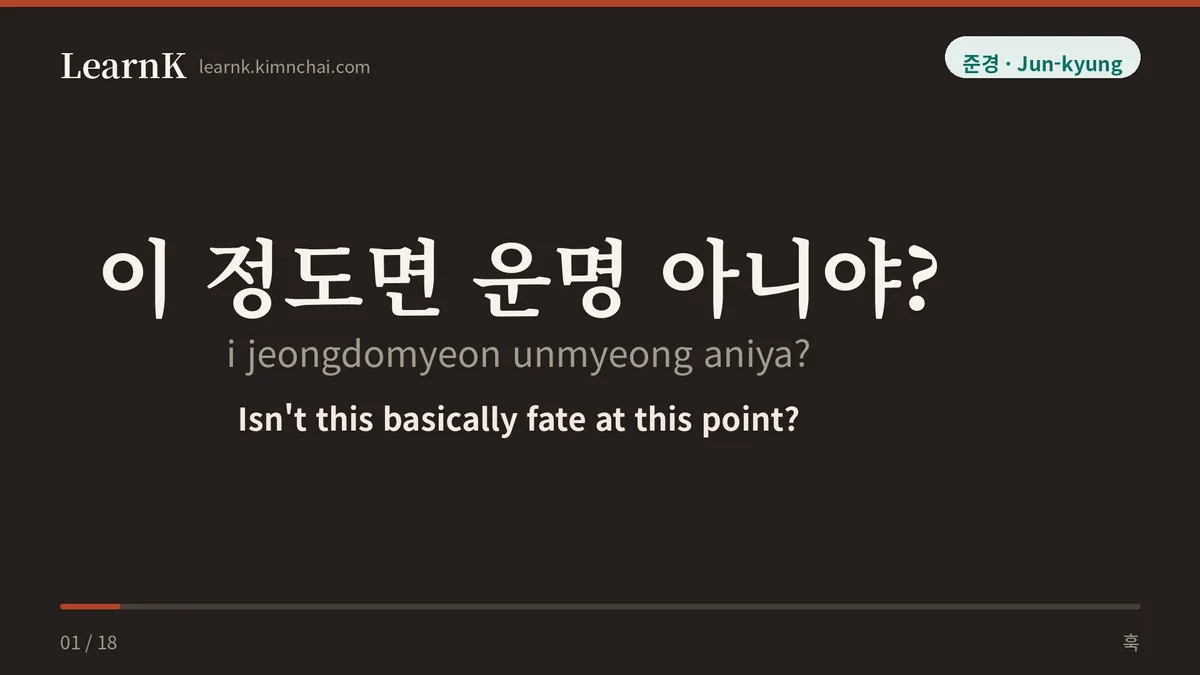
In Korean, the baseline temperature of this word is heavy. It doesn’t point at a small coincidence; it points at something too big for human hands. Use it seriously in everyday conversation and the air in the room drops a level. And precisely because of that weight, it also makes a great joke. If you bump into a friend at the convenience store again and say “이 정도면 운명 아니야? (i jeongdomyeon unmyeong aniya?)” — “At this point isn’t this fate?” — the humor comes from deliberately setting a heavy word down in a light place. It works because you both know exactly how heavy it is.
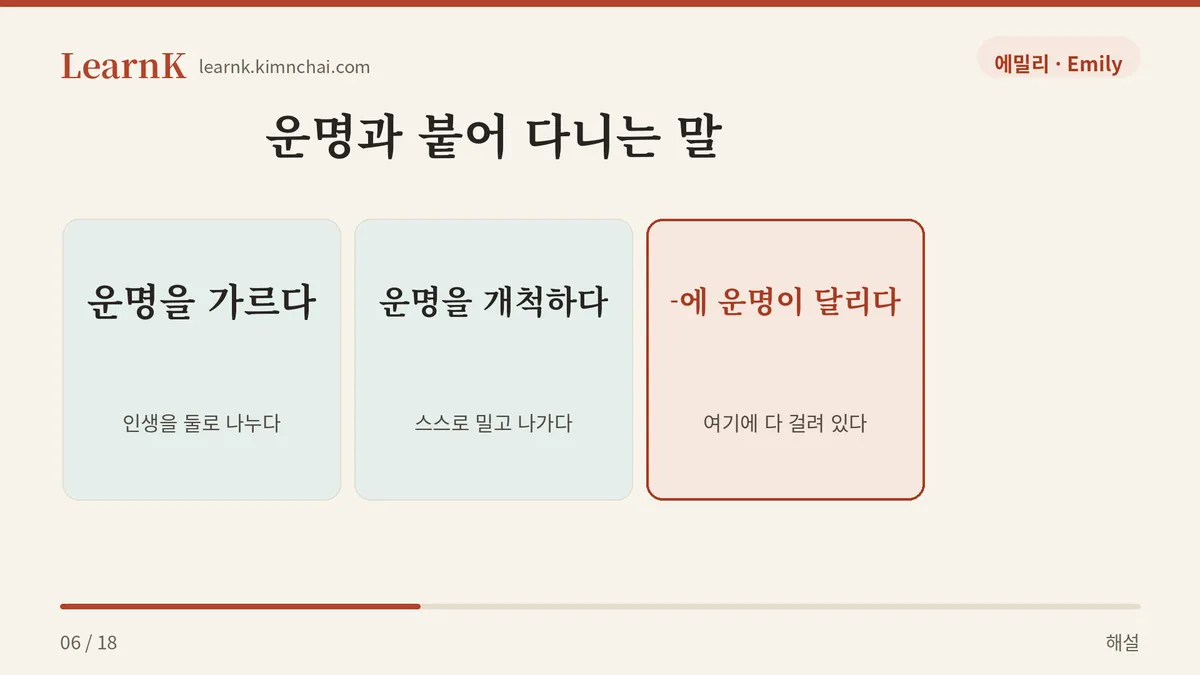
The meaning splits in two directions. One is the “force that decides things” sense we just described. The other is about what lies ahead for someone or something. When you say “이번 경기에 팀의 운명이 달렸다 (ibeon gyeonggie tim-ui unmyeong-i dallyeotda)” — “The team’s fate rides on this match” — nobody is talking about a supernatural power; they mean the fork between thriving and collapsing. That second use is far more common in the news and in meeting rooms. It also helps to learn the predicates that travel with this word: 운명을 가르다 (unmyeong-eul gareuda), to split a fate in two; 운명을 결정하다 (unmyeong-eul gyeoljeonghada), to decide a fate; 운명을 개척하다 (unmyeong-eul gaecheokhada), to carve out one’s own destiny; 운명을 거역하다 (unmyeong-eul geoyeokhada), to defy fate; 운명을 같이하다 (unmyeong-eul gachihada), to share the same fate; and 운명의 갈림길 (unmyeong-ui gallimgil), the fork in the road of fate. Know just these six and you’ll follow most of the sentences this word shows up in.
Checking It in the National Institute of Korean Language Dictionary
The National Institute of Korean Language’s Basic Korean Dictionary lists this as a noun and separates it into two senses.
운명 (unmyeong) 「명사」 (noun)
- 인간과 세상 모든 것에 영향을 미치는 초인적이고 필연적인 힘. 또는 그 힘에 의해 이미 정해진 목숨이나 상태. [en] fate; destiny — A superhuman and inevitable force that affects humans and all the things in the world; or the life or state predetermined by the force. [ja] うんめい【運命】 — 人間と世の中の全てに影響を及ぼす超人的で必然的な力。また、その力によって既に決まっている命や状態。 [es] destino, hado — Fuerza desconocida que, según algunos, obra irresistiblemente sobre los hombres y los sucesos en la tierra. O los acontecimientos o la vida que se consideran irremediables y no se pueden cambiar en razón de esta fuerza. [zh] 命运,宿命 — 给人类和世上所有东西带来影响的超然的力量;或指根据此力量已经定下来的命或状态。 — National Institute of Korean Language, Basic Korean Dictionary (krdict.korean.go.kr)
- 앞으로의 죽고 사는 것이나 흥하고 망하는 것에 관한 처지. [en] fate; destiny — Matters relating to life and death, or successes and failures in the future. [ja] うんめい【運命】 — これからの生死や興亡の成り行き。 [es] destino — Circunstancia de ser favorable o adversa, fatal o viva la supuesta manera de ocurrir los sucesos a alguien o a algo. [zh] 命运,宿命 — 生死或兴亡的处境。 — National Institute of Korean Language, Basic Korean Dictionary (krdict.korean.go.kr)
(The dictionary carries no Portuguese definition. For reference it would be roughly destino, sina — but that one line is our own rendering, not a dictionary quotation.)
Below are five of the dictionary’s actual usage examples, quoted as they are, with a note on the kind of setting each one comes from.
네. 어린 시절 그분이 제게 하신 한마디가 저의 운명을 가른 셈이죠. (ne. eorin sijeol geubuni jege hasin hanmadiga jeo-ui unmyeong-eul gareun semijyo.) Yes. You could say that one thing he said to me as a child is what split my life in two. — National Institute of Korean Language, Basic Korean Dictionary (krdict.korean.go.kr)
This is the kind of sentence you’d hear in an interview. 가르다 (gareuda) means to divide one thing into two, so the speaker is saying that without that single remark, they’d be living a completely different life today. The polite forms and the ending -죠 (-jyo) turn it into a looking-back, reminiscing tone.
대표 선출 문제는 단체의 운명을 결정하기 때문에 그렇게 간단한 문제가 아니다. (daepyo seonchul munjeneun danche-ui unmyeong-eul gyeoljeonghagi ttaemune geureoke gandanhan munjega anida.) Choosing a representative decides the fate of the organization, so it isn’t a simple matter. — National Institute of Korean Language, Basic Korean Dictionary (krdict.korean.go.kr)
A textbook case of the second sense. The subject isn’t a person but an organization, and there’s nothing supernatural in sight — it’s about whether the group thrives or falls apart. Sentences exactly like this show up in meeting documents and news articles.
운명의 갈림길. (unmyeong-ui gallimgil.) A fork in the road of fate. — National Institute of Korean Language, Basic Korean Dictionary (krdict.korean.go.kr)
A set phrase. It marks the point where everything afterward depends on which way you go. It’s also the six syllables that sports broadcasts and drama trailers love most.
나는 어떻게 해서든 내 운명을 스스로 개척해 나갈 거야. (naneun eotteoke haeseodeun nae unmyeong-eul seuseuro gaecheokhae nagal geoya.) Whatever it takes, I’m going to carve out my own destiny. — National Institute of Korean Language, Basic Korean Dictionary (krdict.korean.go.kr)
This one matters because it points in the opposite direction from the examples above. The moment 개척하다 (gaecheokhada) attaches, the word stops being about resignation and becomes the language of will. It accepts the premise that things are already set and then says I’m pushing through anyway — which makes it one of the most spirited uses of the word in Korean.
운명을 같이하다. (unmyeong-eul gachihada.) To share the same fate. — National Institute of Korean Language, Basic Korean Dictionary (krdict.korean.go.kr)
This means going all the way together. It’s used for relationships that share the outcome whether things go well or badly — spouses, colleagues, a ship and its captain. The key point is that it doesn’t mean you get along; it means you share the result.
Seeing It in Real Conversation
Scene: 11 p.m., at the umbrella table in front of the neighborhood convenience store. That’s already the third run-in this week.
Jun-kyung: 야, 또 만났네. 이 정도면 운명 아니야? Hey, we met again. Isn’t this basically fate at this point?
Emily: 무슨 운명이야. 우리 집이 여기서 3분 거리인 거지. What fate. My place is like three minutes from here.
Jun-kyung: 하긴. 근데 너 한국 온 것도 좀 그렇잖아. 원래 일 년만 있으려고 했다며. Fair. But you coming to Korea was kind of like that too, no? You said you were only staying a year.
Emily: 어. 그때 그 학원 등록한 게 내 운명을 갈랐지. 십오 년째 이러고 있잖아. Yeah. Signing up for that language school split my life in two. Fifteen years later, here I am.
Jun-kyung: 그럼 운명한테 고맙다고 해야겠네. Then I guess you owe fate a thank-you.
Emily: 고맙긴. 내가 개척한 거야, 이건. Thank-you my foot. I carved this out myself.
When It Sounds Off
✗ (To a friend who’s anxious about an upcoming surgery) 어쩌겠어, 그게 네 운명인가 봐. (eojjegesseo, geuge ne unmyeong-inga bwa.) — “What can you do. I guess that’s your fate.” ✓ (To a friend who’s anxious about an upcoming surgery) 많이 무섭지? 끝나고 바로 갈게. (mani museopji? kkeunnago baro galge.) — “You must be scared. I’ll come right over when it’s done.” → The grammar is perfectly fine, but the setting is wrong. This word comes with the assumption that a human being can’t change the outcome, so bringing it out in front of someone who’s struggling doesn’t land as comfort — it lands as a declaration of surrender. In practice, the person who uses this word seriously is usually the one living it, not the one standing next to them.
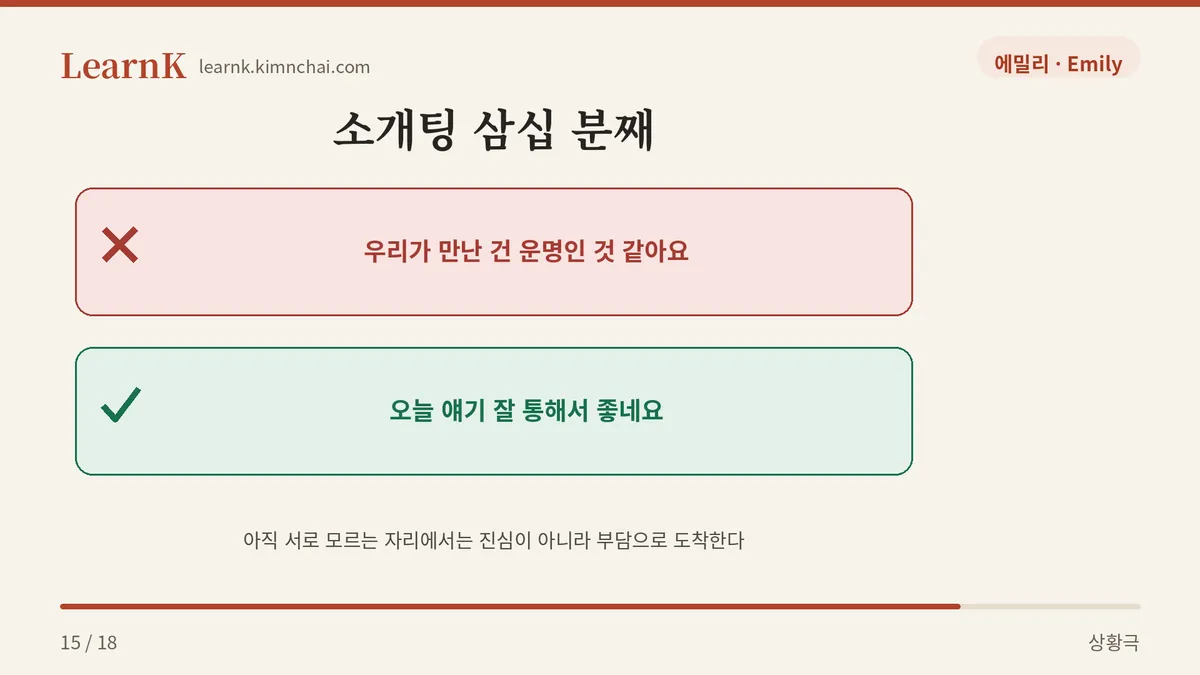
✗ (Thirty minutes into a first blind date) 우리가 만난 건 운명인 것 같아요. (uriga mannan geon unmyeong-in geot gatayo.) — “I think us meeting was fate.” ✓ (Thirty minutes into a first blind date) 오늘 얘기 잘 통해서 좋네요. (oneul yaegi jal tonghaeseo jonneyo.) — “It’s nice how easily we’re talking today.” → The full weight transfers straight onto the other person. In a setting where you two barely know each other, it arrives as pressure rather than sincerity. It’s a completely different thing from laughing and saying “이 정도면 운명이지 (i jeongdomyeon unmyeong-iji)” once you’ve grown close.
Example Sentences by Situation
1) In a meeting room, waiting on the result of a contract you’ve spent months preparing
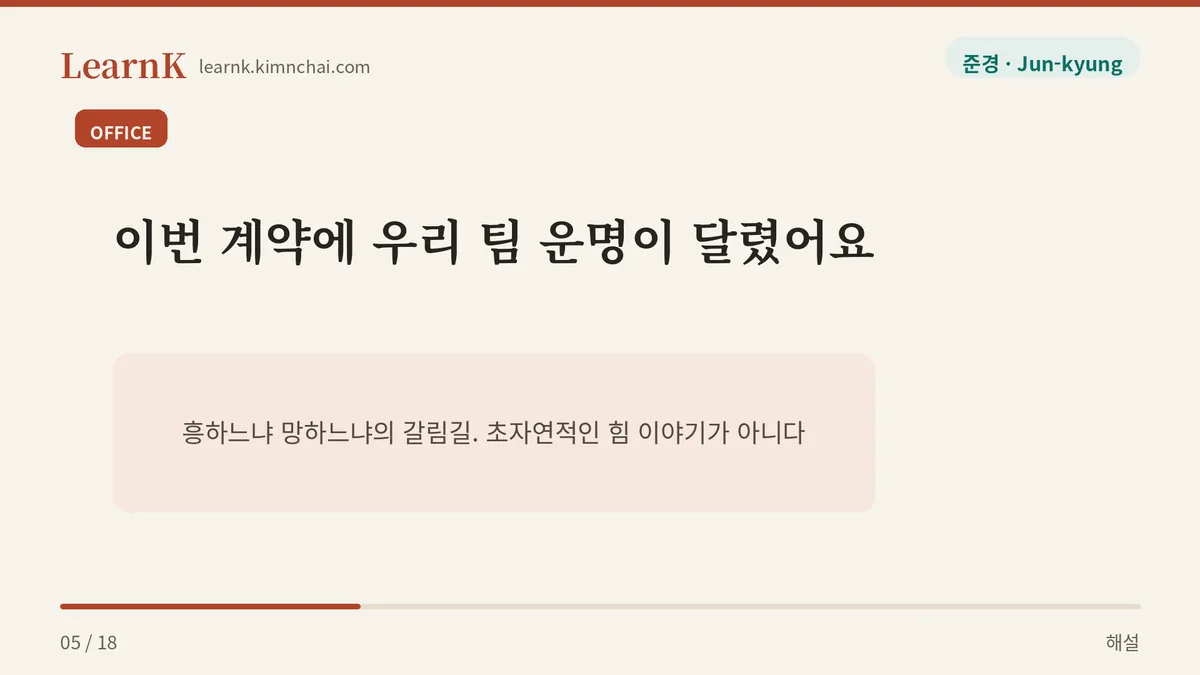
이번 계약에 우리 팀 운명이 달렸어요. ibeon gyeyage uri tim unmyeong-i dallyeosseoyo. The team’s fate rests on this contract.
This is the second sense. Not a story about supernatural forces — a question of whether things work out or shut down. Memorize -에 운명이 달리다 (-e unmyeong-i dallida) as one whole chunk and you can drop it straight into a sentence.
2) Looking back on the moment your path changed
그때 그 수업 하나가 제 운명을 갈랐어요. geuttae geu sueop hanaga je unmyeong-eul gallasseoyo. That one class split my life into before and after.
Use it when one small trigger changed the whole direction of your life. It works beautifully in self-introductions and interviews.
3) Firing back when someone tells you “너는 원래 그런 팔자야 (neoneun wollae geureon paljaya)” — “that’s just the lot you were born with”
저는 제 운명을 스스로 개척하고 싶어요. jeoneun je unmyeong-eul seuseuro gaecheokhago sipeoyo. I want to carve out my own destiny.
This is the sentence that turns a conversation drifting toward resignation back toward will. It shows how the entire direction of the word flips the moment 개척하다 (gaecheokhada) attaches.
Politeness Levels and Similar Expressions
The word itself is a noun, so it has no honorific form of its own; the predicate that follows sets the temperature. Casual: 운명이야 (unmyeong-iya). Everyday polite: 운명이에요 (unmyeong-ieyo). Formal: 운명입니다 (unmyeong-imnida). In meetings and presentations, the most common shape by far is “-에 운명이 달려 있습니다 (-e unmyeong-i dallyeo itseumnida).”
Line it up next to the words that look similar and the differences get clear.
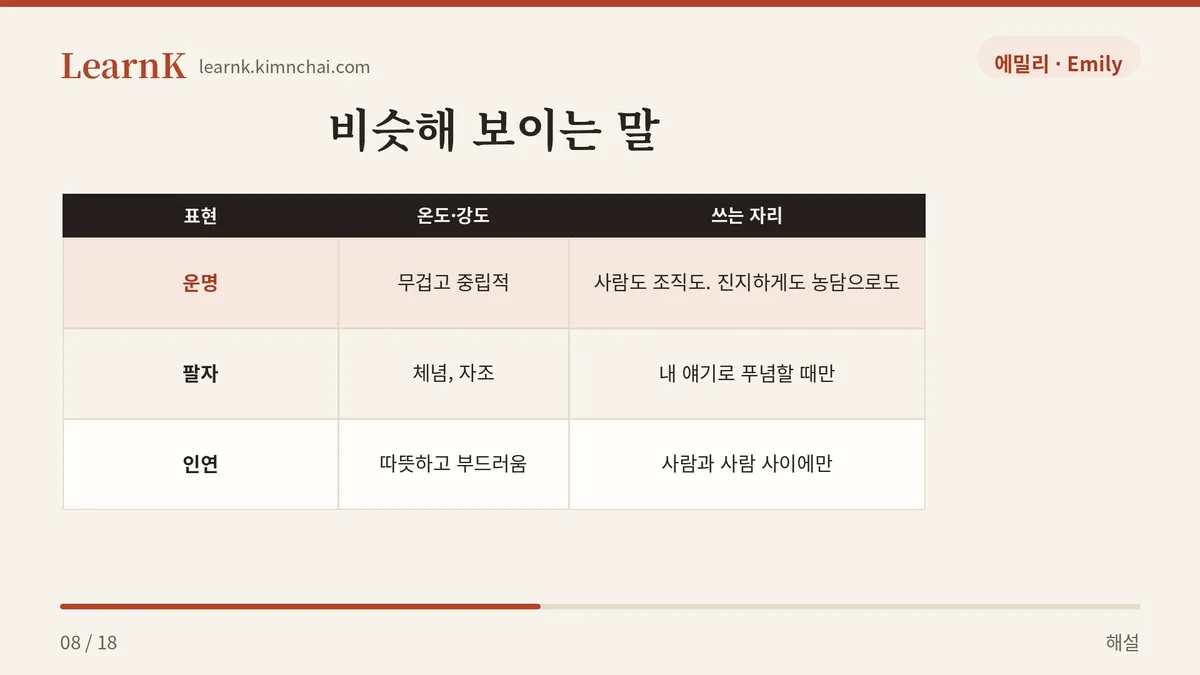
| Expression | Temperature & intensity | Where it’s used |
|---|---|---|
| 운명 (unmyeong) | Heavy but neutral; assumes things are already set | Anywhere — seriously or as a joke |
| 팔자 (palja) | Resigned, self-mocking; colloquial and a notch low | Griping with peers or family. Commenting on someone else’s 팔자 is rude |
| 인연 (inyeon) | Warm and soft | Only between people. Not for organizations or games |
| 숙명 (sungmyeong) | The heaviest; stresses that it can’t be escaped | Writing and speeches. Sounds over-the-top in everyday talk |
The one that confuses learners most is the difference from 인연 (inyeon). 인연 points to the warm thread of the meeting itself; 운명 points to the direction of an entire life, that meeting included. That’s why “좋은 인연이었어요 (joeun inyeon-ieosseoyo)” — “It was a good connection” — sounds lovely even when you’re parting ways, while dropping 운명 into the same slot suddenly makes the sentence heavy.
Cultural Background — Two Chinese Characters in Two Syllables
The word comes from the Sino-Korean 運命. 運 means to turn and to carry along; 命 means life, and also a command handed down from heaven. Together they paint a picture of a turning life — a portion that flows onward without anyone being able to grab hold and stop it. That’s where the faint heaviness this word always has in Korean comes from.
There’s one look-alike to watch for. 殞命 is pronounced the same, but it means a life has run out, so 운명하다 (unmyeonghada) means “to pass away.” At a hospital, “오늘 새벽에 운명하셨습니다 (oneul saebyeoge unmyeonghasyeotseumnida)” is a polite way of announcing a death. Even though the form looks identical, 運命 doesn’t produce a verb like this — so the one mistake to avoid is using 운명하다 where you mean 운명적이다 (unmyeongjeogida), “to be fated.”
There’s also a reason Korean dramas can’t let this word go. One of the oldest grammars of Korean romance is the repeated coincidence. A child you brushed past long ago turns up twenty years later as your boss; something you lost comes back in the other person’s hand. Viewers are trained to think of these two syllables before the characters do. Which is exactly why the dialogue is stingy with the word. Nobody bothers saying out loud what everyone already knows — and then a character who can’t hold it in finally says it, and the scene detonates.
우리가 만난 건 우연이 아니야. (uriga mannan geon uyeoni aniya.) Us meeting wasn’t a coincidence. — from the drama Goblin (도깨비, tvN, 2016)
Today’s word doesn’t actually appear in that line. And yet Korean viewers read the same two syllables right into it. It’s a sentence that knows the unsaid version hits harder. That’s a good hint for learners too: the more often you use this word, the more its power drains away; the more you save it, the more it pays off in one shot.
Today’s Quiz
You came to Korea planning to stay only a year, signed up at a language school, and because of that one decision you’ve now been living in Seoul for fifteen years. Looking back on those days, which sentence sounds most natural?
- 그때 그 학원 등록이 제 운명을 갈랐어요. (geuttae geu hagwon deungnogi je unmyeong-eul gallasseoyo.)
- 그때 그 학원 등록이 제 운명을 같이했어요. (geuttae geu hagwon deungnogi je unmyeong-eul gachihaesseoyo.)
- 그때 그 학원 등록이 제 운명을 거역했어요. (geuttae geu hagwon deungnogi je unmyeong-eul geoyeokaesseoyo.)
Show the answer
The answer is 1. It says that one small decision divided the direction of a life in two, and 가르다 (gareuda) fits that exactly. In 2, 운명을 같이하다 (unmyeong-eul gachihada) means sharing an outcome to the very end, so its object has to be a person or an organization. In 3, 거역하다 (geoyeokhada) means going against a path that’s already laid out, which doesn’t match the act of signing up for a class.
Definitions and example sentences are from the National Institute of Korean Language’s Basic Korean Dictionary (krdict.korean.go.kr); that portion of this post, including our translations, is licensed under CC BY-SA 2.0 KR.