웃프다 (utpeuda): The Korean Slang for When Laughter and Tears Hit at Once
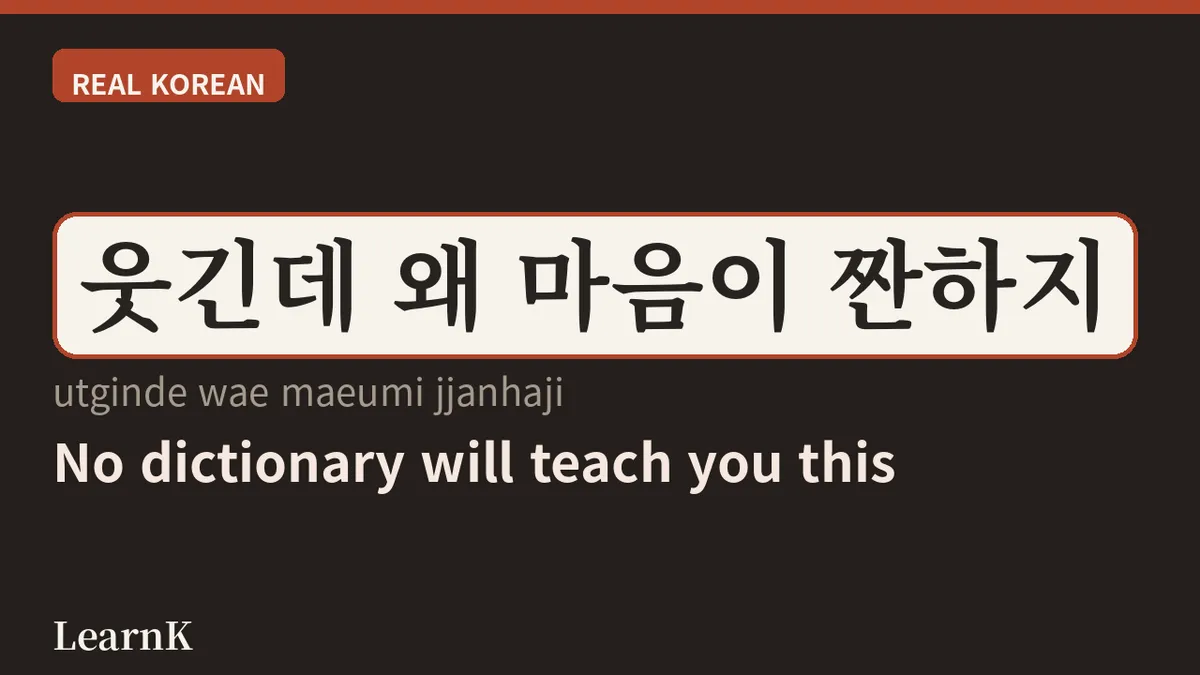
Everyone has moments like this. Something is clearly funny, but once you’ve laughed, some corner of your heart feels a little tender. When a friend who bombed an exam cracks a joke like “It’s fine, my whole life is a mess anyway,” or when you look at your empty wallet and laugh it off with “Guess I’m never getting rich” — Korea’s younger generation captures this complicated feeling in just three syllables. That’s today’s expression: 웃프다 (utpeuda).
웃프다
웃프다 (utpeuda) isn’t an officially registered dictionary word — it’s a newly coined term (slang) born on the internet and in everyday conversation. It’s made by combining two adjectives.
- 웃기다 (utgida) — to be funny, to be laughable
- 슬프다 (seulpeuda) — to be sad
Smoosh these two together and you get 웃 + 프다 → 웃프다. In other words, it means “funny and sad at the same time.” In English, the closest translations would be funny yet sad, or the phrase you hear a lot in English these days: “I’m laughing but also want to cry.”
The key nuance is that both emotions exist at once. It’s not just funny, and it’s not just sad. You use it when the laughter comes first, but underneath that laughter lies a layer of bitterness or tenderness. That’s why 웃프다 usually carries an affectionate feeling toward your own pitiful situation or someone else’s unfortunate circumstances.
Example Sentences by Situation
① When your paycheck just brushes past your bank account
월급 들어온 지 하루 만에 카드값으로 다 나갔어. 진짜 웃프다 (utpeuda). (Just one day after my paycheck came in, it all went out to pay my credit card bill. Seriously, 웃프다 (utpeuda).)
The money you worked so hard for vanishes in an instant. It’s too late to get angry, so this expresses the bitter reality that leaves you with nothing but a hollow laugh.
② The moment your diet resolution collapses
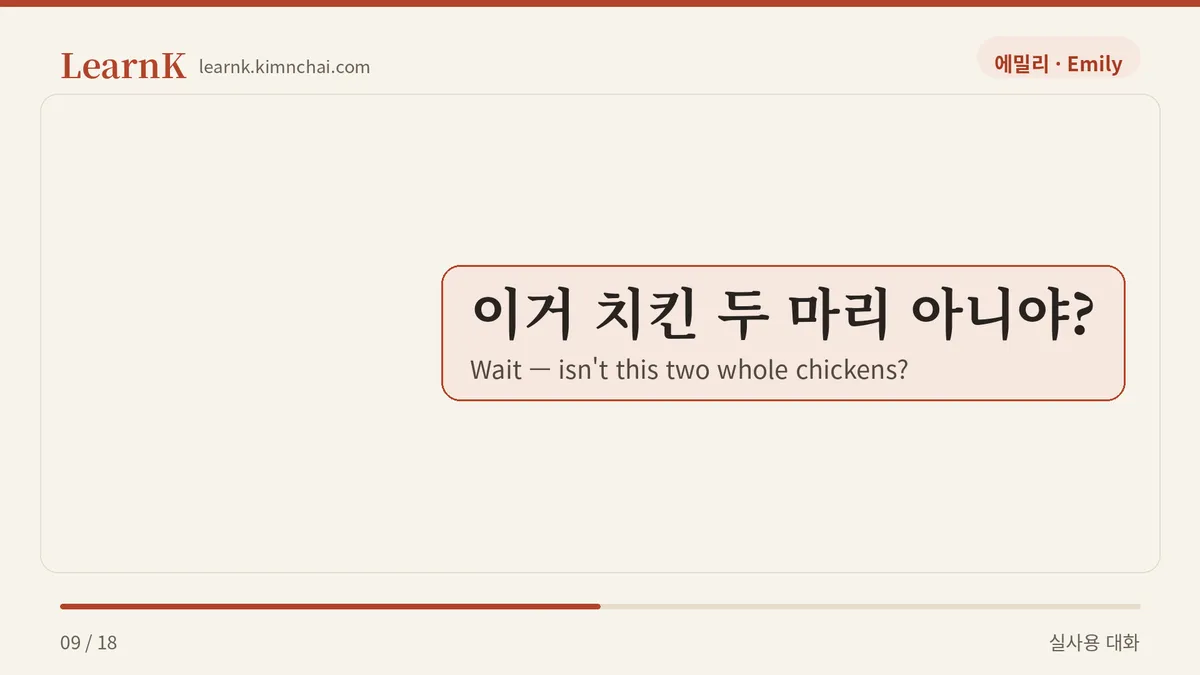
다이어트 한다고 선언한 날 저녁에 치킨 두 마리 시킨 내 모습이 웃펐어 (utpeosseo). (Seeing myself order two whole chickens on the very evening I declared I was going on a diet was 웃펐어 (utpeosseo).)
You blame yourself for your weak willpower, but the scene is so funny that you can’t even be mad. It’s a textbook 웃픈 moment — turning self-deprecation into humor.
③ When you hear the unfortunate news about a friend
걔가 소개팅 나갔는데 상대방이 전 여친 친구였대. 얘기 듣는데 너무 웃프더라 (utpeudeora). (He went on a blind date and it turned out the other person was his ex-girlfriend’s friend. Hearing the story was so 웃프더라 (utpeudeora).)
You laugh listening to someone else’s unlucky episode, but at the same time you feel that “oh no…” pang of sympathy.
Comparing Polite/Casual Forms and Similar Expressions
Since 웃프다 is an adjective, it conjugates freely like any other adjective.
- Casual (반말): 웃프다 / 웃퍼 (utpeo) — “아, 웃퍼.” (“Ugh, so 웃퍼.”)
- Polite (존댓말): 웃프네요 (utpeuneyo) / 웃퍼요 (utpeoyo) — “그 얘기 좀 웃프네요.” (“That story is kind of 웃프네요.”)
Just remember that 웃프다 is, at the end of the day, slang used among friends, on social media, and in casual conversation. If you say “웃프네요” to your boss at work or in a formal setting, it may come across as a bit too casual. In those cases, it’s safer to use a standard word like 씁쓸하네요 (sspsseulhaneyo, from 씁쓸하다).
Standard expressions that carry a similar feeling include 씁쓸하다 (sspsseulhada, to leave an unpleasant aftertaste) and 안쓰럽다 (anssreureopda, to be pitiful and pathetic). However, neither of these contains the element of “laughter.” What makes 웃프다 special is precisely that coexistence of laughter and sadness.
Cultural Background
Behind the spread of 웃프다 lies Korea’s distinctive culture of self-deprecating (자조, 自嘲) humor. Rather than lamenting a hard reality head-on, it’s an attitude of taking a step back and embracing it with laughter. People sum up the tough job market, sky-high housing prices, and the grind of daily life in a single word — “웃프다” — and comfort one another through it.
In Korean variety shows and dramas, too, you’ll often see scenes where a giant caption reading ‘웃픔’ pops up when the main character finds themselves in a ridiculous, pathetic situation. The moment a close-up of the character appears alongside sad background music, viewers laugh while also empathizing with how they feel. In this way, 웃프다 is also a warm language for sharing emotions.
Wrap-Up Quiz
Which of the following is the most natural situation to use 웃프다 (utpeuda)?
- When you win the lottery jackpot and your whole family celebrates
- When your computer shuts off before you saved the presentation you worked so hard on, and all you can do is give a hollow laugh
- When you’re quietly sunk in grief at a funeral
The answer is number 2. It’s ridiculous and upsetting, but you can’t get angry and you can’t cry, so in the end a hollow laugh bursts out — and that’s exactly what a truly ‘웃픈’ moment is!