'뭐 해?' vs. '뭐 하세요?' — How Korean Greetings Change Depending on Who You're Talking To
When you suddenly text a friend on KakaoTalk, how do you usually start? Korean people very often ask 뭐 해? (mwo hae?) even before saying “안녕 (annyeong).” Literally it means “What are you doing?”, but in practice it works more like a greeting that checks in on someone and opens a conversation. Today, let’s take a closer look at this expression in both casual (반말, banmal) and polite (존댓말, jondaenmal) forms, and see how it changes depending on who you’re talking to.
뭐 해? / 뭐 하세요?
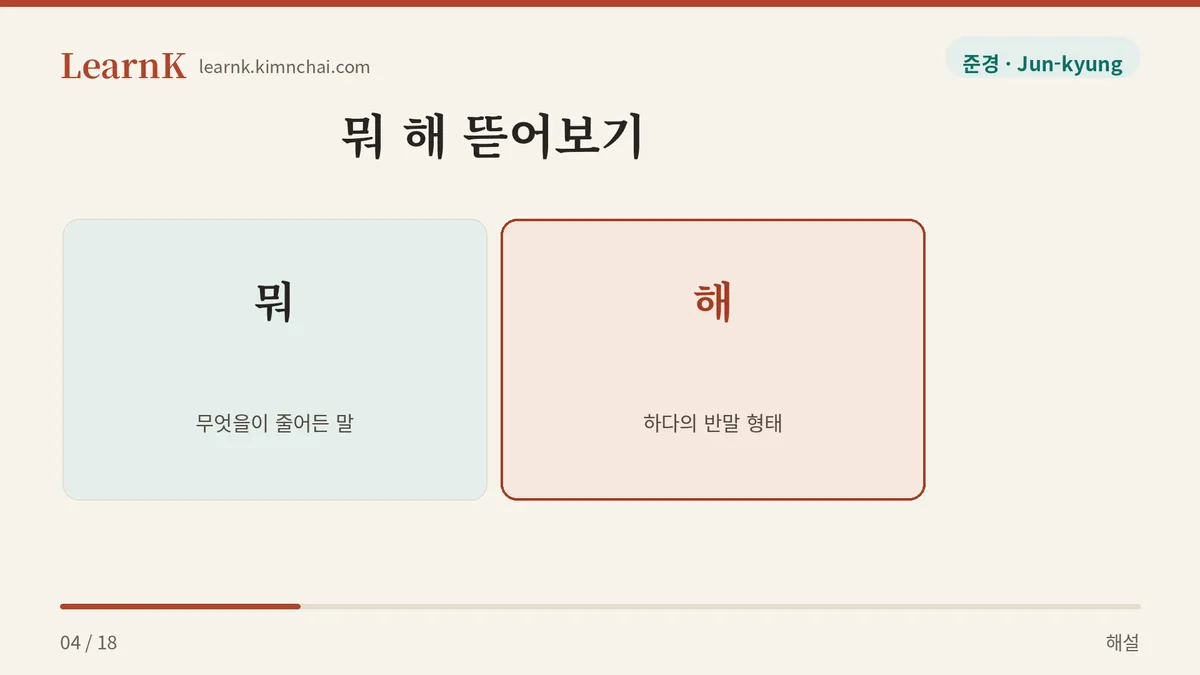
뭐 해? (mwo hae?) is a combination of ‘무엇을 (mueoseul, “what”) → 뭐 (mwo)’ and ‘하다 (hada, “to do”) → 해 (hae).’ Originally it’s a question about what someone is doing, but in Korean it’s used far more often as a light greeting between close friends. It feels closer to “What’s up?” than to a literal “What are you doing?”
The polite form, 뭐 하세요? (mwo haseyo?), adds the honorific ending ‘-세요 (-seyo)’ to the same phrase. You use it with someone you’ve just met, someone older, a boss at work, or anyone you want to show respect to. It’s the same question, but the moment ‘-세요’ is attached, it gives a much more polite and gentle impression.
Here’s a summary of the nuances. 뭐 해? feels relaxed, warm, and sometimes playful, while 뭐 하세요? feels polite and considerate. Depending on your tone, it can be a real question — “What are you doing right this second?” — or a subtle invitation, as in “I’m bored, come hang out with me.”
Example Sentences by Situation
Situation 1 — Checking in on a friend by text
뭐 해? 심심하면 카페나 갈래? (mwo hae? simsimhamyeon kape-na gallae?) “What are you up to? If you’re bored, want to grab a coffee or something?”
This is a classic message you send on a weekend afternoon when you’re curious what your friend is doing. Here, ‘뭐 해?’ isn’t so much asking about their actual activity as it is a signal that says “I feel like talking to you.”
Situation 2 — Reaching out to a friend after a long time
요즘 뭐 해? 얼굴 본 지 진짜 오래됐다. (yojeum mwo hae? eolgul bon ji jinjja oraedwaetda.) “What have you been up to lately? It’s been such a long time since I saw you.”
When you add ‘요즘 (yojeum, “these days”),’ it’s no longer about “this very moment” but becomes a question about how someone has been doing lately. It’s a warm way to check in on someone.
Situation 3 — Politely asking a senior colleague or an elder
부장님, 주말에 보통 뭐 하세요? (bujangnim, jumare botong mwo haseyo?) “Sir, what do you usually do on weekends?”
This is a scene where you open a conversation with your boss by asking about their hobbies or weekend plans. Because of ‘-세요,’ it doesn’t come across as rude — it becomes polite small talk that shows interest.
Situation 4 — Calling to check in on someone’s situation
여보세요? 지금 뭐 하세요? 통화 괜찮으세요? (yeoboseyo? jigeum mwo haseyo? tonghwa gwaenchaneuseyo?) “Hello? What are you doing right now? Is it okay to talk?”
This is a considerate way to ask whether the person you’re calling is busy. In this case, it’s closer to a genuine question that really checks ‘what they’re doing right now.‘
Comparing Polite vs. Casual and Similar Expressions
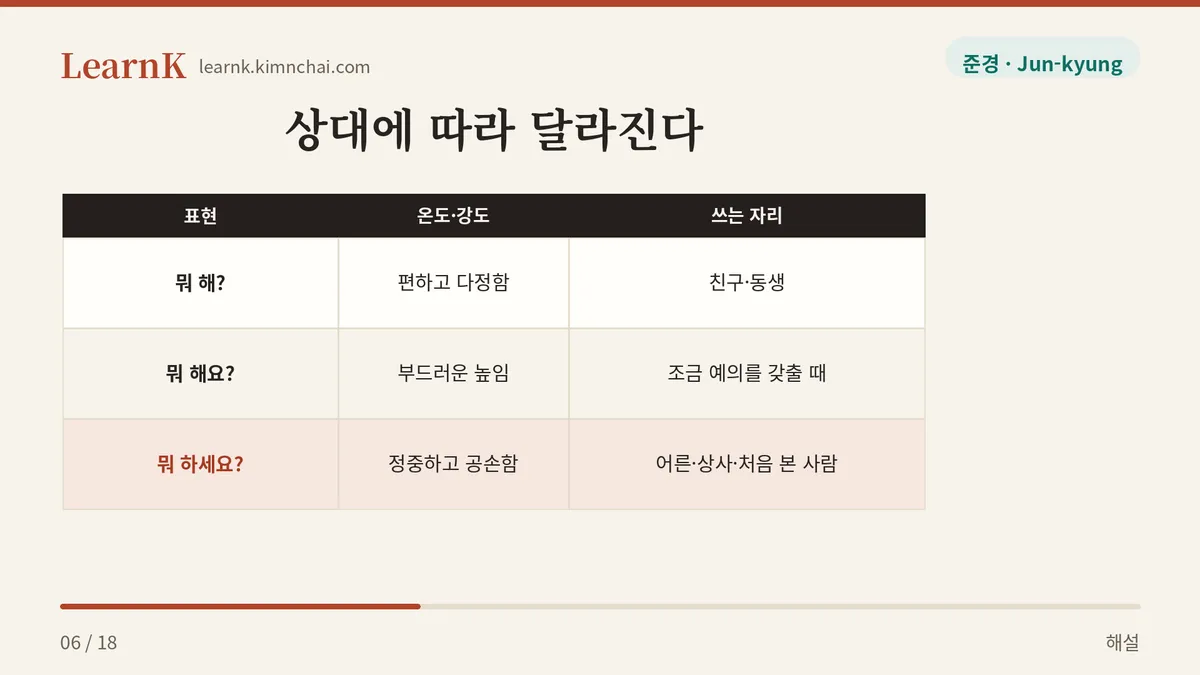
| Who you’re talking to | Expression | Feeling |
|---|---|---|
| A friend or someone younger | 뭐 해? (mwo hae?) | Relaxed and friendly |
| When you want to be a bit polite | 뭐 해요? (mwo haeyo?) | Gentle and polite |
| An elder, a boss, or someone you just met | 뭐 하세요? (mwo haseyo?) | Polite and respectful |
A similar expression is 뭐 하고 있어? (mwo hago isseo?). The ‘-고 있다 (-go itda)’ part more clearly emphasizes “an action in progress right now.” On the other hand, 잘 지내? (jal jinae?) asks not about an action but about someone’s overall well-being. All three are ways to open a conversation, but ‘뭐 해?’ is the lightest and most naturally used.
One thing to watch out for: if you use the casual ‘뭐 해?’ with an elder you’ve just met, it can sound rude. If the other person is older than you or the relationship calls for formality, be sure to add ‘-세요’ and switch to 뭐 하세요?. In Korean, choosing between casual and polite speech is the key that reveals ‘the relationship between you and the other person.‘
Cultural Background — ‘뭐 해?’ in Dramas and Everyday Life
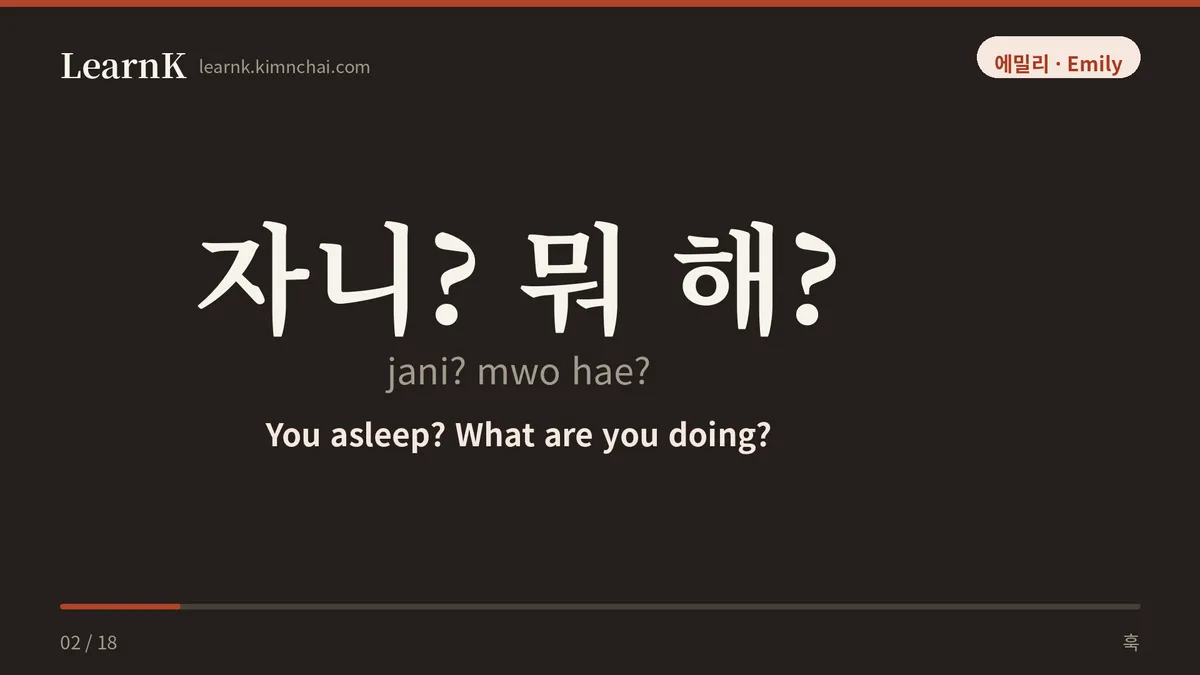
If you watch Korean dramas, you’ll often see two people in the early, flirty stages of romance texting late at night, “자니? 뭐 해? (jani? mwo hae?)” — “Are you asleep? What are you doing?” This short phrase carries the feeling of “I was thinking of you,” so it’s often used like a signal that marks the beginning of a romance. In fact, in many romantic comedies, the very first message the main character works up the courage to send is exactly this ‘뭐 해?’
It’s the same in everyday life. A family member walks in the door and asks “뭐 해? (mwo hae?)”, and friends make plans on a dull afternoon with “뭐 해? 나와 (mwo hae? nawa)” — “What are you doing? Come out.” So if you can use this expression naturally, you’ve already taken a step into the everyday conversations of Korean people.
Closing Quiz
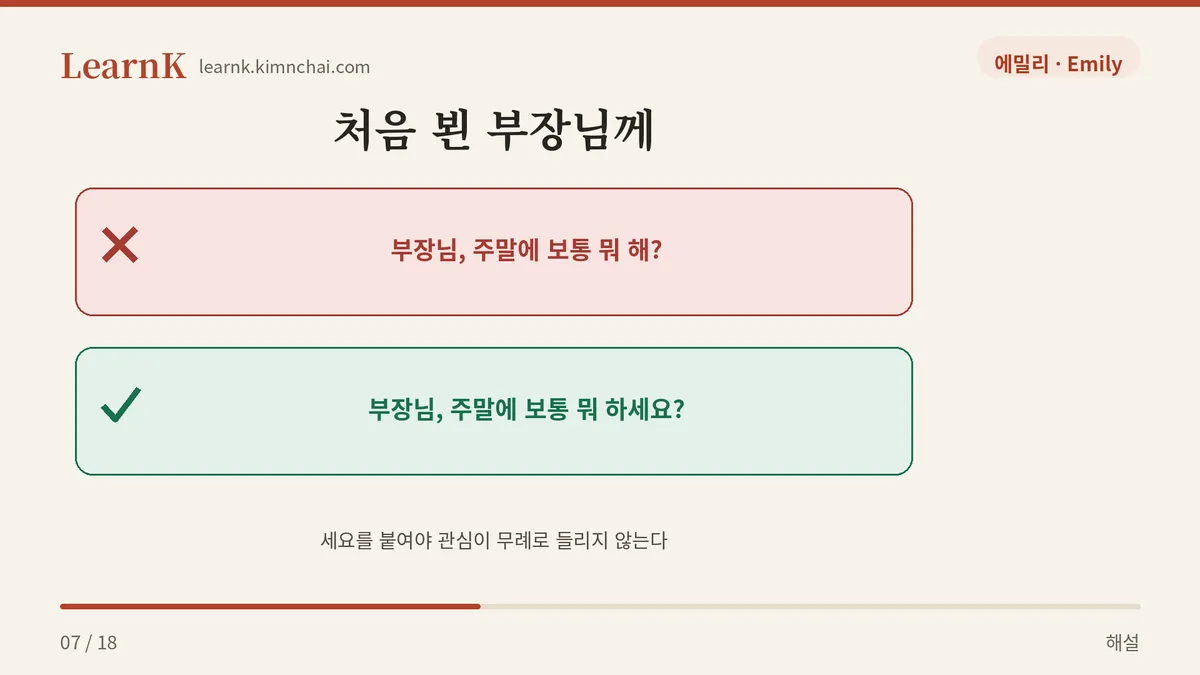
You want to ask your company’s department head — whom you’re meeting for the first time — about their weekend hobbies. Which of the following is the most appropriate expression?
- 뭐 해? (mwo hae?)
- 뭐 하세요? (mwo haseyo?)
- 뭐 하고 있어? (mwo hago isseo?)
See the answer
The answer is number 2, 뭐 하세요? (mwo haseyo?). With an older boss, it’s natural to ask politely by attaching the honorific ending ‘-세요.’ Numbers 1 and 3 are casual speech used with friends or people younger than you, so they don’t fit this situation.