연세가 어떻게 되세요? (yeonsega eotteoke doeseyo?) — The Safest Way to Ask an Elder Their Age
연세가 어떻게 되세요?
연세가 어떻게 되세요? (yeonsega eotteoke doeseyo?) is the honorific way of asking an older person “How old are you?” If you watch enough Korean dramas, you know the scene: a young lead standing in front of a grandmother he’s meeting for the first time hesitates for a beat, lowers his voice a notch, and carefully offers this one line. It’s the same question you’d toss to a friend, but the shape of the words is completely different.
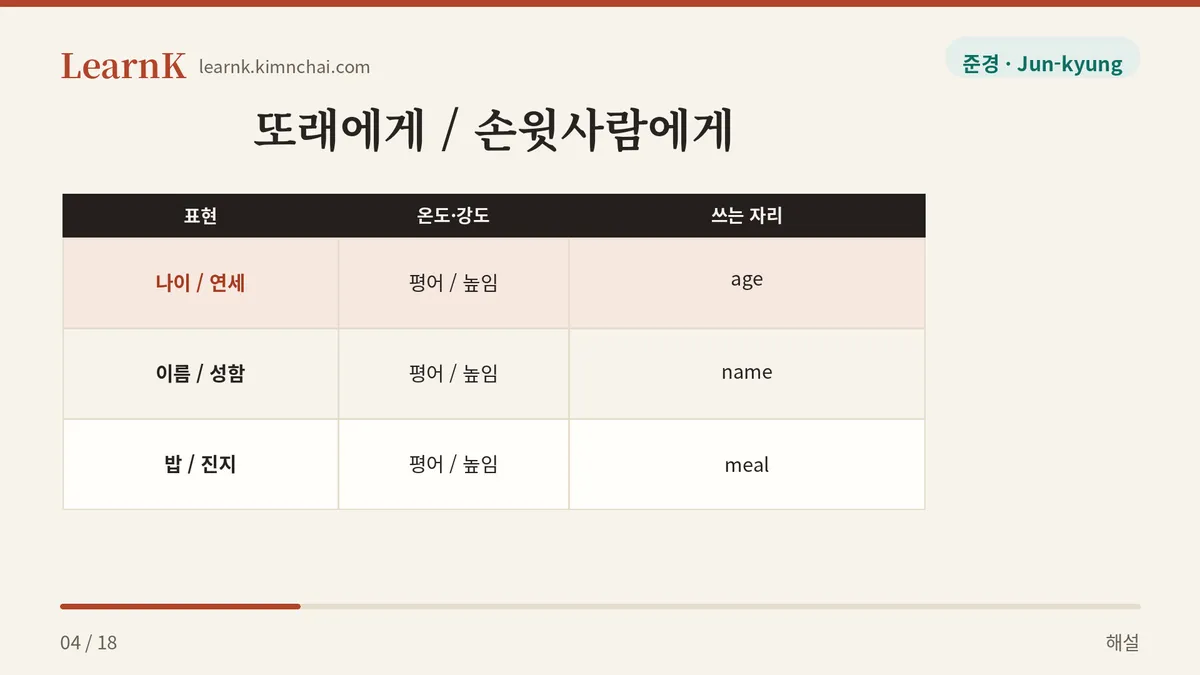
Korean has certain spots where a word splits into two branches depending on who you’re speaking to. “Age” is the classic case. With peers you say 나이 (nai); with someone older than you, 연세 (yeonse). It’s the same pairing you see in 밥 (bap) / 진지 (jinji) for “meal,” 이름 (ireum) / 성함 (seongham) for “name,” and 집 (jip) / 댁 (daek) for “house.” So this expression isn’t just one question — it’s a small window onto how the whole Korean honorific system works.
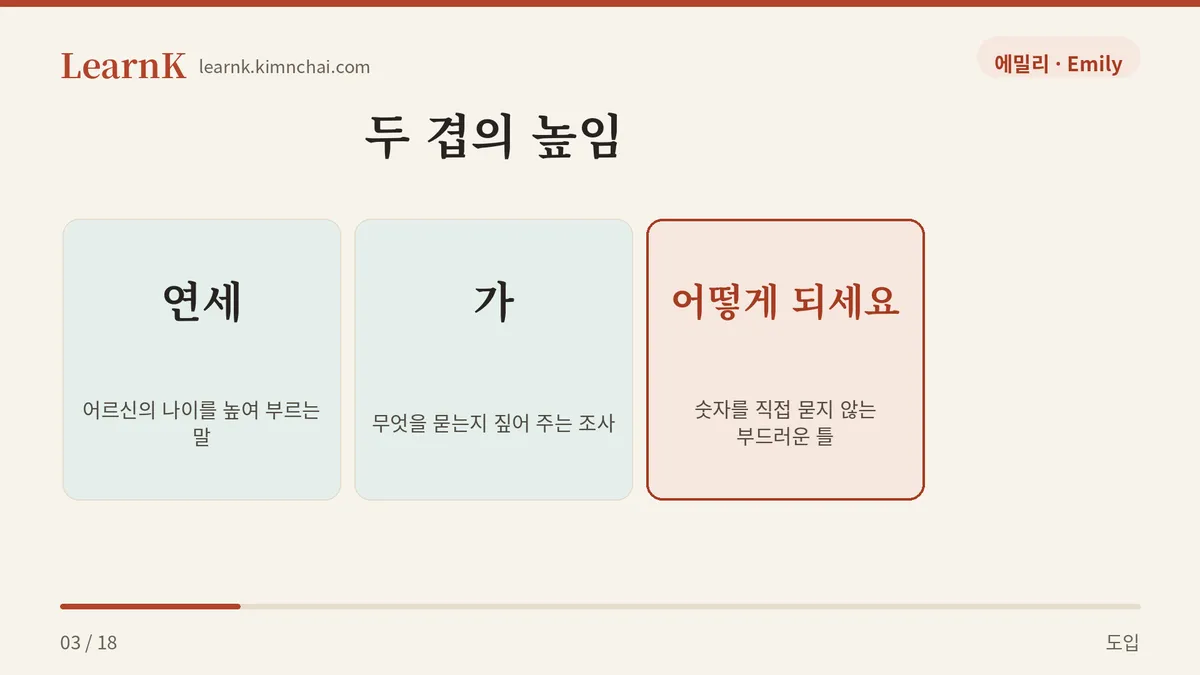
Let’s look at the nuance a little more closely. There are two layers of respect stacked into this phrase. The first is the word 연세 (yeonse) itself, an elevated noun for another person’s age. The second is the frame 어떻게 되세요 (eotteoke doeseyo). Instead of demanding a number outright, it goes around the side and asks “how does it come to be?” — the softest frame Korean has for asking about someone’s personal information. With those two layers overlapping, the phrase lands closer to “Would it be all right if I asked?” than to “Tell me your age.”
That means learners who pick this up get one extra thing out of it: you can lift the 어떻게 되세요 (eotteoke doeseyo) frame whole and reuse it. 성함이 어떻게 되세요? (seonghami eotteoke doeseyo? — “What’s your name?”), 연락처가 어떻게 되세요? (yeollakcheoga eotteoke doeseyo? — “What’s your contact number?”), 직업이 어떻게 되세요? (jigeobi eotteoke doeseyo? — “What do you do for work?”) — the lines you’ll hear several times a day at a hospital or a government office in Korea all come out of this one frame.
A Real Conversation
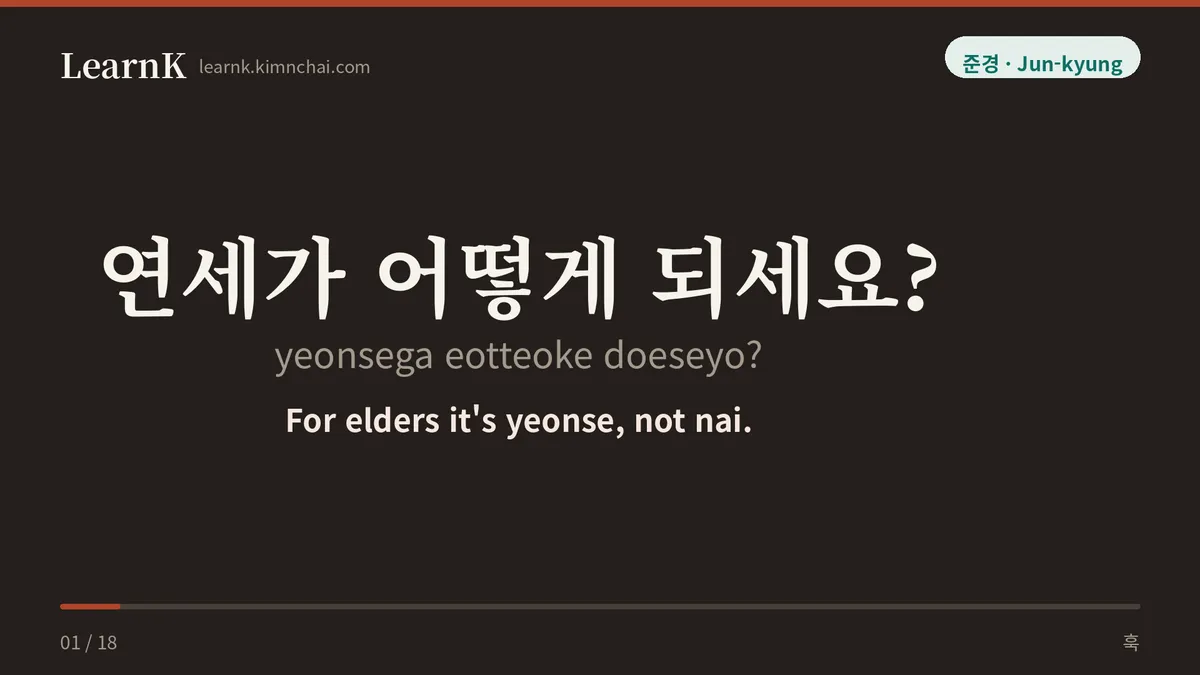
Situation: Saturday morning, volunteering at the free meal service at the neighborhood community center. They’re tying on their aprons, getting ready before it starts.
Emily: 준경아, 나 오늘 좀 긴장된다. 어르신들이랑 무슨 얘기 해야 돼? Jun-kyung, I’m a little nervous today. What am I supposed to talk about with the elderly folks?
Jun-kyung: 웃으면서 인사만 해도 돼. 근데 나이 여쭤볼 일은 한 번쯤 생길걸. Just smiling and saying hello is plenty. But you’ll probably end up asking someone’s age at some point.
Emily: 아, 그럼 “나이가 어떻게 되세요?” 하면 되나? Ah, so I just say “나이가 어떻게 되세요?” then?
Jun-kyung: 어르신한테는 “연세가 어떻게 되세요?” 이렇게. 나이 말고 연세. With elders it’s “연세가 어떻게 되세요?” like that. 연세, not 나이.
Emily: 아 맞다, 연세. 어르신, 연세가 어떻게 되세요? …이렇게? Oh right, 연세. “Ma’am, how old are you?” …like that?
Jun-kyung: 어, 딱 좋아. 근데 대뜸 묻지는 말고 성함부터 여쭤봐. Yeah, perfect. But don’t spring it on them — ask their name first.
When It Sounds Off
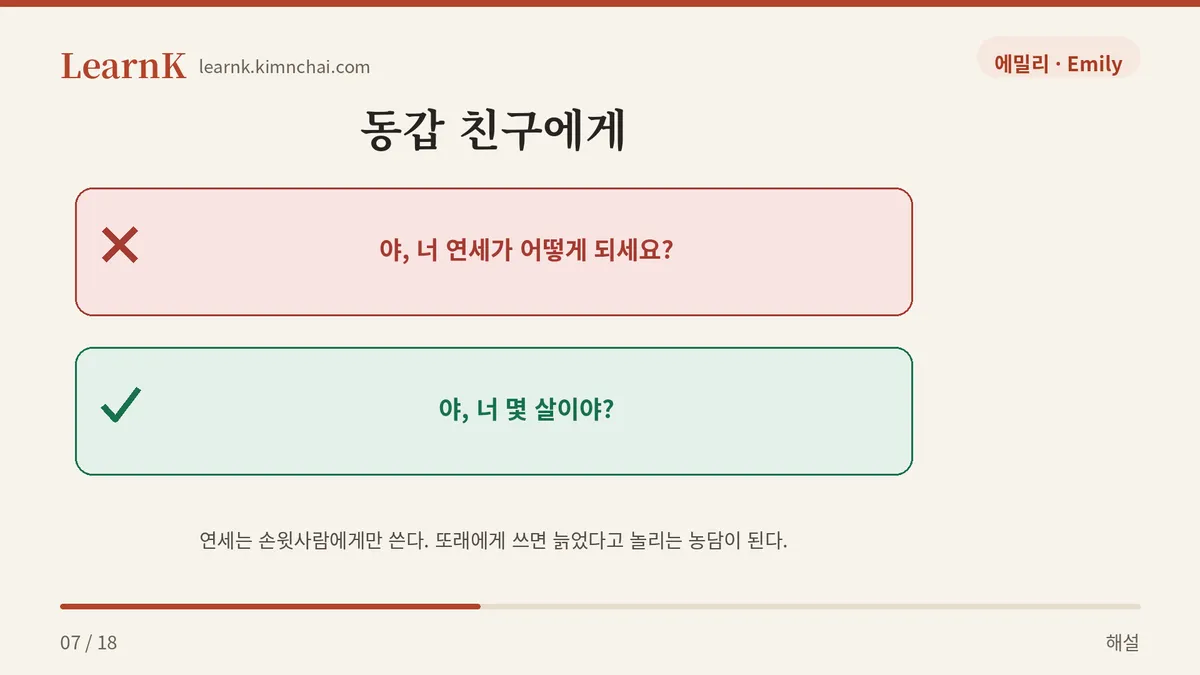
✗ (to a friend your own age) 야, 너 연세가 어떻게 되세요? (ya, neo yeonsega eotteoke doeseyo?) ✓ (to a friend your own age) 야, 너 몇 살이야? (ya, neo myeot sariya?) → 연세 (yeonse) is only for people older than you. Used on a peer, it reads as teasing — “wow, you’re ancient.” Korean speakers actually do say it this way on purpose when they’re making fun of a friend.
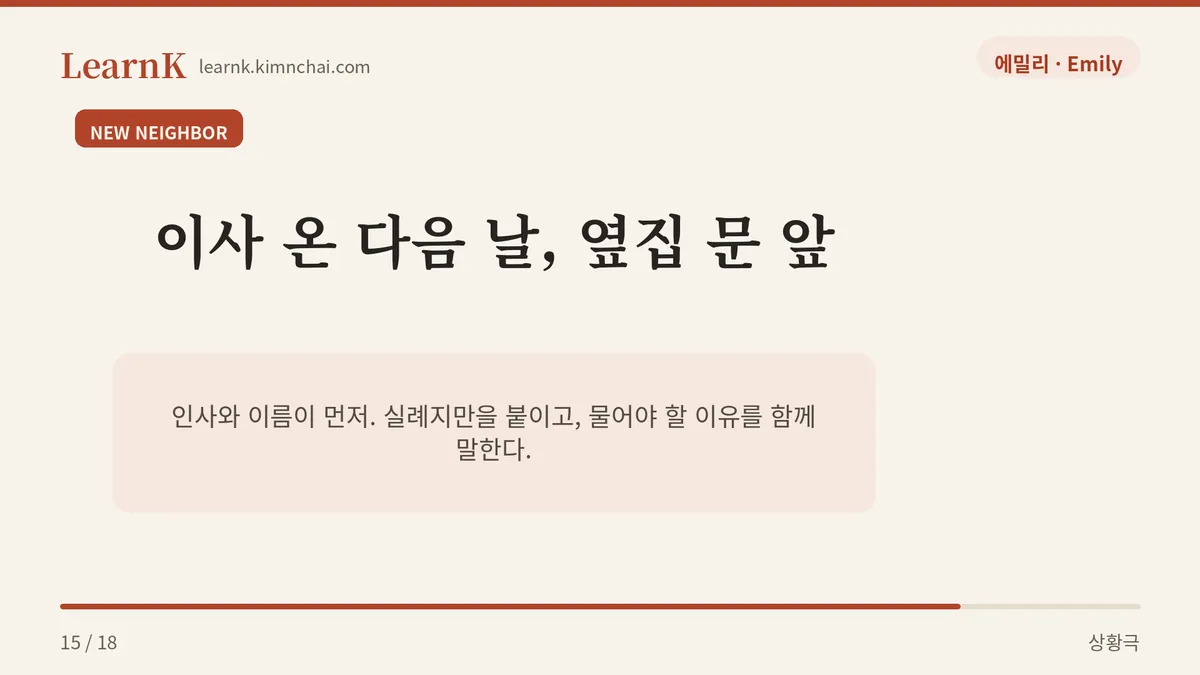
✗ (to an elder you’ve just met, the second the greeting is out) 안녕하세요! 연세가 어떻게 되세요? (annyeonghaseyo! yeonsega eotteoke doeseyo?) ✓ (to an elder you’ve just met) 안녕하세요, 저는 에밀리라고 합니다. … 실례지만 연세가 어떻게 되세요? (annyeonghaseyo, jeoneun Emily-rago hamnida. … sillyejiman yeonsega eotteoke doeseyo?) → The phrase itself is perfectly polite. The problem is the order. Asking about age before the introductions have even finished feels like prying. It’s more natural to ask their name first, put 실례지만 (sillyejiman — “excuse me, but”) in front, and bring it up only when you have a reason to ask.
Example Sentences by Situation
1. At the hospital reception desk — to the family member who brought their mother in
The staff member needs the age to fill out a form. It’s a routine, businesslike moment, but since the person in question is elderly, 연세 (yeonse) is the right word.
어머님 연세가 어떻게 되세요? 접수증에 적어야 해서요. (eomeonim yeonsega eotteoke doeseyo? jeopsujeunge jeogeoya haeseoyo.) “How old is your mother? I need to write it on the registration form.”
Notice the reason tacked on at the end. That one clause — “I need to write it down” — lets the question pass without feeling nosy.
2. The day after moving in, bringing rice cakes to the neighbors
It would feel abrupt to just say hello and turn around, so the conversation gets stretched a little further.
어르신, 이거 얼마 안 되지만 드세요. 그런데 실례지만 연세가 어떻게 되세요? 저희 할머니랑 비슷하실 것 같아서요. (eoreusin, igeo eolma an doejiman deuseyo. geureonde sillyejiman yeonsega eotteoke doeseyo? jeohui halmeonirang biseutasil geot gataseoyo.) “Please have some — it isn’t much. Excuse me, but how old are you, if I may ask? You seem about the same age as my grandmother.”
Adding a reason like “you seem about the same age as my grandmother” turns the question from curiosity into a gesture of warmth.
3. Getting ready for a documentary interview
Asking an elder on camera. This calls for the most respectful register you have.
촬영 전에 몇 가지만 여쭐게요. 성함이 어떻게 되시고, 연세가 어떻게 되세요? (chwaryeong jeone myeot gajiman yeojulgeyo. seonghami eotteoke doesigo, yeonsega eotteoke doeseyo?) “Just a few questions before we start filming. What’s your name, and how old are you?”
Asking for name and age side by side like this is an extremely common pairing in real life. Note, too, that the same 어떻게 되세요 (eotteoke doeseyo) frame shows up twice in a row.
Related Expressions, from Formal to Casual
| Expression | Register / Intensity | Where it’s used |
|---|---|---|
| 춘추가 어떻게 되십니까? (chunchuga eotteoke doesimnikka?) | Most formal, archaic | Historical dramas, official occasions. Almost never in daily life |
| 연세가 어떻게 되세요? (yeonsega eotteoke doeseyo?) | Respectful and careful | Elders, or anyone clearly senior to you |
| 나이가 어떻게 되세요? (naiga eotteoke doeseyo?) | Neutral polite speech | Adult peers, first meetings, service counters |
| 몇 살이세요? (myeot sariseyo?) | Polite but light | To children or younger people. Inappropriate for elders |
| 몇 살이야? (myeot sariya?) | Casual speech, relaxed | Peers, friends, people younger than you |
The further down the table you go, the closer the distance between you and the listener. The rule of thumb when you’re unsure is simple: if the person clearly reads as an elder, use 연세 (yeonse); if it’s ambiguous, go with 나이가 어떻게 되세요? (naiga eotteoke doeseyo?). Using 연세 (yeonse) on someone whose age is borderline can get you a “Do I really look that old?” — so in that case the neutral option is the safe one.
Cultural Background — Why Korean Goes Around the Side with 어떻게
연세 (yeonse, 年歲) is a Sino-Korean word built from 年 (“year”) and 歲 (“year”) set next to each other. Two characters both meaning “year,” stacked, to point at the years a person has lived. The more formal 춘추 (chunchu, 春秋) means “spring and autumn” — counting age by how many times the seasons have come back around. Both words have this in common: instead of naming a number outright, they sketch a picture of time passing.
The back half of the expression carries the same attitude. Rather than asking for the figure head-on the way 몇 살이세요? (myeot sariseyo?) does, it detours through 어떻게 되세요 (eotteoke doeseyo) — Korean’s default frame for asking about someone’s personal details. 성함이 (seonghami), 연락처가 (yeollakcheoga), 직업이 (jigeobi) — they all ride on this same frame. The sense that it’s polite not to ask directly is carved into the grammar itself.
It’s also worth knowing why age comes up so often in Korea in the first place. Knowing someone’s age is what determines whether you use honorific or casual speech, and whether you’ll call them 형 (hyeong), 언니 (eonni), 오빠 (oppa), or 누나 (nuna). Learners from Western countries are often thrown by this, since asking about age is frequently considered rude there — but in Korean it’s closer to a practical step for sorting out a relationship. So if someone asks your age, feel free to take it not as prying but as a signal: “I want to figure out what to call you.”
In family dramas, there’s a scene that comes up again and again — a prospective daughter-in-law meeting her in-laws for the first time, opening the conversation carefully with this very expression. It’s a single line of dialogue, but what it’s doing in that scene isn’t gathering information. It’s closer to a declaration: “I know how to treat my elders as elders.”
Today’s Quiz
You end up chatting in the apartment elevator with an elderly woman you’re meeting for the first time. What’s the most appropriate thing to put in the blank?
“할머니, 안녕하세요. 저 이번에 902호로 이사 온 사람이에요. 실례지만 ______” (“halmeoni, annyeonghaseyo. jeo ibeone gubaegiho-ro isa on saramieyo. sillyejiman ______”) “Hello, ma’am. I’m the one who just moved into unit 902. Excuse me, but ______”
① 몇 살이야? (myeot sariya?) ② 연세가 어떻게 되세요? (yeonsega eotteoke doeseyo?) ③ 나이 몇 살이니? (nai myeot sarini?)
Answer: ②
① and ③ are casual speech, or the kind of thing you’d say to someone younger, so neither works with an elder. ② is the form that has both pieces: the respectful noun 연세 (yeonse) and the soft frame 어떻게 되세요 (eotteoke doeseyo). Memorize it together with the 실례지만 (sillyejiman) in front, and you’ll be able to bring this question up safely in any setting.