열애설 (yeoraeseol) — The Love No One Has Confirmed Yet
Sit down in a Korean hair salon on a Saturday afternoon, wait for your perm to set, and this word will almost certainly come drifting out of the TV on the wall. 열애설 (yeoraeseol) means a not-yet-confirmed rumor that someone is romantically involved with someone else. The article drops in the morning, the agency puts out a statement around lunchtime, and by evening it’s either admitted or denied. If you’re a regular viewer of Korean dramas and variety shows, you’ve already brushed past this word dozens of times — in the subtitles, or in the news captions.
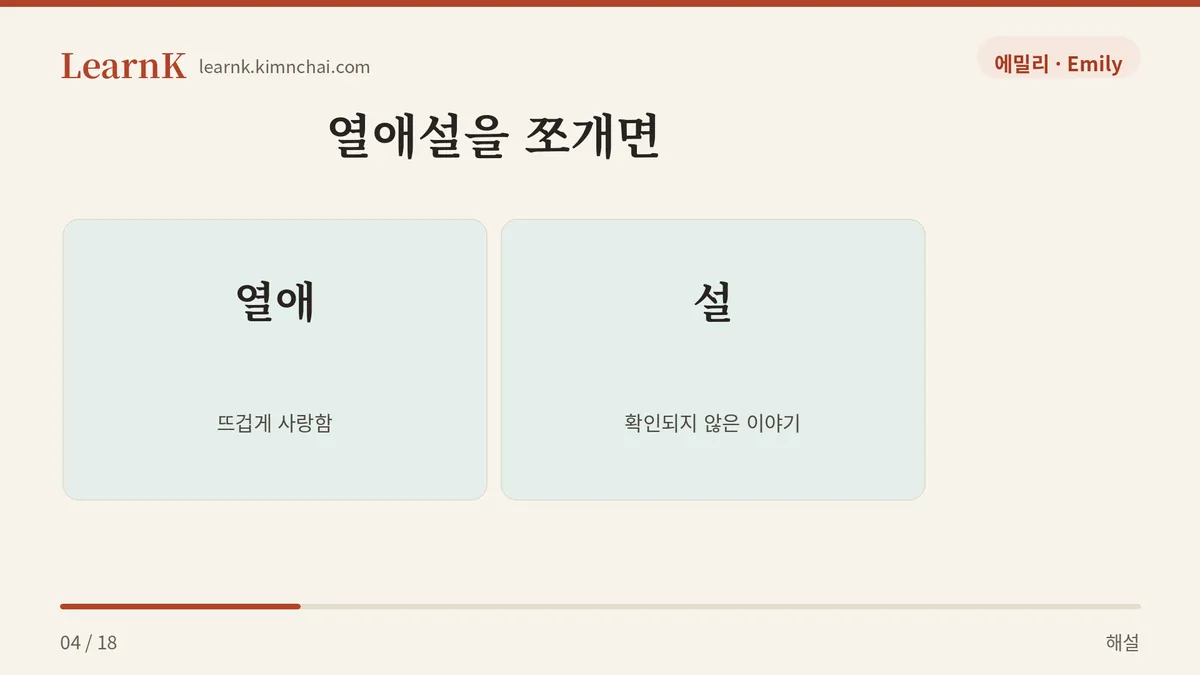
The center of gravity in this word isn’t 연애 (yeonae, dating) — it’s 설 (seol). 열애 (熱愛, yeorae) means loving passionately, and 설 (說, seol) means “the story that…,” that is, an unverified claim. So the moment a relationship gets the label 열애설 attached to it, that romance is nailed down as “not confirmed yet.” Once the two people say for themselves that they’re together, it’s no longer 열애설 but 공개 연애 (gonggae yeonae) or 열애 인정 (yeorae injeong). This is the spot learners miss most often. 열애설 isn’t another word for dating — it’s the name for a rumor about dating.
In practice it travels around with a fixed set of verbs.
- 열애설이 나다 / 열애설이 터지다 (yeoraeseori nada / yeoraeseori teojida) — the rumor becomes public for the first time. 터지다 feels far bigger and more sudden.
- 열애설이 불거지다 (yeoraeseori bulgeojida) — a story that had gone quiet flares back up.
- 열애설이 돌다 (yeoraeseori dolda) — it spreads from mouth to mouth, without making it into an article.
- 열애설을 부인하다 / 인정하다 (yeoraeseoreul buinhada / injeonghada) — the two possible reactions from the people involved.
Seeing it in a real conversation
Scene: a hair salon, Saturday afternoon. The perm solution is on and the two are sitting side by side waiting, while entertainment news plays on the TV mounted on the wall.
Jun-kyung: 어? 저 둘 진짜였네. 지난주에 열애설 났을 때 소속사가 아니라고 했잖아. Huh? So it was true after all. When the dating rumor broke last week, the agency said it wasn’t.
Emily: 원래 처음엔 다 부인하지. 일주일 뒤에 인정하는 거, 거의 공식이야. They always deny it at first. Admitting it a week later is practically a formula.
Jun-kyung: 하긴. 근데 넌 이런 걸 어떻게 다 알아? True. But how do you know all this stuff?
Emily: 나 여기 올 때마다 배워. 원장님은 열애설 나면 기사보다 빨라. I learn it every time I come here. When a dating rumor breaks, the owner beats the news to it.
Jun-kyung: 그럼 나도 슬슬 하나 나야 되는데. Then it’s about time one broke about me, too.
Emily: 야, 네가 무슨 연예인이야. 열애설이 나려면 연애를 먼저 해야지. Come on, you’re not a celebrity. To get a dating rumor you have to date first.
Using it this way sounds off
✗ (At a get-together where a friend has just introduced the person they’re newly dating) 어, 너 요즘 열애설 있다며? (eo, neo yojeum yeoraeseol itdamyeo?) ✓ (Same setting) 어, 너 요즘 만나는 사람 있다며? (eo, neo yojeum mannaneun saram itdamyeo?) → 열애설 means “a rumor that hasn’t been confirmed yet.” Aimed at a friend whose relationship has just been confirmed right in front of your eyes, it floats oddly — as if you were discussing some stranger’s news article instead of your friend.
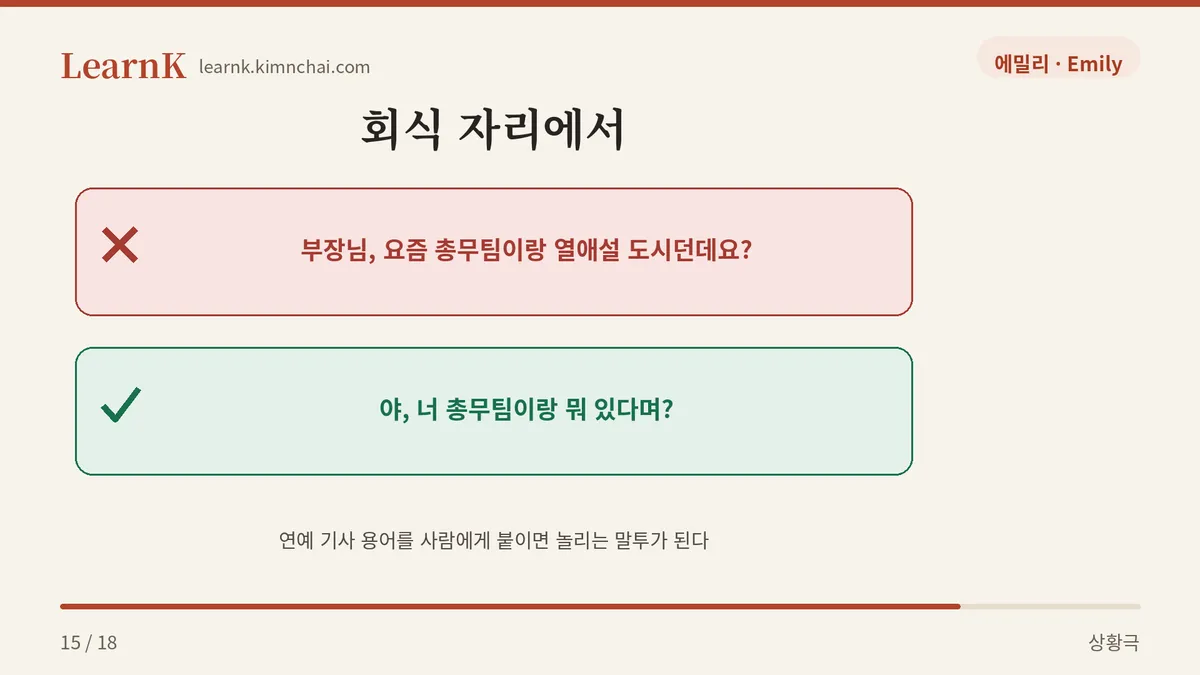
✗ (To your department head at a company dinner) 부장님, 요즘 총무팀이랑 열애설 도시던데요? (bujangnim, yojeum chongmutimirang yeoraeseol dosideondeyo?) ✓ (To a colleague your own age) 야, 너 총무팀이랑 뭐 있다며? (ya, neo chongmutimirang mwo itdamyeo?) → Taking a term that belongs to entertainment journalism and pinning it on an actual person is, by its nature, a teasing tone. Among peers it passes with a laugh, but attached to the private life of someone senior to you, it sounds rude.
Example sentences by situation
Situation 1 — the day an article drops at dawn, in the fans’ group chat The name of an actor you like is up in the search rankings. The agency hasn’t given its position yet.
오늘 아침에 열애설 떴어. 소속사는 아직 아무 말 없대. (oneul achime yeoraeseol tteosseo. sosoksaneun ajik amu mal eoptae.)
When an article or a post comes up on the screen, you say 뜨다 (tteuda). It’s the verb used most often alongside news.
Situation 2 — lunch break at work, half joking and half not Word is going around that two people on the same team have been unusually inseparable lately.
저 둘 열애설 도는 거 알지? 근데 그 소문 사실 내가 냈어. (jeo dul yeoraeseol doneun geo alji? geunde geu somun sasil naega naesseo.)
In everyday life, this is how 열애설 gets used — as a joke where you play at being a celebrity. Used seriously it actually sounds awkward; it’s most natural when it’s meant for a laugh.
Situation 3 — while watching a drama A scene where the main character is called into the agency president’s office.
드라마에서도 주인공이 열애설 때문에 소속사에 불려 가더라. (deuramaeseodo juingongi yeoraeseol ttaemune sosoksae bullyeo gadeora.)
This is the form that attaches to ~때문에 (ttaemune) and functions as a cause. 열애설 is also a stock device for generating conflict in Korean dramas.
Polite and casual forms, and similar expressions
열애설 is a noun, so there’s no honorific level built into the word itself. The predicate that follows it sets the temperature.
- Casual (반말): 열애설 났대? (yeoraeseol natdae?)
- Polite (존댓말): 열애설이 났다고 하네요. (yeoraeseori natdago haneyo.)
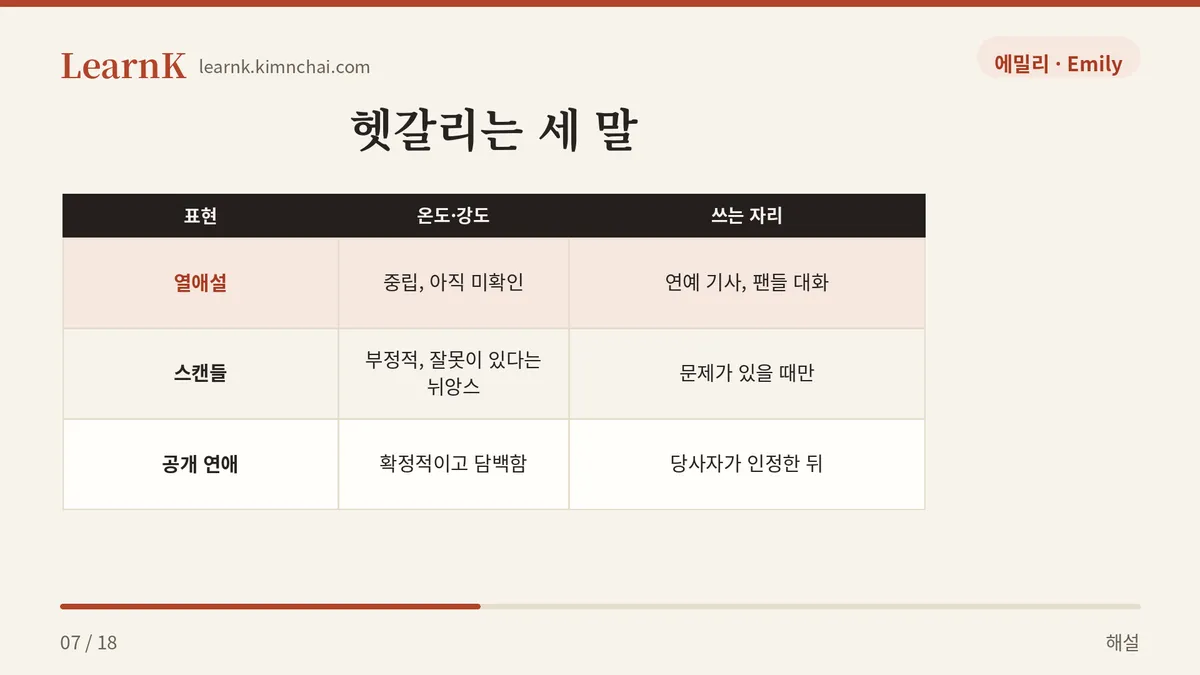
There are words that look similar but belong in completely different places.
| Expression | Temperature / intensity | Where it belongs |
|---|---|---|
| 열애설 (yeoraeseol) | Neutral, but with a strong “not confirmed yet” attached | Entertainment articles, fan conversations. Among friends, as a joke |
| 스캔들 (seukaendeul) | Negative and sensational. Carries the nuance that something wrong happened | Only when there’s an actual problem, like an affair or public disgrace |
| 공개 연애 (gonggae yeonae) | Definite and matter-of-fact | After the people involved have confirmed it |
| 썸 (sseom) | Light and fluttery. Just before dating | Among peers. Never in articles |
Above all, don’t swap 스캔들 and 열애설 for each other. 열애설 is simply “a rumor that they’re dating,” but 스캔들 already contains the judgment that “this is something problematic.” Calling two people in an ordinary relationship a 스캔들 amounts to inventing a wrongdoing and pinning it on them.
Cultural background — the agency statement as its own genre
In Korea, a 열애설 unfolds along an almost fixed script. At dawn or early in the morning, an outlet runs an article with photos. In the morning, the agency puts out a short statement: “확인 중입니다 (hwagin jungimnida, We’re checking).” Then in the afternoon or the next day, one of two things comes out. 사실무근입니다 (sasilmugeunimnida) — a stiff Sino-Korean phrase meaning the story is groundless. Or else a roundabout admission along the lines of “좋은 감정으로 만나고 있습니다 (joeun gamjeongeuro mannago itseumnida, We’re seeing each other with good feelings).” This whole flow is so familiar that Emily, in the conversation above, can say “Admitting it a week later is practically a formula.”
It also pays to know how the word is built, because that makes your vocabulary grow all at once. The -설 (說, seol) in 열애설 is a suffix that creates “an unverified story,” so slotting a different word into the same position gives you a brand-new word as is. 결별설 (gyeolbyeolseol, a rumor that they’ve broken up), 불화설 (bulhwaseol, a rumor that they don’t get along), 은퇴설 (euntoeseol, a rumor that someone is quitting). On some days all three run side by side on a single page of entertainment news.
There’s one more thing learners would do well to keep in mind. For fans, a 열애설 is thrilling news, but for the people involved it’s also their private life being opened without permission. The comment sections under Korean entertainment news are always split between two kinds of reaction: the people saying congratulations, and the people asking why anyone would photograph this and turn it into an article. So when you use this word about an actual person, you have to keep it at the temperature of a light joke, and the natural thing is to back off the moment you sense the other person is uncomfortable.
Today’s quiz
Which of the following sentences uses 열애설 naturally?
- 저희 부모님은 30년째 열애설이세요. (jeohui bumonimeun samsimnyeonjjae yeoraeseorieseyo.)
- 그 배우, 어제 열애설 났는데 오늘 바로 인정했대. (geu baeu, eoje yeoraeseol nanneunde oneul baro injeonghaetdae.)
- 나 어제 소개팅에서 열애설 했어. (na eoje sogaetingeseo yeoraeseol haesseo.)
Answer: number 2. 열애설 means “a rumor that hasn’t been confirmed yet,” so it can’t be used for a relationship that’s already established as fact (number 1), or for an action you performed yourself (number 3). Just remember that it rides on top of a flow — the rumor breaks (나다, nada), and then it’s denied or admitted (부인하다 / 인정하다, buinhada / injeonghada) — and this word will never confuse you again.