육회 (yukhoe) — Today's Korean Expression, Learned in a Market Alley
육회
육회 (yukhoe) means a dish of beef sliced thin, seasoned with various condiments, and eaten raw. The situations where a Korean person actually says this word are pretty much fixed. One is the moment you sit down at a barbecue restaurant, open the menu, and ask, “일단 육회 (yukhoe) 하나 시킬까?” (“Should we start with one order of yukhoe?”). The other is standing at the mouth of that alley in Seoul’s Gwangjang Market, where the yellow signs line up in a row, pointing with your hand and saying, “여기가 그 육회 골목이야” (“This is the famous yukhoe alley”). In other words, it isn’t a hard word locked inside a dictionary — it’s a living word that travels with menus, alley nicknames, and the first order of the night.
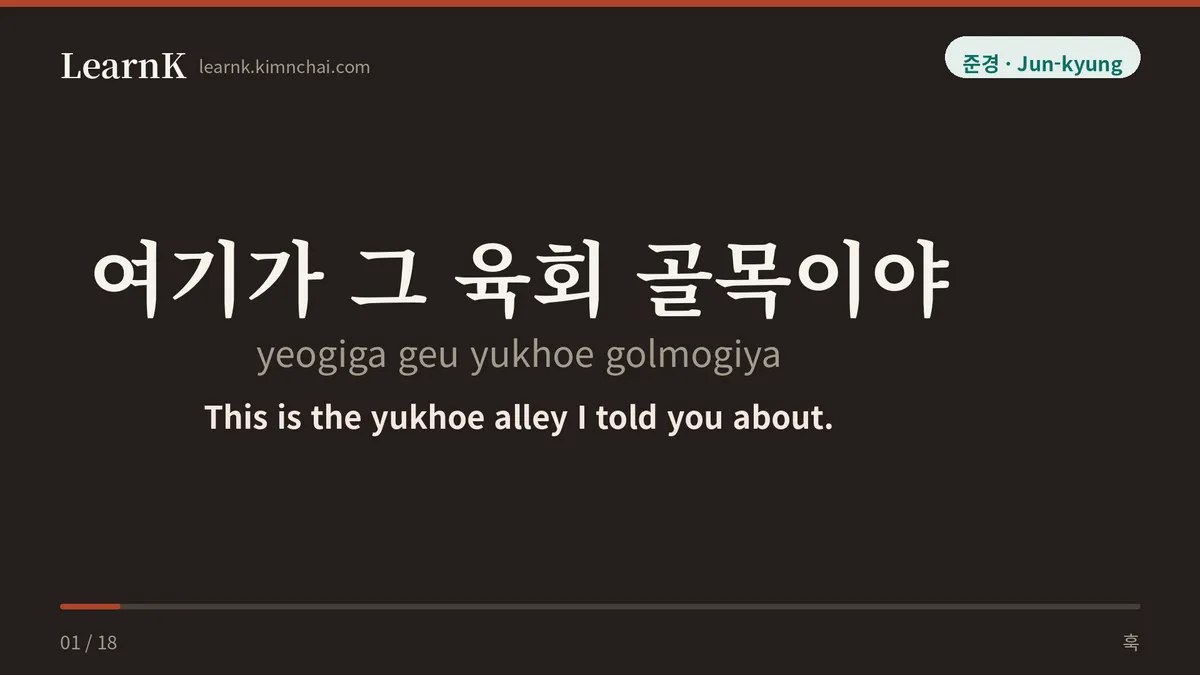
The heart of 육회 lies in the second of its two syllables. 회 (hoe) refers to raw food sliced thin and eaten as is, and the 육 (yuk) in front means “meat.” So 육회 is literally “hoe made of meat.” And this is exactly where Korean learners trip up most often. In Korea, if you say “회 먹으러 가자” (“let’s go eat hoe”) with no modifier in front, nine times out of ten it means 생선회 (saengseonhoe) — raw fish. If you mean beef, you absolutely have to attach 육 to the front.
In terms of temperature, 육회 is a completely ordinary, neutral food name. It’s neither slang nor stiff written language, so everyone from children to elders uses it the same way. That said, in a Korean person’s mind, 육회 carries the sense of “not something you eat just anywhere.” Because it’s raw meat, freshness is everything, so people treat it as something to eat at a place you trust — a butcher-restaurant that cuts its own meat, or an old shop inside a market. That’s why recommending 육회 usually comes with a guarantee about the restaurant attached. Something like, “여기 육회 진짜 괜찮아, 내가 자주 오는 데야” (“The yukhoe here is really good — this is a place I come to a lot”).
Checking the National Institute of Korean Language Dictionary
The National Institute of Korean Language’s Basic Korean Dictionary defines 육회 this way.
육회 「명사」 (noun) 쇠고기를 가늘게 썰어서 여러 가지 양념을 하여 날로 먹는 음식. [en] yukhoe; beef tartare — A dish of beef, which is sliced and seasoned, then eaten raw. [ja] ユッケ — 牛肉を薄く切って、様々な調味料で味付けをして生で食べる物。 [es] yukhoe, plato de carne de vaca cruda — Plato consistente en carne de res cruda cortada en tajadas y condimentada. [zh] 生拌牛肉 — 将牛肉切成丝后,放入各种调料拌匀并生吃的食物。 — National Institute of Korean Language, Basic Korean Dictionary (krdict.korean.go.kr)
A Portuguese definition isn’t included in this dictionary. So we should note that the line below is not a dictionary quotation but our own rendering — yukhoe, prato de carne bovina crua, cortada em tiras finas e temperada (our own translation; not in the dictionary).
There are three phrases worth watching in that definition: “가늘게 썰어서” (sliced thin), “양념을 하여” (seasoned), and “날로” (raw). All three have to be there for it to be 육회. Cut it thick and it becomes a different dish; leave out the seasoning and it becomes yet another dish; cook it and it stops being 육회 altogether. A single line of dictionary text ends up drawing the boundary lines of the recipe itself.
Now let’s look at the actual usages the dictionary lists.
육회를 뜨다. (yukhoereul tteuda) — to slice yukhoe 육회를 무치다. (yukhoereul muchida) — to toss and season yukhoe — National Institute of Korean Language, Basic Korean Dictionary (krdict.korean.go.kr)
These two verbs lay out the order in which 육회 gets made. Shaving the meat thin along the grain with a knife is 뜨다 (tteuda), and adding soy sauce, sesame oil, sugar, and garlic and mixing it by hand is 무치다 (muchida). In particular, ‘회를 뜨다’ is a verb used exclusively with 회, so if you memorize the pair as a set, you’ll never end up saying something awkward like “회를 만들다” (“to make hoe”).
육회를 만들 때에 참기름으로 양념을 하면 비린 맛이 덜하고 고소하다. When you make yukhoe, seasoning it with sesame oil cuts the gamey taste and gives it a nutty richness. — National Institute of Korean Language, Basic Korean Dictionary (krdict.korean.go.kr)
This sentence tells you what to use to tame the smell that raw meat has. The word 고소하다 (gosohada) that appears here is a distinctly Korean adjective for the flavor that comes from sesame oil, sesame seeds, and roasted beans, and it shows up almost without fail whenever 육회 comes up. There’s no word in English that maps onto it neatly, so people say that once you try 육회, you understand this word all at once.
생것 그대로 먹는 육회는 도축 직후에 요리하여 먹는 것이 일반적이다. Yukhoe, eaten completely raw, is generally prepared and eaten right after the animal is butchered. — National Institute of Korean Language, Basic Korean Dictionary (krdict.korean.go.kr)
The basis for that “you don’t eat it just anywhere” feeling mentioned earlier is sitting right there in a dictionary example sentence. With 육회, time is both flavor and safety. The reason Koreans will go out of their way to find a place known for good 육회, and the reason restaurants that double as butcher shops advertise their 육회 proudly, is packed into this one sentence.
민준이는 익힌 음식보다는 생선회나 육회처럼 날로 먹는 음식을 좋아한다. Min-jun likes raw foods like saengseonhoe and yukhoe more than cooked food. — National Institute of Korean Language, Basic Korean Dictionary (krdict.korean.go.kr)
This sentence sets 육회 and 생선회 side by side and shows their relationship at a glance. The two belong to one family, ‘회’, and the fork in the road is whether the ingredient is beef or fish. The very fact that a dictionary example places these two words next to each other is evidence that Korean treats them as a single set.
A Real Conversation
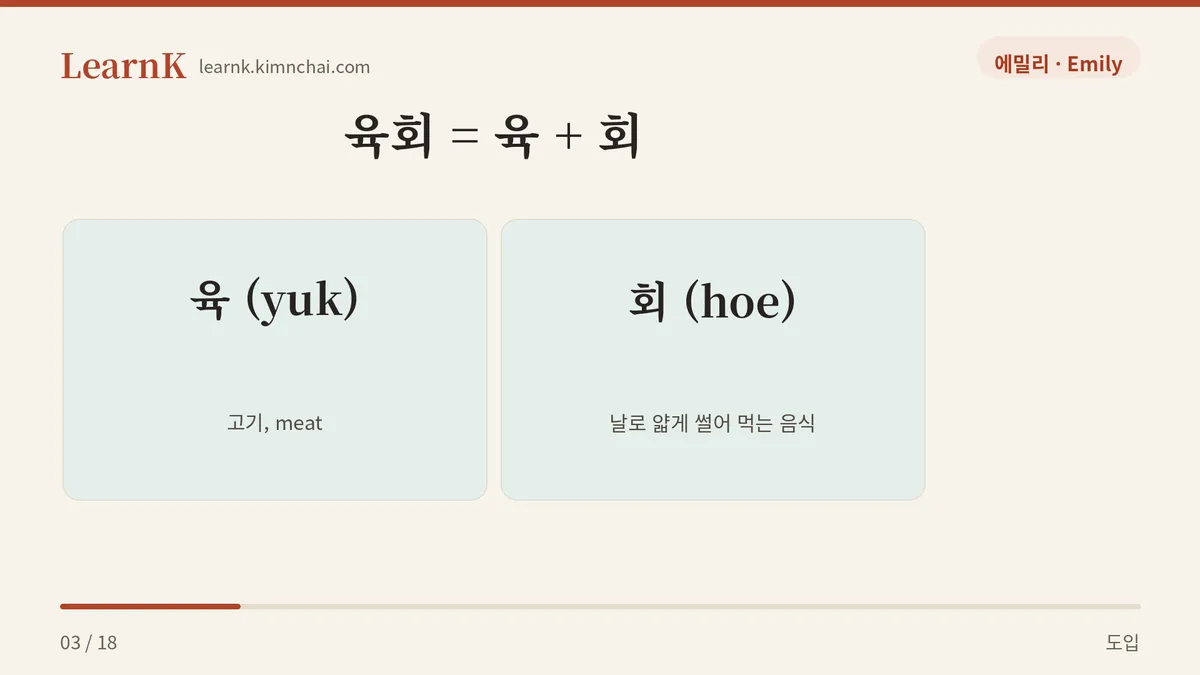
Setting: Saturday evening at Gwangjang Market. Standing in front of an alley lined with yellow signs, deciding which shop to go into.
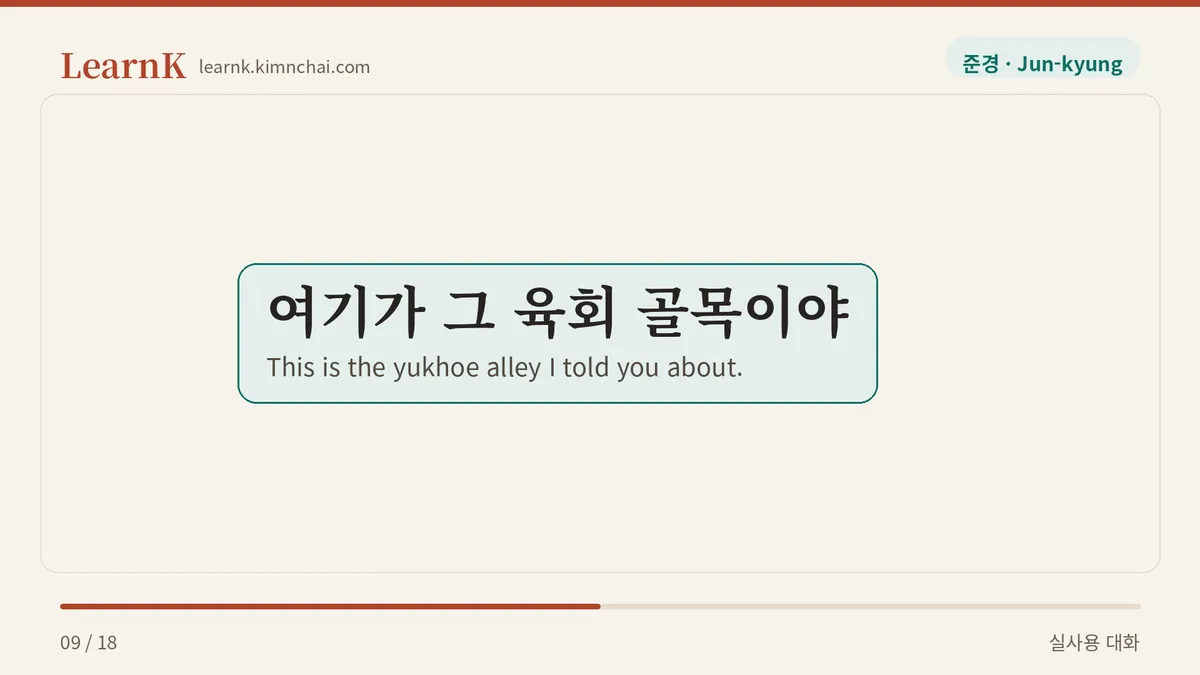
Jun-kyung: 여기가 그 육회 골목이야. 저기 줄 제일 긴 집으로 가자. This is the yukhoe alley I told you about. Let’s go to the one with the longest line.
Emily: 우와, 진짜 다 생고기네. 나 처음 왔을 땐 이거 못 먹었는데. Wow, it really is all raw meat. I couldn’t eat this when I first came here.
Jun-kyung: 근데 지금은 없어서 못 먹지? 참기름이 다 한 거야. But now you can’t get enough of it, right? It’s all thanks to the sesame oil.
Emily: 인정. 근데 넌 노른자 올려 먹어, 안 올려 먹어? Agreed. So do you put the egg yolk on top or not?
Jun-kyung: 당연히 올리지. 노른자 터뜨려서 배랑 같이 비벼야 육회지. Of course I do. Breaking the yolk and mixing it with the pear — that’s what makes it yukhoe.
Emily: 그럼 육회 한 접시에 소주 시키자. 오늘은 내가 살게. Then let’s order a plate of yukhoe and some soju. It’s on me today.
This Sounds Off
육회 is a pure food name that doesn’t discriminate between people, so there’s almost no way to be rude with it. Instead, let’s point out two misunderstandings learners actually run into all the time.
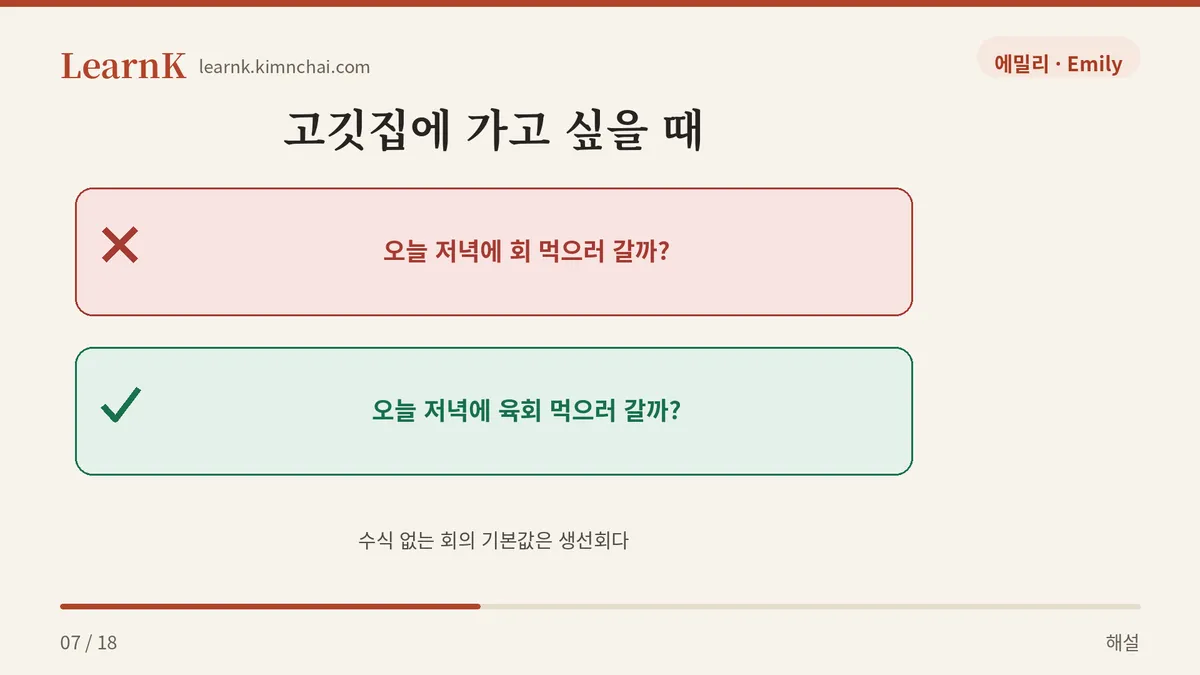
✗ (when you want to go to a beef restaurant) 오늘 저녁에 회 먹으러 갈까? ✓ (when you want to go to a beef restaurant) 오늘 저녁에 육회 먹으러 갈까? → In Korea, the default meaning of an unmodified ‘회’ is raw fish. You said it picturing beef, and your friend books a sashimi restaurant. When you mean the meat side, never drop the 육.
✗ 그 드라마 저 육회까지 봤어요. ✓ 그 드라마 저 6화까지 봤어요. / 여섯 편까지 봤어요. → The number 6회 (“episode six”) and the food 육회 sound exactly the same, so when spoken out loud, the other person freezes for a second. On top of that, drama episodes are more often counted with 화 (hwa) than with 회. When there’s a risk of confusion, it’s safest to just say ‘여섯 편’ (“six episodes”).
Example Sentences by Situation
1. Ordering for the first time in a market alley
“여기 육회 한 접시하고 소주 한 병 주세요.” (yeogi yukhoe han jeopsi-hago soju han byeong juseyo) → 육회 is counted in 접시 (jeopsi), plates. “육회 하나 주세요” works too, but adding ‘한 접시’ sounds far more natural and makes the quantity clear. At a market shop, this one sentence finishes your order.
2. Politely saying you can’t eat raw food
“저는 육회는 좀 못 먹어요. 익힌 걸로 주문할게요.” (jeoneun yukhoeneun jom mot meogeoyo. ikin geollo jumunhalgeyo) → This is a very common situation at company dinners. Here, the single syllable 좀 (jom) dramatically lowers the temperature of the refusal. Saying only ‘못 먹어요’ sounds blunt, but ‘좀 못 먹어요’ becomes a soft refusal with a note of apology mixed in.
3. Recommending a restaurant
“여기 육회 진짜 신선해. 내가 자주 오는 집이야.” (yeogi yukhoe jinjja sinseonhae. naega jaju oneun jibiya) → This sentence is that “guarantee attached” we talked about earlier. When recommending raw meat, Koreans mention freshness and regular-customer status before taste. In speech, 싱싱하다 (singsinghada) is also often used in place of ‘신선하다’.
Formal vs. Casual Speech, and Similar Expressions
육회 is a noun, so the word itself doesn’t change between formal and casual speech. What changes is the verb next to it. Among friends it’s “육회 시키자 (yukhoe sikija),” at a restaurant it’s “육회 한 접시 주세요 (yukhoe han jeopsi juseyo),” and a bit more politely it’s “육회 하나 부탁드릴게요 (yukhoe hana butakdeurilgeyo).” What’s confusing isn’t the politeness level — it’s the neighboring words that look similar.
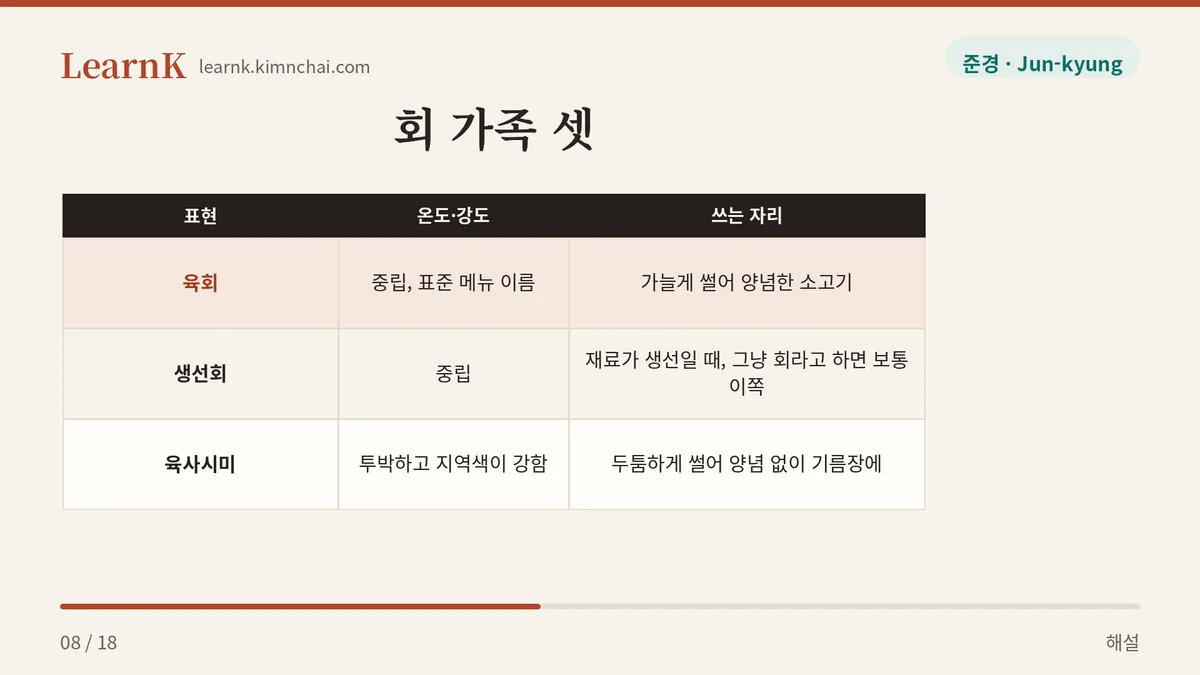
| Expression | Temperature / Intensity | Where it’s used |
|---|---|---|
| 육회 (yukhoe) | Neutral. The standard menu name | Menus, orders, everyday conversation — anywhere |
| 생선회 (saengseonhoe) | Neutral | When the ingredient is fish. If you just say ‘회’, this is usually what’s meant |
| 육사시미 (yuksasimi) | Rough and strongly regional | Cut thick, no seasoning, dipped in sesame-oil-and-salt sauce. In Daegu and Gyeongbuk it’s also called ‘뭉티기’ (mungtigi) |
| 육회비빔밥 (yukhoe bibimbap) | Neutral. A full meal | A proper meal with rice. For when you’re ordering it as a meal rather than a drinking snack |
As the table shows, what separates 육회 from 육사시미 is thickness and seasoning. Think back to the dictionary definition’s ‘가늘게 썰어서’ and ‘양념을 하여’ — those were exactly that boundary line.
Cultural Background — Two Chinese Characters and an Alley of Yellow Signs
육회 comes from two Chinese characters. 육(肉) means meat, and 회(膾) is the character for meat or fish sliced thin to be eaten raw. So you can build words just by swapping out the ingredient in the front slot. Put in fish and you get 생선회; put in meat and you get 육회. The dedicated verb ‘회를 뜨다’ is a pairing that comes out of this same character.
육회 was not a common food for a long time. Back when there was no refrigeration, the only day you could eat raw meat was the day a cow was slaughtered. The dictionary example “도축 직후에 요리하여 먹는 것이 일반적이다” (“it is generally prepared and eaten right after butchering”) captures that reality exactly. The fact that even today the places known for good 육회 are usually shops that also run a butcher counter, or old stores inside a market, is a trace of that history.
That’s how the yukhoe alley at Seoul’s Gwangjang Market became both a tourist stop and a language-learning site. Step into the alley lined with yellow signs and every plate has a yellow egg yolk resting on top of red meat, served together with julienned pear, pine nuts, and sesame oil. Breaking the yolk and mixing it with the pear is such a settled ritual that even among Koreans you’ll hear people say, “그래야 육회지” (“that’s the only way it’s really yukhoe”).
Through Korean dramas and mukbang, this word is going out into the world untranslated. In Japan it’s called ユッケ, a direct transcription of the Korean pronunciation, and that spelling appears in the dictionary’s Japanese definition. In English it gets rendered as ‘beef tartare’, but the moment sesame oil, pear, and egg yolk enter the picture, that translation falls short. So these days more and more restaurants overseas simply write ‘yukhoe’ on the menu. Just as kimchi and bulgogi did, 육회 is crossing over as a name that doesn’t get translated.
Today’s Quiz
A Korean friend says to you, “우리 오늘 저녁에 회 먹으러 갈까?” Where is this friend going to take you?
① A butcher-restaurant that serves beef yukhoe ② A sashimi restaurant that serves raw fish ③ A Korean restaurant that serves yukhoe bibimbap
Answer: ②
In Korean, the default meaning of an unmodified ‘회’ is raw fish. If you want beef, you absolutely have to attach the 육 and say “육회 먹으러 갈까?” If you boil today’s lesson down to one line, it’s this — the single syllable in front of 회 is what divides the sea from the land.
Definitions and example sentences are from the National Institute of Korean Language’s Basic Korean Dictionary (krdict.korean.go.kr); that portion of this post, including our translations, is licensed under CC BY-SA 2.0 KR.