유닛 (yunit) — When Another Team Forms Inside the Group

유닛 (yunit) means a small team formed when a few members of one group get together and promote separately. Instead of an idol group of more than ten people taking the stage all together every time, sometimes just two or three of them gather, put out a song under a team name of their own. The word for that small team is exactly 유닛 (yunit).
If you started learning Korean because you love K-pop, you’ll run into this word in fan communities long before it ever shows up in a textbook. Lines like “이번엔 유닛으로 나온대 (ibeonen yuniseuro naondae)” — “I heard they’re coming out as a unit this time” — or “유닛 무대 봤어? (yunit mudae bwasseo?)” — “Did you see the unit stage?” — get tossed around with no explanation at all. If you don’t know the word, you can’t tell whether it means the group is splitting up or a new group is launching. Short answer: it’s neither. The group stays exactly where it is; a small extra team just forms inside it for a while.
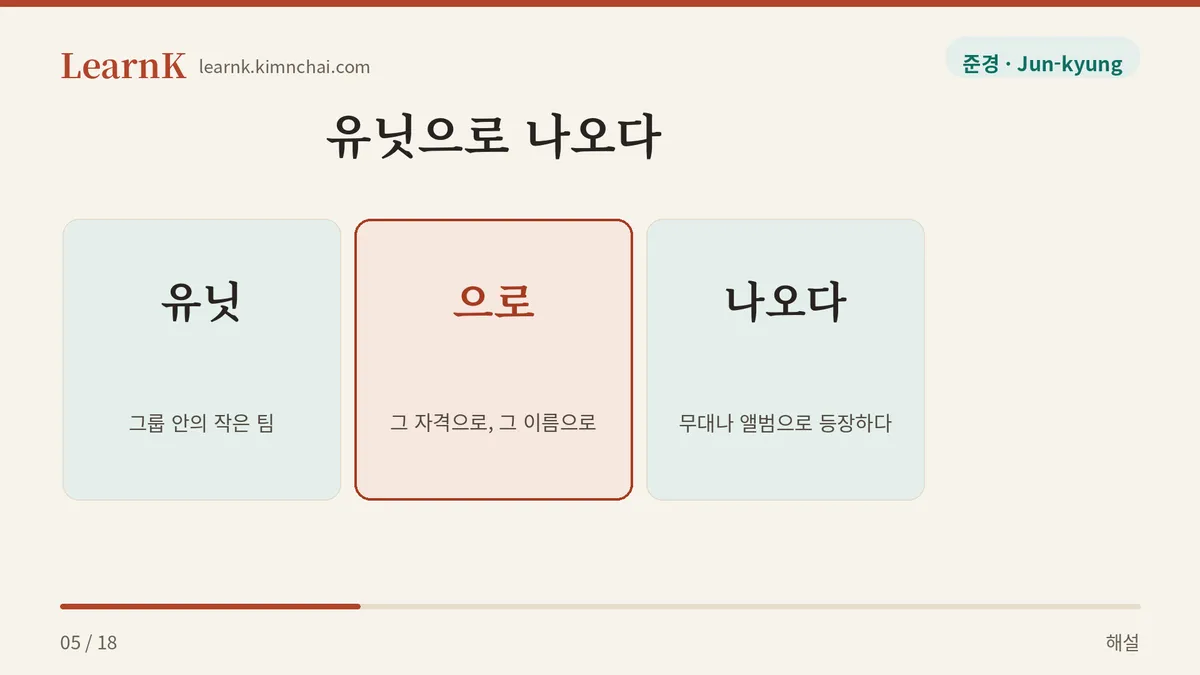
유닛 (yunit) is a loanword taken straight from English unit, so there’s no hanja behind it and its usage is simple. It works as a plain noun, and you stretch it freely by tacking other words onto the end. Compounds like 유닛 활동 (yunit hwaldong) “unit promotions,” 유닛 무대 (yunit mudae) “unit stage,” 유닛 곡 (yunit gok) “unit song,” and 유닛 데뷔 (yunit debwi) “unit debut” are especially common. Used with a particle, 유닛으로 나오다 (yuniseuro naoda) “to come out as a unit” and 유닛으로 활동하다 (yuniseuro hwaldonghada) “to promote as a unit” are the most frequent pairings. To count them, you say 유닛 하나 (yunit hana) “one unit” or 유닛 두 팀 (yunit du tim) “two units.”
It’s worth knowing the nuance, too. Unit news is not bad news for fans — if anything, it lands on the happy side. A full-group comeback takes a long time to prepare, and a unit fills the gap in between; it can also be a chance to try a genre the group’s usual style never allows. So when someone says “유닛 나온대 (yunit naondae)” — “I heard a unit is coming” — the temperature of that sentence is anticipation, not worry. Disbanding or leaving the group, on the other hand, uses completely different words. Mixing these up is an easy way to get misunderstood among fans, so be sure to remember the difference.
A Real Conversation
Situation: Three hours before the concert, in the merch line outside the venue. The line wraps all the way around the building.
Jun-kyung: 야, 줄 왜 이렇게 길어. 우리 앞에 백 명은 되겠는데. Hey, why is the line this long? There’ve gotta be a hundred people ahead of us.
Emily: 어차피 세 시간 남았어. 그것보다 오늘 유닛 무대 나온대, 들었어? We’ve got three hours anyway. More importantly, I heard there’s a unit stage today — did you hear?
Jun-kyung: 진짜? 셋이서 따로 하는 거? 그거 앨범에만 있고 무대는 한 번도 안 했잖아. Really? The one the three of them do separately? That was only on the album, they’ve never performed it.
Emily: 응, 오늘이 처음이래. 나 사실 그 유닛으로 입덕했거든. Yeah, today’s the first time. Honestly, that unit is what got me into them.
Jun-kyung: 아 맞다, 너 원래 그 팀부터 팠지. 그럼 오늘 울겠네. Oh right, you started with that team. You’re gonna cry today, huh.
Emily: 울지. 그래서 손수건도 챙겨 왔어. Of course I will. That’s why I brought a handkerchief.
This Sounds Off in Korean

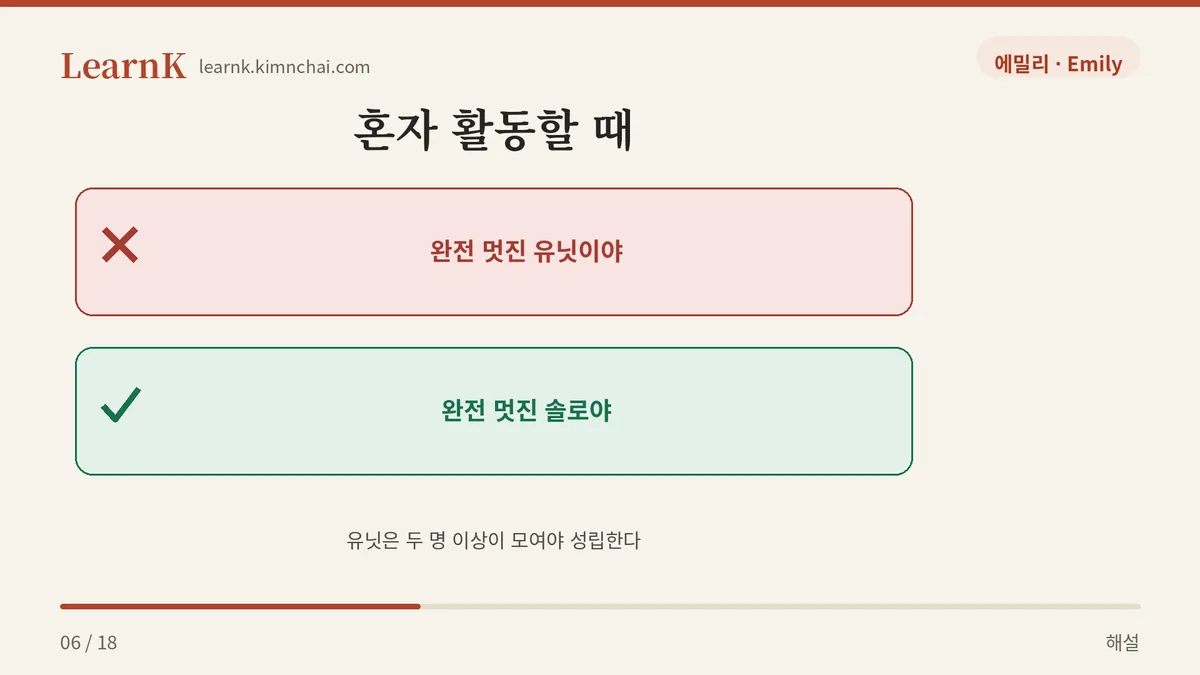
✗ 그 멤버 이번에 혼자 앨범 냈대. 완전 멋진 유닛이야. ✓ 그 멤버 이번에 혼자 앨범 냈대. 완전 멋진 솔로야. “I heard that member put out an album on their own. What a great 솔로 (sollo) — soloist.” → A 유닛 (yunit) only exists when at least two people come together. When one member promotes alone, that’s not a unit — that’s 솔로 (sollo).
✗ (talking about a group project) 우리 유닛 발표 언제야? ✓ (talking about a group project) 우리 조 발표 언제야? “When is our 조 (jo) — our group — presenting?” → 유닛 (yunit) isn’t a word used broadly in everyday Korean; it’s industry jargon that belongs mostly to the music world. For a small team at school or at work, use 조 (jo) or 팀 (tim). Saying 유닛 here wouldn’t be incomprehensible, but it sounds oddly overblown, like you’re putting too much weight on the word.
Example Sentences by Situation
1. Finding out about a new album (a fan community comment)
이번 앨범에 유닛 곡이 두 개나 들어 있어요. (ibeon aelbeome yunit gogi du gaena deureo isseoyo.) “There are two whole unit songs on this album.”
This is someone reacting with surprise to the tracklist. It means that besides the title track everyone sings on, there are two songs split up among just a few members. The 나 in 두 개나 (du gaena) carries the delight of “more than I expected.”
2. Right after walking out of a concert (casual speech, with a friend)
아까 유닛 무대가 제일 좋았어. 세 명 목소리가 진짜 잘 붙더라. (akka yunit mudaega jeil joasseo. se myeong moksoriga jinjja jal butdeora.) “The unit stage earlier was the best. Those three voices really fit together.”
This is the moment where you pick your favorite part of the whole show. 목소리가 붙는다 (moksoriga butneunda), literally “the voices stick together,” means the harmony blends beautifully — fans use it constantly, so it’s worth learning alongside this word.
3. In a TV interview (the artists themselves, in polite speech)
유닛으로는 처음 인사드립니다. 잘 부탁드립니다. (yuniseuroneun cheoeum insadeurimnida. jal butakdeurimnida.) “This is our first time greeting you as a unit. We hope you’ll support us.”
This is the greeting you use when you’re already well known as a group, but it’s your first time on stage in this particular combination. The 는 in 유닛으로는 (yuniseuroneun) quietly lays down the contrast: “we’ve met you many times as the group, but…”
Polite and Casual Speech, and Similar Expressions
유닛 (yunit) is a noun, so it carries no politeness level of its own — that gets decided at the end of the sentence. Between friends it’s 유닛으로 나왔어 (yuniseuro nawasseo), in polite speech 유닛으로 나왔어요 (yuniseuro nawasseoyo), and in a formal setting it becomes 유닛으로 활동하게 되었습니다 (yuniseuro hwaldonghage doeeotseumnida).
Let’s line up the neighboring words that are easy to confuse.
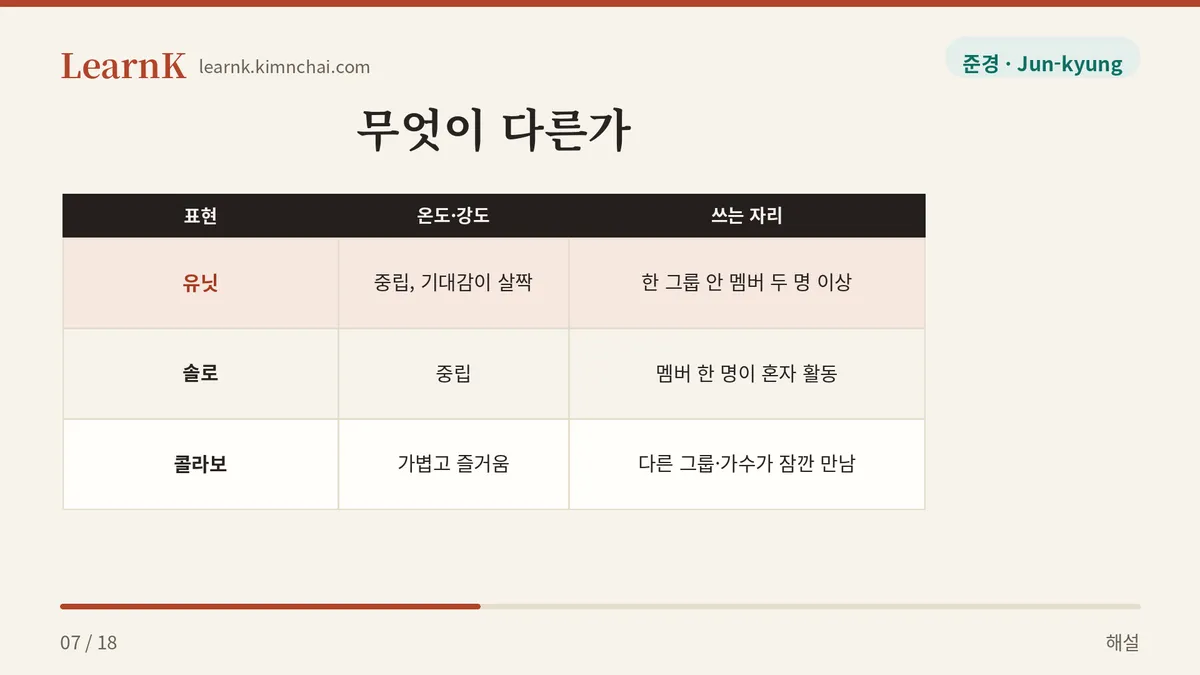
| Expression | Temperature / Intensity | Where it’s used |
|---|---|---|
| 유닛 (yunit) | Neutral, with a slight lift of anticipation | A small team of two or more members from within one group |
| 서브유닛 (seobeuyunit) | Neutral; more formal and explanatory than 유닛 | Articles and official write-ups. In conversation people just shorten it to 유닛 |
| 솔로 (sollo) | Neutral | When one member promotes on their own |
| 콜라보 (kollabo) | Light and fun | When different groups or artists meet on one song or one stage |
| 합동 무대 (hapdong mudae) | Slightly formal | A stage where several teams perform together, at an awards show and the like |
The difference between 유닛 (yunit) and 콜라보 (kollabo) is especially worth pinning down. A unit is a team that came out of one group to begin with; a collab is people who were strangers to each other meeting up briefly. Say “콜라보했대 (kollabohaetdae)” — “I heard they collabed” — about a song made by members of the same group, and fans will feel right away that something’s off.
Cultural Background — A Small Stage Inside the Group
유닛 (yunit) comes from the English word unit — that is, 단위 (danwi), a single component of something larger. The original sense, one block that makes up a whole, is still fully alive in it. A unit is one piece carved out of the big block that is the group. That’s why Korean fans understand a unit as a part of the group, never as an independent new group.
There are practical reasons this practice took hold. Korean idol groups tend to have a lot of members, so gathering everyone to prepare a single song costs an enormous amount of time and money. A unit fills the gap in between, and it also becomes a place to experiment with genres that are hard to attempt in the group’s usual style — two members of a ballad-only group coming out as a unit to do hip-hop, for instance.
Real examples make it click fast. Girls’ Generation had three members promote separately as TaeTiSeo in 2012, and SEVENTEEN launched from their very debut with a three-way structure of a hip-hop team, a vocal team, and a performance team. The teams came first, and the group was laid on top of them. This is also why fans can rattle off unit names from memory: once you know the unit lineups, you can see who has been singing alongside whom for years, and the relationships inside the group lay themselves out like a map.
So for a fan learning Korean, 유닛 (yunit) isn’t just one more vocabulary word. Once you know it, the question “왜 오늘은 세 명만 나왔지? (wae oneureun se myeongman nawatji?)” — “why did only three of them come out today?” — answers itself, and about half of what fans say to one another suddenly starts making sense.
Today’s Quiz

Which word fits the following situation best?
일곱 명짜리 그룹에서 멤버 두 명이 따로 팀 이름을 만들고 새 곡을 냈다. In a seven-member group, two of the members made a separate team name and released a new song. → 이 두 사람은 ( )(으)로 활동하는 것이다. → These two are promoting as a ( ).
① 솔로 (sollo) ② 유닛 (yunit) ③ 콜라보 (kollabo)
Answer: ② 유닛 (yunit)
Two or more people formed a separate team within the same group, so it’s a unit. If it were one person alone, ① would be the answer; if they had teamed up with someone from a different group, ③ would. As a full sentence, you’d say it like this — 그 둘은 유닛으로 활동한다 (geu dureun yuniseuro hwaldonghanda).
The definitions, example sentences, and dialogue in this post are all original work written by us. 유닛 (yunit) is not listed as a headword in the National Institute of Korean Language’s Basic Korean Dictionary (krdict.korean.go.kr), so this post was written without quoting the dictionary.