When It's Neither This nor That — '애매하다,' an Expression Koreans Use Several Times a Day
Have you ever asked a Korean friend, “Should we meet this weekend?” only to hear, “Hmm… that’s kind of 애매한데? (aemaehande?)”? They didn’t exactly say “no,” but they didn’t say “yes” either — a subtle, in-between kind of answer. Today, let’s take a deep dive into 애매하다 (aemaehada), an expression Koreans use several times a day.
애매하다
애매하다 (aemaehada) is used very often in everyday conversation to mean “it’s neither one thing nor the other, so it’s hard to say for sure.” It comes in handy when a situation is unclear, when a decision is hard to make, or when a time or location falls somewhere in the middle.
For example, 3 p.m. is too late for lunch but too early for dinner. In a moment like this, Koreans say, “밥 먹기 애매한 시간이야 (bap meokgi aemaehan sigan-iya)” — “It’s an awkward time to eat.” And when you can’t tell whether a color is blue or green, you might say, “색이 좀 애매해 (saegi jom aemaehae)” — “The color is kind of hard to pin down.”
Meaning and Nuance
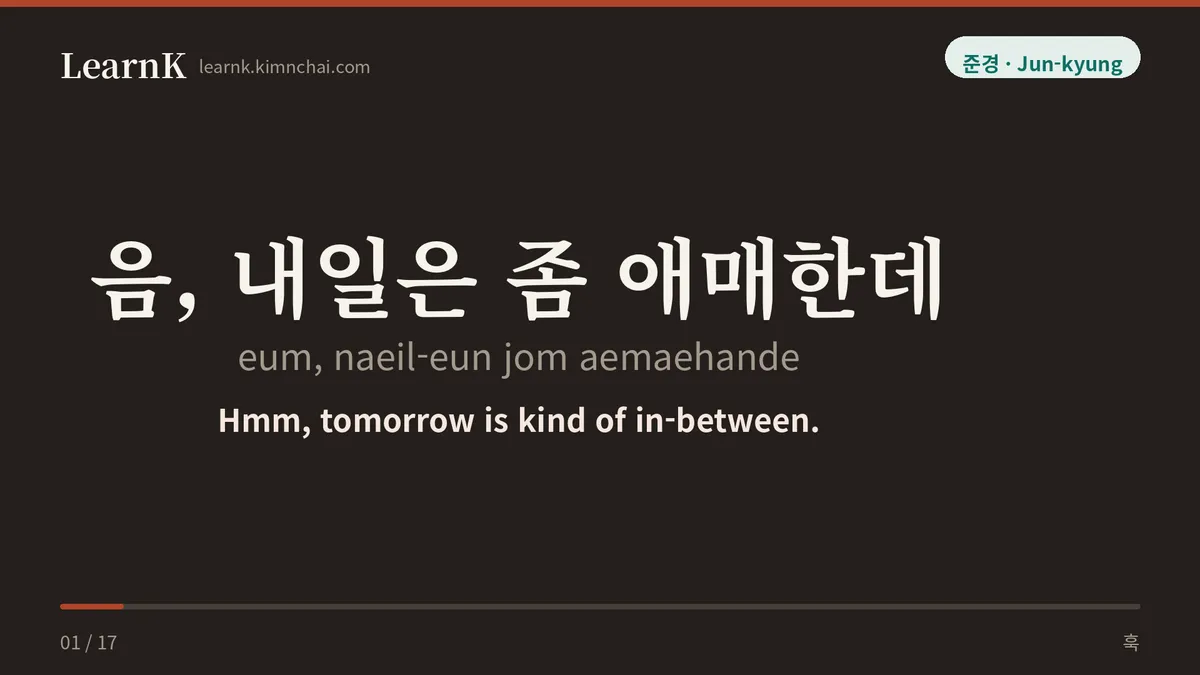
The core nuance is “being right on the border.” It’s the feeling of hesitating to judge because something sits somewhere between A and B, being neither one. So 애매하다 isn’t really negative — it expresses a neutral sort of difficulty, a sense of “not being certain.” It isn’t a word for blaming anyone; it’s a calm acknowledgment that a situation just doesn’t fall neatly into place.
Checking the National Institute of Korean Language Dictionary
The National Institute of Korean Language’s Basic Korean Dictionary defines 애매하다 as an adjective this way:
애매하다: 잘못한 것이 없이 꾸중을 듣거나 벌을 받게 되어 억울하다. [en] falsely charged; unjustly suspected — Feeling mortified because one has been scolded or punished even though one did nothing wrong. [es] inocente, no culpable [ja] 無辜だ・無実だ [zh] 冤枉,无辜,冤屈 — National Institute of Korean Language, Basic Korean Dictionary (krdict.korean.go.kr)
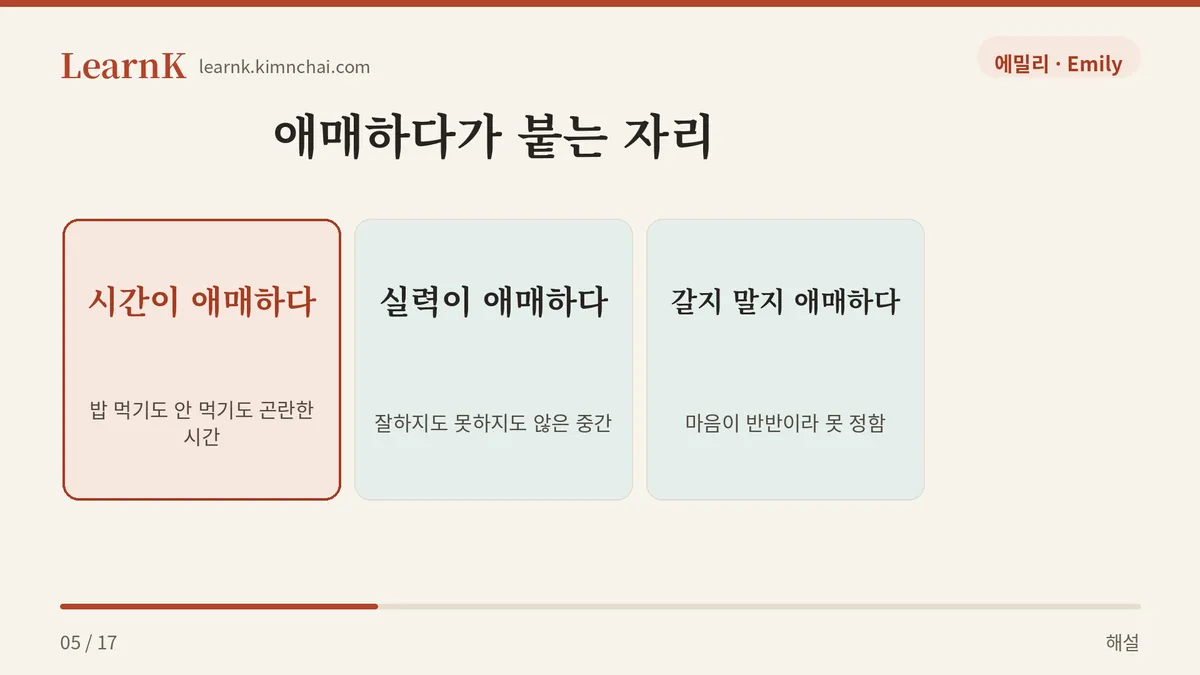
Interestingly, the dictionary’s headline definition is closer to “억울하다 (eogulhada)” — to feel wronged. As in “애매하게 누명을 썼다 (aemaehage numyeong-eul sseotda),” meaning “to be unfairly framed,” this is a somewhat literary usage referring to being punished and feeling wronged despite having done nothing. The meaning we use in daily life, “to be in-between,” comes through more clearly in the examples below.
시간이 애매하다. — National Institute of Korean Language, Basic Korean Dictionary (krdict.korean.go.kr)
This describes a situation where the time isn’t quite right for doing something and is just left hanging.
수업이 끝나면 오후 네 시라 식사를 하기에는 시간이 애매하다. — National Institute of Korean Language, Basic Korean Dictionary (krdict.korean.go.kr)
It means that since class ends at 4 p.m. — between lunch and dinner — it’s awkward whether to eat or not. Any student can relate to this.
Note: the Portuguese translation of the example above isn’t in the dictionary, so we translated it ourselves (our own translation): “O horário está numa hora inconveniente para comer.”
Example Sentences by Situation
-
When setting a time to meet — “3시는 좀 애매하니까 5시에 볼까요? (se-si-neun jom aemaehanikka daseot-si-e bolkkayo?)” This is a suggestion to push the time back because 3 o’clock is in an in-between spot.
-
When talking about skill or degree — “제 한국어 실력은 아직 애매해요 (je hangugeo sillyeogeun ajik aemaehaeyo).” This is a modest way of saying you’re at a middle stage — neither good nor bad.
-
When putting off a decision — “갈지 말지 애매해서 아직 못 정했어 (galji malji aemaehaeseo ajik mot jeonghaesseo).” It means you’re torn fifty-fifty and haven’t been able to reach a conclusion.
Comparing Polite/Casual Forms and Similar Expressions
- Polite: 애매해요 (aemaehaeyo), 애매합니다 (aemaehamnida)
- Casual: 애매해 (aemaehae)
Let’s also get to know some similar words.
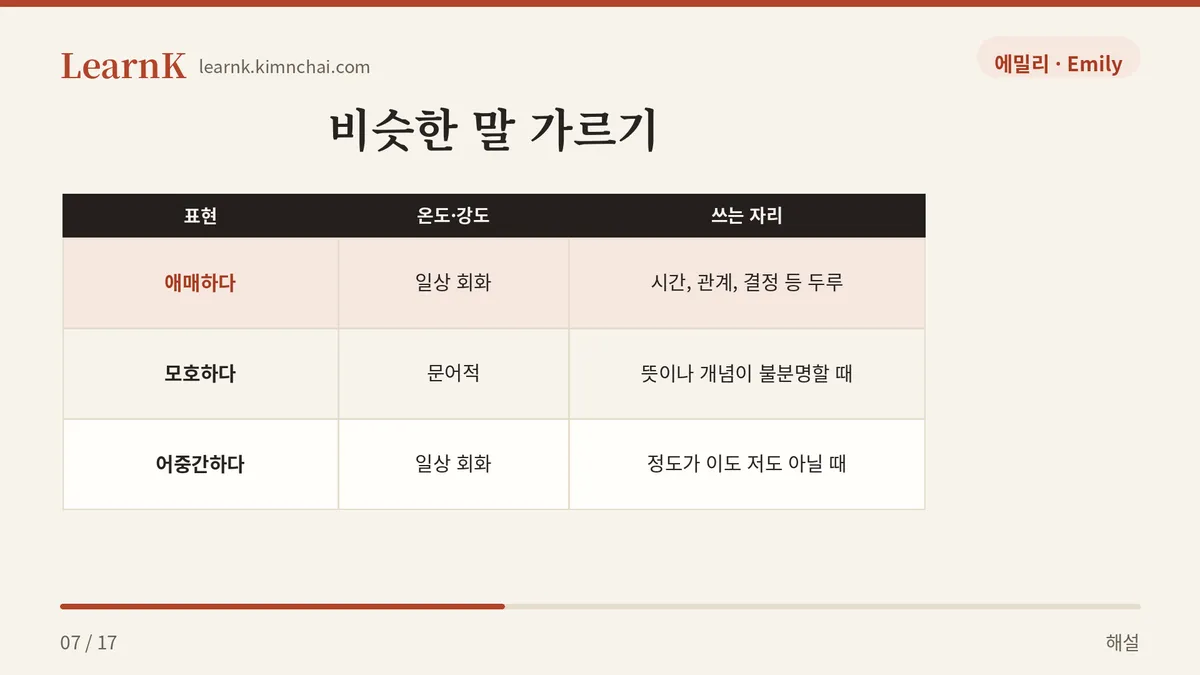
- 모호하다 (mohohada): When a meaning or concept is unclear. It’s stiffer and more literary than 애매하다. (e.g., “표현이 모호하다 (pyohyeon-i mohohada)” — “The wording is vague.”)
- 어중간하다 (eojunggan-hada): When a degree is neither this nor that. This is the closest in meaning to 애매하다.
- 글쎄요 (geulsseyo): An interjection used to avoid giving a definite answer, it often pairs up with “애매해요 (aemaehaeyo).”
Cultural Background
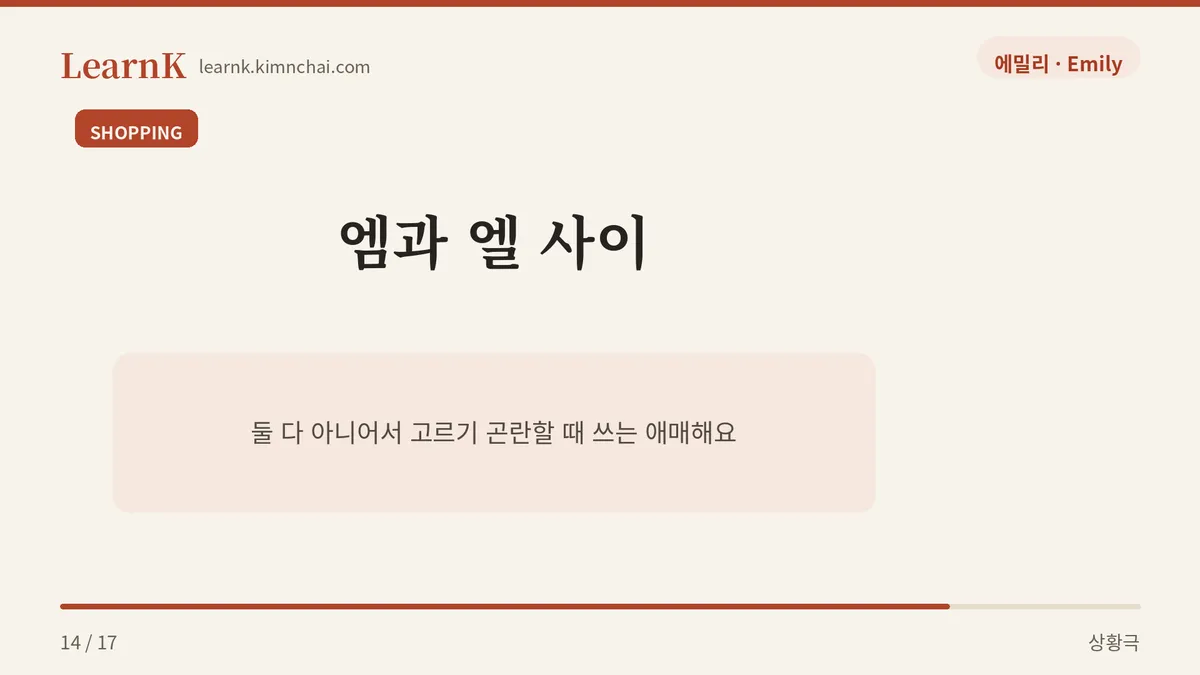
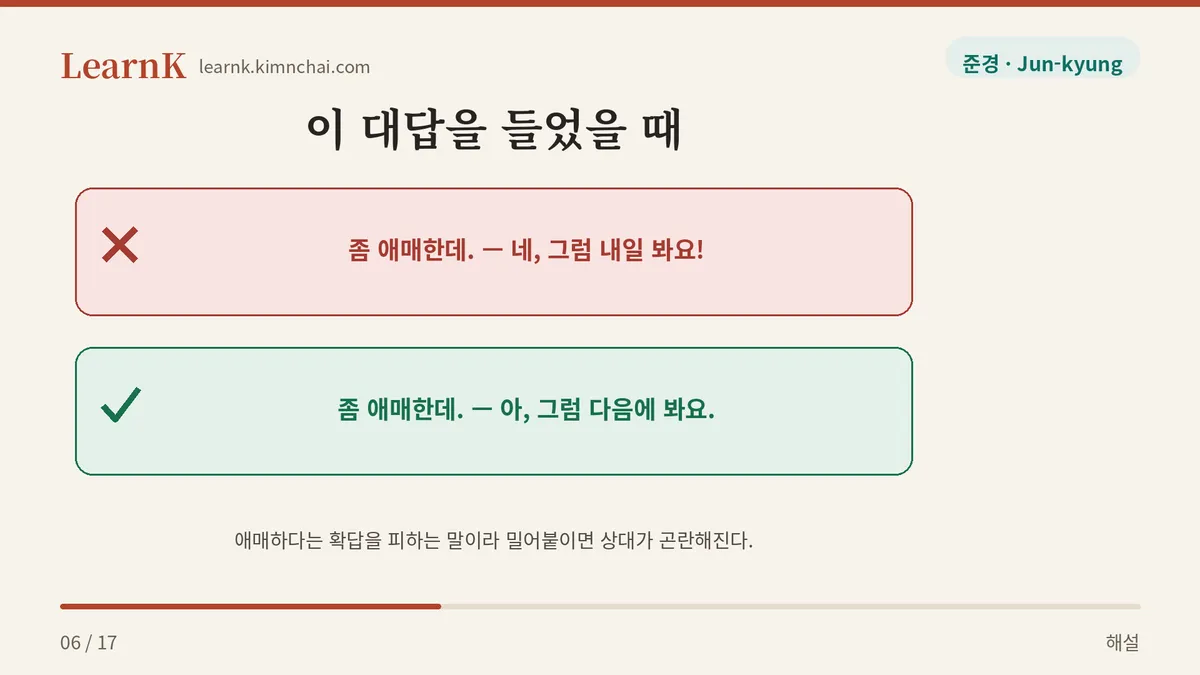
In Korean dramas, you’ll often see scenes where a character hesitates, unable to answer a confession right away. That subtle relationship — saying neither “I like you” nor “I don’t” — is what people these days call a “썸 타는 애매한 사이 (sseom taneun aemaehan sai),” an ambiguous, flirting-but-not-quite relationship. In this way, 애매하다 is an all-purpose expression you can use for “anything that doesn’t fall neatly into place” — feelings, time, relationships, and more. It also fits well with Korean conversational culture, which prefers to soften things and avoid a direct “no.” So once you start using this word naturally, your Korean will sound a good deal more like a native speaker’s.
Closing Quiz
At 3 p.m., it’s too late for lunch and too early for dinner. Complete this sentence describing the awkward situation of not knowing whether to eat, using the expression you learned today.
“지금은 밥 먹기 ___ 시간이야.”
Answer: 애매한 (aemaehan) → “지금은 밥 먹기 애매한 시간이야.” (“Right now it’s an awkward time to eat.”)
Definitions and example sentences are from the National Institute of Korean Language’s Basic Korean Dictionary (krdict.korean.go.kr); that portion of this post, including our translations, is licensed under CC BY-SA 2.0 KR.