안무 (anmu) — The Word Behind the People Who 'Build' Dances Backstage
안무
안무 (anmu) means the work of creating or teaching a dance set to music. The key to this word is that it doesn’t refer to the act of dancing on stage itself, but to the process of designing that dance and passing it on to someone else.
If you’re a Hallyu fan, you run into this word several times a day. When a teaser for a new song drops, comment sections fill up with “이번 안무 (anmu) 미쳤다” (this choreography is insane), and comeback stage reaction videos slow the eight counts of the chorus down to 0.25x speed to break down the angle of a fingertip. Even that eight-second move going around as a short-form challenge is, in the end, a slice cut from the most eye-catching part of a song’s 안무 (anmu). So once you’ve got a firm grip on this word, fan community posts and music show subtitles suddenly start reading clearly.
If there’s one nuance to hold onto, it’s that 안무 (anmu) is closer to a ‘finished blueprint.’ If dance is flowing water, choreography is the map of the channel dug out in advance. That’s why in Korean, 안무 goes together with 짜다 (jjada, to put together, to construct), 만들다 (mandeulda, to make), 배우다 (baeuda, to learn), 외우다 (oeuda, to memorize), and 소화하다 (sohwahada, to fully make something your own and pull it off). This is also why “안무를 짠다” sounds far more natural than “춤을 짠다.” What you put together is the design of the movements, not the movements themselves.
One more thing. This word is neutral, with almost no emotional temperature. It wears the same face in news articles, in the practice room, and in fan tweets. Instead, the temperature comes from the words placed in front of it — 격렬한 안무 (fierce choreography), 다이내믹한 안무 (dynamic choreography), 절제된 안무 (restrained choreography), and so on.
Checking the National Institute of Korean Language Dictionary
The National Institute of Korean Language’s Basic Korean Dictionary defines the word like this.
안무 「명사」 음악에 맞추어 춤을 만들거나 가르침. [en] choreography — The act of designing or teaching a dance that goes with a certain song. [ja] ふりつけ【振付・振り付け】 — 音楽に合わせて踊る動作を考案し、教えること。 [es] coreografía — Composición o enseñanza de baile al ritmo de la música. [zh] 编舞 — 配合音乐创作或教授舞蹈。 — National Institute of Korean Language, Basic Korean Dictionary (krdict.korean.go.kr)
Don’t miss the last word of the definition: ‘가르침’ (teaching). Not just making, but teaching too falls under 안무. Those minutes in the practice room when the teacher breaks the eight counts down and demonstrates them are, by the dictionary’s definition, also 안무.
A Portuguese definition isn’t included in this dictionary. The following is our own rendering, not a dictionary quotation — [pt] coreografia — o ato de criar ou ensinar uma dança que acompanha a música.
Now let’s look at real usage as recorded in the dictionary. First, the short collocations.
안무가 격렬한 안무. 댄스 안무. — National Institute of Korean Language, Basic Korean Dictionary (krdict.korean.go.kr)
안무가 (anmuga) is a person who builds dances — a choreographer by profession. Note too how words expressing intensity, like ‘격렬한’ (fierce), attach in front. 안무 itself is neutral, but the moment a modifier is added, the temperature of the stage is set. ‘댄스 안무’ may look redundant at first glance, but it’s genuinely common when distinguishing pop dance from ballet or traditional dance.
민준이는 안무 팀을 구성해 매일같이 새로운 안무를 배우고 연습했다. — National Institute of Korean Language, Basic Korean Dictionary (krdict.korean.go.kr)
안무 appears twice in one sentence, but with a different grain each time. The first, ‘안무 팀’ (choreography team), refers to an organization; the second, ‘새로운 안무를 배우고’ (learning new choreography), is the object of learning. Any learner who has started a cover dance club could use this sentence as their own story word for word.
이번 달에 음반을 발매한 그 그룹은 빠른 노래와 그에 맞는 다이내믹한 안무로 인기를 끌었다. — National Institute of Korean Language, Basic Korean Dictionary (krdict.korean.go.kr)
This is a sentence you could see verbatim in a music article. The pairing ‘노래와 그에 맞는 안무’ (a song and the choreography that matches it) is what matters. Choreography is always attached to some song; it never floats around on its own.
그 가수는 어려운 댄스 안무를 완벽하게 소화해 내서 큰 박수를 받았다. — National Institute of Korean Language, Basic Korean Dictionary (krdict.korean.go.kr)
This shows just how well 소화하다 (sohwahada) pairs with 안무. For someone on stage, the accurate compliment isn’t ‘안무를 잘한다’ but ‘안무를 잘 소화한다.’ We’ll come back to this in the misuse section below.
민준 씨한테 이번 공연 안무 부탁해 봤어? — National Institute of Korean Language, Basic Korean Dictionary (krdict.korean.go.kr)
What’s being requested here isn’t ‘please dance’ but ‘please build the dance.’ Asking someone for 안무 carries the meaning of entrusting them with the creative work.
A Real Conversation
Scene: The lobby of a dance studio near Hongdae. A K-pop cover class has just ended, and Emily is on her way out, wiping sweat with a towel.
Jun-kyung: 어? 너 여기서 뭐 해. 땀 범벅이네. Huh? What are you doing here? You’re drenched in sweat.
Emily: 나 이번 달부터 여기 다녀. 오늘 안무 딱 절반 뗐어. I started coming here this month. I got through exactly half the choreography today.
Jun-kyung: 반이나? 그 곡 후렴 동작 장난 아니던데. Half already? The moves in that chorus are no joke.
Emily: 그러니까. 발이 진짜 안 따라와. 근데 선생님이 안무를 조각조각 끊어서 가르쳐 주시니까 되더라고. Right? My feet just won’t keep up. But the teacher breaks the choreography into little pieces, and then it works.
Jun-kyung: 오, 그럼 다음 주 회식 때 한번 보여 줘. Oh, then show us at the company dinner next week.
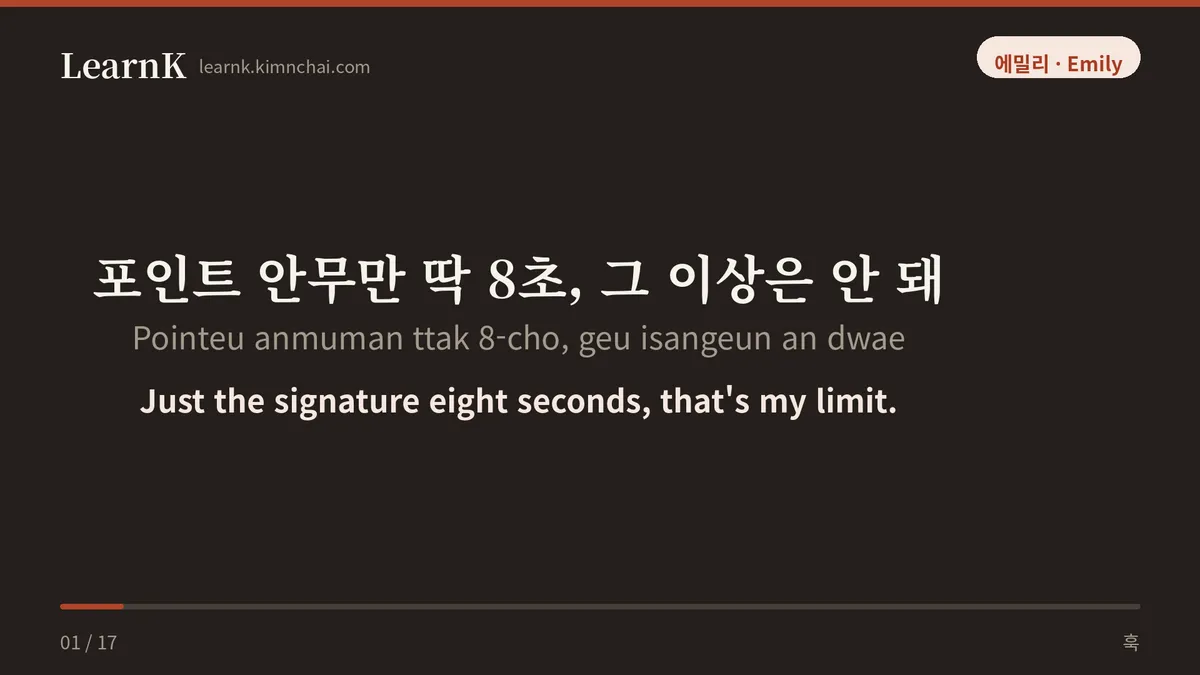
Emily: 야, 그건 좀. 포인트 안무만 딱 8초, 그 이상은 안 돼. Hey, no way. Just the signature eight seconds, that’s my limit.
This Sounds Awkward
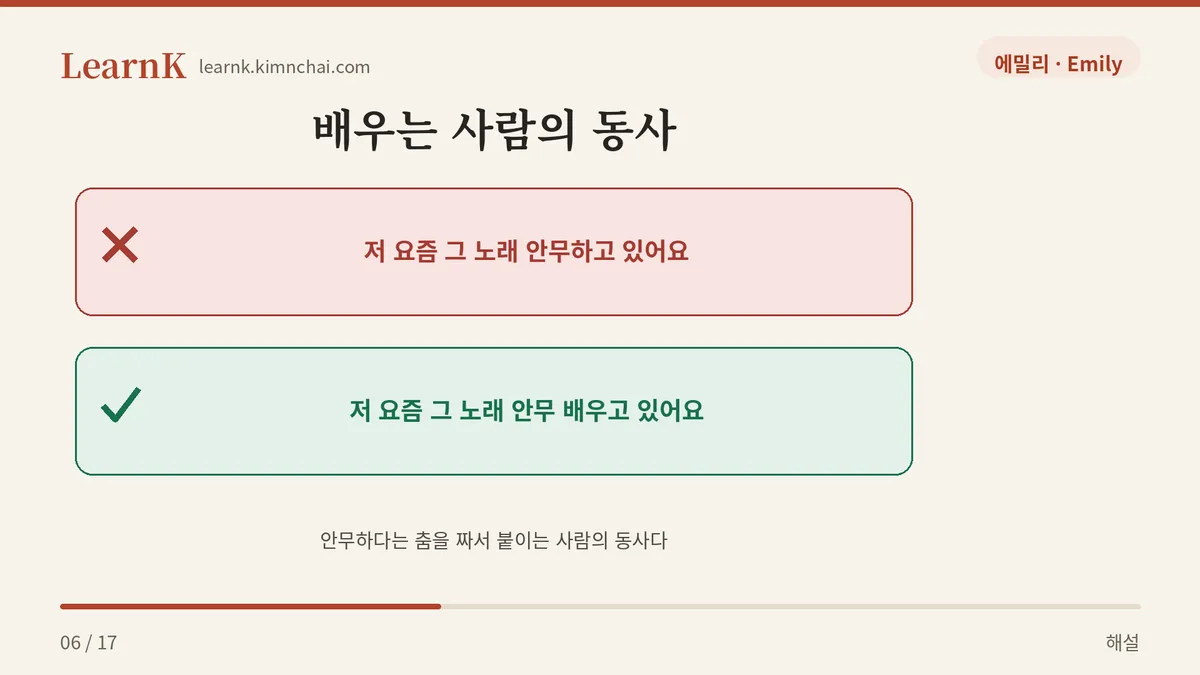
✗ 저 요즘 그 노래 안무하고 있어요. (meaning “I’m learning it”) ✓ 저 요즘 그 노래 안무 배우고 있어요. → 안무하다 is on the ‘building and setting the dance’ side — it’s the verb of the person who creates. The person learning says 안무를 배우다 (learn), 외우다 (memorize), or 따라 하다 (follow along). Miss this fine distinction and you end up with “제가 그 곡을 안무했어요,” which amounts to declaring that you are that song’s choreographer.
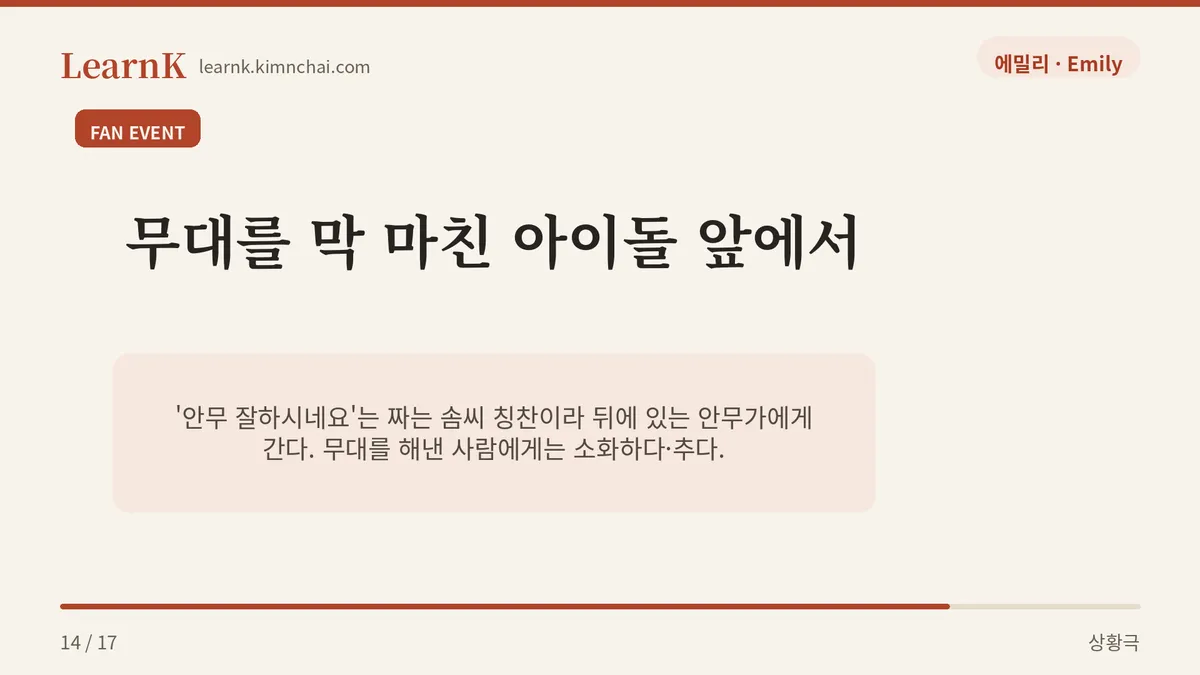
✗ (to an idol who has just finished a stage) 안무 진짜 잘하시네요! ✓ (to an idol who has just finished a stage) 안무 진짜 잘 소화하시네요! / 춤 진짜 잘 추세요! → ‘안무를 잘한다’ means you’re skilled at building dances, so the compliment goes not to the person on stage but to the choreographer behind them. For the person who pulled off the stage, 소화하다 or 추다 is the right verb.
Example Sentences by Situation
1) Three days before the talent show at a company workshop The person who took charge gathers the team in a meeting room and says this to take the pressure off. “이번 장기자랑 안무는 내가 짤게. 다들 여덟 박자만 외우면 돼.” (Ibeon janggijarang anmuneun naega jjalge. Dadeul yeodeol bakjaman oeumyeon dwae.) I’ll put the choreography together for the talent show. You all just need to memorize eight counts.
2) The day after your first concert, to a friend This is the very first thing that surprises someone who has only ever seen the stage on video and finally sees it in person. “오늘 직접 보니까 안무 동선이 생각보다 훨씬 넓더라.” (Oneul jikjeop bonikka anmu dongseoni saenggakboda hwolssin neopdeora.) Seeing it live today, the choreography covers way more of the stage than I thought.
3) Calling a dance studio for a consultation If you’re a learner traveling in Korea looking into a one-day class, this is a sentence you can use as is. “초보라 어려운 건 못 따라가는데, 안무를 천천히 끊어서 가르쳐 주시나요?” (Chobora eoryeoun geon mot ttaraganeunde, anmureul cheoncheonhi kkeuneoseo gareuchyeo jusinayo?) I’m a beginner and can’t keep up with hard routines — do you teach the choreography slowly, section by section?
Formal vs. Casual Speech, and Similar Expressions
안무 is a noun, so there’s no honorific level built into the word itself. The politeness level is decided by the predicate that follows. Casually it’s “안무 다 외웠어?”, and politely it’s “안무 다 외우셨어요?” That said, when addressing the person who built the dance for you, attaching 님 — as in 안무가님 (anmuganim) or 안무 선생님 (anmu seonsaengnim) — is basic practice-room etiquette.
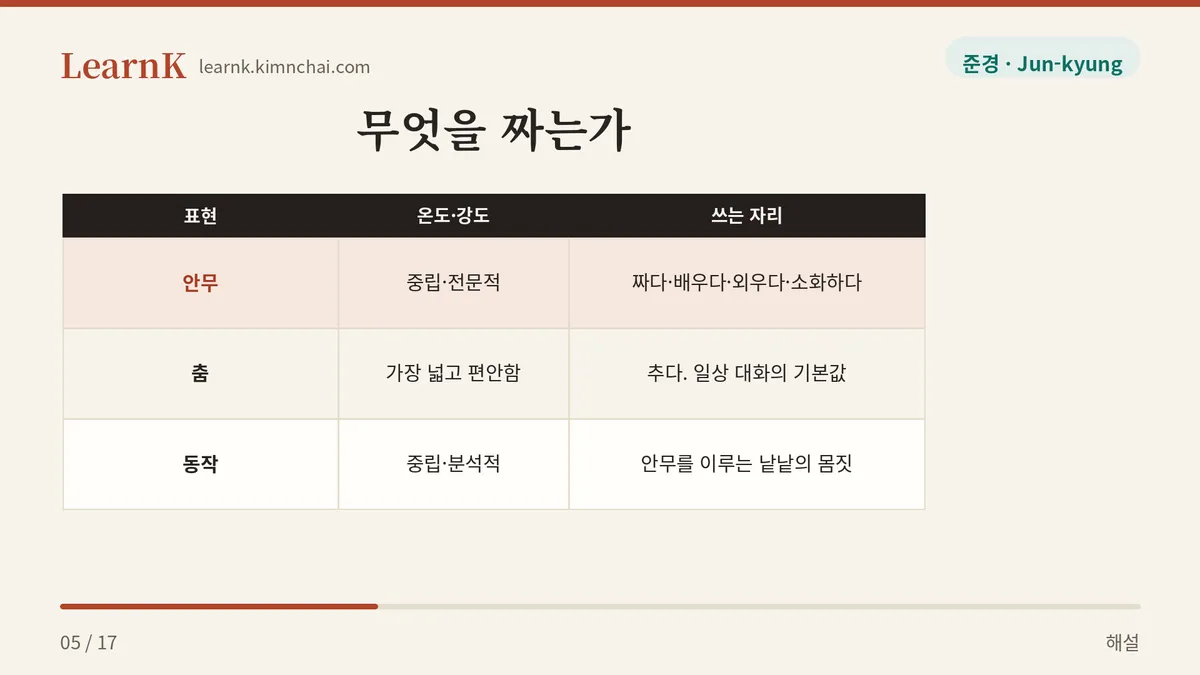
| Expression | Temperature / Intensity | Where it’s used |
|---|---|---|
| 안무 (anmu) | Neutral, professional | The work of building and teaching a dance. Practice rooms, stages, articles — anywhere |
| 춤 (chum) | Broadest and most comfortable | Dancing in general. The default in everyday conversation |
| 동작 (dongjak) | Neutral, analytical | The individual movements that make up choreography. “이 동작이 제일 어렵다” (this move is the hardest) |
| 퍼포먼스 (peopeomeonseu) | Big and formal | Singing, dancing, and staging taken as a whole. Reviews and articles |
| 칼군무 (kalgunmu) | Fandom vocabulary mixed with admiration | Group dance synced with knife-like precision. Communities and variety show subtitles |
Cultural Background — 칼군무 and 포인트 안무
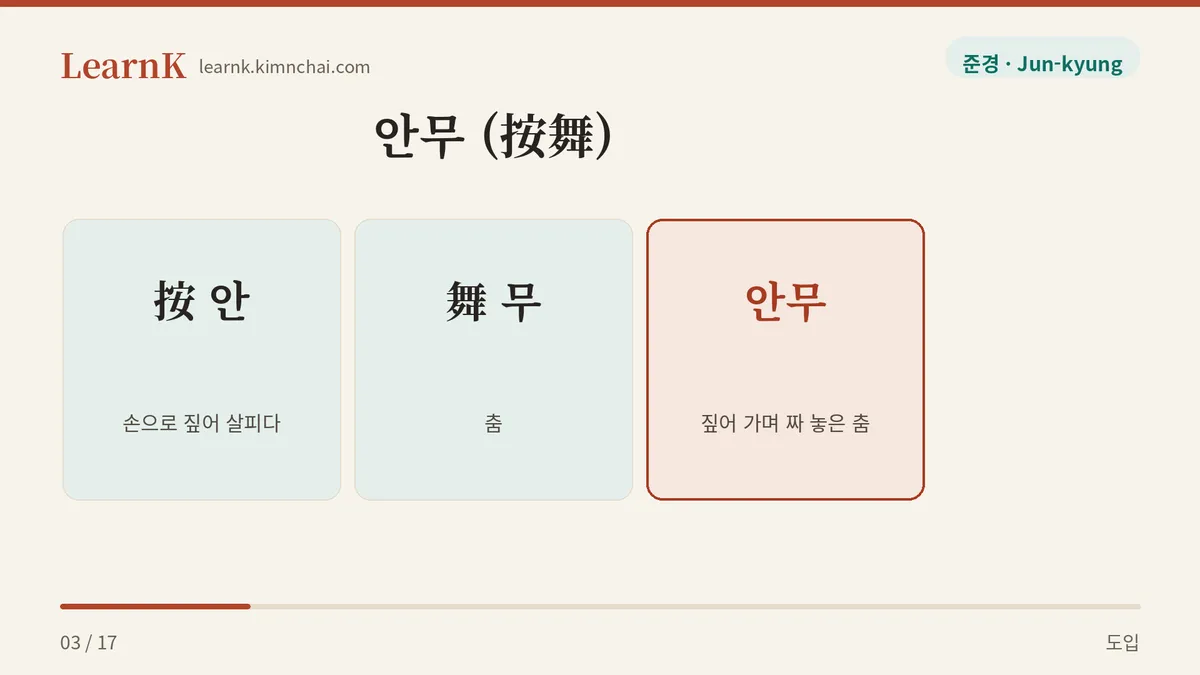
안무 is written in Chinese characters as 按舞. 舞 means dance and 按 means to press and examine with the hand, so the picture built into the word is one of building a dance by checking it over move by move. Branching off from this is 안무가 (anmuga), the person who does that work for a living.
In Korean popular music, choreography holds an unusually high status. The word 칼군무 (kalgunmu) is the proof. Take 군무 (gunmu, 群舞), dance performed as a group, and attach ‘칼’ (knife) in front, and you get a term for the state where many people’s fingertips and toes line up with knife-cut precision. Stage reviews in other countries tend to talk about individual expressiveness first, but Korean fans look first at whether all eight members’ angles match. The very standard for praise is different.
포인트 안무 (pointeu anmu) is another term coined and cemented in Korea. It refers not to the whole song but to a few seconds of the chorus — a signature move designed so that anyone can copy it. Most of what circulates as short-form challenges these days is this 포인트 안무. That’s why choreography teams now build dances in two layers from the start — the layer that eight people complete together on stage, and the layer that still looks good when one person copies it alone in a vertical phone screen.
The people who used to stand backstage stepping forward is another change of the last decade. In the past, a name would flicker by in a single line of credits; now dance crews and choreographers make their faces known on variety shows and YouTube, and build fanbases of their own. When a new song comes out, a separate choreographer interview goes up, and which move in the song grew out of which lyric becomes content in itself. The labor behind what the dictionary records as ‘creating or teaching’ has finally been given a name.
At the same time, choreography often becomes a site of controversy. It’s still not rare for a broadcaster’s review board to demand that some movements be changed, sending choreography back for revision right before a stage. The fact that audition programs about trainees repeatedly feature scenes of learning new choreography in a matter of days is also evidence of how heavily choreography is weighed in Korean pop music — as heavily as the song itself.
Today’s Quiz
Here’s someone asking a friend for a favor ahead of a cover dance competition. Which fits the blank best?
“이번 무대 ( ) 좀 짜 줄 수 있어? 나는 발이 안 따라와서.”
① 동작 ② 안무 ③ 칼군무 ④ 퍼포먼스
Answer: ② 안무
The word that pairs with ‘짜다’ is 안무. ① refers to individual movements, so it sounds awkward except in very narrow cases like “동작 하나만 짜 줘” (just build me one move). ③ is an admiring term for the result of many people syncing up, not something you build. ④ is a big word covering the whole stage, so “퍼포먼스를 준비한다” (prepare a performance) is more natural than “퍼포먼스를 짠다.”
Definitions and example sentences are from the National Institute of Korean Language’s Basic Korean Dictionary (krdict.korean.go.kr); that portion of this post, including our translations, is licensed under CC BY-SA 2.0 KR.