아쉽다 (aswipda) — Saying "the feeling of just barely missing out" in one word: Today's Korean Expression
On a Saturday morning you finally carve out some time — and of course, it starts pouring rain. You lose the concert ticket you waited months for, just one minute into the booking. The neighborhood bakery you walked past every day quietly closes down one day. In moments like these, there’s a word Koreans blurt out almost reflexively: 아쉽다 (aswipda).
This word isn’t about being angry, and it isn’t deep sadness either. It’s the feeling of lingering regret over something that slipped through your fingers by just a hair — a wish that it had been “just a little better” or “lasted just a little longer.” That’s why 아쉽다 (aswipda) comes up constantly in everyday life, yet it’s surprisingly tricky to capture with a single perfect English word.
아쉽다 (aswipda)
아쉽다 (aswipda) carries two broad shades of meaning.
First, when something is lacking or insufficient, leaving you unsatisfied. As in ‘끝마무리가 조금 아쉽다 (kkeummamuriga jogeum aswipda)’ — it pinpoints that feeling of something being not bad, but 2% short.
Second, when lingering attachment leaves you regretful and wistful. It’s the emotion that surfaces at a goodbye, a narrowly missed opportunity, or the end of a good time. In real conversation, this second use shows up far more often.
When pronouncing it, pay attention to the final consonant (받침, batchim). 아쉽다 (aswipda) sounds close to [아쉽따 (aswiptta)], while the conjugated forms 아쉬워요 (aswiwoyo) and 아쉬워 (aswiwo) link the sounds together smoothly.
Checking with the National Institute of Korean Language Dictionary
First, let’s look at the definition from an authoritative dictionary.
아쉽다 (aswipda) (adjective)
- Not satisfactory because something needed is absent or insufficient. (lacking)
- Feeling regretful and wistful because lingering attachment remains. (being a pity) — National Institute of Korean Language, Basic Korean Dictionary (krdict.korean.go.kr)
The second meaning has been rendered into several languages like this:
[ja] みれんがましい・おしい・ざんねんだ / [zh] 可惜,舍不得,依依不舍 / [es] apenado — National Institute of Korean Language, Basic Korean Dictionary (krdict.korean.go.kr)
Let’s also look at the actual example sentences listed in the dictionary.
네가 더 높이 뛸 수 있었는데 아쉽다. (It’s a shame — you could have jumped even higher.) — National Institute of Korean Language, Basic Korean Dictionary (krdict.korean.go.kr)
→ A situation where the other person could easily have done better but didn’t. It carries the wistful sense of “with your ability, you would have made it.”
학교를 졸업하려니 학교 생활을 같이한 친구들과 헤어지는 것이 아쉽다. (Now that I’m about to graduate, it’s hard to part with the friends I shared school life with.) — National Institute of Korean Language, Basic Korean Dictionary (krdict.korean.go.kr)
→ Even in the face of something good like graduation, a lingering attachment remains because the shared time is coming to an end — a classic scene.
그러게. 겨우 일 점 차이로 꺾여서 더 아쉽다. (I know. Losing by just one point makes it even more of a shame.) — National Institute of Korean Language, Basic Korean Dictionary (krdict.korean.go.kr)
→ When you lose a sports match by a razor-thin margin. Because you nearly won, the 아쉬움 (aswium) stings all the more.
내가 휴가를 낼 수 있었으면 여기에 며칠 더 머무르련만 그러지 못해 아쉽다. (If I could take time off, I’d stay here a few more days, but I can’t, and that’s a pity.) — National Institute of Korean Language, Basic Korean Dictionary (krdict.korean.go.kr)
→ The wistfulness you feel at a travel destination when you want to stay longer but circumstances won’t allow it.
(The Portuguese definition isn’t listed in this dictionary. For reference, the closest rendering would be something like ‘que pena / ser uma pena’ — note that this part is our own translation, not dictionary material.)
Seeing It in Real Conversation
Situation: In front of an apartment complex. Emily has decided to sell the film camera she’s used for years, and she and Jun-kyung are waiting for the buyer who’s coming to pick it up.
Jun-kyung: 이거 진짜 팔 거야? 너 이 카메라 끔찍이 아끼잖아. You’re really selling this? You cherish this camera so much.
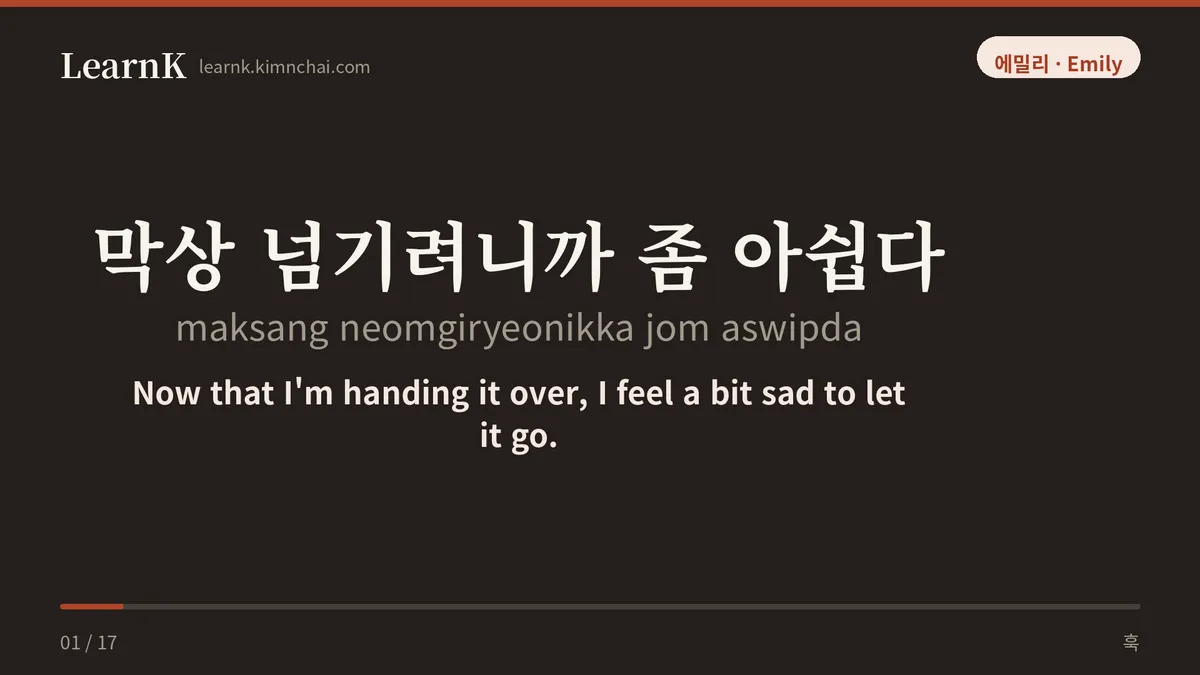
Emily: 어… 그니까. 막상 넘기려니까 좀 아쉽다. Yeah… I know. Now that I’m actually handing it over, I feel a bit sad to let it go.
Jun-kyung: 그럼 그냥 갖고 있지 그랬어. Then you should’ve just kept it.
Emily: 안 써서 서랍에만 처박혀 있는데 뭐. 근데 첫 배낭여행 때부터 같이한 거라 그런가, 자꾸 눈에 밟혀. It just sits in a drawer unused. But maybe because it’s been with me since my first backpacking trip, I keep thinking about it.
Jun-kyung: 사진 많이 찍었겠다. You must’ve taken a lot of photos with it.
Emily: 응. 필름값 아까워서 한 컷 한 컷 신중하게 찍었지. 요즘은 폰으로 막 찍고 막 지우잖아. 그게 좀 아쉬워. Yeah. Film was expensive, so I took each shot carefully. These days we just snap and delete on our phones. That part feels like a bit of a loss.
Jun-kyung: 하긴, 아무 때나 찍으니까 오히려 기억엔 안 남더라. True — since we shoot anytime, somehow less of it actually sticks.
Emily: 그치? …아, 저기 오시나 봐. 새 주인이 잘 써 줬으면 좋겠다. Right? …Oh, I think that’s them. I hope the new owner uses it well.
Here, 아쉽다 (aswipda) precisely captures the lingering feeling of “handing over the object while your heart stays behind.” It’s not anger or regret — it’s the warmth of parting with something you loved.
Example Sentences by Situation (our own sentences)
1) A narrowly missed opportunity — when you couldn’t quite nail the last question in an interview: 답변은 다 좋았는데 마지막에 너무 긴장해서 아쉬웠어요 (aswiwosseoyo). (Everything went well, but I got too nervous at the end — what a shame.)
2) The end of a good time — at the airport on the last day of a trip: 벌써 돌아갈 시간이라니, 하루만 더 있었으면 좋겠는데 아쉽네요 (aswimneyo). (Time to head back already — I wish we had one more day. It’s a pity.)
3) When it’s 2% short — when you sought out a hyped restaurant but it turned out more ordinary than expected: 맛은 괜찮았는데 그 가격이면 좀 아쉽다. (The taste was fine, but for that price it’s a little underwhelming.)
Comparing Formal/Informal Speech and Similar Words
The same emotion takes different forms depending on who you’re talking to.
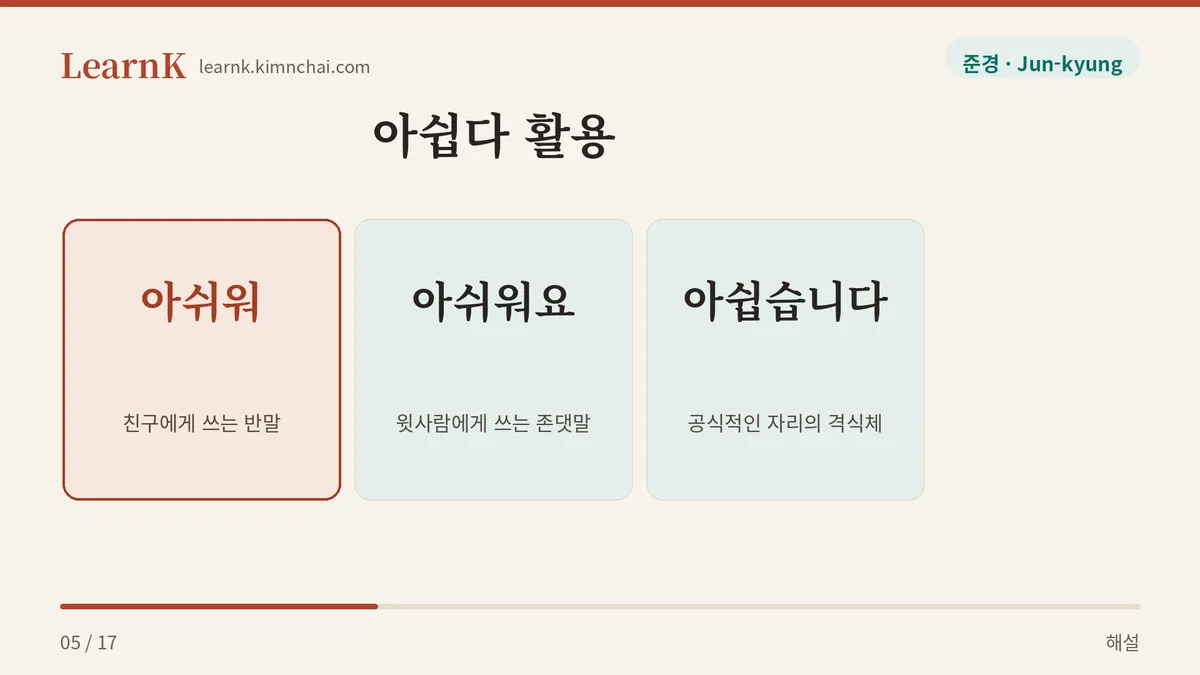
- Informal (반말, banmal): 아쉬워 (aswiwo) / 아쉽다 (aswipda) — with friends or people you’re close to.
- Polite (존댓말, jondaenmal): 아쉬워요 (aswiwoyo) / formal 아쉽습니다 (aswipseumnida) — with elders or in official settings.
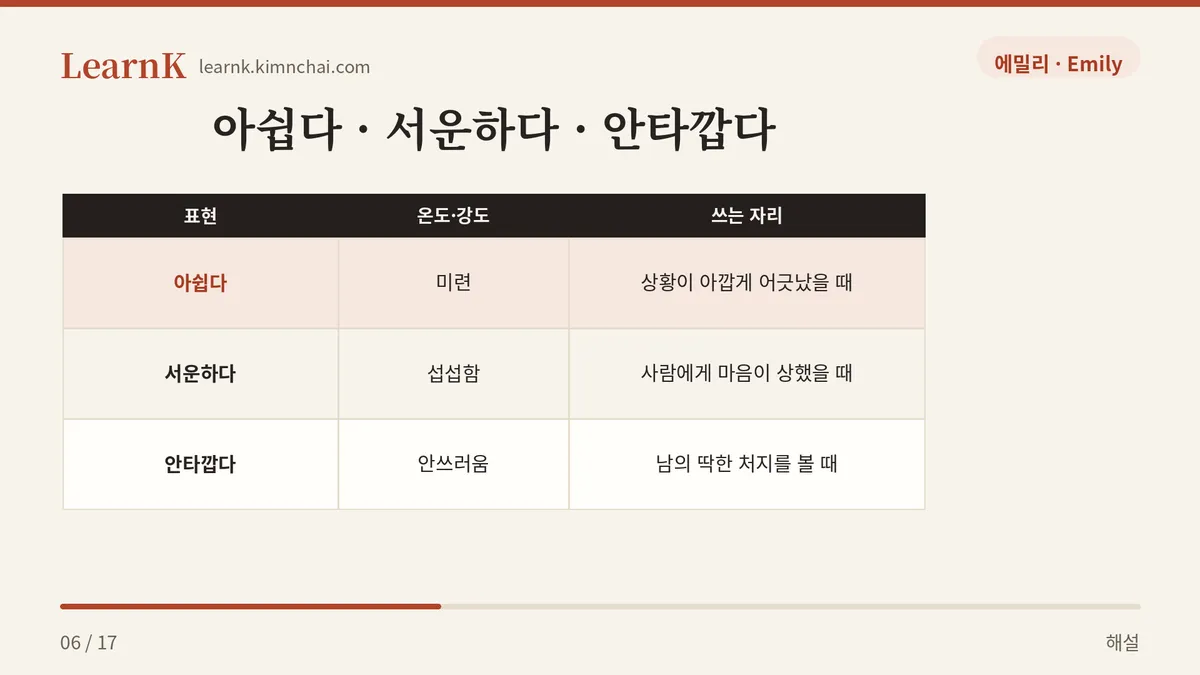
Let’s also sort out some similar words that are easy to mix up.
- 안타깝다 (antakkapda): an emotion felt mainly when watching someone else’s unfortunate situation. If 아쉽다 (aswipda) is about “my own lingering attachment,” 안타깝다 (antakkapda) leans more toward “feeling for someone else.”
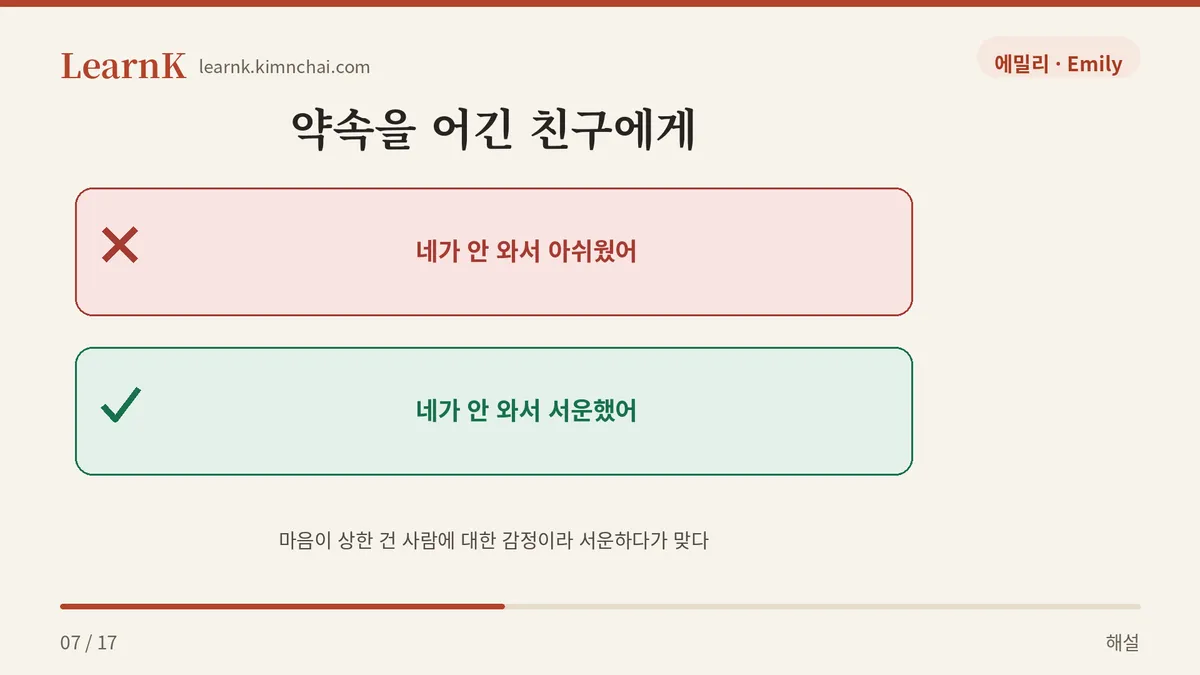
- 서운하다 (seounhada) / 섭섭하다 (seopseopada): closer to the hurt you feel from another person — that is, disappointment in a relationship. ‘네가 안 와서 서운했어 (nega an waseo seounhaesseo)’ is a relationship issue, while ‘네가 못 와서 아쉬웠어 (nega mot waseo aswiwosseo)’ is a situational one.
‘아쉽다’ in K-Dramas, and in Daily Life
In Korean dramas, the moment 아쉽다 (aswipda) shines brightest is always “on the threshold of a goodbye.” Picture two people who’ve been together a long time parting at an airport or a bus stop — instead of a long explanation, one of them just tosses out a single ’…아쉽네요 (aswimneyo).’ The scene falls quiet, and everything left unsaid is packed into that one word. (Rather than quoting a specific line verbatim, we’re introducing it through the situation.)
It’s the same in everyday life. When a company dinner wraps up — ‘벌써 가시게요? 아쉽네요 (beolsseo gasigeyo? aswimneyo)’; when relatives head home after a holiday — ‘더 있다 가시지, 아쉽다 (deo itda gasiji, aswipda)’ — in Korea, 아쉽다 (aswipda) follows farewell greetings almost like a courtesy. If you can use this one word naturally, your Korean has already stepped beyond the textbook and into “real conversation.”
Today’s Quiz
Your friend missed the score they wanted on a test by just one point. Which line fits this situation best?
① 축하해! (Congratulations!) ② 겨우 1점 차이라니, 진짜 아쉽다. (Just one point off — what a shame.) ③ 네가 안 도와줘서 서운해. (I’m hurt that you didn’t help me.)
(The answer is ②. The lingering feeling of missing out by a hair’s breadth — exactly where 아쉽다 (aswipda) belongs. The 서운하다 (seounhada) in ③ is an emotion felt toward a person, so it doesn’t fit here.)
Definitions and example sentences are from the National Institute of Korean Language’s Basic Korean Dictionary (krdict.korean.go.kr); that portion of this post, including our translations, is licensed under CC BY-SA 2.0 KR.