벚꽃 (Beotkkot) — The One Word the Whole Country Waits for When Spring Arrives

When spring comes, there’s a word that shows up in Korean conversations without fail. It’s 벚꽃 (beotkkot) — cherry blossoms. Once late March rolls around, every news broadcast reports that “the cherry blossoms have started blooming, beginning in the south,” and before people make weekend plans, the first thing they check is the bloom timing. Today we’ll take a deep look at this word, which is inseparable from the idea of travel.
벚꽃
벚꽃 (beotkkot) refers to the pale pink or white flowers that bloom on cherry trees in spring. But in Korea, this word isn’t just the name of a flower. It’s a signal that “spring is finally here,” and it also carries the bittersweet feeling of “it’s now or never.” Because cherry blossoms fall within a week to ten days of fully blooming, people deliberately make time so they won’t miss that brief peak. That’s why 벚꽃 pairs so well with the category of “travel” — going to see the cherry blossoms becomes a spring trip in itself.
The pronunciation is close to [벋꼳]. Because of the final consonants (받침), it comes out a little clipped and clustered rather than being read letter by letter.
Checking the National Institute of Korean Language Dictionary
The National Institute of Korean Language’s Basic Korean Dictionary (《한국어기초사전》) defines 벚꽃 like this:
벚꽃 (noun): A pale pink or white flower that blooms on a cherry tree in spring. [en] cherry blossom — A pale pink or white flower, blooming from a cherry tree in spring. [ja] 桜(さくら)— 春、桜の木に咲く薄い桃色や白色の花。 [es] flor del cerezo — Flor del cerezo de color blanco o rosado claro que florece en la primavera. [zh] 樱花 — 春天樱花树上开的浅粉色或白色的花朵。 — National Institute of Korean Language, Basic Korean Dictionary (krdict.korean.go.kr)
(The Portuguese has no translation in the dictionary, so we’ve supplied our own: flor de cerejeira — flor rosa-clara ou branca que desabrocha da cerejeira na primavera. This sentence is our own translation, not a dictionary quotation.)
Let’s also look at some real usage examples from the dictionary.
올해 벚꽃 축제가 왜 미뤄진 거야? 비가 많이 내려서 벚꽃의 개화 시기가 늦춰졌대. — National Institute of Korean Language, Basic Korean Dictionary (krdict.korean.go.kr)
This is a conversation between friends about the schedule of a cherry blossom festival. The idea that the 개화 시기 (gaehwa sigi, the time when the flowers bloom) got pushed back because of the weather is the kind of talk that really does go around every spring.
오늘 뉴스를 보니까 다음 주가 벚꽃이 절정으로 개화하는 주간이래. — National Institute of Korean Language, Basic Korean Dictionary (krdict.korean.go.kr)
Notice the word 절정 (jeoljeong, the state of being in fullest bloom). Cherry blossoms have such a short peak that people count down the days to this “peak week.”
학생들은 점심시간에 벚꽃이 핀 교정을 산책했다. — National Institute of Korean Language, Basic Korean Dictionary (krdict.korean.go.kr)
You don’t have to travel far to a festival — cherry blossoms bloom everywhere: at schools, at workplaces, along neighborhood streets. Here’s a scene of soaking up spring just by taking a short walk during a lunch break.
벚꽃이 참 흐드러지게 피었구려. — National Institute of Korean Language, Basic Korean Dictionary (krdict.korean.go.kr)
흐드러지게 (heudeureojige) is a lovely adverb meaning “in full, overflowing bloom.” The old-fashioned ending -구려 gives it the feel of an admiring remark from an elderly person.
Seeing It in a Real Conversation
Scene: A Saturday afternoon in early April, on Yunjung-ro in Yeouido. It’s the weekend when the cherry blossoms are at their peak, so the crowds leave barely any room to stand.
Jun-kyung: 와, 올해 벚꽃 제대로 폈다. 타이밍 기가 막히게 잘 왔네. Wow, the cherry blossoms bloomed properly this year. Our timing is incredible.
Emily: 그러니까. 나 어제 뉴스 봤는데 이번 주가 절정이래. 안 왔으면 후회할 뻔했어. Right? I saw the news yesterday — this week is the peak. I almost would’ve regretted not coming.
Jun-kyung: 근데 사람이 왜 이렇게 많아… 사진 한 장 찍기가 힘드네. But why are there so many people… it’s hard to even take a single photo.
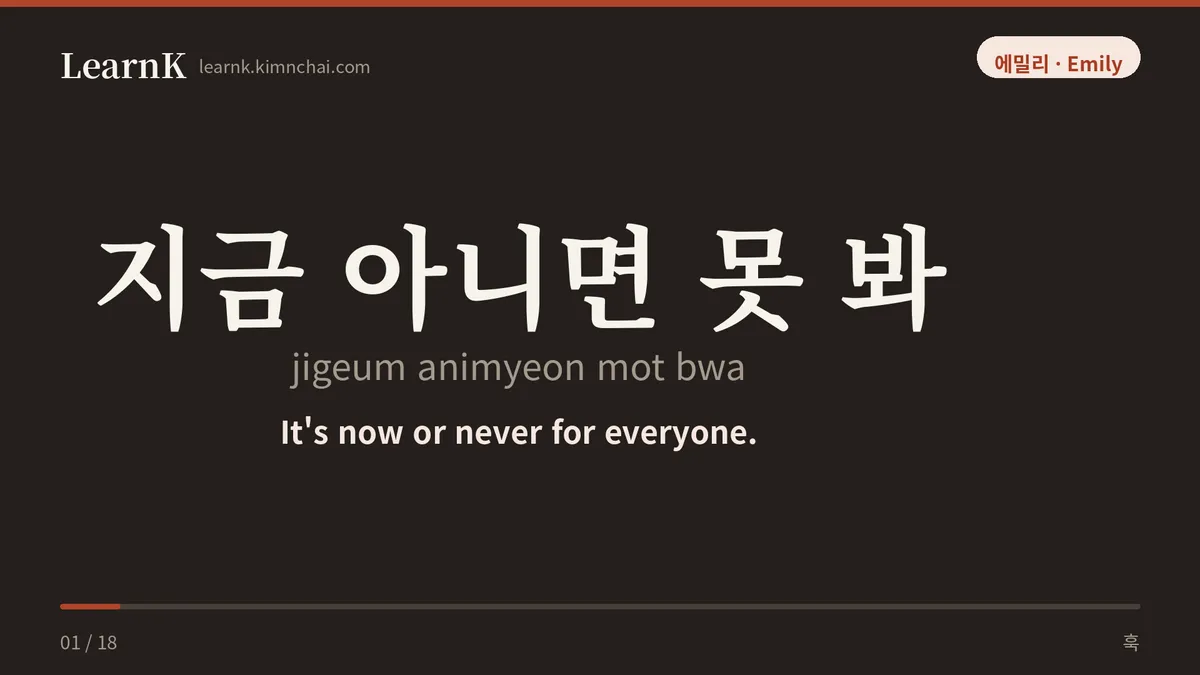
Emily: 원래 벚꽃 필 때 다 몰리잖아. 잠깐 피고 지니까 다들 지금 아니면 못 봐. Cherry blossoms always draw crowds when they bloom. They bloom briefly and fall, so it’s now or never for everyone.
Jun-kyung: 하긴, 비 한 번 오면 다 떨어지니까. 저기 나무 밑에서 한 장 찍자. True — one rain and they all fall. Let’s take a shot under that tree over there.
Emily: 좋아. 꽃잎 날릴 때 딱 맞춰 찍으면 진짜 예쁘겠다. Sounds good. It’ll look gorgeous if we time it right as the petals fall.
Example Sentences by Situation
1. When suggesting a trip “이번 주말에 벚꽃 (beotkkot) 보러 진해 갈까? 지금이 딱 절정이래.” → This is a situation where you’re suggesting a day trip to Jinhae, famous as a cherry blossom hotspot. 보러 가다 means to travel somewhere for the purpose of seeing something.
2. When expressing disappointment “어제 비 와서 벚꽃 (beotkkot) 다 졌어. 올해는 그냥 놓쳤네.” → This is the disappointment of having missed the peak. 지다 means for a flower to wither and fall — it’s the opposite of 피다 (to bloom).
3. When suggesting a photo “저기 벚꽃 (beotkkot) 나무 밑에 서 봐. 내가 예쁘게 찍어 줄게.” → Taking a keepsake photo under fully bloomed cherry blossoms — a very common springtime scene in the park.
Polite/Casual Speech and Similar Expressions
벚꽃 itself is a noun, so it has no separate polite or casual form, but within a sentence it changes to fit the situation.
- Casual: “벚꽃 보러 갈래?” (beotkkot boreo gallae?)
- Polite: “벚꽃 보러 가실래요?” (beotkkot boreo gasillaeyo?)
Here are some easily confused neighboring words, sorted out for you.
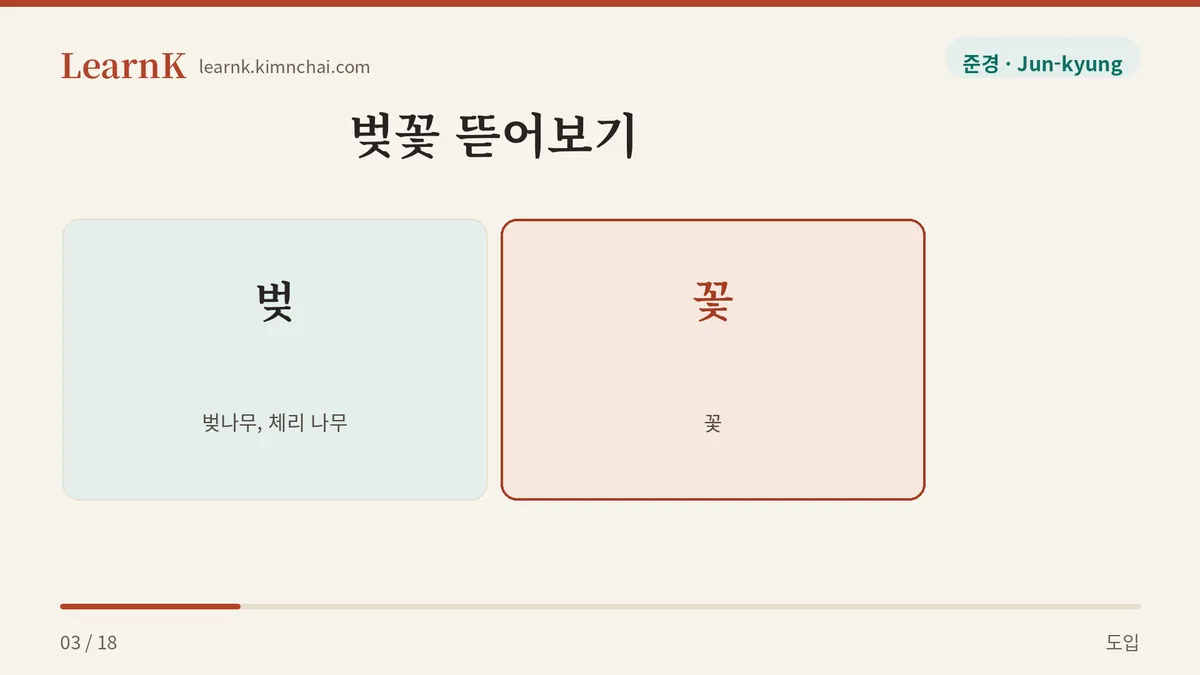
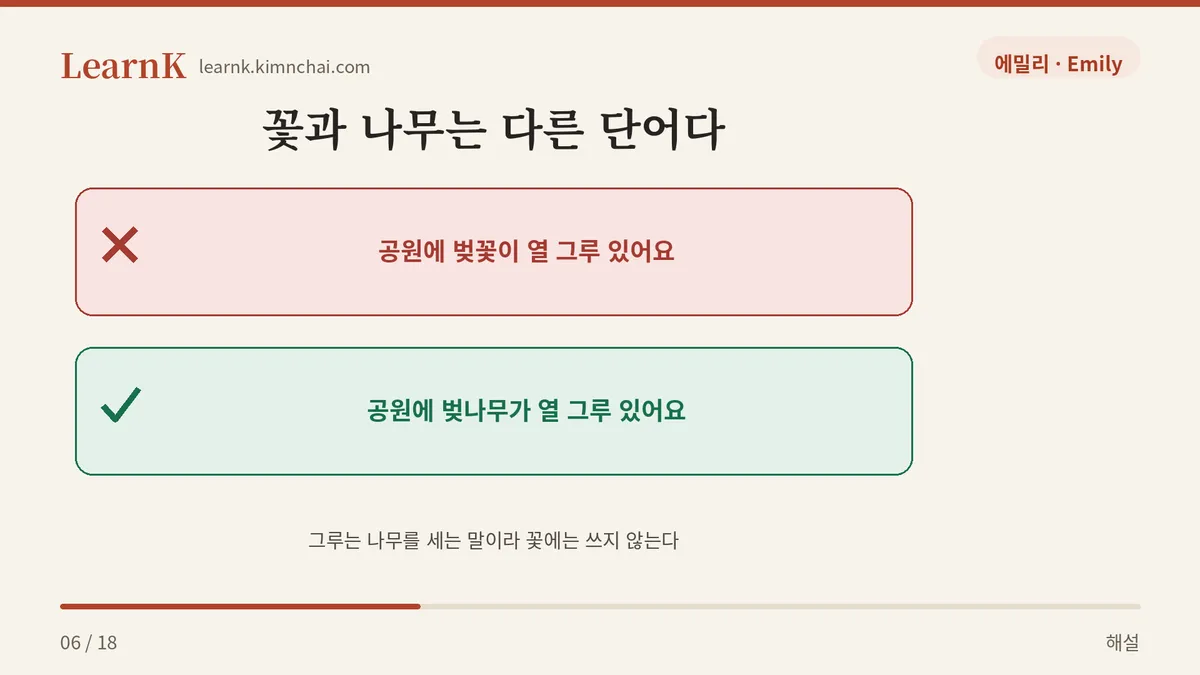
- 벚나무 (beotnamu): The tree itself, on which the flowers bloom. The flower is 벚꽃, the tree is 벚나무.
- 꽃구경 (kkotgugyeong): A spring outing to enjoy the cherry blossoms. “꽃구경 가자” (Let’s go flower-viewing) sounds very natural.
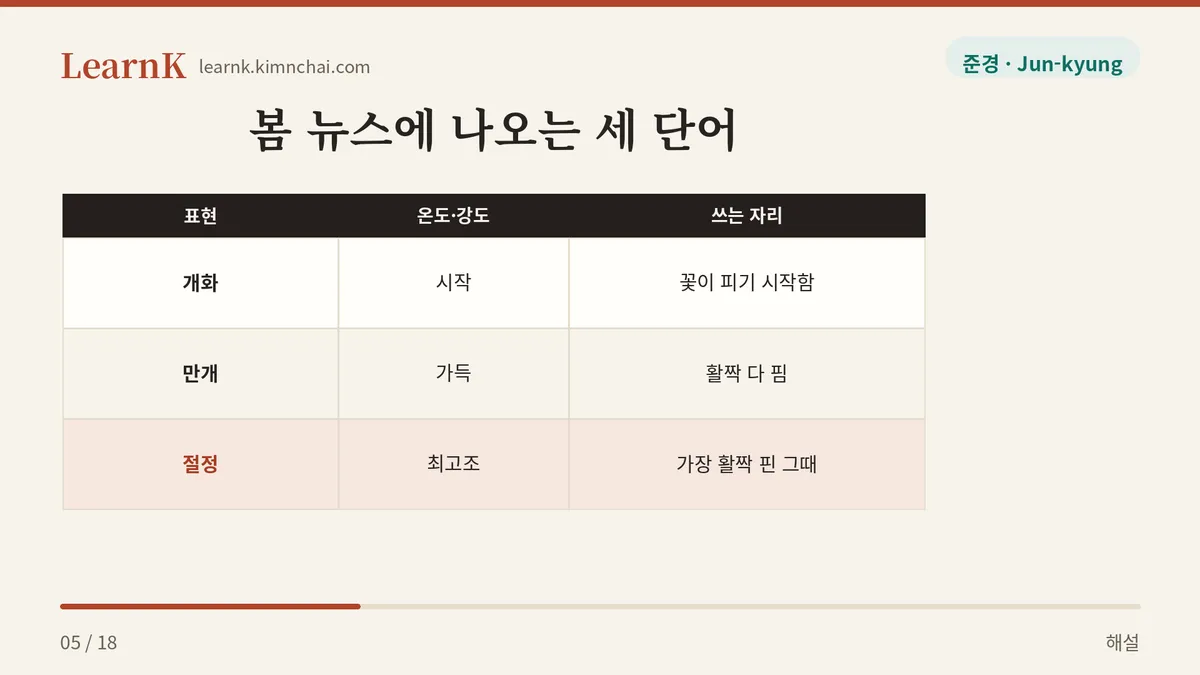
- 개화 (gaehwa) · 만개 (mangae) · 절정 (jeoljeong): Respectively, “the flowers blooming,” “in full bloom,” and “reaching the very peak.” These are words that appear as-is in weather forecasts.
Cultural Background — When Spring Comes
In Korea, cherry blossom season is practically a nationwide event. With festivals like the Jinhae Gunhangje and the Yeouido Spring Flower Festival, a single flower gets entire cities buzzing, and people follow the bloom forecast just like the weather forecast.
There’s even a song that naturally comes to mind on the streets in spring. Busker Busker’s 〈벚꽃 엔딩〉 (“Cherry Blossom Ending”) sings of the longing to walk together on a spring night as the cherry blossoms flutter down, and it climbs back up the charts every spring — so much so that it’s nicknamed the “cherry blossom pension” (a steady seasonal payout). (Rather than quoting the lyrics, we’re just describing the mood of the song.)
Cherry blossom paths are a staple backdrop in dramas, too. The scene where the two leads walk side by side down a path of drifting blossoms and confirm their feelings tends to capture the emotion that this very moment is precious — just like a flower that blooms and falls so quickly.
Closing Quiz
A friend says, “이번 주가 벚꽃 ○○이래, 지금 안 가면 다 져!” (This week is the ○○ of the cherry blossoms — if you don’t go now, they’ll all fall!). What’s the two-syllable word that fills the blank ○○, meaning “the state of fullest bloom”?
See the answer
It’s 절정 (jeoljeong). You’d use it like “이번 주가 벚꽃 절정이래” (This week is the peak of the cherry blossoms). 만개 (mangae) has a similar meaning and can be swapped in naturally as well.
Definitions and example sentences are from the National Institute of Korean Language’s Basic Korean Dictionary (krdict.korean.go.kr); that portion of this post, including our translations, is licensed under CC BY-SA 2.0 KR.