비빔밥 (bibimbap) — Korea's Rice, All Mixed Together in One Bowl

When you sit down at a Korean restaurant, open the menu, and have no idea what to order, there’s one choice with the lowest chance of going wrong. It’s that dish that comes out as rice topped with colorful namul (seasoned vegetables), meat, and egg, which you mix up with a good scoop of red gochujang before eating. Today’s expression is what you could call the face of Korean food: 비빔밥 (bibimbap).
비빔밥
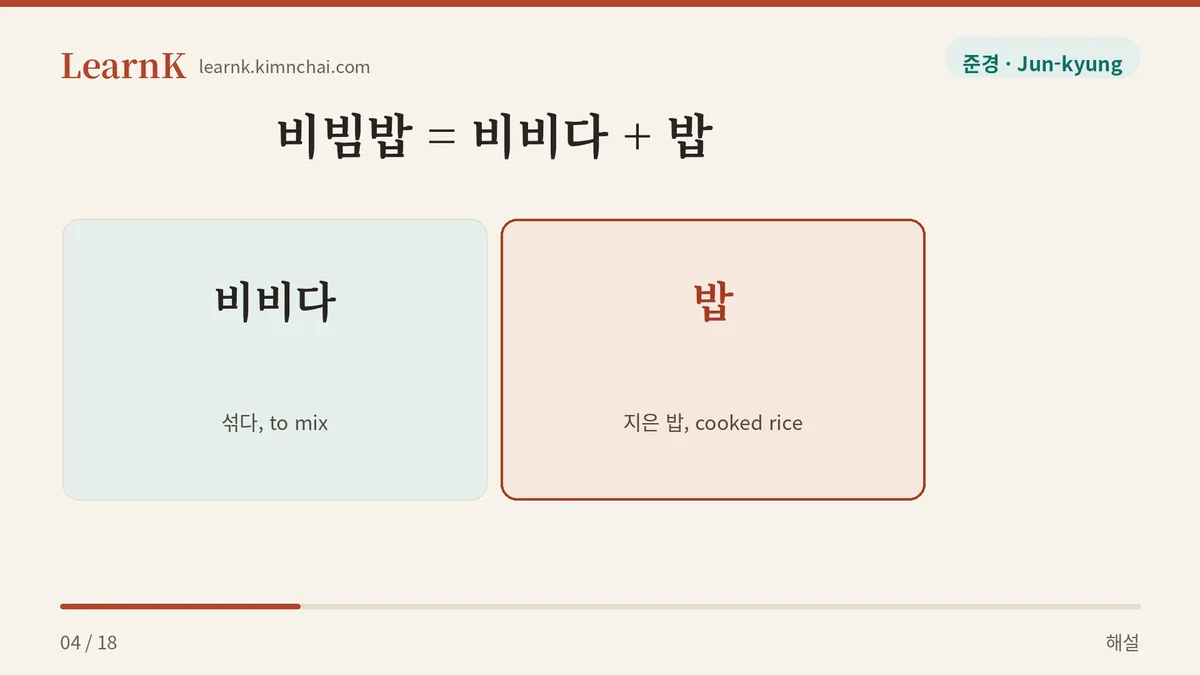
비빔밥 (bibimbap) is made from the verb ‘비비다 (bibida, to mix)’ plus ‘밥 (bap, rice).’ It literally means ‘rice you mix and eat.’ It’s a wonderfully practical yet harmonious dish where you pile a bunch of different ingredients onto a single bowl of rice and mix it all together with seasoning.
Here’s a fun fact: bibimbap actually started out as ‘the wisdom of using up leftover side dishes.’ When you have little bits of various namul left in the fridge, instead of throwing them away, you can toss them all onto some rice, mix, and end up with a fantastic meal. That’s why bibimbap carries a certain feeling — ‘don’t waste what’s still good, and let different ingredients come together in harmony in one bowl.‘
Checking the National Institute of Korean Language Dictionary

The National Institute of Korean Language’s Basic Korean Dictionary explains bibimbap like this:
비빔밥 (noun): Rice topped with sliced meat, mushrooms, eggs, namul, seasoned vegetables, some seasonings, etc., of which all the ingredients are stirred before eating. [en] bibimbap — Rice topped with sliced meat, mushrooms, eggs, namul, seasoned vegetables, some seasonings, etc., of which all the ingredients are stirred before eating. [ja] ビビンバ — ご飯に肉とキノコ、卵、ナムルなどの具を入れ、色々な調味料と共によく混ぜて食べる料理。 [es] bibimbap — Plato de arroz con carne, huevo, hongos, una variedad de verduras y diferentes condimentos encima, para mezclar antes de servirse. [zh] 拌饭 — 在肉丝、蘑菇、鸡蛋、拌菜等材料中加入各种调料后拌着吃的饭。 — National Institute of Korean Language, Basic Korean Dictionary (krdict.korean.go.kr)
The Portuguese translation isn’t included in the dictionary, so we’ve translated it ourselves for reference (our own translation): bibimbap — Prato de arroz coberto com carne, cogumelos, ovo e legumes temperados (namul), tudo misturado antes de comer.
The dictionary also comes with real usage examples. Let’s look at a few of them exactly as they appear in the original.
엄마는 밥과 반찬을 한 그릇에 같이 섞어 비빔밥을 만들어 주셨다. — National Institute of Korean Language, Basic Korean Dictionary (krdict.korean.go.kr)
This is the most heartwarming scene — a mother at home making bibimbap out of leftover side dishes. It’s a sentence that shows exactly where bibimbap comes from.
밥 위에 고사리 등 여러 가지 나물을 얹어 비빔밥을 만들었다. — National Institute of Korean Language, Basic Korean Dictionary (krdict.korean.go.kr)
This example captures the cooking process — ‘placing (얹어)’ various namul like bracken (gosari), spinach, and bean sprouts on top of the rice. It shows just how important namul is as an ingredient in bibimbap.
비빔밥이 싱거워서 고추장을 더 넣어서 비벼 먹었다. — National Institute of Korean Language, Basic Korean Dictionary (krdict.korean.go.kr)
This is a very realistic mealtime scene — adding more gochujang to adjust the flavor when it’s a bit bland. The seasoning of bibimbap is mostly determined by gochujang.
여기는 비빔밥이 아주 기막히게 맛있어요. — National Institute of Korean Language, Basic Korean Dictionary (krdict.korean.go.kr)
This is a sentence you’d use to recommend a great restaurant. You can feel the admiration in the word ‘기막히게 (gimakhige, incredibly).’
Seeing It in a Real Conversation
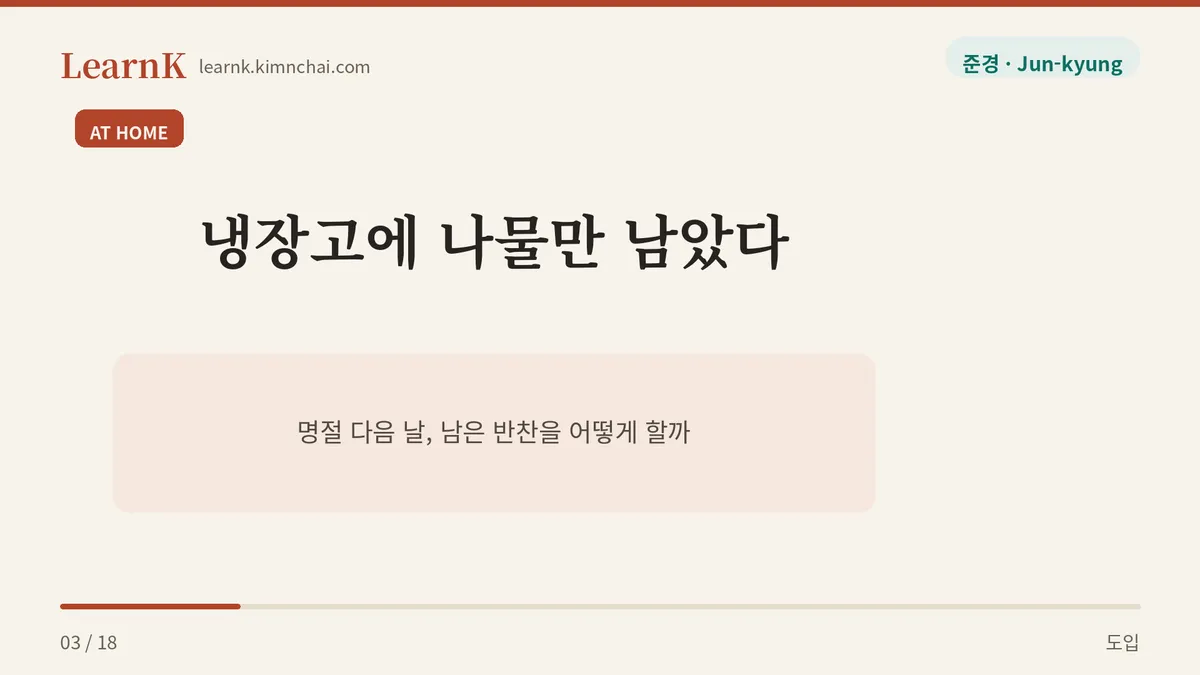
Scene: The morning after Chuseok. The holiday feast is over, and the fridge is packed with nothing but leftover namul side dishes.
Jun-kyung: 에밀리야, 이 나물들 이거 다 어떡하냐. 냉장고 터지겠어. Emily, what are we gonna do with all this namul? The fridge is about to burst.
Emily: 그걸 뭘 고민해. 다 넣고 비빔밥 해 먹으면 되지. What’s there to think about? Just throw it all in and make bibimbap.
Jun-kyung: 오, 역시. 고추장 많이 넣어서 맵게 비빌까? Oh, right. Should we mix in a lot of gochujang and make it spicy?
Emily: 당연하지. 참기름도 한 바퀴 두르고, 계란 프라이 딱 하나 올리면 끝이야. Of course. Drizzle some sesame oil too, top it with a fried egg, and it’s done.
Jun-kyung: 야, 너 진짜 한국 사람 다 됐다. Wow, you’ve completely become Korean.
Emily: 15년인데 이 정도는 해야지. 자, 큰 그릇 줘 봐. 비빔밥은 넉넉한 그릇에 비벼야 제맛이야. It’s been 15 years, I should manage at least this much. Here, hand me a big bowl. Bibimbap only tastes right when you mix it in a roomy bowl.
Example Sentences for Different Situations
So you can try using it yourself, we’ve made a few example sentences based on real situations.
-
When ordering at a restaurant: 돌솥비빔밥 하나 주세요. (dolsotbibimbap hana juseyo.) This is the most basic sentence for ordering bibimbap that comes served in a hot stone pot.
-
When suggesting something to a friend: 점심 뭐 먹지? 그냥 비빔밥 먹을까? (jeomsim mwo meokji? geunyang bibimbap meogeulkka?) This is an expression for suggesting bibimbap as a safe, filling option when you’re unsure what to eat.
-
When adjusting the flavor: 좀 싱거우면 고추장 더 넣어서 비벼 봐. (jom singeoumyeon gochujang deo neoheoseo bibyeo bwa.) As we saw in the dictionary examples, adding more gochujang when it’s under-seasoned is the Korean-style solution.
Polite Form, Casual Form, and Similar Expressions
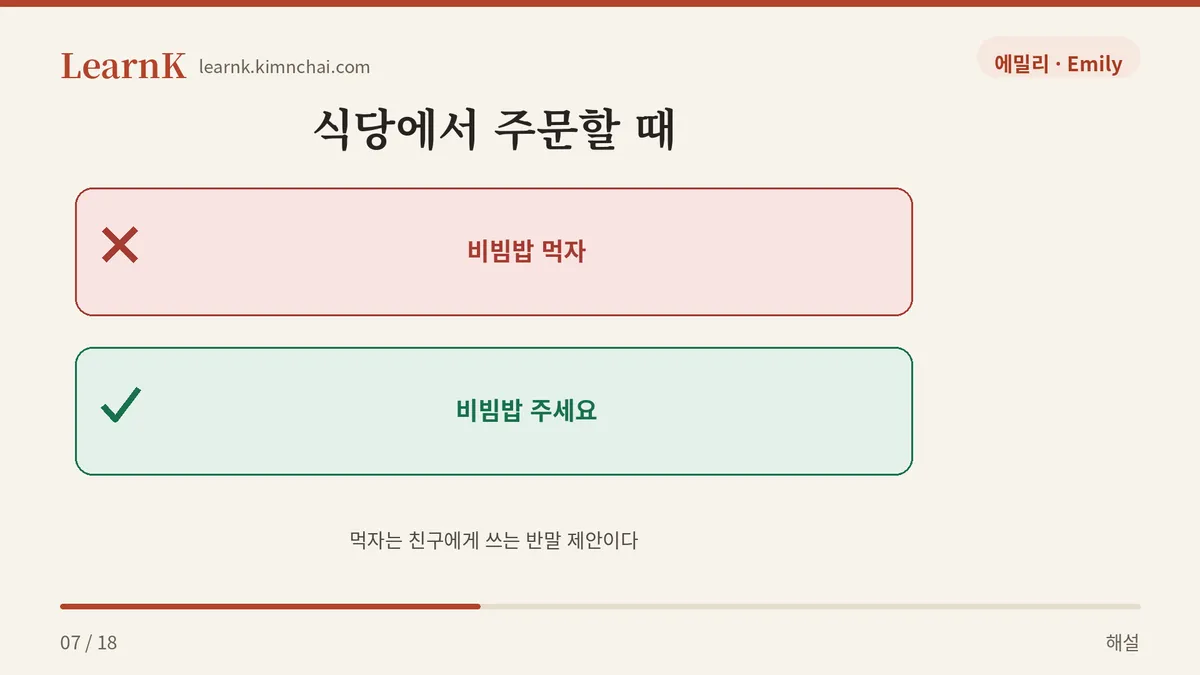
Since ‘비빔밥’ is the name of a food (a noun), the word itself doesn’t have separate polite or casual forms — but the difference shows up in the sentences you use to order it. At a restaurant you’d speak politely, as in 비빔밥 주세요 (bibimbap juseyo), and among friends you’d speak casually, as in 비빔밥 먹자 (bibimbap meokja).
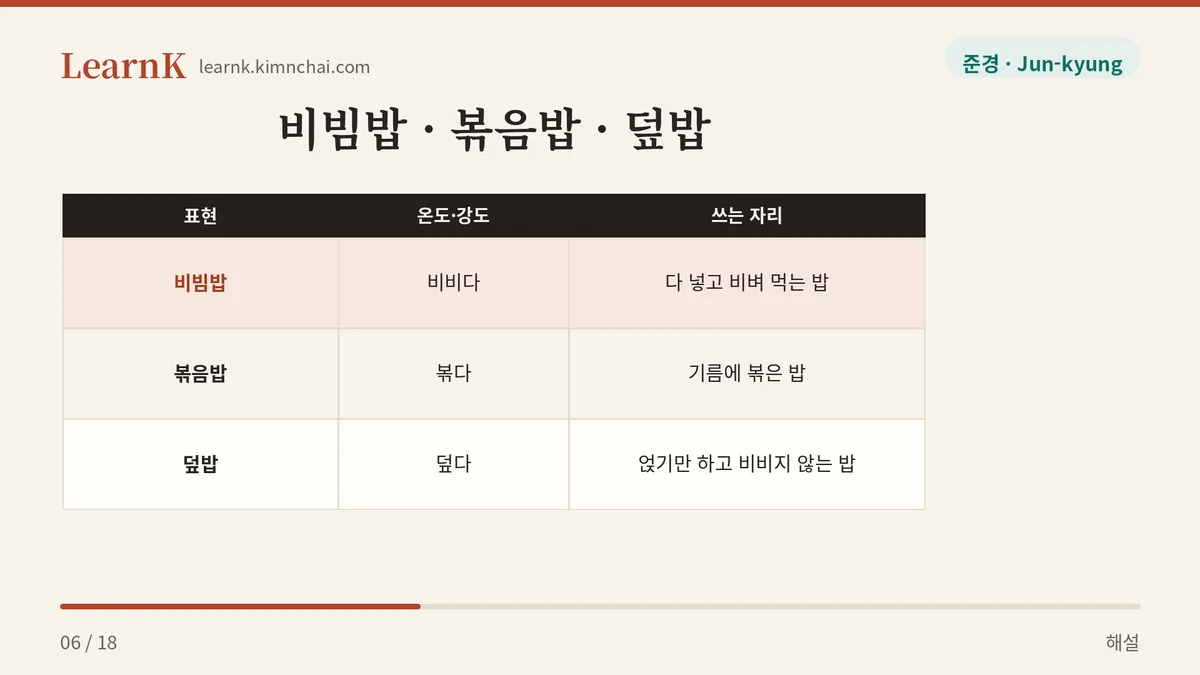
It’s also good to learn some similar but different food names. 볶음밥 (bokkeumbap) is rice that’s been ‘stir-fried (볶은)’ in oil, and 덮밥 (deopbap) is rice with side dishes ‘draped (덮어)’ on top but not mixed in. All three end in ‘밥 (bap, rice),’ but the verb in front (비비다 mix · 볶다 stir-fry · 덮다 cover) tells you exactly how it’s cooked. By the way, the imperative form of ‘비비다,’ namely 비벼 (bibyeo) — as in “잘 비벼 먹어 (mix it up well before you eat)” — is an expression that always travels together with bibimbap.
Cultural Background
Jeonju bibimbap is especially famous, and dolsot bibimbap — served in a hot stone pot where the rice turns golden and crispy on the bottom — is popular too. Thanks to its symbolism of many ingredients coming into harmony in one bowl, bibimbap is a regular feature on international flight meals and at events introducing Korean cuisine.
Bibimbap also shows up often in Korean dramas and variety shows. In particular, the scene where a family dumps holiday food or leftover side dishes into a big basin (양푼, yangpun) and everyone gathers around to mix and eat it together really captures the spirit of the Korean table — sharing 정 (jeong, warm affection) over formality. It’s good on its own, but bibimbap becomes most truly itself when it’s mixed in a big bowl and shared.
Closing Quiz
What do you call ‘rice topped with various namul, meat, and egg, all stirred up together with gochujang and sesame oil’ in Korean?
(Answer: 비빔밥 (bibimbap)!)
Definitions and example sentences are from the National Institute of Korean Language’s Basic Korean Dictionary (krdict.korean.go.kr); that portion of this post, including our translations, is licensed under CC BY-SA 2.0 KR.