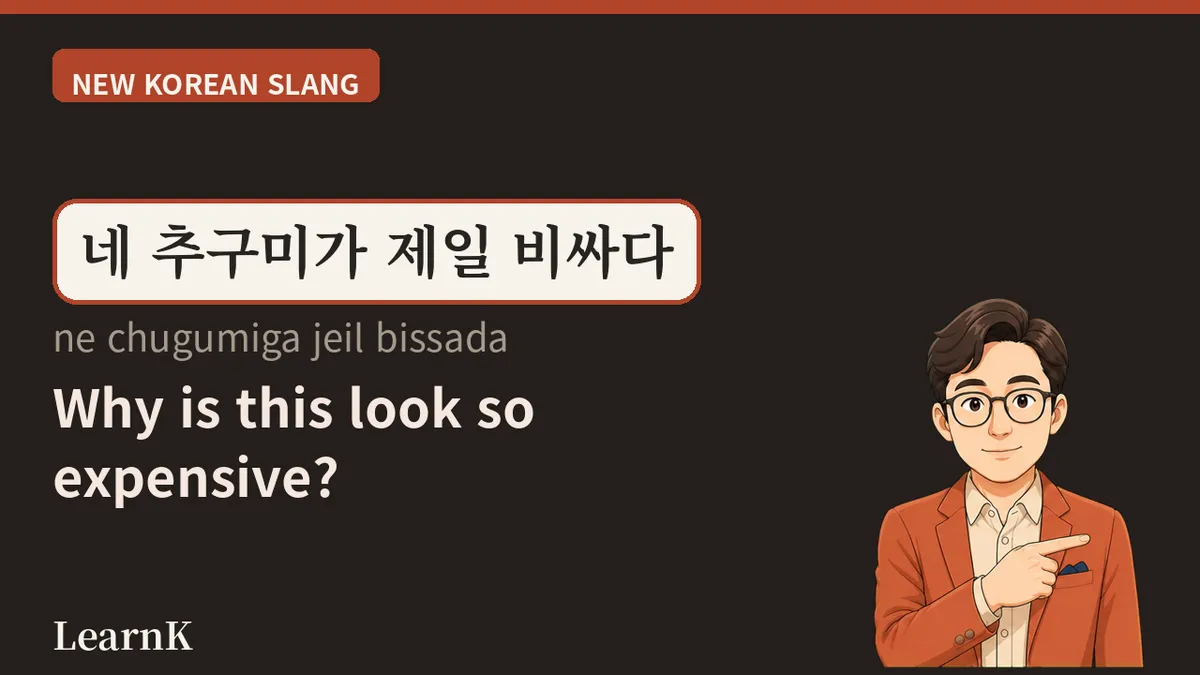
추구미 (chugumi) — The Vibe of the Me I Want to Become
추구미
추구미 (chugumi) means the version of yourself you want to become — the image and atmosphere you are reaching for on your own. Anyone who has flipped through twenty photos in their camera roll before sitting down in the salon chair has already lived through the moment this word exists for. Standing in front of the mirror at a clothing store, muttering 예쁜데 나는 아니야 (yeppeunde naneun aniya) — “it’s pretty, but it’s not me.” Facing a new semester or a new job and wondering 이번엔 좀 다르게 살아 볼까 (ibeonen jom dareuge sara bolkka) — “maybe I’ll try living a little differently this time.” The word that finally puts a name to that picture floating hazily in your head is exactly 추구미 (chugumi).
There are three layers to this word. First, it is overwhelmingly used for talk about looks and style. It attaches first to things you can see: hairstyles, clothes, makeup, the color tone of your photos, the way your room is decorated. Second, it doesn’t point at a whole person — it points at a mood and a texture. If a role model is 저 사람처럼 살고 싶다 (jeo saramcheoreom salgo sipda), “I want to live like that person,” then 추구미 is closer to 저런 공기를 두르고 싶다 (jeoreon gonggireul dureugo sipda), “I want to wear air like that.” That’s why the answer to “what’s your 추구미?” is sometimes a whole scene instead of a person’s name — something like 퇴근하고 그냥 걸어 나온 사람 같은 느낌 (toegeunhago geunyang georeo naon saram gateun neukkim), “the feeling of someone who just walked out of the office.” Third, buried in this word is a confession that you haven’t gotten there yet. People who already have it all don’t bother naming their 추구미. That’s why the word sticks so easily to self-deprecation and jokes. The sentence pattern 추구미는 미니멀인데 현실은 맥시멀 (chugumineun minimeorinde hyeonsireun maeksimeol) — “my 추구미 is minimalist, but my reality is maximalist” — accounts for roughly half of how this word actually gets used.
A Real Conversation
Scene: Saturday afternoon at a hair salon. Jun-kyung has just finished his cut, and Emily is scrolling through her camera roll while she waits her turn.
Jun-kyung: 아직도 사진 고르고 있어? 아까부터 스무 장은 넘겼겠다. You’re still picking a photo? You must have scrolled past twenty by now.
Emily: 이게 어렵다니까. 나 올해 추구미가 딱 정해졌거든. It’s hard, okay? I finally figured out my chugumi for this year.
Jun-kyung: 뭔데? 말해 봐. What is it? Tell me.
Emily: 음… 퇴근하고 그냥 걸어 나온 사람? 힘 하나도 안 준 것처럼 보이는 거. Um… someone who just walked out of the office? Like I didn’t try at all.
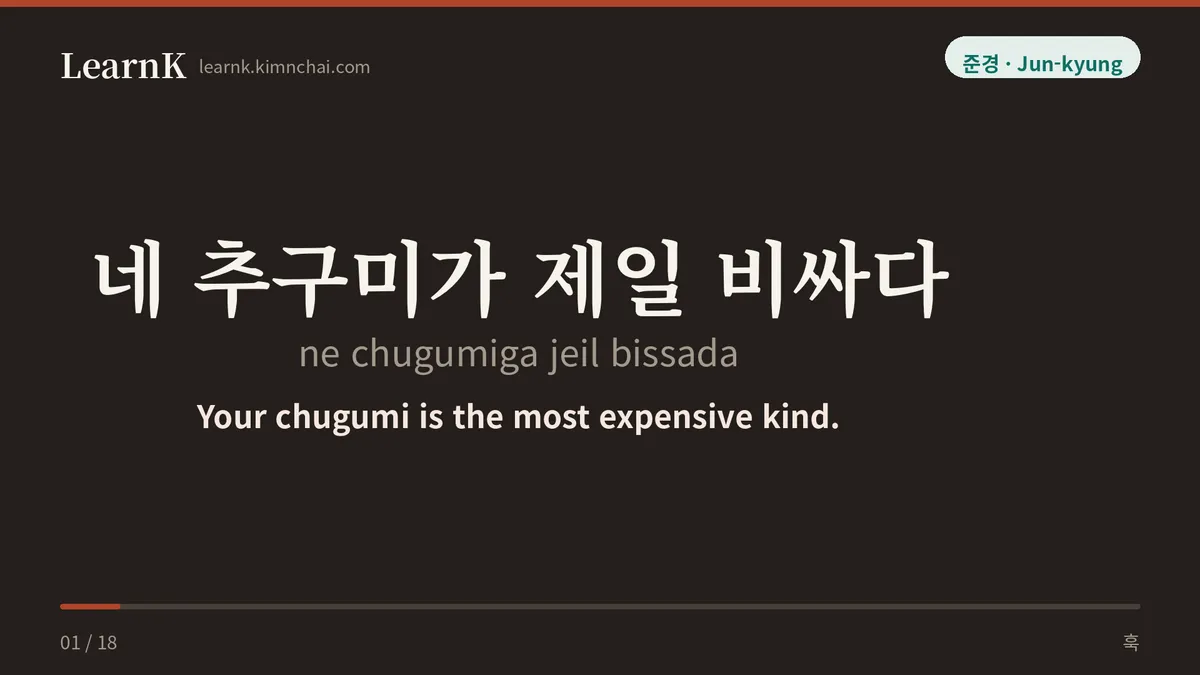
Jun-kyung: 야, 그게 제일 힘 많이 주는 거야. 네 추구미가 제일 비싸다. Hey, that’s the look that takes the most effort. Your chugumi is the most expensive kind.
Emily: 알아. 그러니까 사진이라도 잘 골라야지. I know. That’s why I at least have to pick the right photo.
When This Sounds Unnatural
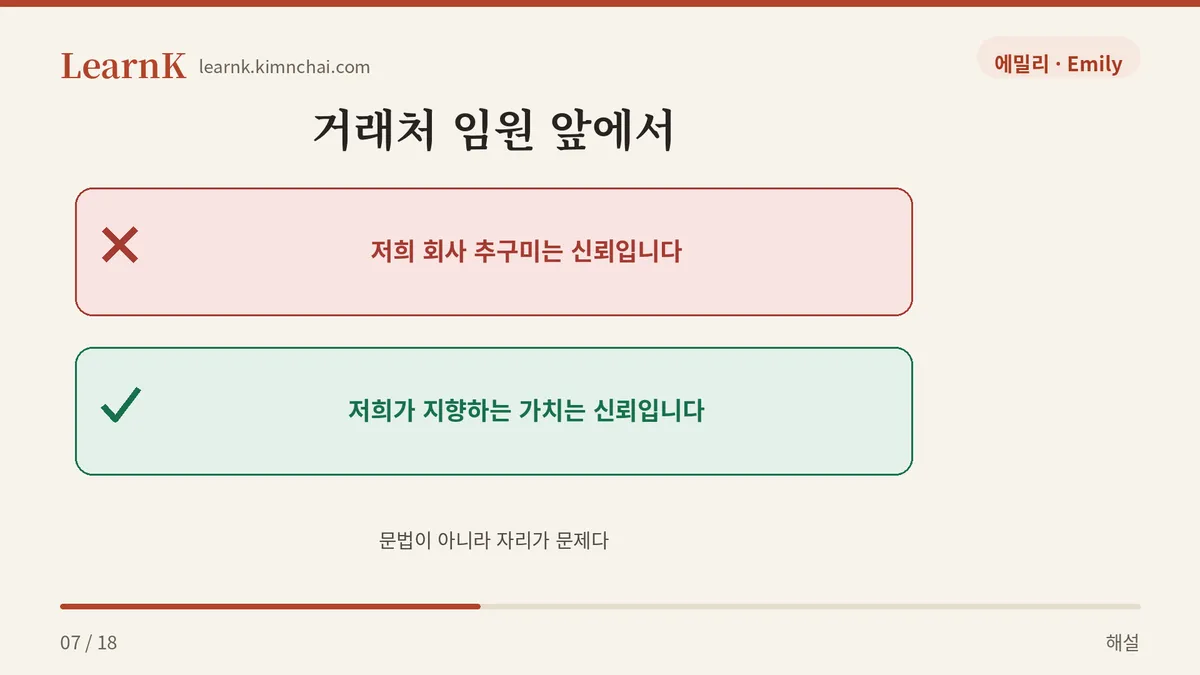
✗ (To an executive at a client company) 상무님, 저희 회사 추구미는 신뢰입니다. (sangmunim, jeohui hoesa chugumineun silloeimnida — “Director, our company’s chugumi is trust.”) ✓ (To an executive at a client company) 상무님, 저희 회사가 지향하는 가치는 신뢰입니다. (sangmunim, jeohui hoesaga jihyanghaneun gachineun silloeimnida — “Director, the value our company strives for is trust.”) → 추구미 is slang that grew up on social media, so using it in an official setting makes your company introduction sound like a joke. In formal situations, 지향점 (jihyangjeom), “aim,” or 지향하는 가치 (jihyanghaneun gachi), “the values one strives for,” are the safer picks.
✗ (To someone you’ve just met for the first time) 스타일 보니까 추구미가 청순이신가 봐요? (seutail bonikka chugumiga cheongsunisin’ga bwayo? — “From your style, I’m guessing your chugumi is the pure-and-innocent look?”) ✓ (To a close friend) 너 요즘 추구미 바뀐 것 같은데? (neo yojeum chugumi bakkwin geot gateunde? — “I feel like your chugumi has changed lately.”) → 추구미 is fundamentally a word for declaring about yourself the you that you want to become. Deciding someone else’s 추구미 for them the first time you meet doesn’t land as encouragement — it lands as a comment on their appearance.
Example Sentences by Situation
1. At a clothing store — when you like it but it isn’t yours
이거 예쁘긴 한데 내 추구미는 아니야. igeo yeppeugin hande nae chugumineun aniya (It’s pretty, but it’s not the look I’m going for.)
This is a comfortable sentence because it lets you say “it doesn’t match me” without finding any fault with the item itself. The strength of the expression is that it never puts down the taste of the friend shopping with you.
2. Starting to work out — stretching the word beyond appearance
요즘 추구미가 계단 안 쉬고 오르는 사람이라 헬스장 끊었어. yojeum chugumiga gyedan an swigo oreuneun saramira helseujang kkeuneosseo (These days the version of me I’m after is someone who climbs stairs without stopping, so I got a gym membership.)
추구미 started out as a word about surfaces, but stretching it to cover habits and attitudes like this has become steadily more common. Used this way, it moves closer to meaning “the state I want to be in.”
3. Posting a photo of your room — as a self-deprecating joke
방 추구미는 호텔인데 현실은 창고야. bang chugumineun hoterinde hyeonsireun changgoya (My room’s aspirational look is a hotel, but the reality is a storage closet.)
The “추구미 vs. reality” structure is the form you’ll see most often on social media. By turning the gap between the ideal and the real into your own punchline, you carve out a spot that is neither bragging nor making excuses.
Formal Speech, Casual Speech, and Similar Expressions
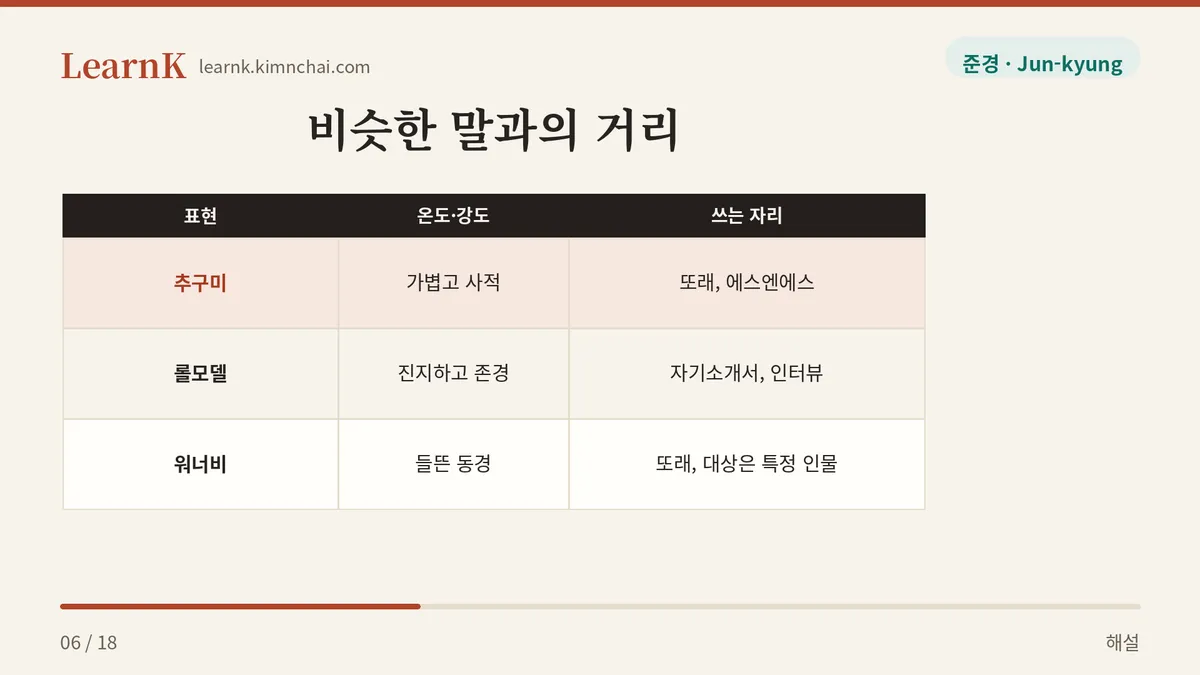
추구미 is a noun, so you can drop it straight into a polite sentence: 제 추구미는 단정한 쪽이에요 (je chugumineun danjeonghan jjogieyo), “my 추구미 is on the neat and tidy side.” The catch isn’t grammar, though — it’s the setting. Raising the politeness level doesn’t change the light temperature the word itself carries, so for a job interview or a formal report you’re better off looking at the right-hand column of the table below and choosing a different word.
| Expression | Temperature / Intensity | Where it’s used |
|---|---|---|
| 추구미 (chugumi) | Light and personal; mixed with a confession that you haven’t gotten there yet | Among peers and on social media. Not used in official documents or formal settings |
| 워너비 (wonneobi, “wannabe”) | Giddy admiration | Among peers. The target is usually one specific person |
| 롤모델 (rolmodel, “role model”) | Serious, tinged with respect | Fine in formal settings like personal statements and interviews |
| 지향점 (jihyangjeom, “aim, direction”) | Stiff and neutral | Reports, meetings, company introductions |
| 이상형 (isanghyeong, “ideal type”) | Leans romantic | Used only about people, never about a style |
롤모델 (rolmodel) is especially easy to confuse with 추구미. A role model is someone whose entire way of living you take after; 추구미 peels off just one visible layer of that — the atmosphere. That’s why 제 롤모델은 어머니예요 (je rolmodereun eomeoniyeyo), “my role model is my mother,” sounds natural, while 제 추구미는 어머니예요 (je chugumineun eomeoniyeyo), “my 추구미 is my mother,” sounds somehow out of joint.
Cultural Background — A New Arrival in the ‘-미 (-mi, 美)’ Slot
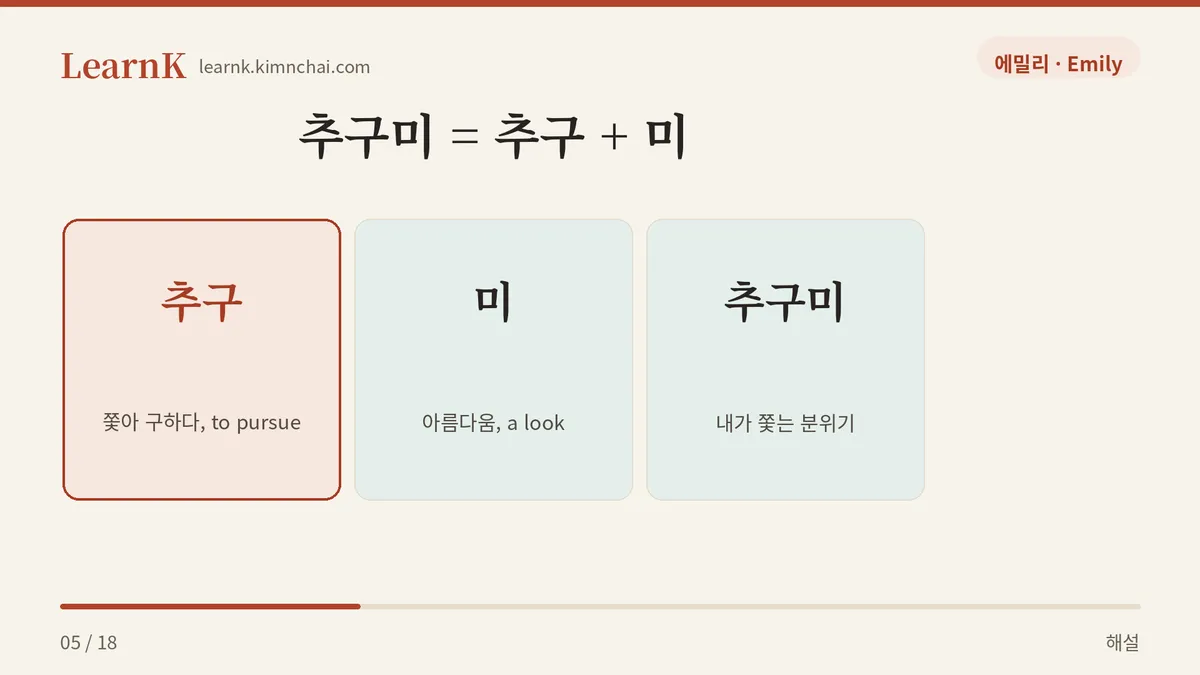
The way this word is built is right there on the surface. It joins the Sino-Korean roots 추구 (chugu, 追求), “to pursue,” and 미 (mi, 美), “beauty,” packing “the beauty I pursue” into a single word. It may not look like anything new, but there’s a reason it took hold so quickly. Korean has long had a slot for attaching a mood word in front of -미 (-mi, 美): 청순미 (cheongsunmi), pure and innocent beauty; 우아미 (uami), elegant beauty; 반전미 (banjeonmi), the beauty of an unexpected contrast. 추구미 simply pushed 추구 into that familiar slot, so even first-time listeners catch the meaning almost immediately.
There is one decisive difference from the other ‘-미’ words. 청순미 and 우아미 are kinds of beauty other people discover in you, but 추구미 is a direction you set and declare yourself. The subject has moved from the seat of being evaluated to the seat of choosing — and that shift is closely tied to why this word has spread so widely over the past few years.
In daily life, the hair salon is about as close as it gets to this word’s home base. The culture of saving a few photos and holding them out instead of describing the haircut you want, and the mood-board culture of collecting atmosphere shots before picking clothes or makeup, both settled straight onto this word. The sense is useful when you watch Korean dramas, too. In the episode where a character resolves to start over, notice how often they cut their hair or change their whole color palette; that change, shown on screen rather than explained in dialogue, is precisely the 추구미 the character has newly chosen. If you can read a scene that way, this word is already part of you.
Today’s Quiz
Which of the following uses 추구미 unnaturally?
① 나 요즘 추구미가 아침에 뛰는 사람이야. (na yojeum chugumiga achime ttwineun saramiya — “These days my chugumi is someone who runs in the morning.”) ② 이 코트 예쁜데 내 추구미는 아니네. (i koteu yeppeunde nae chugumineun anine — “This coat is pretty, but it’s not my chugumi.”) ③ (첫 미팅에서 거래처 임원에게) 저희 회사 추구미는 신뢰입니다. (To an executive at a client company in a first meeting: jeohui hoesa chugumineun silloeimnida — “Our company’s chugumi is trust.”) ④ 방 추구미는 호텔인데 현실은 창고야. (bang chugumineun hoterinde hyeonsireun changgoya — “My room’s chugumi is a hotel, but the reality is a storage closet.”)
Show the answer
Answer: ③
추구미 is slang that peers toss back and forth casually, or use on social media. The grammar is perfectly sound, but in a first meeting with a client it makes the whole company introduction sound flippant. In a setting like that, 저희가 지향하는 가치는 신뢰입니다 (jeohuiga jihyanghaneun gachineun silloeimnida), “the value we strive for is trust,” is the better choice. Stretching the word to cover a lifestyle habit as in ①, or using it as a self-deprecating joke as in ④, are both perfectly natural.
‘추구미 (chugumi)’ is a new coinage that has not yet been entered in the National Institute of Korean Language’s Basic Korean Dictionary. The definitions, example sentences, and dialogue in this post were all written by our editorial team, and no part of it is quoted from the dictionary.