단풍 (danpung) — How to Name a Korean Autumn in a Single Word

단풍
When late September comes around, a single map appears at the tail end of the news in Korea. Red arrows drift slowly down from the northern mountains toward the south, and people watch it to decide what to do that weekend. 단풍 (danpung) means “the phenomenon of leaves turning yellow or red in autumn, or a leaf that has turned that way.” It names the phenomenon and it names the leaf itself, so a single word covers both 「올해는 단풍이 늦네」 (olhaeneun danpungi neunne — “the foliage is late this year”) and 「이 단풍 좀 봐」 (i danpung jom bwa — “look at this leaf”).
There is a separate reason this word matters to travelers. Almost every autumn itinerary in Korea is built around 단풍. The weekends when lodging prices jump, the days when tour buses line up at trailheads, the stretch when regional festivals all cluster together — every bit of it moves with the foliage peak. So if you ask 「가을에 언제 가면 좋아요?」 (gaeure eonje gamyeon joayo? — “when’s a good time to come in autumn?”), a Korean person will answer almost reflexively: 「단풍 들 때요」 (danpung deul ttaeyo — “when the leaves turn”). The difference between catching that answer and missing it is bigger than you’d think.
The nuance is plain and unadorned. This isn’t a poetic word; it turns up in the weather forecast. That said, the words that travel alongside it lean toward admiration — 단풍이 곱다 (danpungi gopda), 단풍이 들다 (danpungi deulda), 단풍이 절정이다 (danpungi jeoljeongida). The pairing with 들다 (deulda) especially matters. The color isn’t “painted on” the leaf; it “comes in.” The dictionary’s second sense is the tree itself — the maple — but in real conversation, when people mean the tree, they say 단풍나무 (danpungnamu) all the way to the end. Say just 단풍 and nine times out of ten you’re talking about colored leaves.
Checking It in the National Institute of Korean Language Dictionary
The National Institute of Korean Language’s Basic Korean Dictionary splits 단풍 into two senses. Here’s the first.
단풍 「명사」
1. 가을에 나뭇잎이 노란 색이나 붉은 색으로 변하는 현상. 또는 그렇게 변한 잎.
[en] autumn foliage — A natural phenomenon in which leaves turn yellow or red in autumn, or such a tinged leaf.
[ja] もみじ【紅葉】 — 秋に木の葉が黄色や赤色に染まる現象。また、その葉。
[es] hojas coloradas de otoño — Fenómeno que consiste en el cambio de color de las hojas de los árboles, que se vuelven amarillas o rojas en otoño. U hojas que han adquirido dichas tonalidades.
[zh] 红叶,枫叶 — 在秋季树叶变成黄色或红色的现象;或指变成那样的叶子。
— National Institute of Korean Language, Basic Korean Dictionary (krdict.korean.go.kr)
Notice that the definition comes in two layers: “a phenomenon. Or a leaf that has turned that way.” It’s no accident that English autumn foliage, Japanese 紅葉, and Chinese 红叶 all carry the same doubleness. The dictionary carries no Portuguese definition, so we translated it ourselves — folhagem de outono: fenômeno em que as folhas das árvores ficam amarelas ou vermelhas no outono; ou as próprias folhas assim tingidas. (our own translation)
2. 손바닥 모양의 잎이 가을에 빨갛게 물드는 나무.
[en] maple tree — A tree whose hand-shaped leaves turn red in autumn.
[ja] もみじ【紅葉】 — 手のひら模様の葉が秋に赤くなる木。
[es] arce — Árbol cuyas hojas tienen la forma de la palma de la mano y se vuelven rojas en otoño.
[zh] 枫树 — 手掌形状的树叶在秋季变成红色的树木。
— National Institute of Korean Language, Basic Korean Dictionary (krdict.korean.go.kr)
That description — “hand-shaped leaves” — is exact. Pick up a maple leaf and hold it against your palm and even the size roughly matches.
Now let’s look at the real usage examples in the dictionary. The three sentences below aren’t one person talking; they’re a back-and-forth conversation.
가을은 날씨도 시원하고 산에 단풍도 예뻐서 등산하기가 참 좋습니다.
Autumn is really good for hiking — the weather is cool and the foliage in the mountains is pretty.
맞아요. 특히 가을맞이 단풍 구경을 할 수 있는 곳이 많아요.
True. There are so many places where you can go leaf-viewing to welcome the fall.
그러게요. 잦은 가을비에 단풍도 빨리 떨어져 단풍 구경도 못 가겠네요.
I know. With all this autumn rain the leaves are falling fast, so I doubt we’ll even get to go leaf-viewing.
— National Institute of Korean Language, Basic Korean Dictionary (krdict.korean.go.kr)
Talk about autumn hiking slides naturally into 단풍 구경 (danpung gugyeong), “leaf-viewing,” and then bends at the end into worry about rain. Autumn conversations in Korea really do run this way. It’s lovely → here’s where it’s lovely → but if it rains, it’s over. In the third sentence, 단풍도 빨리 떨어져 (“the leaves fall fast too”) is the word being used in its leaf sense.
전국 관광 명소에는 가을철 단풍을 구경하려는 관광객들로 붐볐다.
Tourist spots across the country were crowded with visitors hoping to see the autumn foliage.
— National Institute of Korean Language, Basic Korean Dictionary (krdict.korean.go.kr)
That’s news-article style. Come October, almost exactly this sentence airs every single year. And for trip planning it means one thing — the roads will be jammed that weekend.
단풍이 곱다.
The foliage is lovely.
— National Institute of Korean Language, Basic Korean Dictionary (krdict.korean.go.kr)
곱다 (gopda) is a compliment a notch quieter and more refined than 예쁘다 (yeppeuda, “pretty”). It carries a sense of deep color and even, well-ordered texture. It’s the word Koreans pick most often when praising fall leaves.
Seeing It in a Real Conversation
Scene: six in the morning on the last Saturday of October, at the stop where people are waiting for the tour bus to Naejangsan.
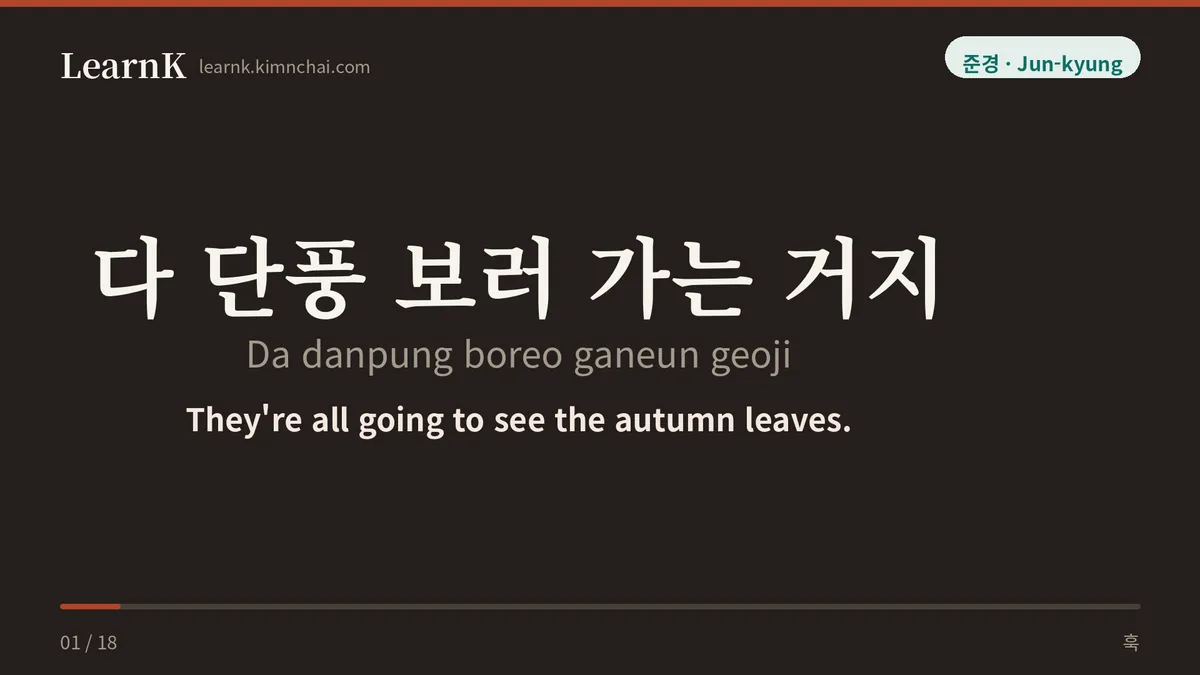
Jun-kyung: 야, 이 시간에 사람 이렇게 많은 거 실화냐. 다 단풍 보러 가는 거지. Whoa, this many people at this hour? They’re all going to see the autumn leaves.
Emily: 그러니까. 어제 뉴스 봤는데 이번 주가 절정이래. Right? I saw the news yesterday — this week is peak.
Jun-kyung: 절정 지나면 그냥 나뭇가지야. 작년엔 비 와서 다 떨어졌잖아. Once peak passes it’s just bare branches. Last year the rain knocked them all down.
Emily: 아 맞다, 그때 꼭대기까지 기어 올라갔는데 단풍이 하나도 없었지. Oh right, we crawled all the way to the top and there wasn’t a single colored leaf.
Jun-kyung: 올해는 진짜 곱대. 사진 찍을 데 미리 봐 뒀어. They say it’s really beautiful this year. I already scoped out photo spots.
Emily: 오, 준비성 봐라. 버스 온다, 앞자리 앉자! Ooh, look at you being prepared. Bus is here — let’s grab the front seats.
Said This Way, It Sounds Off
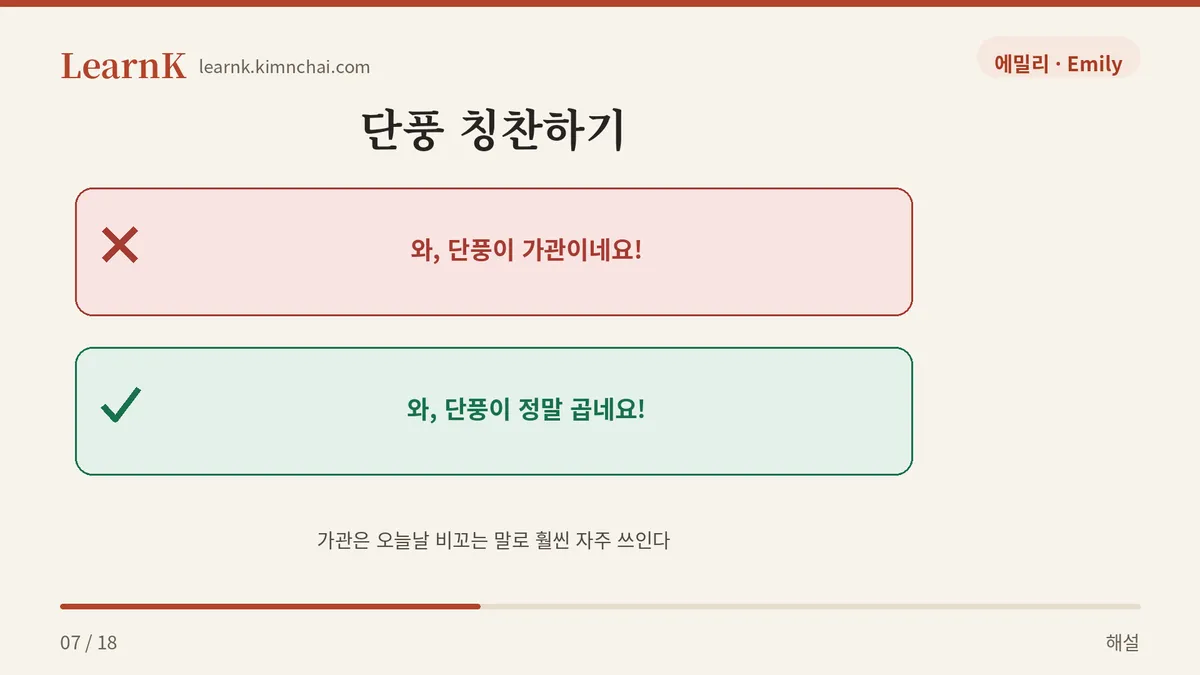
✗ (to an older person showing you their foliage photos) 와, 단풍이 가관이네요! (wa, danpungi gagwan-ineyo!) ✓ (to an older person showing you their foliage photos) 와, 단풍이 정말 곱네요! (wa, danpungi jeongmal gomneyo! — “Wow, the foliage really is lovely!”) → 가관 (可觀, gagwan) originally meant “worth seeing,” but in everyday conversation today it’s far more often sarcastic, as in 「꼴이 가관이다」 (kkori gagwan-ida, “what a sight you are”). Carry the old usage over as-is and your compliment lands as a sneer.
✗ 길에 단풍이 잔뜩 쌓여서 미끄러웠어요. (gire danpungi jantteuk ssahyeoseo mikkeureowosseoyo.) ✓ 길에 낙엽이 잔뜩 쌓여서 미끄러웠어요. (gire nagyeobi jantteuk ssahyeoseo mikkeureowosseoyo. — “The road was slippery with all the fallen leaves piled up.”) → The dividing line isn’t color, it’s location. Still attached to the tree and turning color, it’s 단풍; fallen and piled on the ground, it’s 낙엽 (nagyeop). Same leaf — but the moment it lands under your feet, its name changes.
Example Sentences by Situation
1. Tossing weekend plans at a friend (casual speech, messaging)
이번 주말에 설악산 갈래? 지금이 단풍 절정이래. Ibeon jumare Seoraksan gallae? Jigeumi danpung jeoljeong-irae. Want to go to Seoraksan this weekend? They say the foliage is at its peak right now.
The -대/-래 (-dae/-rae) in 절정이래 is the ending you use to pass along something you heard from someone else. Since you’re relaying foliage news you saw on TV or online, this form attaches almost by default.
2. With a driver in a taxi or intercity bus (polite speech)
이 길은 단풍이 참 곱네요. 매년 이맘때 이래요? I gireun danpungi cham gomneyo. Maenyeon imamttae iraeyo? The foliage along this road is lovely. Is it like this every year around now?
In Korea, weather and seasons are the safe openers for striking up a conversation with someone you’ve just met. If it’s red outside the window, this one line opens the door.
3. Sending a photo to a friend who has left Korea
여기 단풍 다 들었어. 네가 있을 때 같이 왔어야 했는데. Yeogi danpung da deureosseo. Nega isseul ttae gachi wasseoya haenneunde. The leaves have all turned here. We should have come together while you were still around.
단풍이 들다 (danpungi deulda) is the single most representative partner for this word. You don’t say 단풍이 되다 (danpungi doeda) or 단풍을 하다 (danpungeul hada).
Formal, Casual, and Related Expressions
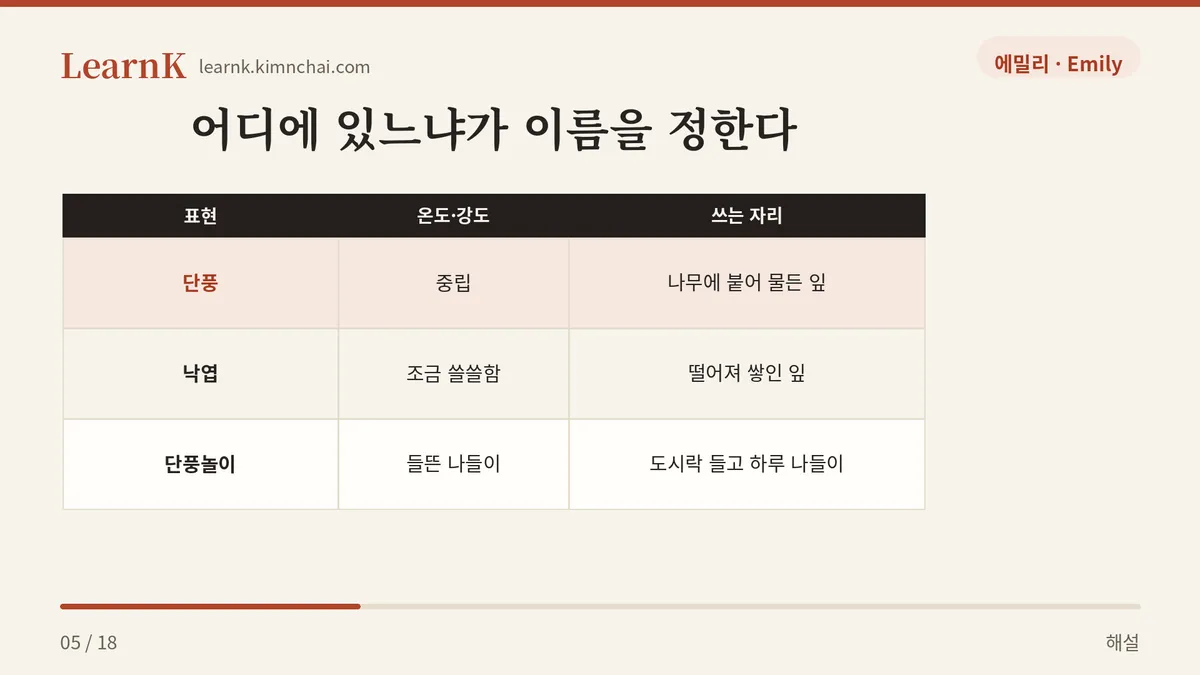
단풍 is a noun, so the word itself doesn’t change shape between polite and casual speech. The honorifics are carried by the verbs around it. To a friend: 「단풍 봤어?」 (danpung bwasseo?). To an older person: 「단풍 보셨어요?」 (danpung bosyeosseoyo?). More politely still: 「단풍놀이 다녀오셨어요?」 (danpungnori danyeoosyeosseoyo?). This is a word you’ll often use when speaking to older people while traveling, so it’s worth learning all three layers together.
| Expression | Temperature / intensity | Where it’s used |
|---|---|---|
| 단풍 (danpung) | Neutral. The turned leaves themselves | Anywhere — news, daily life |
| 낙엽 (nagyeop) | A little wistful | Fallen leaves piled up. The end of autumn |
| 단풍 구경 (danpung gugyeong) | Plain and everyday | 「주말에 단풍 구경 가자」 (“let’s go leaf-viewing this weekend”) |
| 단풍놀이 (danpungnori) | The buzz of an outing | Family or group outings. Comes as a set with packed lunches |
| 단풍나무 (danpungnamu) | Neutral. The plant’s name | When you mean the tree itself |
Cultural Background — The Month the Front Line Comes Down
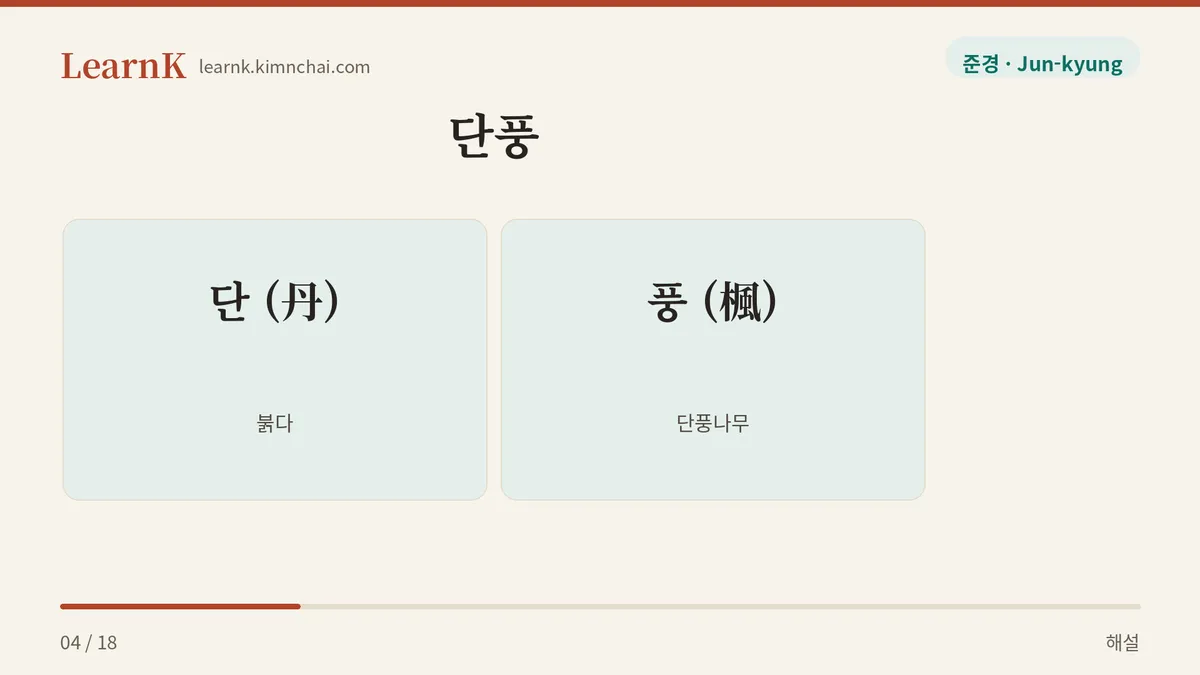
단풍 is a Sino-Korean word. It’s 붉을 단 (丹, “red”) plus 단풍나무 풍 (楓, “maple”) — it comes from the literal picture of a “red maple.” It has grown into a word that takes in even yellow ginkgo leaves, but red is still sitting there inside it.
The reason 단풍 in Korea goes beyond a seasonal greeting and becomes an actual schedule is that this country is long from north to south and full of mountains. Come autumn, the phrase 단풍 전선 (danpung jeonseon), the “foliage front,” shows up in weather reports. It maps a line that starts in the high mountains of the north and descends southward; the time when the upper slopes begin to turn is called 첫 단풍 (cheot danpung, “first foliage”), and the time when the whole mountain has nearly turned is 절정 (jeoljeong, “peak”). It takes roughly a month for that line to travel from the mountains of Gangwon Province down to the southern regions. For a traveler, the rule of thumb is simple: late September, head for the northern mountains; early November, head south.
And the weekends in this stretch are occupied wholesale by 단풍. At six in the morning people in hiking gear are lined up in front of tour buses, and up on the wooden platforms halfway up the mountain, packed lunches get spread out. This is called 단풍놀이 (danpungnori) — if 구경 (gugyeong) is about looking, 놀이 (nori) is closer to an outing that takes up the whole day.
The reason autumn dramas so often show two people walking side by side down a red-turned path comes from this same seasonal feeling. With no dialogue at all, the background alone says two things at once: time is passing, and this season is about to end. 단풍 is beautiful and short in the same breath. When a Korean person asks 「올해 단풍 봤어?」 (olhae danpung bwasseo? — “have you seen the foliage this year?”), there’s a quiet impatience mixed into the question.
Today’s Quiz
A friend who went to the mountains over the weekend has sent you a photo. Every branch is loaded with leaves gone bright red. What goes in the blank?
와, ( )이 진짜 곱다! (Wow, the ______ is really lovely!)
① 낙엽 (nagyeop) ② 단풍 (danpung) ③ 단풍나무 (danpungnamu) ④ 가관 (gagwan)
Answer: ② 단풍 — the leaves are still on the tree and turning color, so it’s 단풍. If the photo had shown them fallen and piled on the ground, ① would be right; ③ points to the tree rather than the leaves; and ④ still means “worth seeing” in the dictionary, but today it lands as sarcasm.
Definitions and example sentences are from the National Institute of Korean Language’s Basic Korean Dictionary (krdict.korean.go.kr); that portion of this post, including our translations, is licensed under CC BY-SA 2.0 KR.