Deungjjak Seumaesing — The Sound of Mom's Palm Flying at You
등짝 스매싱
등짝 스매싱 (deungjjak seumaesing) is the playful name for that single hard smack a parent — Mom, especially — lands on a child’s back once the child has been caught red-handed. Whenever a Korean drama or variety show gives you a sharp “짝!” followed by someone clutching their back and yelping “아야!”, nine times out of ten these very words flash across the subtitles. It isn’t a dictionary word; it’s an everyday slang coinage that took hold on the internet and on TV from the 2010s onward.
The situations that call for it are practically fixed. Snitching pieces of jeon one by one while your mother fries them for a holiday. Gaming until three in the morning when the bedroom door suddenly opens. A fully grown adult tossing whites and colors into the washing machine together. In other words, not a serious wrong but an obvious one — the kind where you knew you’d get scolded and your hand went ahead anyway.
For the nuance, just remember three things. First, the direction is fixed. The one doing the smacking is almost always the parent (usually the mother), and the one being smacked is the child. You don’t use it for a child hitting a parent’s back. Second, it’s said to get a laugh, not because it hurt. Usually the person who got hit is the one telling the story the next day, grinning: “나 어제 등짝 스매싱 당했잖아 (na eojeo deungjjak seumaesing danghaetjana).” Third, never use it for real violence. What’s underneath this word isn’t pain but a resigned sort of affection — that “there they go again” feeling.
Seeing It in a Real Conversation
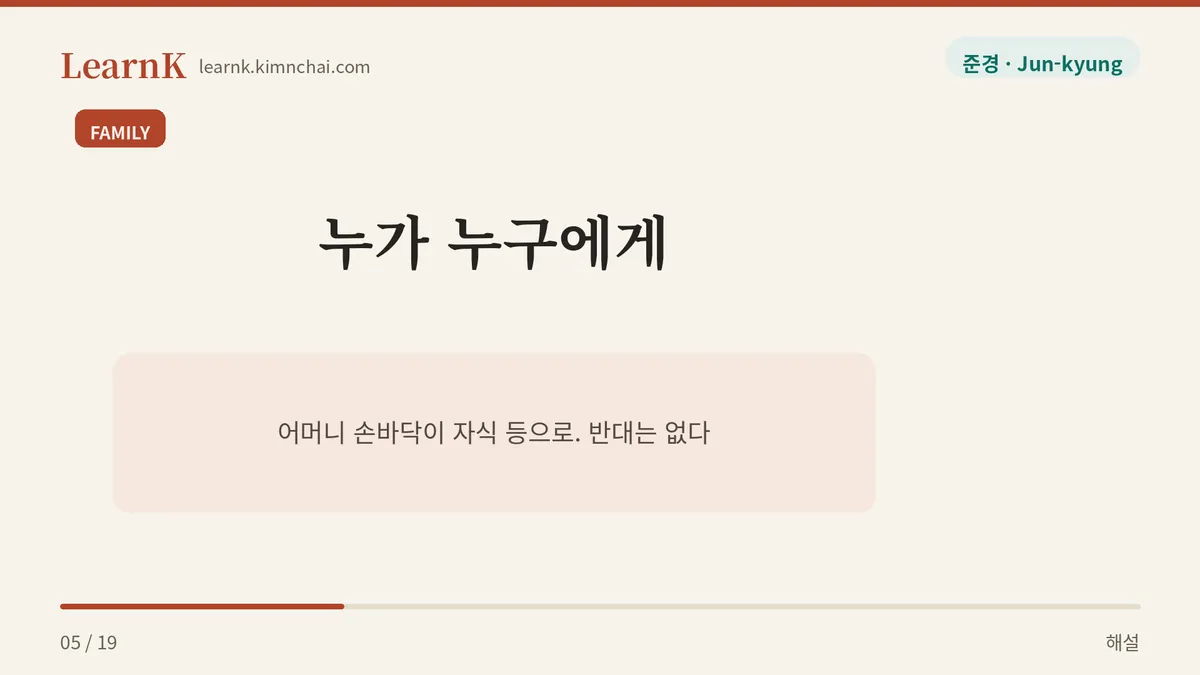
Situation: The last night of the Chuseok holiday. Jun-kyung, just back from his parents’ place, is sitting under a parasol in front of the neighborhood convenience store, rubbing his back.
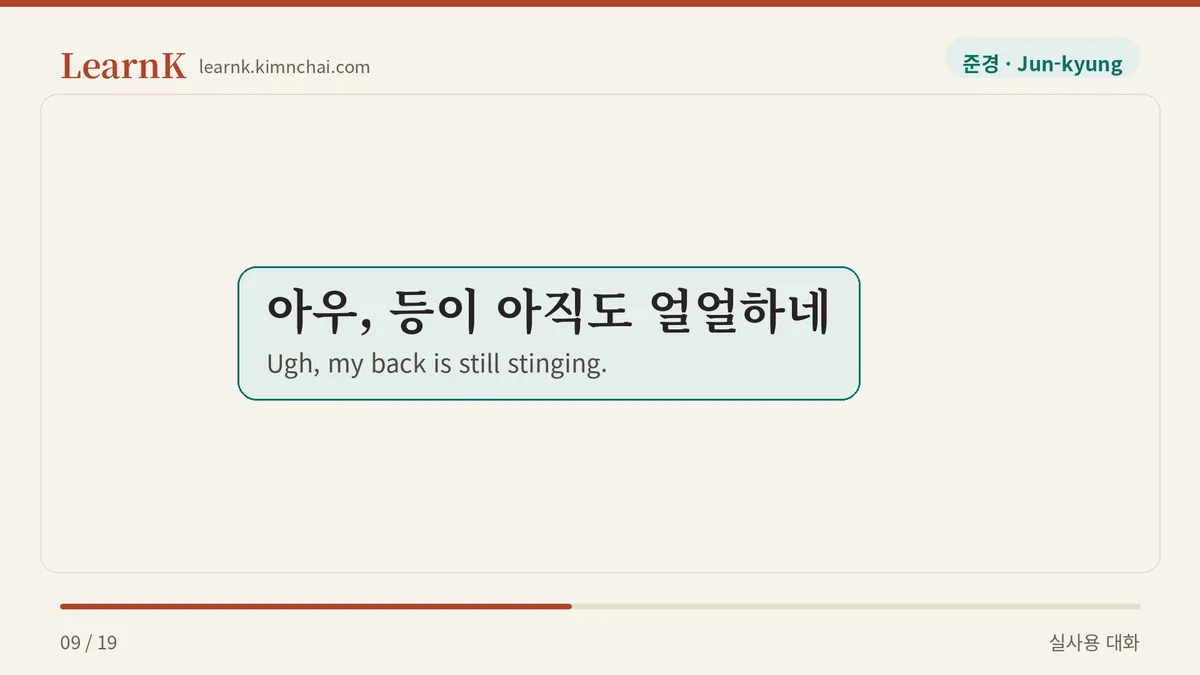
Jun-kyung: 아우, 등이 아직도 얼얼하네. Ugh, my back is still stinging.
Emily: 왜? 짐 옮기다가 어디 부딪혔어? Why? Did you bump into something moving stuff?
Jun-kyung: 아니, 엄마한테 등짝 스매싱 당했지. 전 부치는 옆에서 계속 집어 먹다가. Nope, I got a back-smash from my mom. I kept sneaking jeon while she was frying it.
Emily: 아, 진짜? 어머님 손 매운 거 알면서 왜 그래. Seriously? You know she’s got a heavy hand — why do that?
Jun-kyung: 손이 먼저 나가는 걸 어떡해. 소리만 컸어, 사실 안 아파. My hand just moves on its own. It was all noise — it didn’t actually hurt.
Emily: 그거 아프라고 때리는 거 아니잖아. 나도 예전에 하숙집 아주머니한테 한 번 맞아 봤어. 라면 국물 흘렸다고 등짝 스매싱. That’s not meant to hurt anyway. I got one once too — from my old boarding-house landlady, for spilling ramyeon broth.
Using It This Way Sounds Off
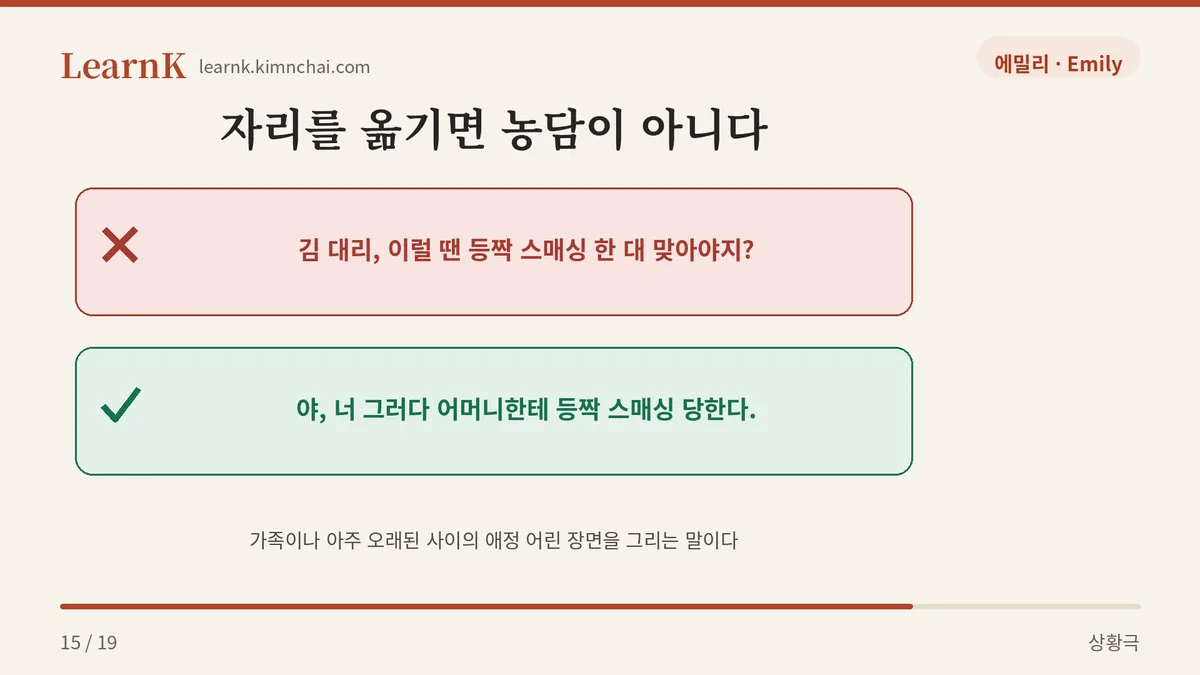
✗ (A manager to a new hire who slipped up) 김 대리, 이럴 땐 등짝 스매싱 한 대 맞아야지? Kim, this is the kind of thing that earns you a back-smash, isn’t it?
✓ (To an old friend) 야, 너 그러다 어머니한테 등짝 스매싱 당한다. Hey, keep that up and your mom’s going to give you a back-smash.
→ This phrase paints an affectionate scene between family or people who go way back. Move it into a workplace hierarchy and it stops being a joke and starts implying physical contact — which turns uncomfortable fast.
✗ (In a news report) 피해자는 가해자에게 등짝 스매싱을 당한 것으로 알려졌습니다. The victim is reported to have received a back-smash from the assailant.
✓ 피해자는 가해자에게 폭행을 당한 것으로 알려졌습니다. The victim is reported to have been assaulted by the assailant.
→ Because it’s slang with a laugh built into it, using it for actual violence or abuse makes the matter sound trivial. This is the misuse Koreans react to most sharply.
Example Sentences by Situation
Situation 1 — Monday morning, chatting about the weekend at work
주말에 집 청소 안 하고 누워만 있었더니 엄마한테 등짝 스매싱 맞았어요. (jumare jip cheongso an hago nuwoman itdeoni eommahante deungjjak seumaesing majasseoyo.) I lay around all weekend without cleaning, so I got a back-smash from my mom.
This is the most common shape of all: an adult child telling a coworker about getting scolded by a parent. Even when you attach a polite ending like “맞았어요”, the expression itself stays exactly the same. The phrase has a casual-speech feel, but the sentence around it can be perfectly polite.
Situation 2 — Warning a sibling in advance
그거 엄마 아끼는 그릇이야. 깨면 너 등짝 스매싱 각이야. (geugeo eomma akkineun geureusiya. kkaemyeon neo deungjjak seumaesing gagiya.) That’s Mom’s favorite dish. Break it and you’re in for a back-smash.
”~ 각이다 (~ gagida)” is a current expression meaning “it’s shaping up to go that way.” You tack it on like this to forecast something that hasn’t happened yet.
Situation 3 — Said by the person who did the smacking (rare)
애가 하도 게임만 하길래 등짝 스매싱 한 번 날렸다. (aega hado geimman hagille deungjjak seumaesing han beon nallyeotda.) The kid did nothing but game, so I landed one back-smash.
This is the parents’ generation making themselves the punchline. Here it pairs naturally with “날리다 (nallida, to send flying).” “날리다” shows up far more often than “때리다” (to hit).
Politeness Levels and Similar Expressions
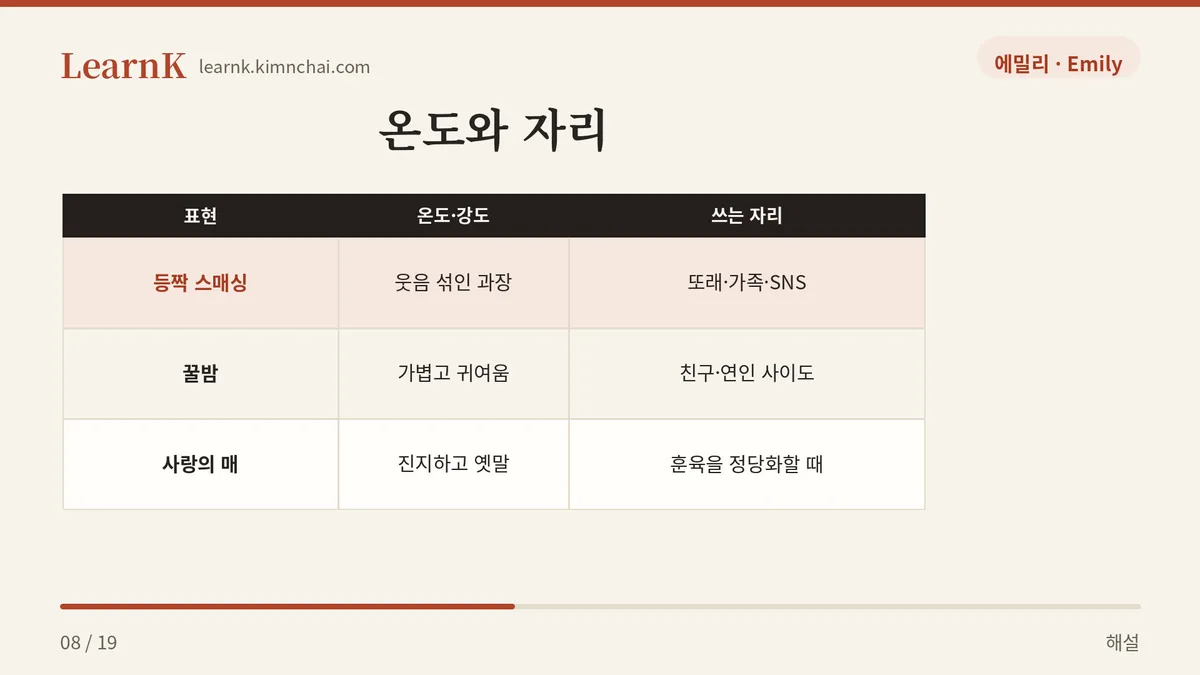
| Expression | Warmth & intensity | Where it belongs |
|---|---|---|
| 등짝 스매싱 | Exaggeration with a laugh in it; the force is mild | Peers, family, social media. In front of elders, only as a story about yourself |
| 등짝을 맞다 (deungjjageul matda) | Neutral description | Anywhere. Carries no slang flavor |
| 꿀밤 (kkulbam) | Light and cute | A little knuckle-rap on the head. Used between friends and couples too |
| 사랑의 매 (sarangui mae) | Serious, somewhat old-fashioned | A phrase that justifies discipline. These days it’s often quoted critically |
When you shift into polite speech, the expression itself doesn’t change form. Only the verb that follows gets elevated, as in 등짝 스매싱을 당했습니다 (deungjjak seumaesingeul danghaetseumnida). That said, it’s worth knowing that bringing this phrase out in a formal setting is itself a lighthearted choice.
Cultural Background — A Blow That Arrives as Sound First
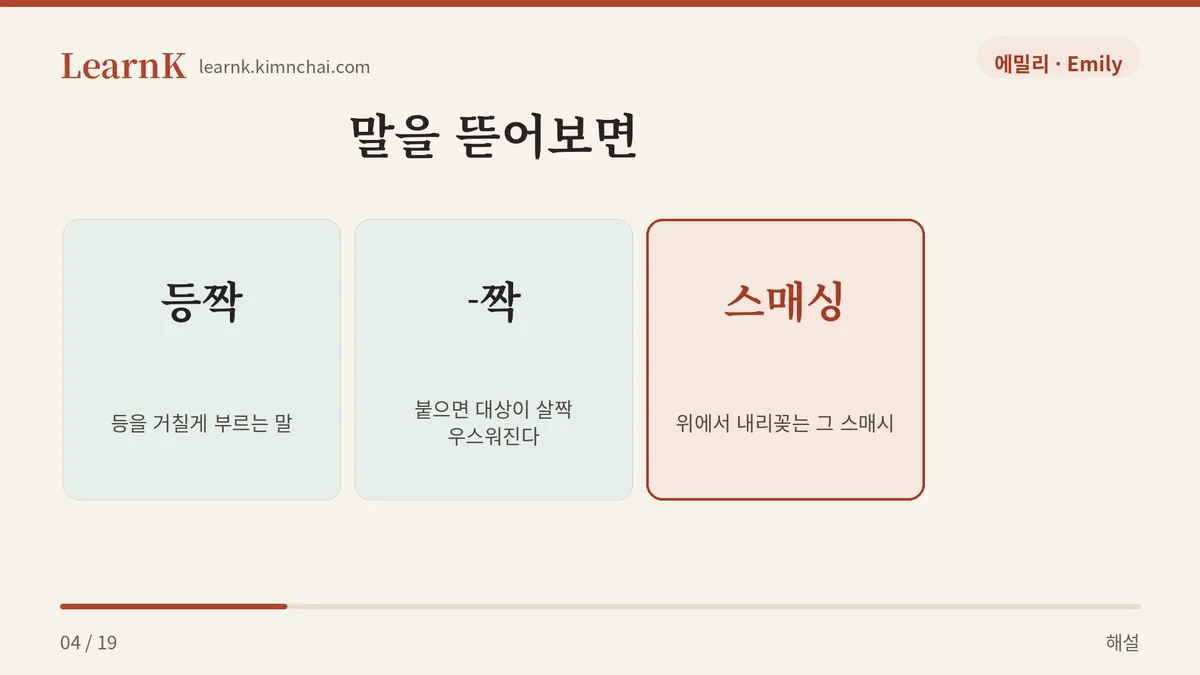
Take the coinage apart and it’s very simple. 등짝 (deungjjak) is a rough, blunt way of saying “back.” The suffix “-짝” makes whatever it attaches to a little bit ridiculous. And the 스매싱 tacked onto it is exactly the smash from badminton or table tennis — the overhead spike that drives a high ball straight down. It’s hard to pin down who first put the two together, but it’s obvious why a smash of all things. It’s loud, it comes down at a steep angle from above, and it gives no warning. It’s a joke that takes the most satisfying shot in racket sports and pastes it onto a mother’s palm.
Korean family variety shows and sitcoms did a lot to spread the phrase. The kid does something dumb, the mother walks over without a word, the picture drops into slow motion, and the sound effect bursts with a “짝!” The scene explains itself without a line of dialogue, so putting those few characters on screen as a subtitle is all it takes. Watch enough Korean dramas with subtitles and you’ll notice times when the phrase appears only in the subtitle and never in the actual dialogue — that’s how thoroughly the scene itself has become an idiom.
Still, the temperature of this phrase keeps cooling. As society’s view of corporal punishment shifts — the way “사랑의 매”, once used without a second thought, has become a phrase people handle carefully — 등짝 스매싱 is now safe only in the territory of “a cute memory.” Dress up a story about actually hitting a child in these words and Koreans today won’t laugh. If you’re a learner, the safest thing is to narrow your use of it to a fully grown adult telling a funny story about their own past.
Today’s Quiz
In which of the following situations can 등짝 스매싱 be used naturally?
- A manager laughing while smacking the back of a new employee who made a mistake in a meeting
- A college student who got caught by their mother secretly cooking ramyeon during exam season, telling a friend about it the next day
- A news report describing the extent of an assault victim’s injuries
- Greeting a friend’s parents for the very first time
Answer: 2. This phrase works best when ① it’s between a parent and child, ② the wrong is obvious and trivial, and ③ the person who got hit is the one telling it with a laugh. Number 1 is a workplace hierarchy, so it stops being a joke and becomes a physical-contact problem; number 3 makes real violence sound light; and number 4 is a formal first greeting, where slang like this simply doesn’t fit.
Definitions and example sentences are from the National Institute of Korean Language’s Basic Korean Dictionary (krdict.korean.go.kr); that portion of this post, including our translations, is licensed under CC BY-SA 2.0 KR.