드세요 (deuseyo) — The Korean Polite Expression You'll Hear Most Often Before a Meal
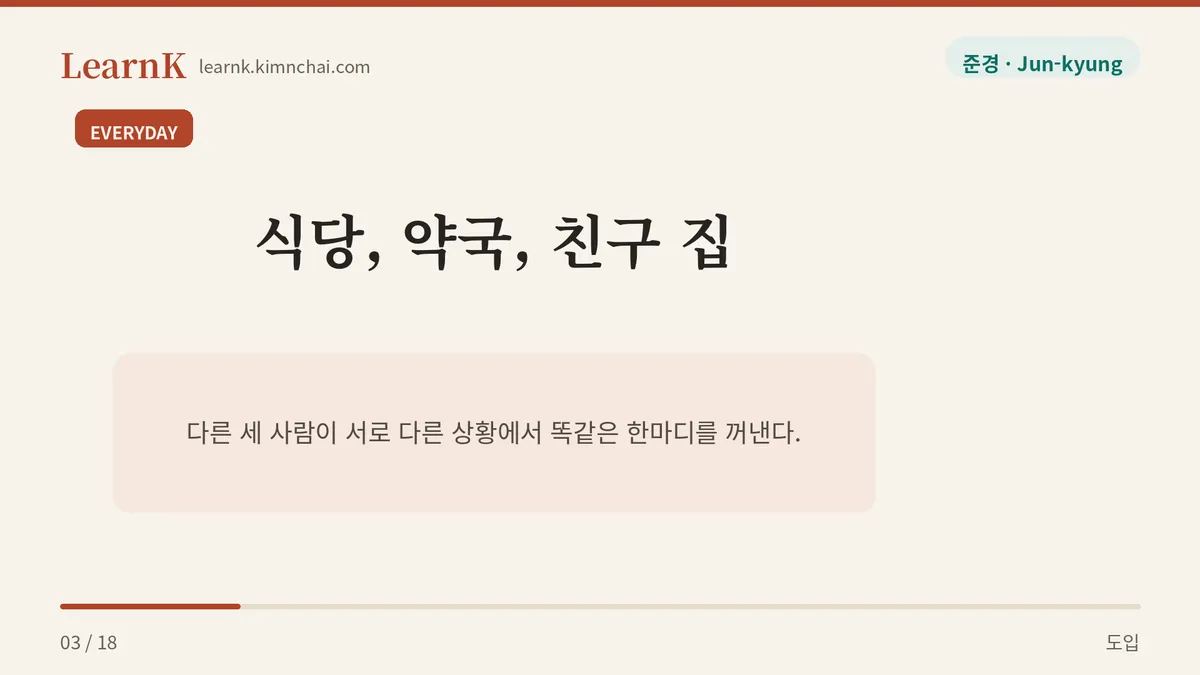
There’s a phrase you’re guaranteed to hear if you spend a day in Korea. At a restaurant, the owner says it as they set down the side dishes. At the pharmacy, the pharmacist says it while handing you a bag of medicine. At a friend’s house, that friend’s mother says it. Three completely different people, in three completely different situations, all reach for the exact same line. It’s the kind of expression that rarely shows up in Lesson 1 of a textbook, yet in real life you’ll hear it maybe ten times a day. Today’s expression is 드세요 (deuseyo).
드세요
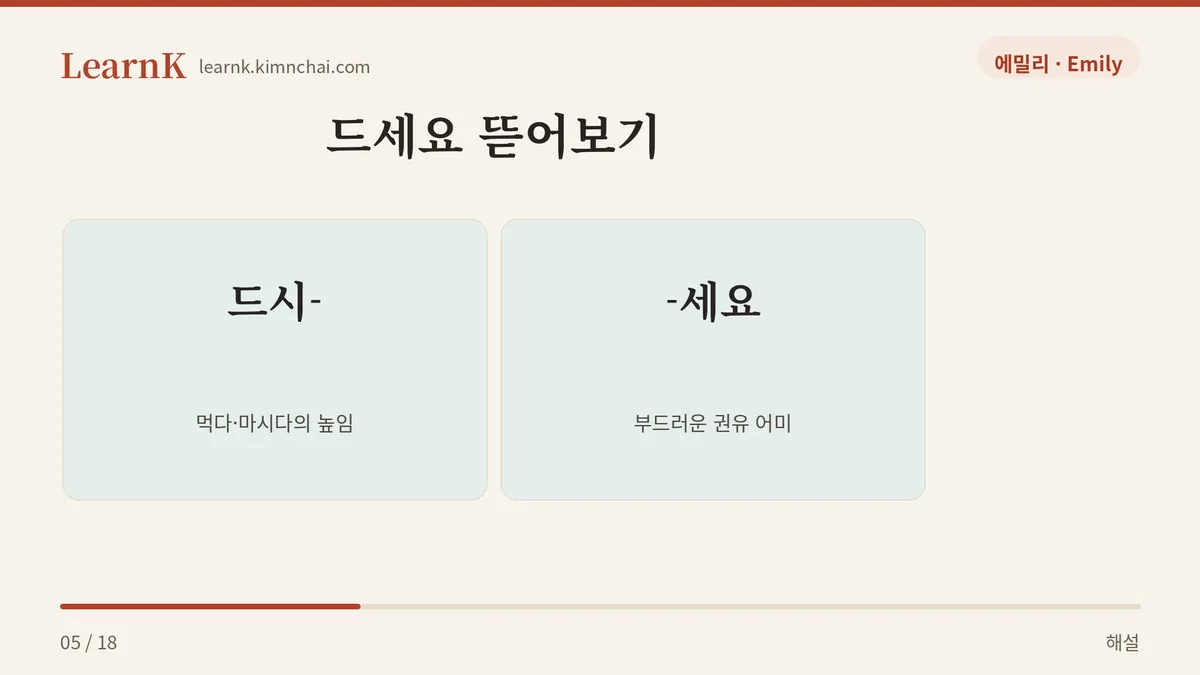
드세요 (deuseyo) is formed from 드시다 (deusida), the honorific form of ‘먹다 (meokda, to eat)’, plus the soft suggestion/command ending ‘-세요’. It doesn’t collapse neatly into a single English word. Depending on context, “Please eat,” “Help yourself,” “Enjoy your meal,” and “Please take your medicine” are all packed into these three syllables.
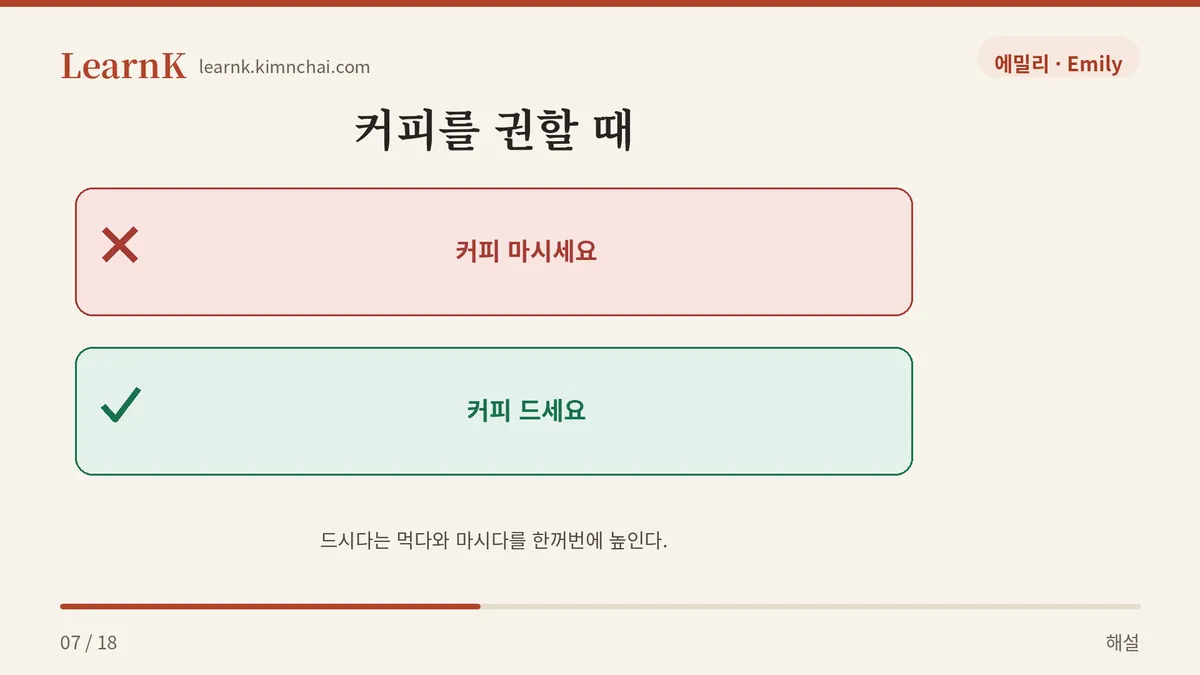
There’s one thing learners almost always miss. 드시다 (deusida) doesn’t just elevate ‘먹다 (to eat)’ — it elevates ‘마시다 (masida, to drink)’ too. So you 드시다 rice, you 드시다 water, you 드시다 coffee, and you 드시다 medicine. In a spot where English would force you to pick between eat / drink / take, Korean covers everything with a single word: 드시다. That’s why “커피 마시세요 (keopi masiseyo)” isn’t grammatically wrong, but it sounds a bit stiff. To a Korean ear, 커피 드세요 (keopi deuseyo) sounds far more natural — and carries the warmth of someone hosting you.
One more thing. 드세요 (deuseyo) is grammatically an imperative, but in actual use it’s almost never a command — it’s hospitality. It’s not “you have permission to eat now”; it’s closer to “I made this for you, so please enjoy it.” That’s why the phrase is almost always accompanied by a slight smile.
Seeing It in a Real Conversation
Situation: It’s moving day for Jun-kyung. The last of the boxes have just come up, and Emily, who’s come to help, is about to pull the canned coffee out of the fridge.
Jun-kyung: 에밀리야, 냉장고에 커피 있어. 아저씨들 좀 드려야 되는데. Emily, there’s coffee in the fridge. I should give some to the movers.
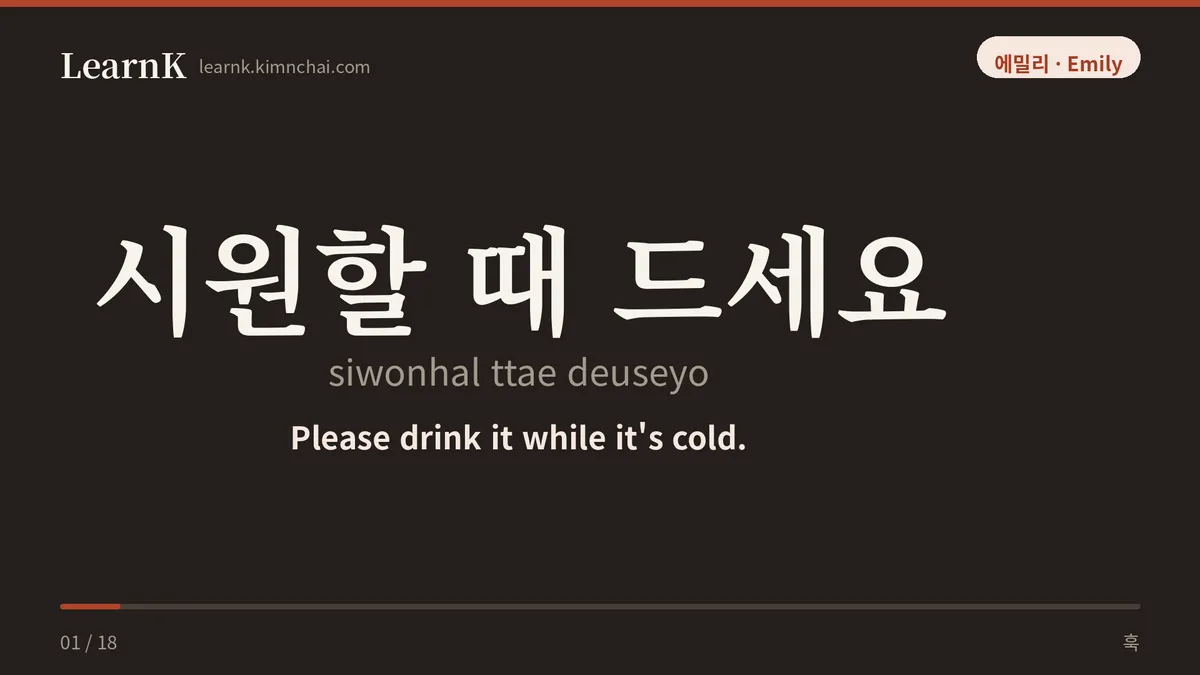
Emily: (현관 쪽으로) 아저씨, 여기 커피요! 시원할 때 드세요. (toward the door) Sir, here’s some coffee! Please drink it while it’s cold.
Jun-kyung: 오, 자연스럽다. 나 같으면 그냥 “마시세요” 했을 텐데. Oh, that sounded natural. I’d have just said “masiseyo.”
Emily: “마시세요”보다 드세요가 낫지 않아? 뭔가 더 따뜻하잖아. Isn’t “deuseyo” better than “masiseyo”? It feels warmer, right?
Jun-kyung: 맞아. 아까 경비 아저씨한테 “떡 좀 드세요” 한 것도 좋았어. Right. “Please have some rice cake” to the security guard earlier was good too.
Emily: 짜장면 시켰어. 너는 그냥 먹어, 나 손 좀 씻고 올게. I ordered jjajangmyeon. You just eat, I’ll go wash my hands.
Look at that last line. 드세요 (deuseyo) for the movers, 먹어 (meogeo) for her friend Jun-kyung. The same person, in the same moment, swaps the word depending on who she’s talking to. Korean honorifics aren’t a measure of how formal a sentence sounds — they’re a ruler for the distance between you and the person you’re talking to.
Example Sentences by Situation
1. Offering food to an elder — the safest thing to say at the table when an elder’s bowl is empty.
아버님, 국 식기 전에 어서 드세요. (abeonim, guk sikgi jeone eoseo deuseyo.) 아버님, 국이 식기 전에 어서 드세요.
2. To a customer at a shop — said almost like a greeting as the food is set down. “감사합니다 (gamsahamnida, thank you)” alone is enough of a reply.
맛있게 드세요. (masitge deuseyo.)
3. When handing over medicine — because ‘드시다’ covers both drinking and swallowing rather than just ‘먹다’, it’s used for medicine too.
이 약은 식후 삼십 분에 드세요. (i yageun sikhu samsip bune deuseyo.)
At a market or a department store food court, you’ll hear 하나 드셔 보세요 (hana deusyeo boseyo). With ‘-어 보다’ (try doing something) attached, it becomes “go ahead and give it a try.”
Comparing Similar Casual and Polite Expressions
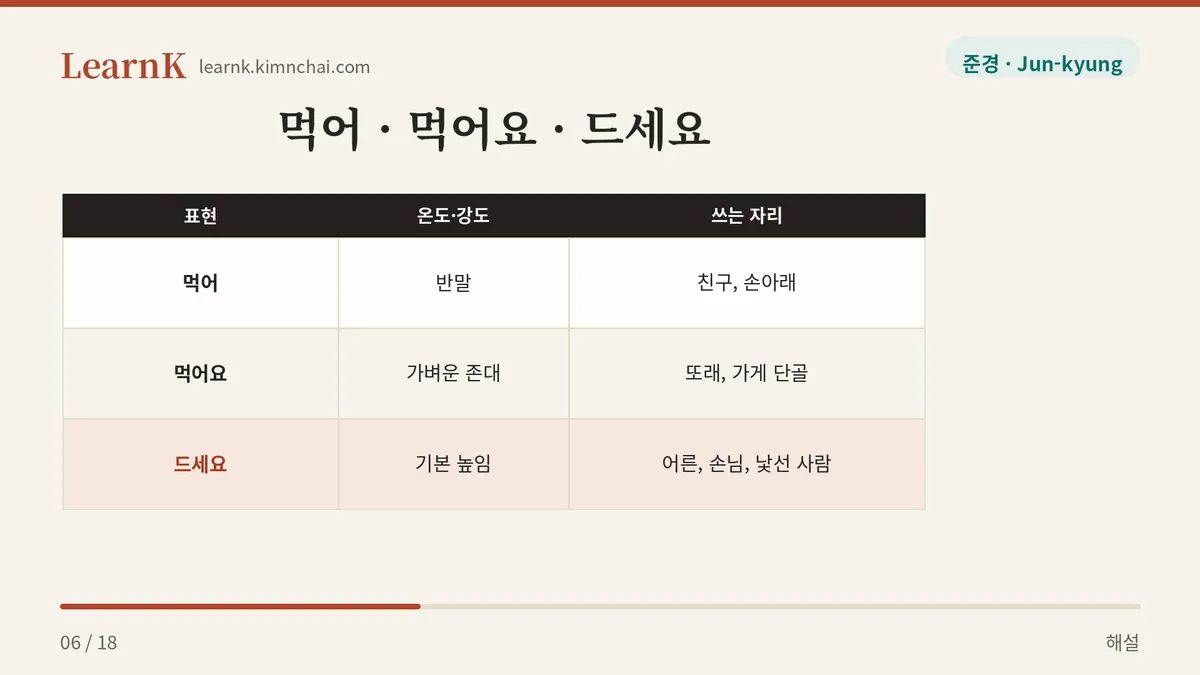
| Expression | Romanization | When to use |
|---|---|---|
| 먹어 | meogeo | Friends, people younger than you. Full banmal (casual speech) |
| 먹어요 | meogeoyo | Polite but casual. Peers and above, regulars at a shop |
| 드세요 | deuseyo | Standard polite. Safe for elders, guests, and strangers alike |
| 드십시오 | deusipsio | Formal register. Broadcasts, announcements, documents |
| 잡수세요 | japsuseyo | An even more elevated, old-fashioned form. For your grandparents’ generation |
There’s an easy trap here. You never use honorific speech about yourself. “제가 벌써 드셨어요” is wrong; “제가 벌써 먹었어요 (jega beolsseo meogeosseoyo, I already ate)” is correct. Conversely, when someone offers you 드세요 (deuseyo), the reply is “잘 먹겠습니다 (jal meokgetseumnida, I’ll eat well / thank you for the meal).” The giver and the receiver each use a different, paired phrase.
Cultural Background
In Korean dramas set in old neighborhood alleys, conflicts tend to get resolved at the dinner table. Side-dish bowls pass back and forth over the wall, and two people who’d been awkward around each other end up sitting at the same table, picking up their spoons. The word exchanged in that moment is almost always 드세요 (deuseyo). There’s no line about making up — pushing a bowl of rice toward someone is enough to settle things.
There’s a layer of table manners folded into it too. Traditionally, the oldest person at the table picks up their spoon first, and everyone else waits to start eating until then. So the moment an elder says 드세요 (deuseyo), it’s effectively the signal that means “everyone, let’s begin.” A three-syllable phrase flips the switch for the whole table.
Today’s Quiz
Jun-kyung is handing medicine to the grandmother next door, who has a cold. What best fills in the blank?
“할머니, 이 약 식후에 꼭 ____.”
- 먹어
- 먹어요
- 드세요
- 드셨어요
The answer is #3, 드세요 (deuseyo). #1 is banmal (casual speech), so it can’t be used with a grandmother. #2 is polite, but still too casual for an elder. #4 is past tense, so it doesn’t work as a suggestion. Whether you think of medicine in terms of ‘마시다 (drink)’ or ‘먹다 (eat)’, 드시다 (deusida) covers both, which makes it exactly right here.
If you get the chance to hand someone a drink today, don’t just hold it out silently — add 드세요 (deuseyo). You’ll feel how much warmer a single word can make the moment.
Definitions and example sentences are from the National Institute of Korean Language’s Basic Korean Dictionary (krdict.korean.go.kr); that portion of this post, including our translations, is licensed under CC BY-SA 2.0 KR.