기억상실 (gieoksangsil) — The Word Korean Dramas Love Most
기억상실
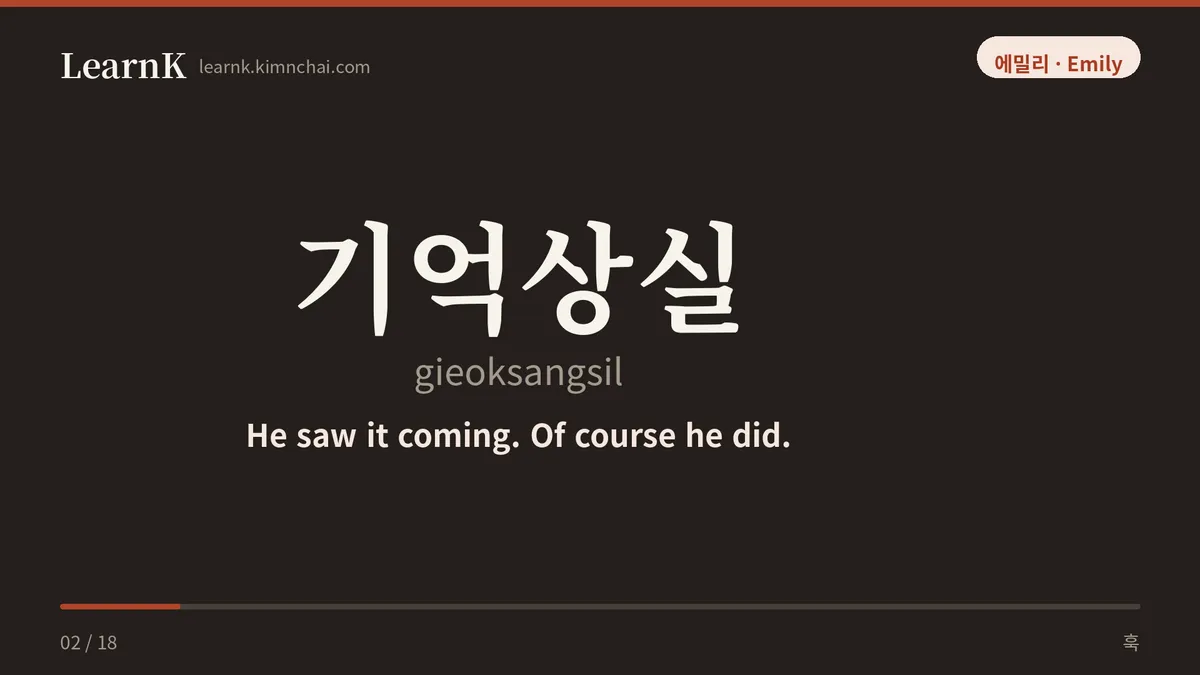
Watch even a handful of Korean dramas and there’s one word you’re guaranteed to run into: 기억상실 (gieoksangsil). 기억상실 refers to losing your memory of things that happened in the past because of an accident or an illness — in English, amnesia. You know the scene: the main character wakes up in a hospital bed, stares for a long moment at the person who’s been holding their hand all night, and asks 누구세요? (nuguseyo?) — “Who are you?” If you’ve watched much Korean TV, you can probably sketch out the whole next episode without ever reading the subtitles.
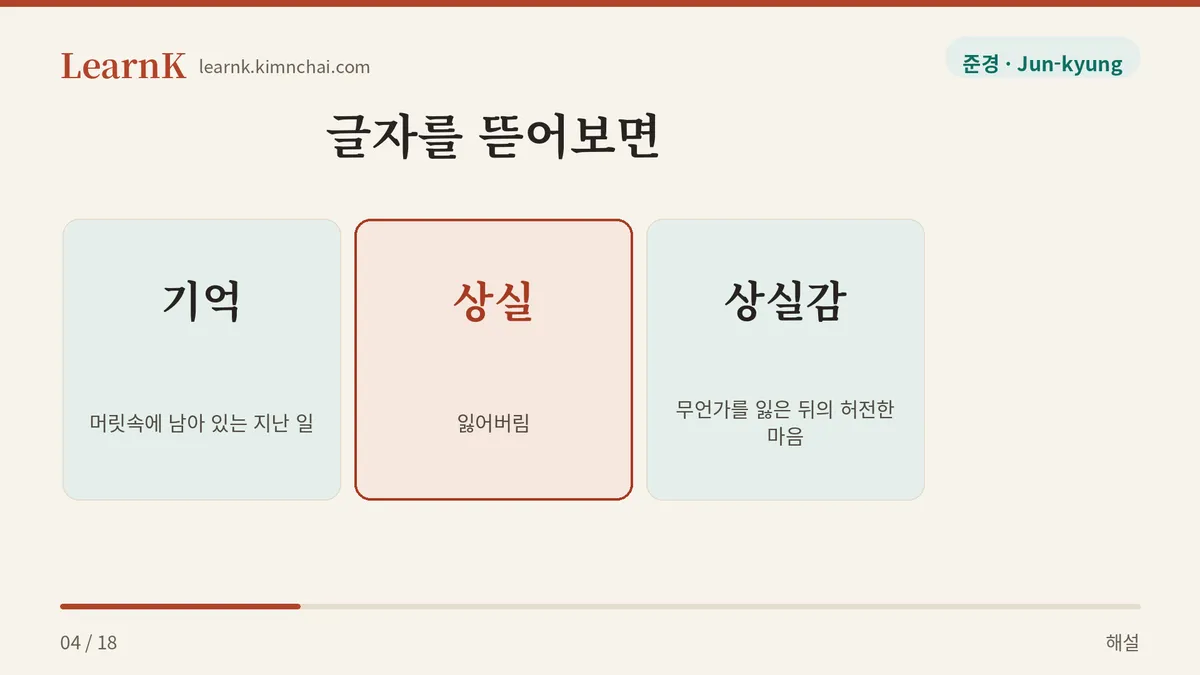
This is a Sino-Korean word. 기억(記憶) is what stays in your head from the past, and 상실(喪失) is loss. Stick the two together and you get, literally, “loss of memory.” Another word built on that same 상실 is 상실감 (sangsilgam) — the hollow feeling left behind after you lose something — so learning this one character opens up several words at once.
The nuance is fairly heavy. 기억상실 sits close to medical vocabulary, so you don’t use it for something like forgetting yesterday’s appointment. When Korean people do use it in everyday life, it’s usually in one of two situations: talking about the plot of a drama or movie, or wildly exaggerating their own forgetfulness as a joke. It is not a word you toss out lightly in front of someone who’s actually living with an illness.
It also helps to memorize the forms it usually shows up in: 기억상실에 걸리다 (gieoksangsire geollida), 기억상실이 오다 (gieoksangsiri oda), and — adding 증(症), meaning “condition” or “disorder” — 기억상실증 (gieoksangsiljeung). All three are natural, but when you’re talking about a drama, “기억상실에 걸렸어” is by far the most common.
See It in a Real Conversation
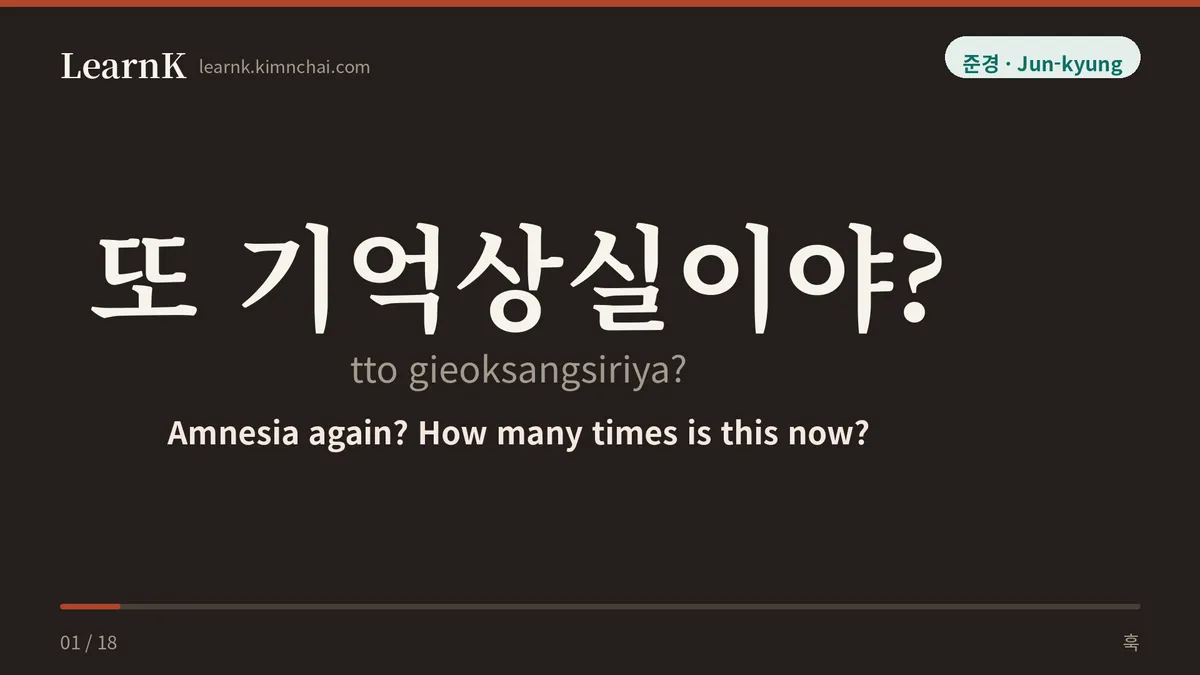
Setting: Friday night, in Jun-kyung’s living room. The finale of the drama Emily has been pushing on him for weeks is right at its climax.
Jun-kyung: 어? 또 기억상실이야? 이거 몇 번째냐 진짜. Huh? Amnesia again? Seriously, how many times is this now?
Emily: 야, 조용히 좀 해 봐. 이번엔 진짜 슬프단 말이야. Hey, be quiet for a sec. This time it’s actually sad.
Jun-kyung: 슬프긴. 다음 회에 비 오는 날 다시 다 기억나잖아. Sad, my foot. Next episode it all comes back on some rainy day.
Emily: …어떻게 알았어? 스포일러 하지 마! …How did you know? Don’t spoil it!
Jun-kyung: 한국 드라마 이십 년 봤으면 나도 이제 안다. 기억상실, 출생의 비밀, 재벌 2세. 삼종 세트야. Twenty years of K-dramas and you learn a thing or two. Amnesia, secret birth, chaebol heir. The classic set.
Emily: 그래도 난 볼 때마다 울어. 오늘은 좀 봐줘. Even so, I cry every single time. Just let me have this today.
When It Sounds Off
✗ (to a coworker who is caring for a mother living with dementia) 어머, 어머니가 기억상실이세요? 드라마 같네요. (“Oh my, your mother has amnesia? That’s just like a drama.”)
✓ (to the same coworker) 어머니가 예전 일을 잘 못 떠올리신다고요… 많이 힘드시겠어요. (“So she has trouble recalling things from the past… that must be so hard on you.”)
→ Pulling this word out in front of an actual patient or their family is like slapping drama subtitles onto someone else’s pain. In that moment, describe the situation gently rather than naming the condition, and speak to how the other person is feeling first.
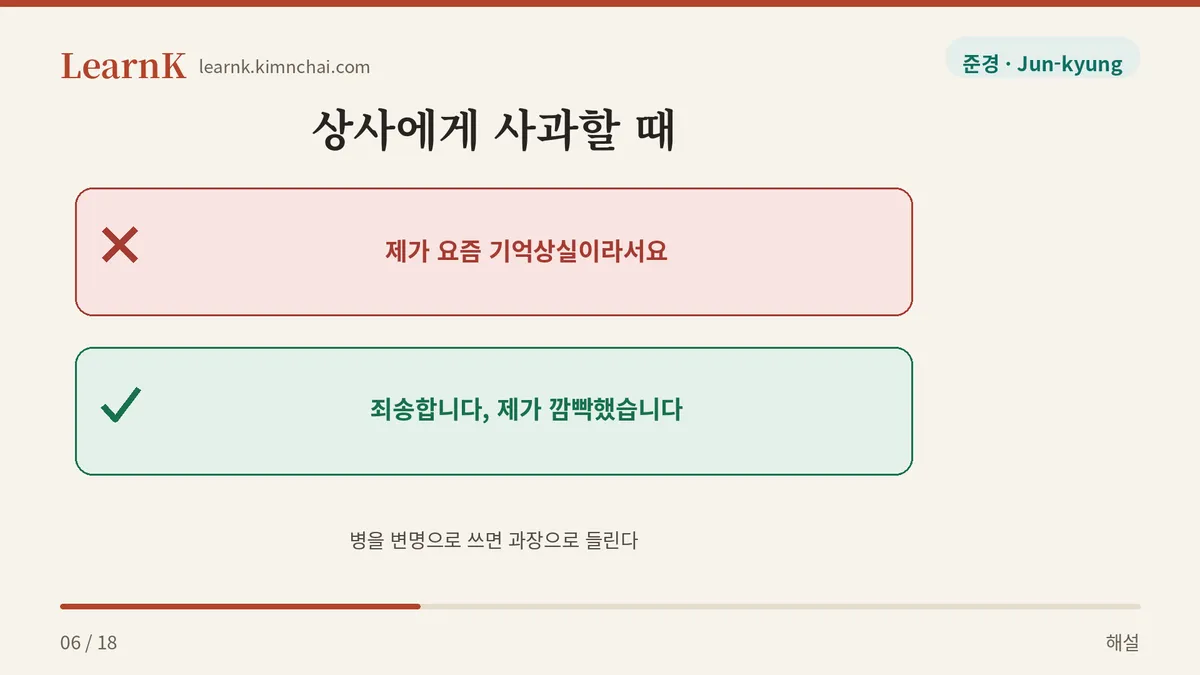
✗ (to your boss, after failing to read the document you were given yesterday) 죄송합니다, 제가 요즘 기억상실이라서요. (“Sorry, I’ve had amnesia lately.”)
✓ (to your boss) 죄송합니다, 제가 깜빡했습니다. 지금 바로 확인하겠습니다. (“I’m sorry, it slipped my mind. I’ll check it right now.”)
→ 기억상실 is a heavy word that points to an illness, so using it as an excuse sounds like an exaggeration — and ends up making you look like someone who isn’t actually sorry. For ordinary slip-ups, 깜빡하다 (kkamppakada) is the right answer.
Example Sentences by Situation
1. Explaining a drama’s plot to a friend
주인공이 교통사고로 기억상실에 걸려서, 여자친구를 못 알아봐. (jugongi gyotongsagoro gieoksangsire geollyeoseo, yeojachingureul mot arabwa.) Meaning: the main character loses his memory in an accident and can’t recognize his girlfriend.
When you’re recapping a plot, stringing things together in the present tense like this is what sounds natural. “~에 걸려서” ties cause and effect into a single sentence, which makes it extremely handy for summarizing events.
2. The day after drinking, poking fun at yourself
나 어제 이차부터 기억상실이야. 내가 뭐라 그랬어? (na eoje ichabuteo gieoksangsiriya. naega mwora geuraesseo?) Meaning: you remember nothing from the second round of drinks onward. Following it up with “What did I say?” is the standard move.
Here it’s obvious hyperbole, and the listener takes it as a joke. That said, there’s a more authentically Korean expression for this exact situation — see 필름이 끊기다 in the comparison table below. Among friends, that one sounds far more natural.
3. In a serious register, in news or writing
드라마 속 기억상실과 실제 의학적인 기억상실은 많이 다릅니다. (deurama sok gieoksangsilgwa siljje uihakjeogin gieoksangsireun mani dareumnida.) Meaning: amnesia as a drama device and amnesia as a real medical condition are quite different. This is a sentence pattern you’ll often see in explanatory writing.
Polite vs. Casual Speech, and Similar Expressions
기억상실 is a noun, so the word itself doesn’t shift into an honorific form. The politeness level comes from the predicate that follows. Casual: “기억상실에 걸렸어.” Polite: “기억상실에 걸렸어요.” And when you’re telling someone about an older person’s situation, you raise the ending, as in “기억상실이 오셨대요.”
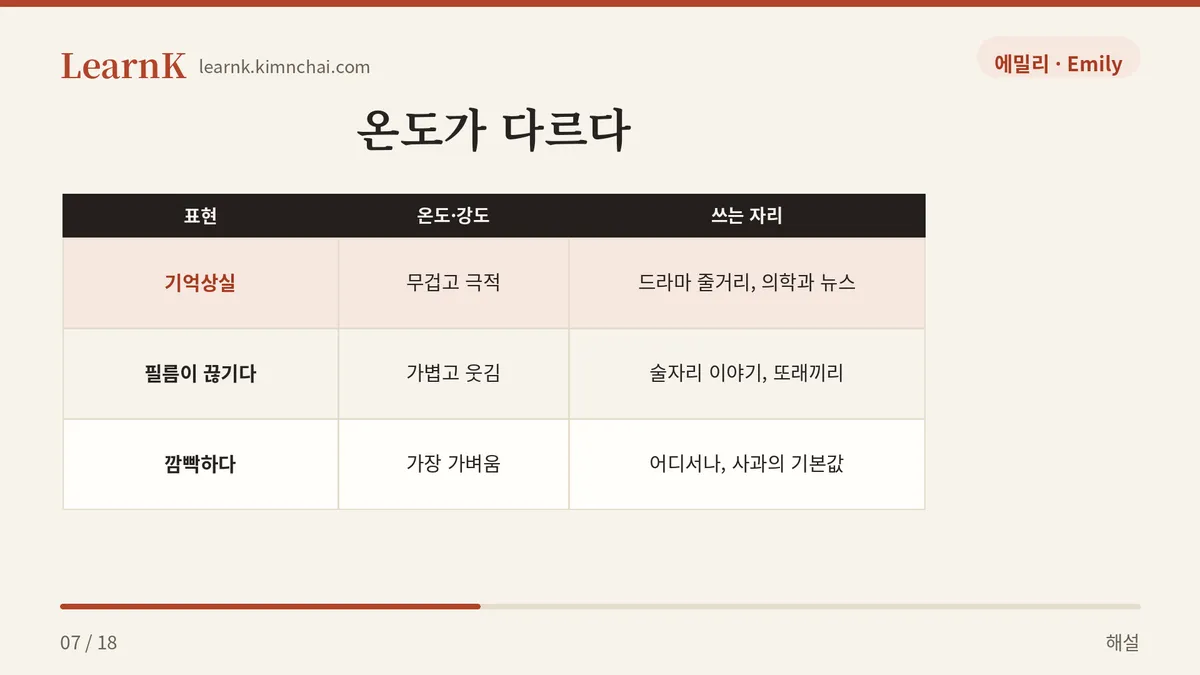
Words that look similar all run at different temperatures.
| Expression | Temperature / Intensity | Where to use it |
|---|---|---|
| 기억상실 (gieoksangsil) | Heavy, dramatic | Drama plots, medicine and news. Overkill for everyday slip-ups |
| 필름이 끊기다 (pilmi kkeunkida) | Light and funny | Drinking stories, among peers. Not used with anyone senior to you |
| 건망증 (geonmangjeung) | Everyday; a recurring tendency | Talking about your own habits or your age. Perfectly safe |
| 깜빡하다 (kkamppakada) | Lightest of all | Anywhere. The default when apologizing |
필름이 끊기다 comes from the image of a strip of movie film snapping and jumping straight to the next scene. It describes having a whole chunk of a drinking night vanish from some point onward, and because it’s said with a laugh, it never sounds serious. 건망증 is less an illness than a tendency — “I’m the type who keeps forgetting things.” “제가 건망증이 좀 있어서요” even works as the opening line of an apology.
Cultural Background — Why the Memories Always Come Back on a Rainy Day
There’s a structural reason amnesia has survived so long in Korean dramas. Korean melodrama has run for decades on obstacles: class differences, families who disapprove, misunderstandings and breakups. Amnesia manufactures every one of those obstacles at once. It separates the couple without making anyone the villain, it lets the show run for several episodes with only the viewers knowing the truth, and when the memories finally return at the end, all that emotion detonates at once. After Winter Sonata — 겨울연가 (Gyeoul Yeonga) (KBS, 2002) — became a hit across Asia in the early 2000s, the device effectively became the grammar of the genre. Notably, that drama’s most famous scenes are remembered less for their dialogue than for snow-covered streets, a scarf, and a pair of eyes that don’t recognize you.
Which is why, for Korean viewers today, 기억상실 is half a running joke. The moment the setup appears in a new drama, the comment section fills up with “또 기억상실이냐” — “amnesia again?” Everyone knows it’s a cliché, and yet when the lead finally recognizes the other person in the last episode, everyone cries anyway. For a Korean learner, picking up this word isn’t just memorizing a definition — it means you get to be in on the joke, love-hate and all.
One last thing worth adding: real amnesia looks very different from the drama version. In reality, people usually lose a short stretch right before the accident; the form where you neatly forget your own name and your family while the rest of your life runs perfectly fine barely exists. Knowing that difference makes those drama scenes a little more fun to watch.
Today’s Quiz
You’re standing in front of your department head, having failed to review yesterday’s meeting materials. Which of the following is the best thing to say?
- 부장님, 제가 요즘 기억상실이라서요.
- 부장님, 어제 그거 보다가 필름이 끊겨서요.
- 부장님, 죄송합니다. 제가 깜빡했습니다. 지금 바로 확인하겠습니다.
See the answer
Answer: 3. Option 1 drags a heavy, illness-related word in as an excuse, so it comes across as an exaggeration. Option 2 is light drinking-table slang, so in front of a superior the problem escalates from the mistake to your attitude. For small slip-ups, 깜빡했습니다 (kkamppakhaetseumnida) is the most accurate and the safest choice.
The definitions, example sentences, and dialogue in this post are all original writing of our own; nothing here is quoted from the National Institute of Korean Language’s Basic Korean Dictionary.