Today's Korean Expression: 김밥 (gimbap) — The Star of the Picnic Lunchbox
For Koreans, the word “picnic” (소풍) instantly brings one food to mind. It’s the dish where glossy seaweed wraps around rice, with colorful fillings tucked neatly inside. That’s exactly today’s expression: 김밥 (gimbap). On the morning of a picnic, the image of mom in the kitchen — spreading rice over a sheet of seaweed, laying down pickled radish and spinach, then rolling it all up — lives on in the childhood memories of many Koreans.
김밥
김밥 (gimbap) is a dish made by placing rice and various side ingredients on a sheet of dried seaweed (laver), rolling it up, and slicing it into bite-size pieces. “김 (gim)” means the dried seaweed that comes from the sea, and “밥 (bap)” means cooked rice — so the name literally is “김 + 밥,” or “seaweed + rice.”
Two pronunciations are both in use. The standard pronunciation is [김ː밥 (gimːbap)], but in real conversation, many people use a tensed sound and say [김ː빱 (gimːppap)]. Either way, everyone understands you.
Gimbap isn’t just a simple food — it symbolizes “정성 (jeongseong),” or heartfelt care and effort. That’s because it takes a lot of hands-on work: slicing each ingredient into long strips, cooking the rice, spreading it over the seaweed, and pressing as you roll. So the phrase “the gimbap mom made for me” carries a special kind of warmth.
Checking the National Institute of Korean Language Dictionary
First, let’s look at how an authoritative national institution defines the word.
김밥 (noun): A dish made by rolling rice and various other ingredients in dried laver seaweed and cutting them into bite-size slices. [en] gimbap — A dish made by rolling rice and various other ingredients in dried laver seaweed and cutting them into bite-size slices. [es] gimbap — Comida envuelta por alga rellenado de arroz y de varias guarniciones y que se sirve cortado en rodajas. [zh] 紫菜卷饭,紫菜包饭 — 用紫菜将米饭和各种菜包卷起来,再切成适当大小的食物。 — National Institute of Korean Language, Basic Korean Dictionary (krdict.korean.go.kr)
A Portuguese translation isn’t included in the dictionary, so we should note that the translation below is one we added ourselves.
[pt] gimbap — Prato feito enrolando arroz e vários outros ingredientes em alga seca (laver) e cortado em fatias do tamanho de uma mordida. (our own translation)
Now let’s look at the real-life example sentences the dictionary provides.
민수는 김밥 먹을 때 오이를 따로 빼서 먹더라. (Minsu-neun gimbap meogeul ttae oi-reul ttaro ppaeseo meokdeora.) — National Institute of Korean Language, Basic Korean Dictionary (krdict.korean.go.kr)
This sentence paints a picture of someone who dislikes cucumber picking it out of their gimbap. Because you can freely swap out the fillings, this kind of “picking and choosing” is common with gimbap.
그냥 김밥 싸 가지고 갈게요. (Geunyang gimbap ssa gajigo galgeyo.) — National Institute of Korean Language, Basic Korean Dictionary (krdict.korean.go.kr)
This means that instead of going to a restaurant, the speaker will make gimbap at home and bring it along. Notice how “싸다 (ssada)” is used here to mean “to make gimbap.”
김밥에 넣을 재료니까 가지런한 길이로 썰어 주세요. (Gimbap-e neoeul jaeryonikka gajireonhan giri-ro sseoreo juseyo.) — National Institute of Korean Language, Basic Korean Dictionary (krdict.korean.go.kr)
Gimbap fillings need to be cut into long strips that match the length of the seaweed so it rolls up nicely. This example vividly captures a real cooking moment.
김밥이 잘 말리지 않아요. (Gimbap-i jal malliji anayo.) — National Institute of Korean Language, Basic Korean Dictionary (krdict.korean.go.kr)
This is the situation where you’re struggling to make gimbap because the seaweed keeps splitting or the rice won’t hold together. Every beginner goes through this moment.
Example Sentences by Situation
Now let’s build some practical instincts with sentences we made ourselves.
① Ordering at a snack shop (분식집, bunsikjip) 김밥 한 줄 주세요. (gimbap han jul juseyo.) — “One roll of gimbap, please.” A single long cylinder of gimbap is counted as “한 줄 (han jul).” It’s important that you use “한 줄 (han jul),” not “한 개 (han gae),” when counting them.
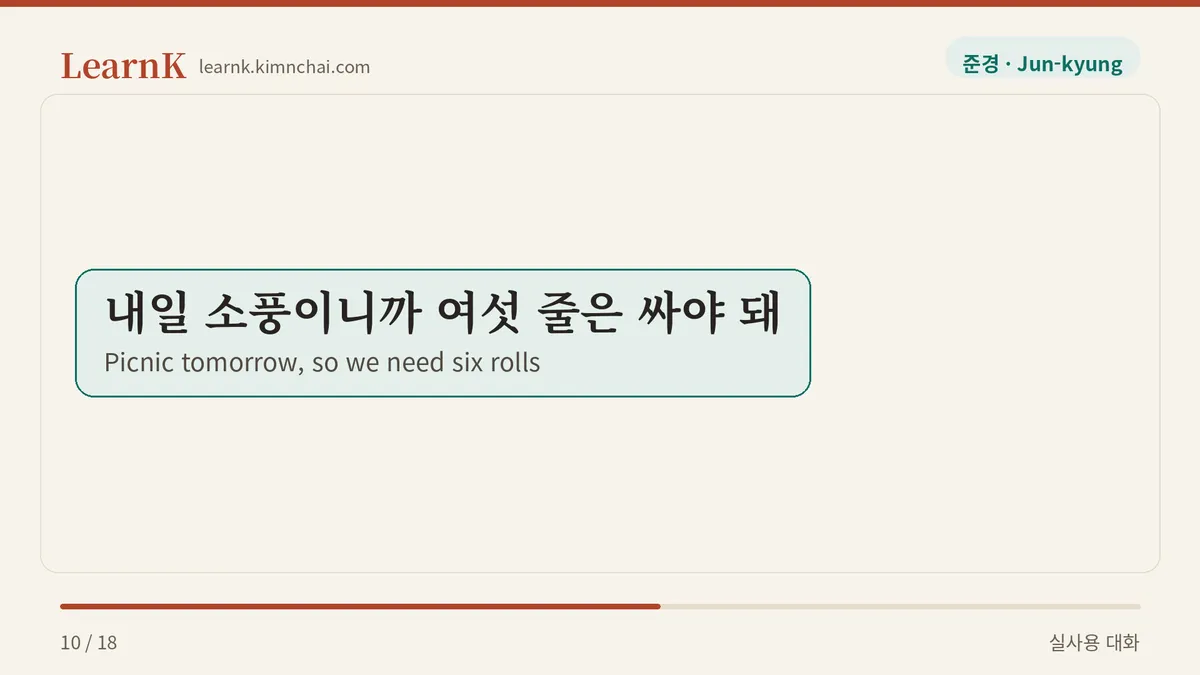
② Ahead of a picnic 내일 소풍 가니까 김밥 쌀 거예요. (naeil sopung ganikka gimbap ssal geoyeyo.) — “We’re going on a picnic tomorrow, so I’m going to make gimbap.” Here, “싸다 (ssada)” refers to the act of rolling gimbap. It even carries the sense of packing a lunchbox.
③ Sharing your preferences 저는 김밥에 오이 빼 주세요. (jeoneun gimbap-e oi ppae juseyo.) — “No cucumber in my gimbap, please.” This is how you ask for an ingredient you dislike to be left out. “빼다 (ppaeda)” means “to take out” or “to exclude.”
Formal vs. Casual Speech, and Similar Expressions
With a friend, you’d use casual speech: “김밥 먹을래? (gimbap meogeullae?)” (“Want some gimbap?”). With an elder, you’d use polite speech: “김밥 드실래요? (gimbap deusillaeyo?)” (“Would you like some gimbap?”). The food name “김밥” itself doesn’t change — only the verb used with it shifts depending on the level of politeness.
It’s also good to distinguish gimbap from similar foods. 주먹밥 (jumeokbap) is rice shaped by hand rather than rolled in seaweed. 충무김밥 (chungmu-gimbap) is a regional dish where plain rice is rolled with no filling and served alongside seasoned squid and radish kimchi. 꼬마김밥 (kkoma-gimbap) refers to small, bite-size mini gimbap.
Cultural Background
Gimbap is the go-to lunchbox for picnics, field days, and outings, and it’s also a national snack you can buy cheaply anytime at snack shops like “김밥천국 (Gimbap Cheonguk, “Gimbap Heaven”).” It shows up often in Korean dramas, too — the main character working late into the night grabbing a convenience-store gimbap for a meal, or a family rolling gimbap together the night before a picnic. Scenes like these show that gimbap has two faces at once: it’s both “a quick meal in a busy daily life” and “a heartfelt, homemade taste.”
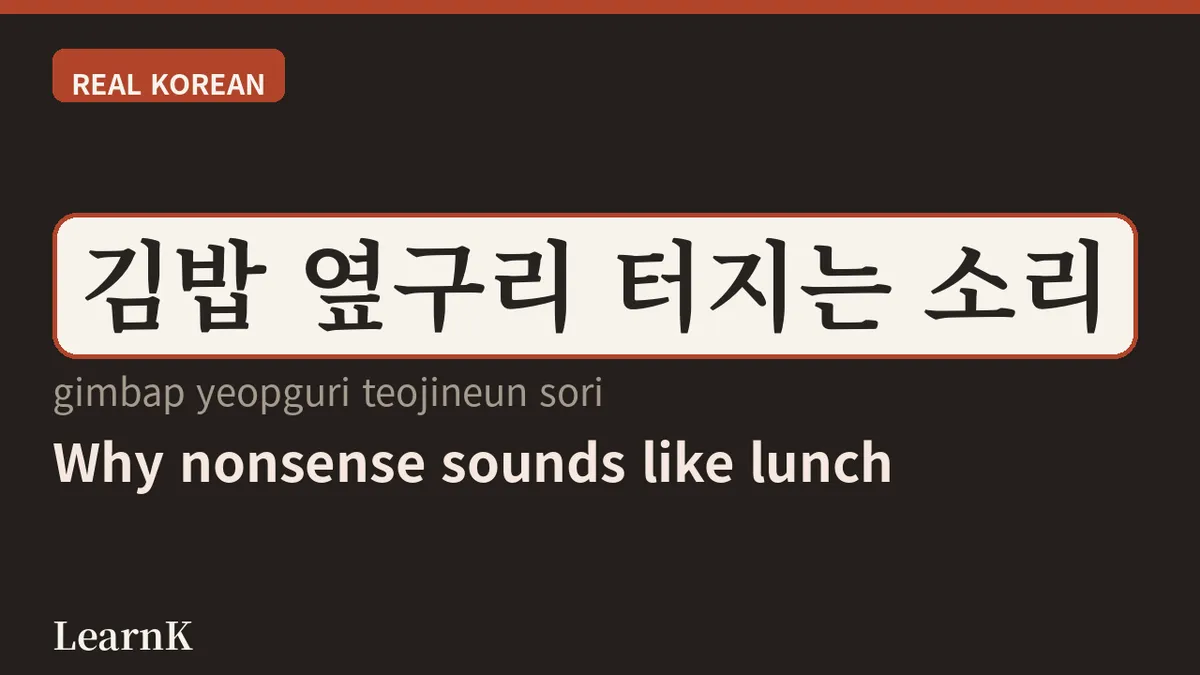
There’s a fun idiomatic expression, too. When someone says something absurd, you tease them with “김밥 옆구리 터지는 소리 (gimbap yeopguri teojineun sori)” — literally, “the sound of gimbap bursting at the side.” Just as gimbap splits open at the seam when it’s rolled wrong, the phrase means someone is spouting nonsense.
Closing Quiz
You want to order one gimbap at a snack shop. What’s the right counting word for the blank?
“이모, 김밥 한 ____ 주세요! (Imo, gimbap han ____ juseyo!)” — “Ma’am, one ____ of gimbap, please!”
The answer is 줄 (jul). A single cylinder of gimbap is counted as “한 줄 (han jul),” so “김밥 한 줄 주세요 (gimbap han jul juseyo)” is the natural way to order. With just this one phrase you learned today, you can confidently order gimbap at any snack shop in Korea!
Definitions and example sentences are from the National Institute of Korean Language’s Basic Korean Dictionary (krdict.korean.go.kr); that portion of this post, including our translations, is licensed under CC BY-SA 2.0 KR.