곱창 (gopchang): A Chewy Bite of Korea's Group-Dinner Culture

When you watch Korean dramas, you’ll often see characters busily grilling something on a hot plate in a smoke-filled restaurant. Clinking soju glasses and shouting “One more piece!” — the dish you’ll always find at gatherings like these is today’s expression, 곱창 (gopchang). On a rough exam day, on payday, on a day you want to share a heart-to-heart with a friend — Koreans open up with the line “우리 곱창에 소주 한잔? (Shall we get some gopchang and a glass of soju?)”
곱창
곱창 refers to the small intestines of a cow (소의 작은창자, 小腸). It might sound unfamiliar at first, but in Korea it’s cherished as one of the top delicacies and a favorite dish to go with drinks. When it’s properly cleaned and grilled over a fire, the outside turns crispy while the inside stays wonderfully chewy, and this signature texture has earned it a devoted fan base. On the flip side, some people can’t eat it because of its distinctive smell, which makes 곱창 a classic example of a “love-it-or-hate-it food.”
Checking with the National Institute of Korean Language Dictionary
The National Institute of Korean Language’s Basic Korean Dictionary defines 곱창 like this:
곱창 (noun): The small intestines of a cow. [en] beef intestines — Small intestines of a cow. [ja] もつ【臓物】。ホルモン。ないぞうにく【内臓肉】 — 牛の小腸。 [es] chinchulín — Intestino delgado de res. — National Institute of Korean Language, Basic Korean Dictionary (krdict.korean.go.kr)
Shall we also take a look at the real usage examples the dictionary provides?
선홍색을 띠고 윤기가 많이 나는 곱창이 맛있다. (seonhongsaegeul ttigo yungiga mani naneun gopchang-i masitda.) — National Institute of Korean Language, Basic Korean Dictionary (krdict.korean.go.kr)
This sentence tells you how to pick fresh 곱창. The brighter the color and the glossier it looks, the better the ingredient.
나는 잘 구워진 곱창의 쫀득쫀득한 맛을 좋아한다. (naneun jal guwojin gopchang-ui jjondeuk-jjondeukhan mateul joahanda.) — National Institute of Korean Language, Basic Korean Dictionary (krdict.korean.go.kr)
This sentence captures a 곱창 lover’s heart exactly. 쫀득쫀득 (jjondeuk-jjondeuk) is an onomatopoeic/mimetic word that’s indispensable when describing the texture of 곱창.
아니, 나는 곱창 특유의 냄새를 안 좋아해. (ani, naneun gopchang teugyu-ui naemsaereul an joahae.) — National Institute of Korean Language, Basic Korean Dictionary (krdict.korean.go.kr)
This is the honest reaction of someone who, on the other hand, avoids 곱창. It shows nicely how opinions are divided.
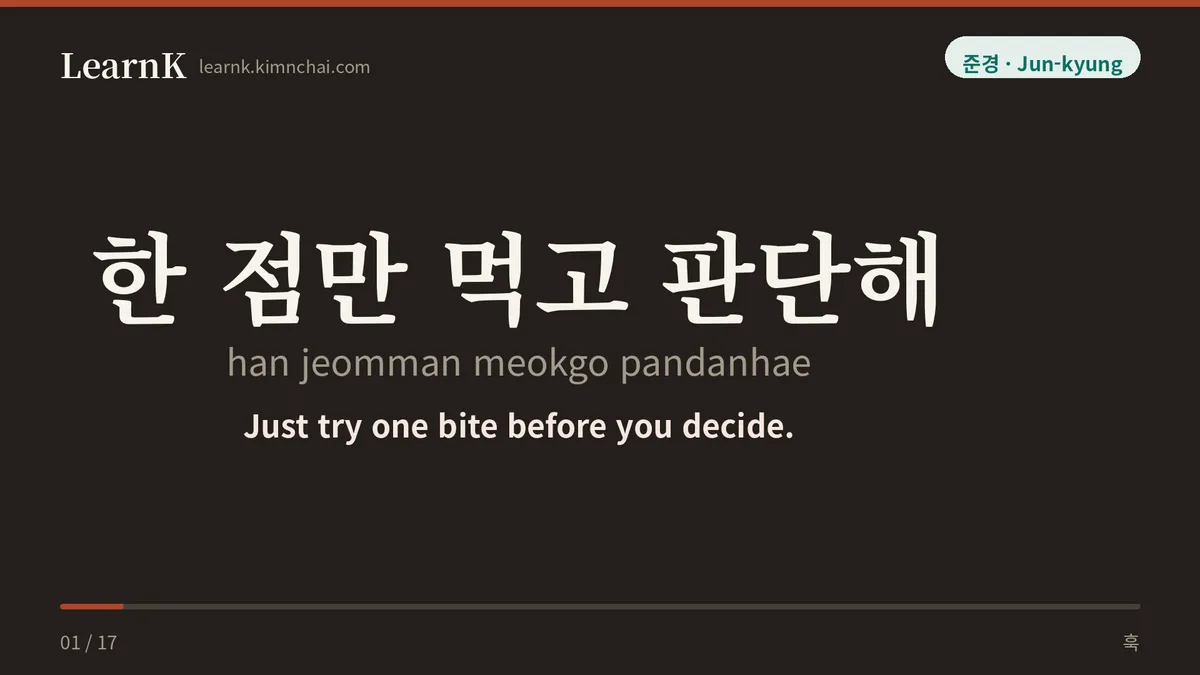
너 곱창 좋아해? (neo gopchang joahae?) — National Institute of Korean Language, Basic Korean Dictionary (krdict.korean.go.kr)
This is a casual (반말) expression for asking a friend about their taste — a question that comes up often before deciding on a spot for a group dinner.
(For reference, a Portuguese translation isn’t included in the dictionary, so we’ve rendered it ourselves for learners: it corresponds to tripa de boi. Please note that this translation is our own creation, not dictionary material.)
Example Sentences by Situation
1. When deciding on a spot for a group dinner
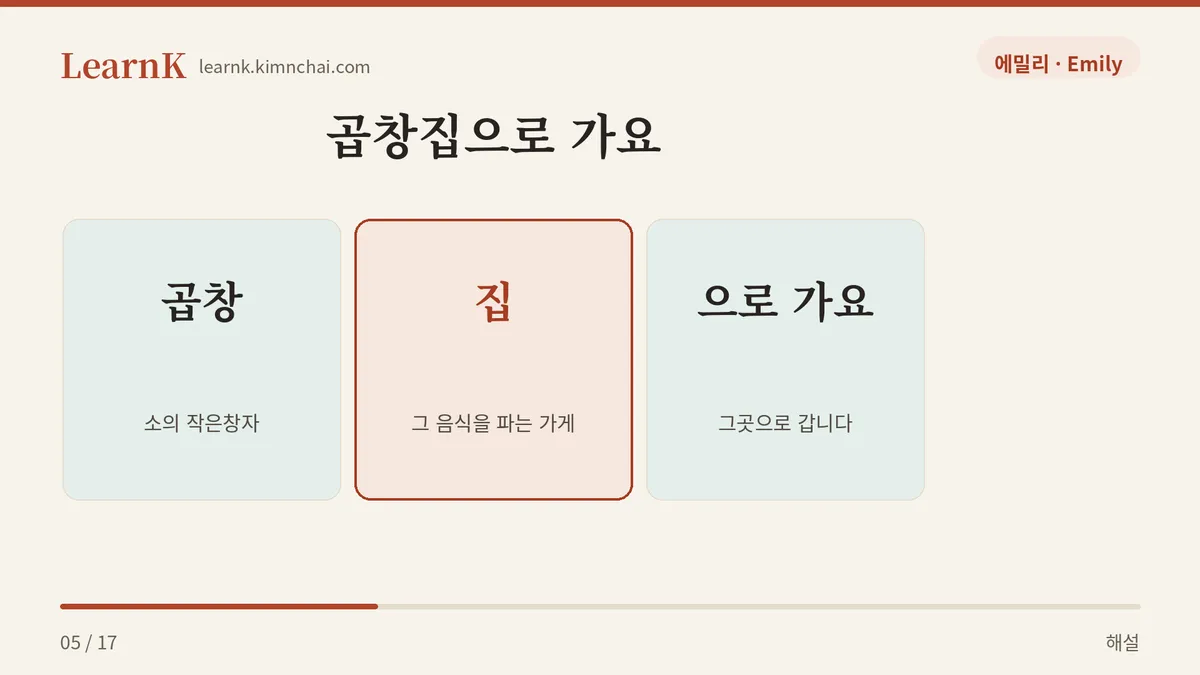
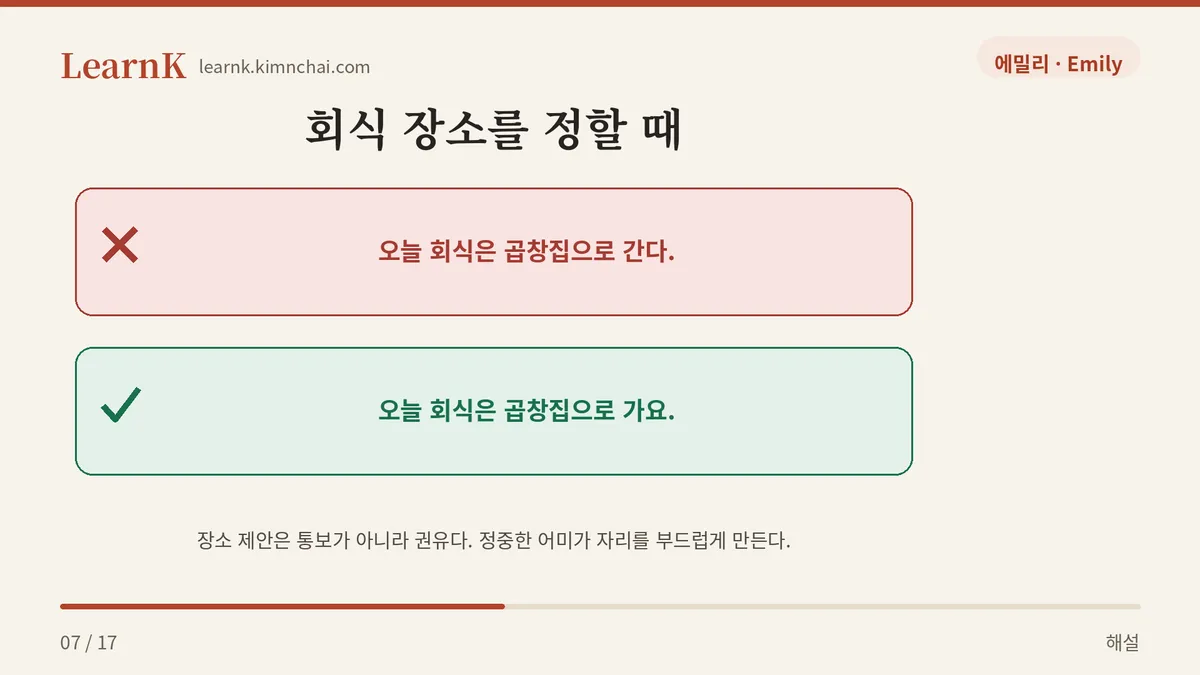
오늘 회식은 곱창집으로 가요. (oneul hoesigeun gopchang-jibeuro gayo.) — Let’s go to a gopchang place for today’s group dinner.
A restaurant that serves 곱창 is called a 곱창집 (gopchang-jip). This is a polite way to suggest a menu for the group dinner.
2. When sharing your preferences
저는 곱창은 좋아하는데 막창은 좀 부담스러워요. (jeoneun gopchang-eun joahaneunde makchang-eun jom budamseureowoyo.)
This sentence explains your own taste by comparing 곱창 with 막창 (makchang), a similar cut.
3. When ordering at a restaurant
곱창 2인분이랑 볶음밥 하나 주세요. (gopchang i-inbun-irang bokkeumbap hana juseyo.)
볶음밥 (bokkeumbap) — fried rice made by stir-frying rice in the seasoning left over after you’ve finished the 곱창 — is the 국룰 (unspoken standard, i.e., the essential final course) of a gopchang place.
Comparing Polite vs. Casual Speech and Similar Expressions
Even the same question about someone’s taste changes depending on who you’re talking to. With a friend, you use casual speech: “너 곱창 좋아해? (neo gopchang joahae?)”, and with an elder or someone you’re meeting for the first time, you use polite speech: “곱창 좋아하세요? (gopchang joahaseyo?)”.
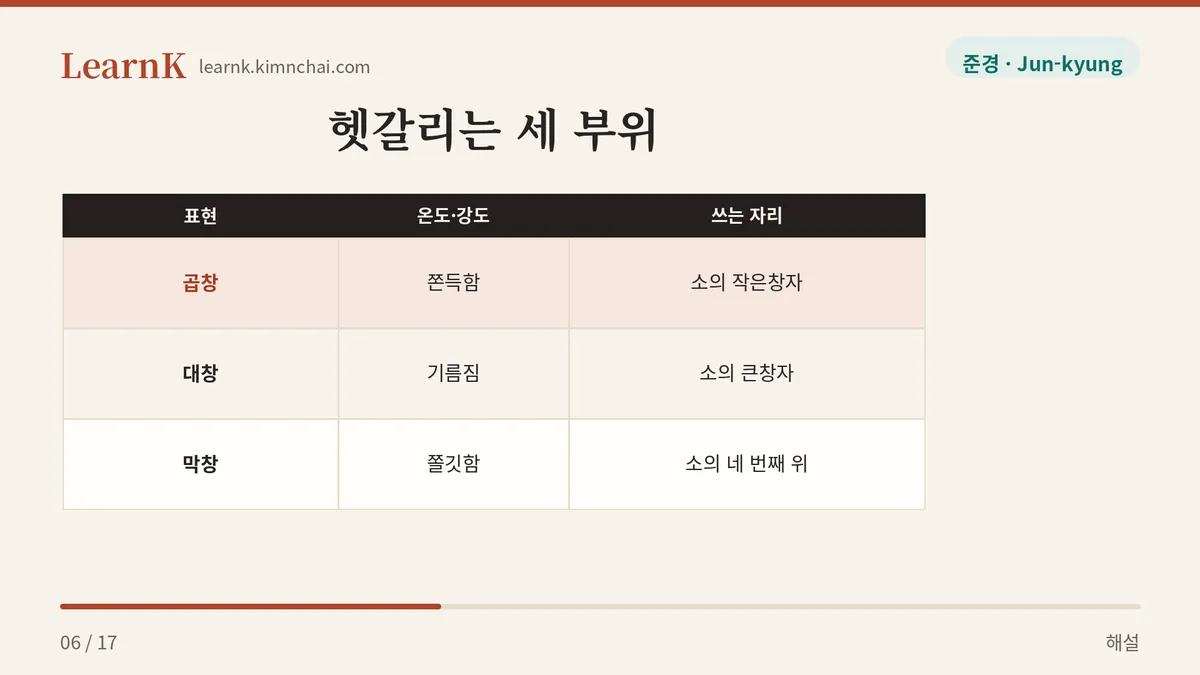
Shall we also sort out the cuts that are easy to confuse with 곱창? 곱창 is a cow’s small intestine, 대창 (daechang) is the large intestine, and 막창 (makchang) is a cow’s fourth stomach. All three are eaten grilled, but they differ in texture and fattiness, and Koreans sometimes get into heated debates over these differences.
Cultural Background
곱창 is more than just food — it symbolizes a “place of comfort.” Even in dramas, it’s common to see characters who’ve had a hard day gather at a gopchang place and pour out what’s on their minds.
오늘 같은 날엔 곱창에 소주지. (oneul gateun naren gopchang-e sojuji.) — A paraphrase of a group-dinner scene in the mood of the drama Guardian: The Lonely and Great God (쓸쓸하고 찬란하神 – 도깨비)
(The sentence above is not the original line from any specific script, but a loose rendering of the gopchang-place scenes that so often appear in Korean dramas.) In this way, 곱창 is a food of Korean-style 정 (情, deep affection), shared in both joy and comfort.
Closing Quiz
Q. What do you call the final dish you make by adding rice to the leftover seasoning and stir-frying it after you’ve finished your 곱창?
(Answer: 볶음밥 (bokkeumbap) — the popular closing course at a gopchang place.)
Definitions and example sentences are from the National Institute of Korean Language’s Basic Korean Dictionary (krdict.korean.go.kr); that portion of this post, including our translations, is licensed under CC BY-SA 2.0 KR.