굿즈 (gutjeu): How to Hold Your Bias in Your Hands — A Word Every K-pop Fan Knows
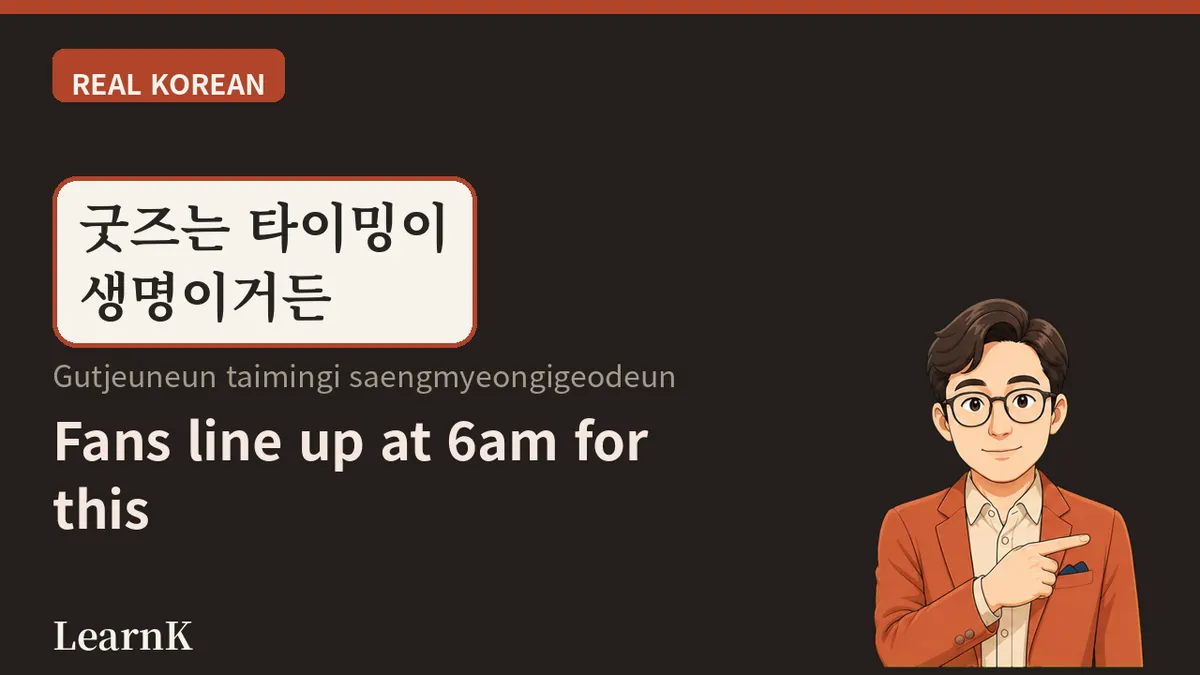
Outside a K-pop concert venue, a long line stretches out hours before the doors even open. Fans aren’t waiting like that just to get into the show. Photocards, light sticks, plushies, T-shirts — they’re there to get their hands on 굿즈 (gutjeu). Today we take a deep dive into a word that Korean-culture fans hear and say several times a day: 굿즈.
굿즈
굿즈 (gutjeu) is a loanword from the English “goods,” but in Korean its meaning is far narrower — and far more passionate. It doesn’t mean just any “product”; it refers to merchandise made in connection with something you love. Idol photocards, drama OST albums, anime figures, sports team jerseys — the moment “something I love” takes physical form, it becomes 굿즈.
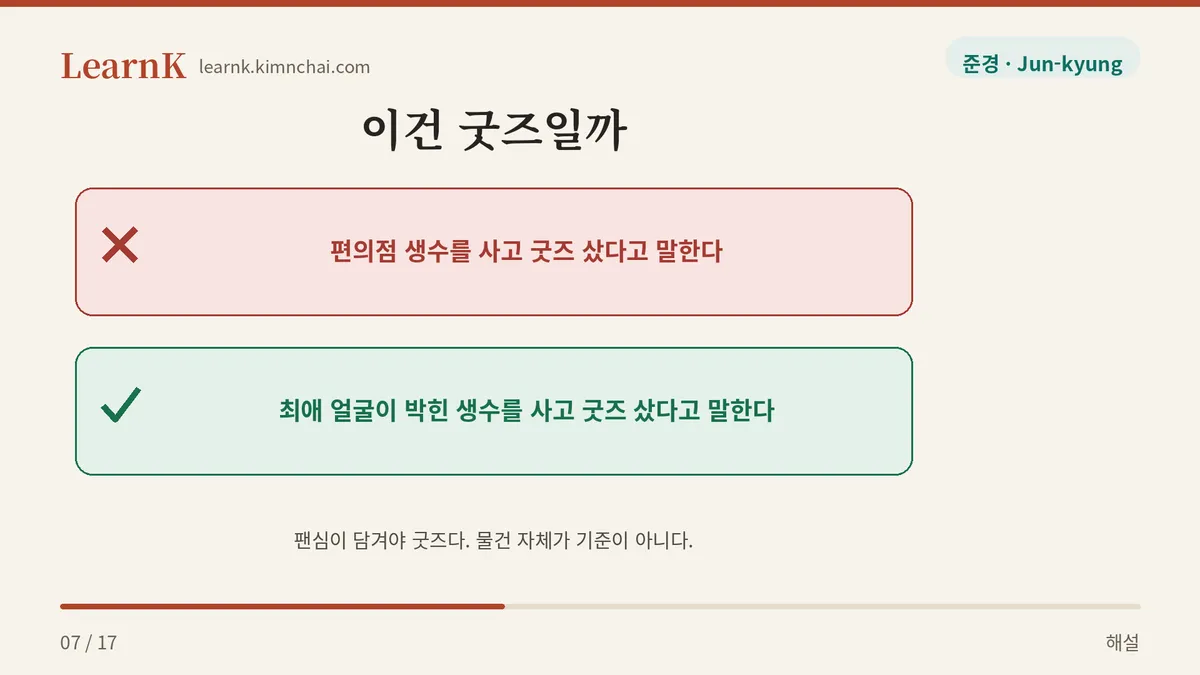
The key nuance is 팬심 (paensim) — a fan’s devotion. A regular bottle of water sold at a convenience store isn’t 굿즈, but a bottle of water with your bias idol’s face on it is. It’s a word where the feeling of “collecting” and “stanning” comes before practicality. That’s why 굿즈 is always accompanied by words like 한정판 (hanjeongpan) (limited edition), 선착순 (seonchaksun) (first-come-first-served), and 오픈런 (openreon) (open run).
Checking the National Institute of Korean Language dictionary
The National Institute of Korean Language’s Basic Korean Dictionary defines 굿즈 like this:
굿즈 「noun」 Merchandise produced in connection with a particular celebrity, drama, animation, event, and so on. [en] goods · [ja] グッズ · [es] mercancía oficial · [zh] 周边产品 — National Institute of Korean Language, Basic Korean Dictionary (krdict.korean.go.kr)
Shall we also look at the real usage examples the dictionary provides?
좋아하는 연예인의 굿즈를 사려는 팬들이 상점 앞에 길게 줄을 서 있다. (Fans hoping to buy their favorite celebrity’s merch are standing in a long line in front of the store.) — National Institute of Korean Language, Basic Korean Dictionary (krdict.korean.go.kr)
It’s exactly the “open run” scene we described up top. This single sentence shows why 굿즈 is a word inseparable from “lines.”
연예인이나 애니메이션 등과 관련한 굿즈의 판매가 늘고 있다. (Sales of merch related to celebrities, animation, and the like are on the rise.) — National Institute of Korean Language, Basic Korean Dictionary (krdict.korean.go.kr)
This carries the nuance that 굿즈 has now become an industry of its own. It’s the kind of sentence tone you often see in news articles.
이번에 열린 올림픽 관련 굿즈를 사고 싶은데 구할 수가 없네. (I want to buy some merch related to the Olympics that just took place, but I can’t get any.) — National Institute of Korean Language, Basic Korean Dictionary (krdict.korean.go.kr)
The important thing here is that 굿즈 is not used only for celebrities. Merch for an “event” like the Olympics is perfectly natural too.
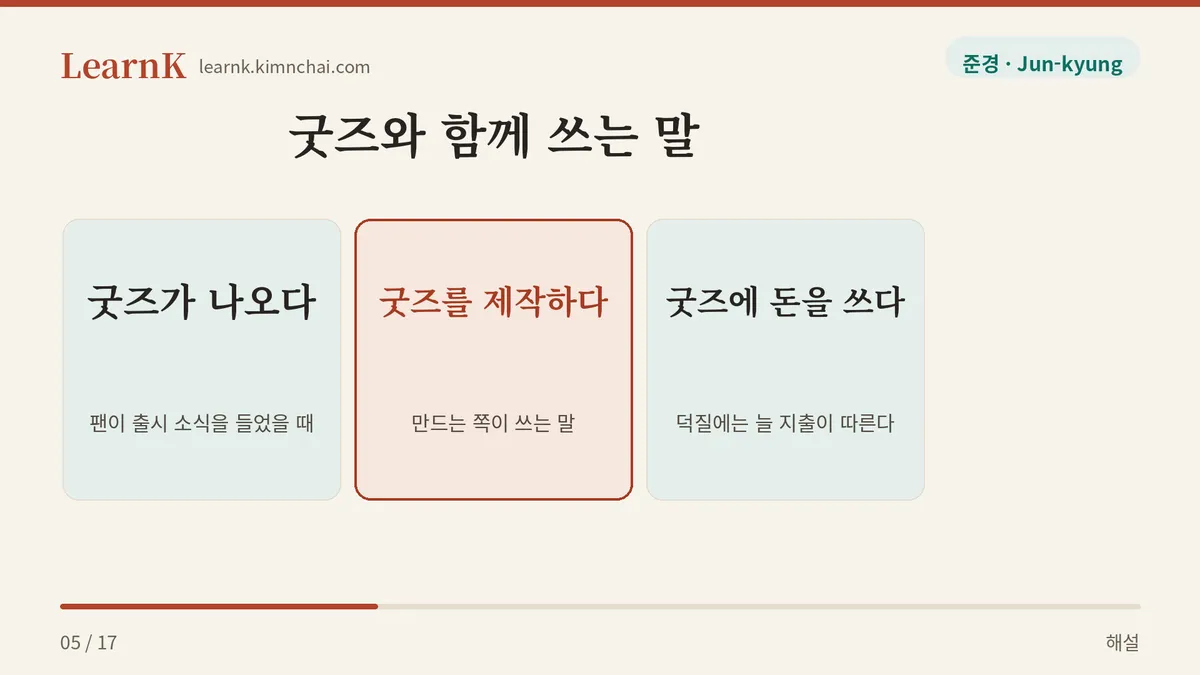
굿즈를 제작하다. / 굿즈가 나오다. (To produce merch. / For merch to come out.) — National Institute of Korean Language, Basic Korean Dictionary (krdict.korean.go.kr)
The makers say “제작하다 (to produce),” while fans who catch the news say “굿즈가 나오다 / 나왔다 (merch is out / came out).” Keep these two partner verbs in mind.
For reference, the dictionary has no Portuguese translation, so preserving the meaning it comes out to roughly produtos oficiais / mercadoria de fã (this Portuguese phrasing is our own translation, not from the dictionary).
Seeing it in a real conversation
Scene: In front of a K-pop pop-up store in Hongdae. It’s 30 minutes before opening, but the line is already so long it wraps around the alley.
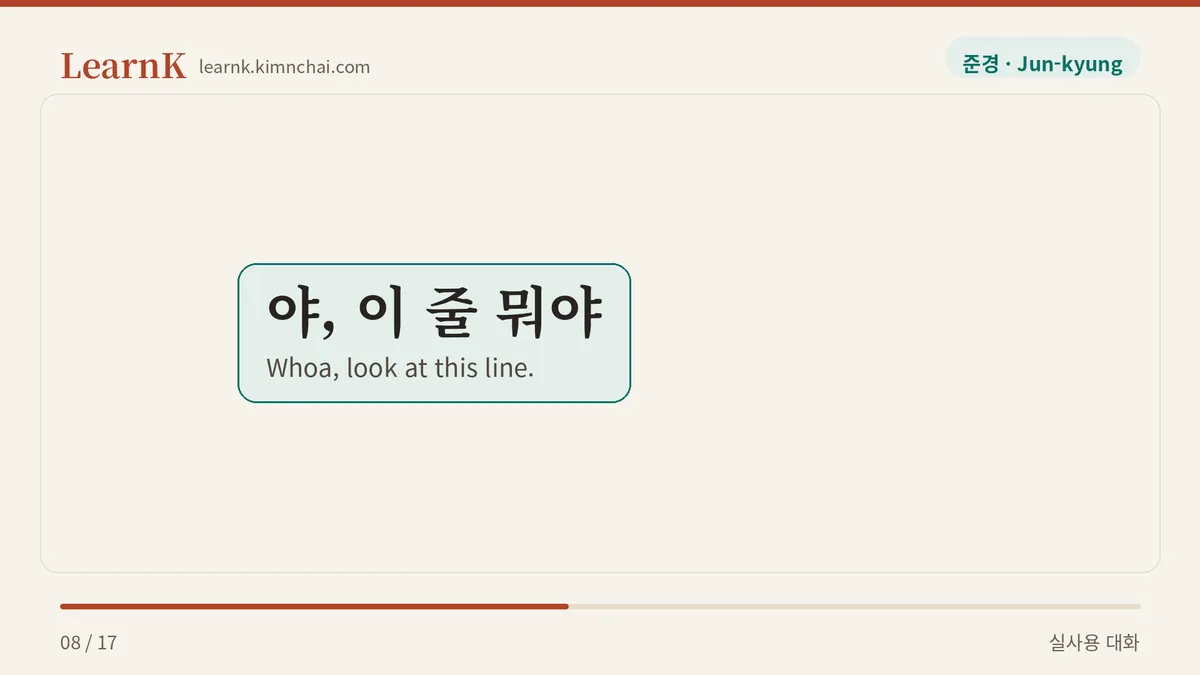
Jun-kyung: 야, 이 줄 뭐야. 우리 진짜 오늘 안에 들어갈 수 있는 거 맞아? Whoa, look at this line. Are we even going to get in today?
Emily: 당연하지. 이 정도면 양반이야. 나 지난번엔 새벽 여섯 시부터 줄 섰어. Of course. This is nothing. Last time I lined up from six in the morning.
Jun-kyung: 여섯 시? 대체 뭘 사려고 그렇게까지 해? Six a.m.? What on earth are you buying to go that far?
Emily: 한정판 굿즈. 오늘 놓치면 중고로 웃돈 주고 사야 돼. 굿즈는 타이밍이 생명이거든. Limited-edition merch. If I miss it today, I’ll have to pay a premium secondhand. With goods, timing is everything.
Jun-kyung: 아… 그래서 다들 오픈런을 하는구나. Ah… so that’s why everyone does the “open run.”
Emily: 이제 좀 알겠어? 들어가면 인형은 나한테 양보해. 알겠지? Getting it now? When we go in, the plushie’s mine. Deal?
Example sentences by situation
1) When you hear about new merch “이번 컴백 굿즈 나왔대! 응원봉이랑 포토카드 세트래.” (“The merch for this comeback is out! Apparently it’s a light stick and photocard set.”) → This is a typical sentence for sharing news of a new release in a fan group chat. “나왔대” is a shortened form of “나왔다고 해 (they say it came out).”
2) When you’re worried about your budget “이번 달 굿즈에 돈을 너무 많이 썼어. 다음 달은 진짜 아껴야 해.” (“I spent way too much on merch this month. Next month I really have to save.”) → “덕질 (deokjil)” — stanning — always comes with spending. 굿즈 often pairs like this with “돈을 쓰다 (to spend money).”
3) In a secondhand-trading situation “안 쓰는 굿즈 있으면 저한테 파세요. 정가에 살게요.” (“If you have merch you’re not using, sell it to me. I’ll buy it at face value.”) → Fans buying and selling 굿즈 among themselves is a whole culture. “정가 (jeongga)” means the original price.
Polite vs. casual speech, and related words
굿즈 itself is a noun, so its form doesn’t change — only the end of the sentence does.
- Casual: “굿즈 사러 가자. (gutjeu sareo gaja)” (Let’s go buy merch.)
- Polite: “굿즈 사러 가요. (gutjeu sareo gayo)” (Let’s go buy merch.)
It’s also good to learn some similar or related words:
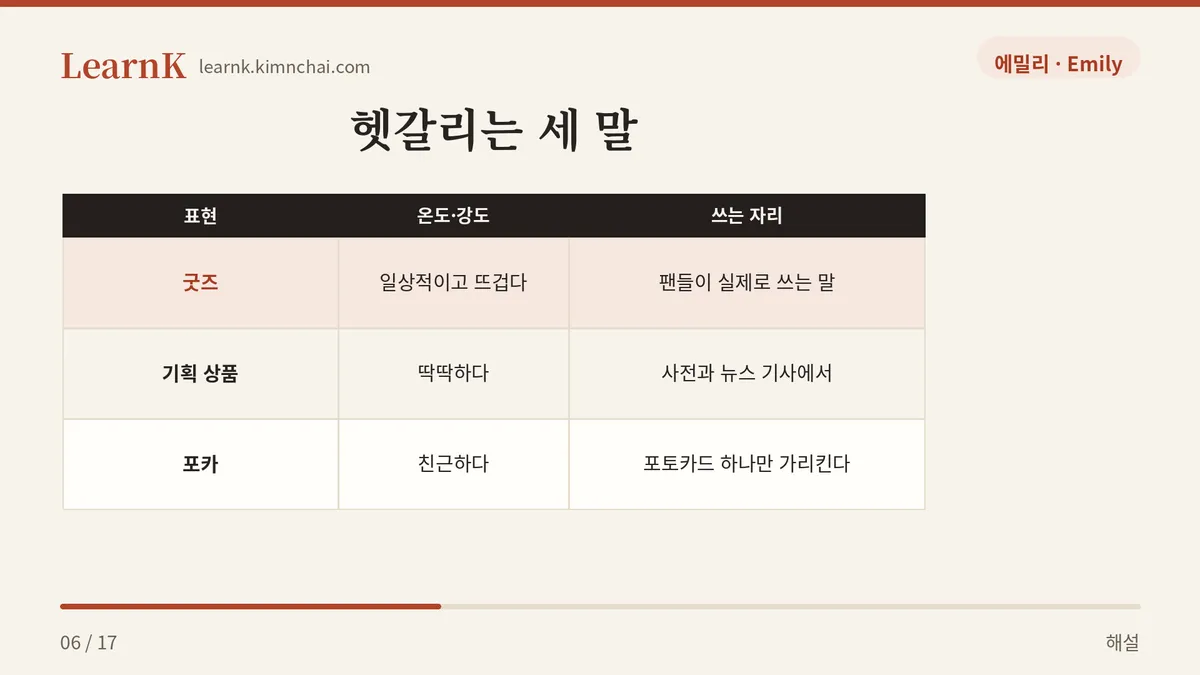
- 기획 상품 (gihoek sangpum): a more “purified” way of saying 굿즈. It shows up in the dictionary definition too, but in everyday conversation it sounds much stiffer.
- 포카 (poka): short for “포토카드 (photocard).” It’s the single most popular type of 굿즈.
- 한정판 (hanjeongpan): limited-edition merch, made in a set quantity. When this word gets attached, fans’ hands start moving fast.
Cultural background — why is 굿즈 such a big deal?
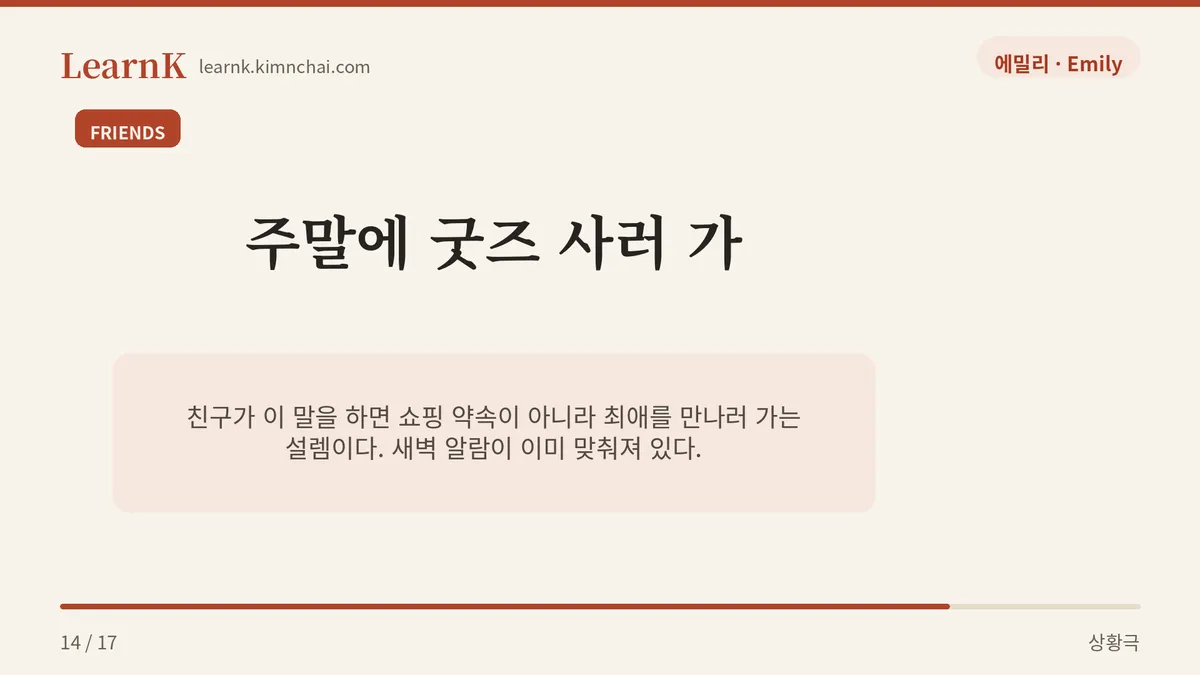
In Korea, 굿즈 goes beyond a simple “souvenir.” It’s a way to collect your feelings for a beloved idol or drama in a visible form, and a medium of communication for sharing those same feelings with like-minded people. The long lines in front of pop-up stores, the seasonal “시즌그리팅 (season’s greetings)” releases, the “포카 교환 (photocard exchanges)” where fans trade cards with one another — 굿즈 sits at the center of all these scenes. It’s the same in drama fandoms: when a popular show ends, it’s common for a published script book or OST to come out as 굿즈 and sell out completely. So when a Korean friend says, “나 이번 주말에 굿즈 사러 가 (I’m going merch shopping this weekend),” that’s not just shopping — it’s an expression of the thrill of “I’m going to meet my bias.”
Closing quiz
What word goes in the blank below?
“좋아하는 아이돌 얼굴이 그려진 한정판 컵을 샀어. 이런 걸 ____ 라고 해.” (“I bought a limited-edition cup with my favorite idol’s face on it. You call something like this ____.”)
The answer is — yes, that’s right. 굿즈 (gutjeu). Starting today, use it with confidence!
Definitions and example sentences are from the National Institute of Korean Language’s Basic Korean Dictionary (krdict.korean.go.kr); that portion of this post, including our translations, is licensed under CC BY-SA 2.0 KR.