귀성길 (gwiseonggil) — The Road You Take Even If It's Eight Hours Long
귀성길 (gwiseonggil)
귀성길 (gwiseonggil) means the road you travel down to your hometown to see your parents over a holiday. As 설날 (seollal, Lunar New Year) or 추석 (chuseok, Korean Thanksgiving) gets close, Korean news stations start running the same footage days in advance: a highway filmed from a helicopter, red taillights strung out to the horizon, and a caption across the bottom reading 귀성길 정체 절정 (gwiseonggil jeongche jeoljeong) — “holiday traffic home at its peak.” A drive that normally takes three hours crawls out to eight or nine hours, and people set off anyway.
So 귀성길 (gwiseonggil) isn’t simply the name of a route. It’s closer to the name of those few days, twice a year, when the whole country moves in the same direction. If you’re learning Korean and you happen to be in Korea around a holiday, you’ll hear this word several times a day — on the news, and in a coworker’s question, 언제 내려가? (eonje naeryeoga?, “When are you heading down?”).
Let’s break the meaning down a little more precisely. Three conditions have to hold for the word to fit. First, the destination has to be your hometown. A trip to Busan for work is not a 귀성길 (gwiseonggil), no matter how bad the traffic gets. Second, the direction is “down.” In Korean, going to your hometown is almost always described as 내려가다 (naeryeogada, “to go down”) regardless of where it actually sits on the map, and coming back is 올라오다 (ollaoda, “to come up”). Third, it has to be a holiday, or an occasion close to one. Popping over to your parents’ place on an ordinary weekend doesn’t get called a 귀성길 (gwiseonggil).
The tone is close to neutral, with a light coat of formality. Newspapers and broadcasters are fond of the word, so it carries a faint written-language smell, and that’s why friends talking casually are far more likely to say 집에 내려가다 (jibe naeryeogada), “go down home.” But formal doesn’t mean stiff here. If anything, the word holds weariness and tenderness at once — the reason people willingly swallow eight hours of stopped traffic is folded right into it.
See It in a Real Conversation
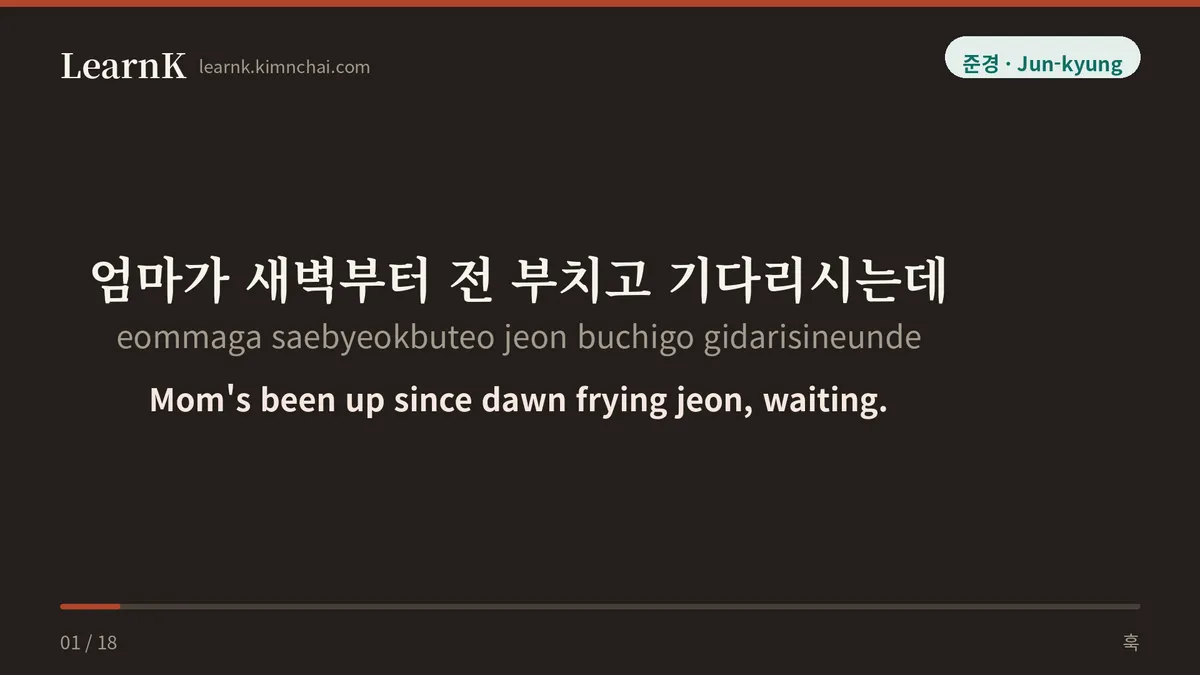
Setting: the evening before the Chuseok holiday, in the waiting room of an express bus terminal. The departure board is lined with SOLD OUT notices.
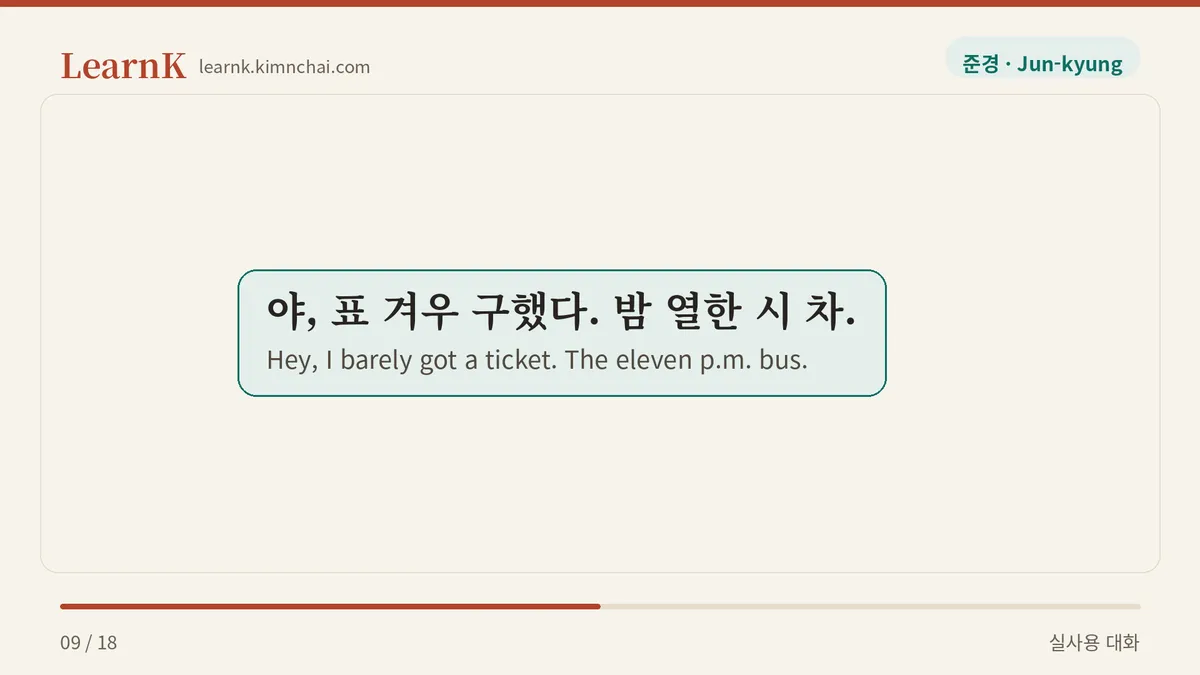
Jun-kyung: 야, 표 겨우 구했다. 밤 열한 시 차. Hey, I barely got a ticket. The eleven p.m. bus.
Emily: 헐, 밤 열한 시? 귀성길 진짜 장난 아니네. What, eleven at night? The holiday trip home is no joke.
Jun-kyung: 명절엔 늘 이래. 평소 세 시간이면 갈 길을 여덟 시간 걸려서 가. It’s always like this on holidays. A three-hour drive takes eight.
Emily: 그럼 연휴 끝나고 가면 안 돼? 나 같으면 그냥 미룰 것 같은데. Then can’t you go after the holiday? I’d just put it off.
Jun-kyung: 그게 안 되지. 엄마가 새벽부터 전 부치고 기다리시는데. No way. Mom’s been up since dawn frying jeon, waiting.
Emily: 아… 그래서 다들 그 고생을 하면서도 귀성길에 오르는 거구나. Ah… so that’s why everyone goes through all that and still sets off for home.
These Would Sound Off
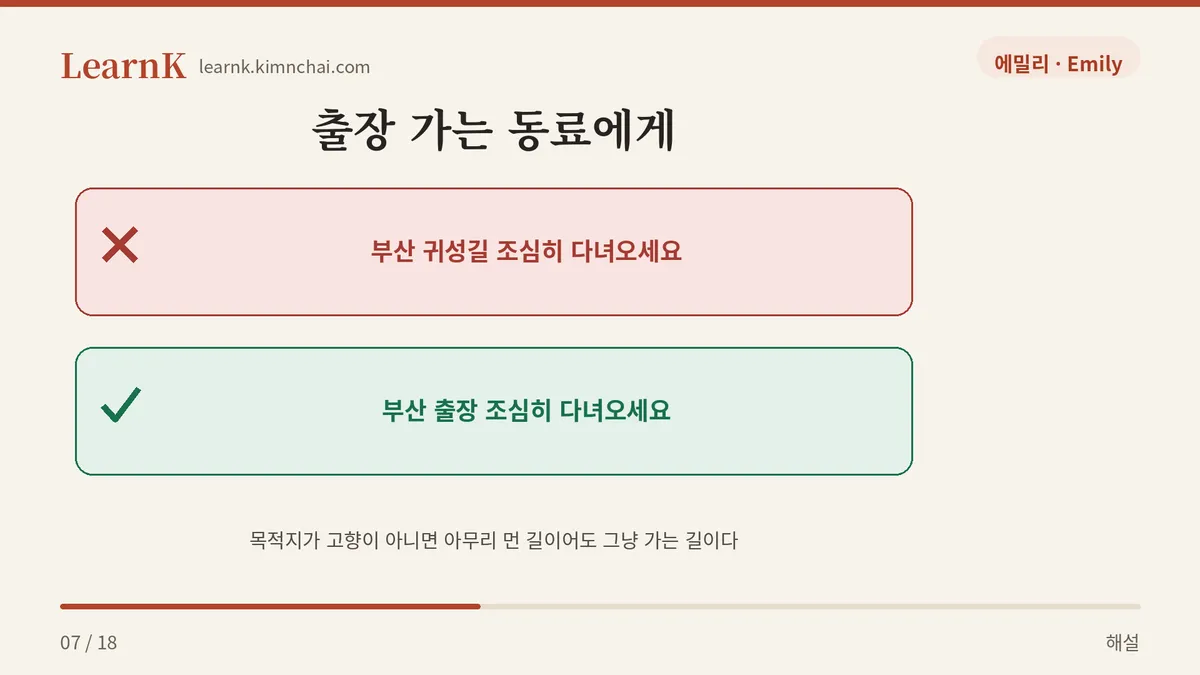
✗ (To a coworker leaving on a business trip) 부산 귀성길 조심히 다녀오세요. ✓ (To a coworker leaving on a business trip) 부산 출장 조심히 다녀오세요. (“Have a safe trip to Busan for work.”) → 귀성길 (gwiseonggil) refers only to “the road taken to see your parents in your hometown.” If the destination isn’t your hometown, it’s just 가는 길 (ganeun gil, “the way there”), however long the drive. Attach it to a vacation or a business trip and your listener will pause for a second.
✗ (On the last day of the holiday, driving from your hometown back to Seoul) 이제 귀성길 막히겠다, 얼른 출발하자. ✓ (On the last day of the holiday, driving from your hometown back to Seoul) 이제 귀경길 막히겠다, 얼른 출발하자. (“The road back is going to jam up soon — let’s get going.”) → The road down is 귀성길 (gwiseonggil); the road back up is 귀경길 (gwigyeonggil). Korean speakers sort these two automatically by direction, so swapping them briefly scrambles your listener’s sense of which way you’re going. The news splits them precisely too: 귀성길 (gwiseonggil) at the front of the holiday, 귀경길 (gwigyeonggil) at the back.
Example Sentences by Situation
1. Before a holiday, with a coworker at the office
저는 내일 오후에 귀성길에 오를 예정이에요. 새벽에 출발하면 좀 낫다던데요. jeoneun naeil ohue gwiseonggire oreul yejeongieyo. I’m planning to set off for my hometown tomorrow afternoon. They say it’s a bit better if you leave before dawn.
귀성길에 오르다 (gwiseonggire oreuda) is the phrase this word travels with most often. 길에 오르다 (gire oreuda) means to set out on a journey, so it carries a little more weight than plain 간다 (ganda, “I’m going”). It’s exactly the level of formality that works when you’re telling your boss your holiday plans.
2. Stuck in traffic in the car, with family
귀성길이 이렇게 막힐 줄 알았으면 그냥 기차 탈걸. gwiseonggiri ireoke makil jul arasseumyeon geunyang gicha talgeol. If I’d known the drive home would be this backed up, I’d have just taken the train.
The ending -ㄹ걸 (-lgeol) is what you use to regret a choice you’ve already made. It’s also one of the most-said sentences on Korean roads. Holiday gridlock repeats every single year, and so does this line.
3. To a friend you haven’t talked to in a while
이번 설엔 귀성길 포기했어. 표가 하나도 없더라. ibeon seoren gwiseonggil pogihaesseo. pyoga hanado eopdeora. I gave up on going home this Seollal. There wasn’t a single ticket left.
In casual speech the word lightens up like this. The ending -더라 (-deora) tacked on the end gives it the feel of reporting something you experienced firsthand. It’s a common way to explain why you can’t make it home for a holiday.
Formal vs. Casual, and Similar Expressions
귀성길 (gwiseonggil) is a noun, so it carries no politeness level on its own. The formal/casual split happens in the verb that follows. With someone older or senior, a slightly formal pairing like 귀성길에 오르다 (gwiseonggire oreuda) works well; with friends, 내려가다 (naeryeogada) sounds natural. Here’s how it compares with related expressions.
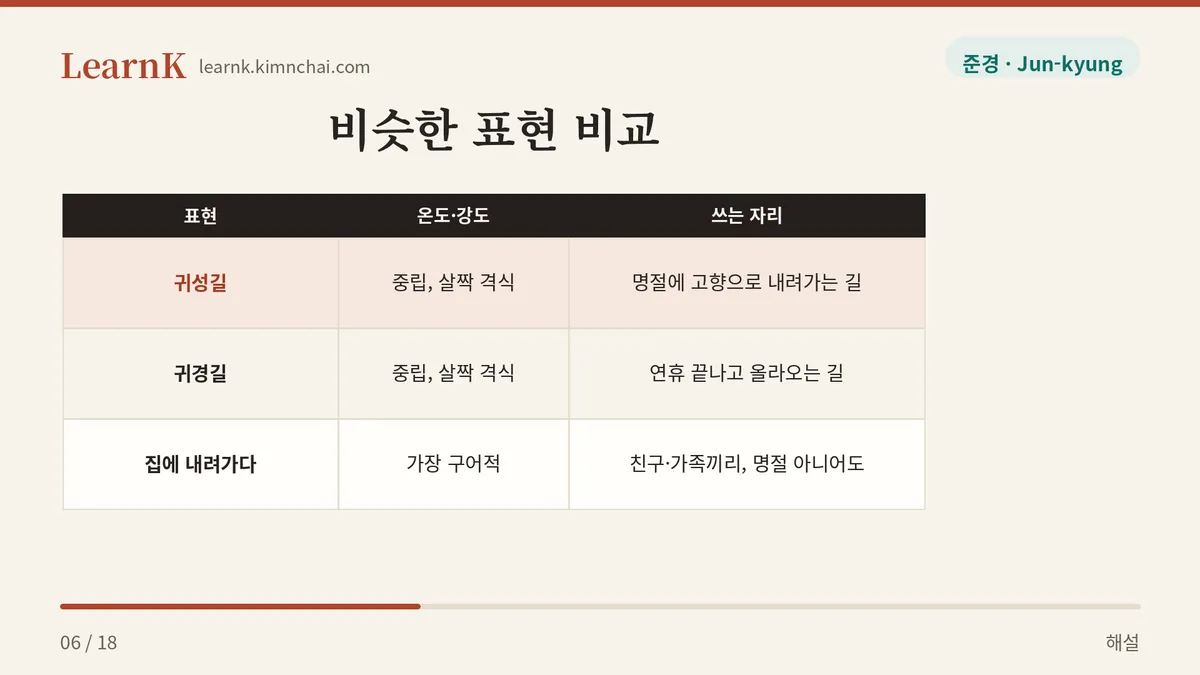
| Expression | Tone & intensity | Where it’s used |
|---|---|---|
| 귀성길 (gwiseonggil) | Neutral, slightly formal. News register | Talk about holiday traffic and travel. Also used in everyday conversation |
| 귀경길 (gwigyeonggil) | Neutral, slightly formal | The road back after the holiday ends. Opposite direction |
| 고향 가는 길 (gohyang ganeun gil) | Soft, lyrical | Doesn’t need to be a holiday. Sentimental writing or speech |
| 집에 내려가다 (jibe naeryeogada) | Most colloquial, most relaxed | Between friends and family. Doesn’t need to be a holiday |
As the table shows, 귀성길 (gwiseonggil) and 귀경길 (gwigyeonggil) aren’t near-synonyms — they’re a pair pointing in exactly opposite directions. Memorize them as a set and holiday news broadcasts suddenly start making sense as a whole. 집에 내려가다 (jibe naeryeogada), on the other hand, has no holiday condition attached, so it’s used far more broadly. For a learner, it’s also the one you’ll actually use most often.
Cultural Background — A Road Taken to Check In
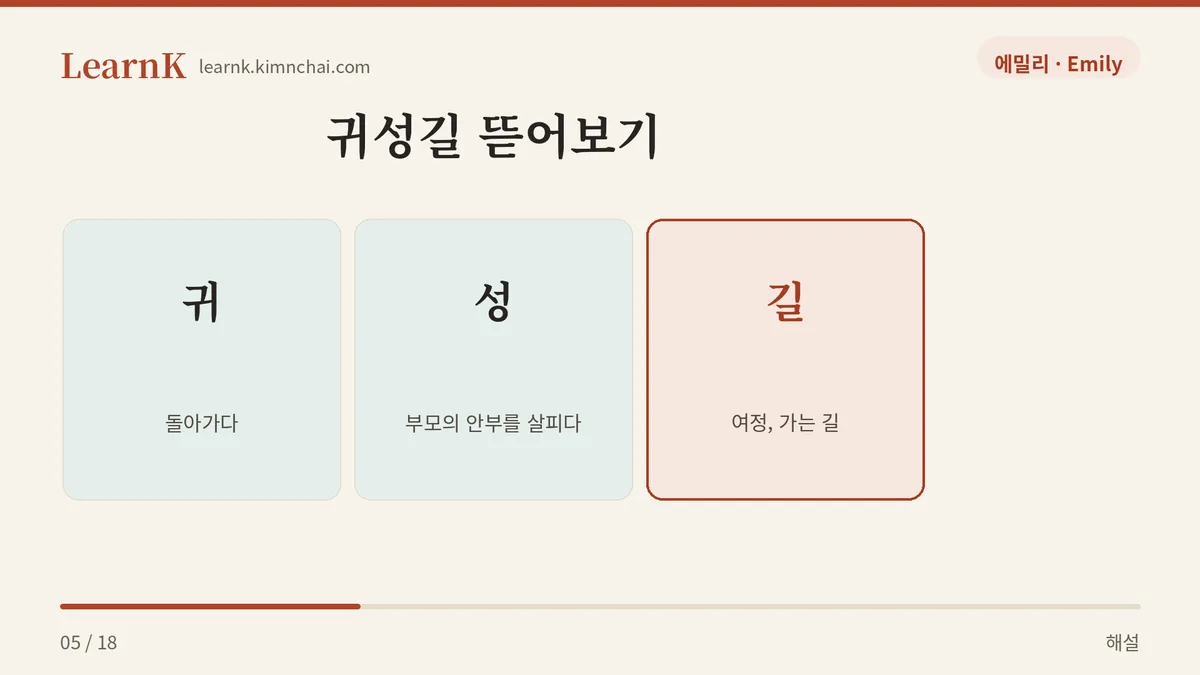
귀성 (gwiseong) is a Sino-Korean word, written 歸省: 歸 (귀, gwi) “to return” plus 省 (성, seong) “to look after, to examine.” Translated literally it’s “return and check” — and what you’re checking on is your parents’ well-being. So at the root of this word sits not a road but an act: seeing with your own eyes that your parents are doing all right. Add the native Korean word 길 (gil, “road”) and you get 귀성길 (gwiseonggil). In its counterpart 귀경 (gwigyeong, 歸京), the 京 (경, gyeong) is the character for the capital, Seoul. “The road back up to Seoul from your hometown” is written right into it.
There’s a reason this word lands so heavily. In the late twentieth century, as people crowded into the big cities for work, Korea settled into a structure where the parents’ generation stayed in the provinces and the children’s generation lived in Seoul and the surrounding metro area. So when a holiday comes, tens of millions of people move in the same direction at the same time. Korean media calls this phenomenon the 민족 대이동 (minjok daeidong), the “great migration of the people.” It sounds like an exaggeration, but during those few days central Seoul really does go noticeably quiet, and highway rest stops are packed at three in the morning.
This is also why holiday scenes show up so often in Korean dramas and films. The whole family gathers in one place, so conflicts and reconciliations both erupt right there. But such scenes usually begin not at the dinner table but on the road: a couple bickering in a car that hasn’t moved in twenty minutes, or someone realizing they left their parents’ gift at home. 귀성길 (gwiseonggil) is a stage where the story starts.
The picture is shifting a little these days. There’s now a word for parents traveling up to their children’s homes in Seoul — 역귀성 (yeokgwiseong), “reverse gwiseong” — and more people spend the holiday on a trip abroad. The pressure people used to feel for not going home has faded compared with the past. Even so, the crowds filling terminal waiting rooms the night before a holiday, the fruit boxes and backpacks in their hands, look exactly the same. That’s why the word 귀성길 (gwiseonggil) hasn’t lost its force yet.
Today’s Quiz
It’s the afternoon of the last day of the Chuseok holiday, and you’re on the highway heading from your hometown back to your place in Seoul. What will the radio traffic report say?
① 지금 귀성길 정체가 절정입니다 (Traffic heading down to hometowns is at its peak right now.) ② 지금 귀경길 정체가 절정입니다 (Traffic heading back to Seoul is at its peak right now.) ③ 지금 출근길 정체가 절정입니다 (Commuter traffic is at its peak right now.)
The answer is ②. The road down to your hometown is 귀성길 (gwiseonggil); the road back up to Seoul is 귀경길 (gwigyeonggil). The last day of a holiday is the day everyone returns, so the radio reports 귀경길 (gwigyeonggil) congestion. Remember it by direction: go down, 귀성 (gwiseong); come up, 귀경 (gwigyeong).
Definitions and example sentences are from the National Institute of Korean Language’s Basic Korean Dictionary (krdict.korean.go.kr); that portion of this post, including our translations, is licensed under CC BY-SA 2.0 KR.