Hongdae — Seoul's Street of Youth, and What a Single Name Holds
If you’ve been to Korea, or if you enjoy K-pop music videos and variety shows, you’ve probably heard these two syllables at least once. In Seoul, if you ask a friend, “Where should we meet this weekend?”, eight times out of ten they’ll answer like this: “Let’s just meet at Hongdae.” Strangely, there’s no exact address in these words. And yet everyone knows where it means. Today, let’s talk about how a single place name came to point to a whole mood all by itself.
홍대
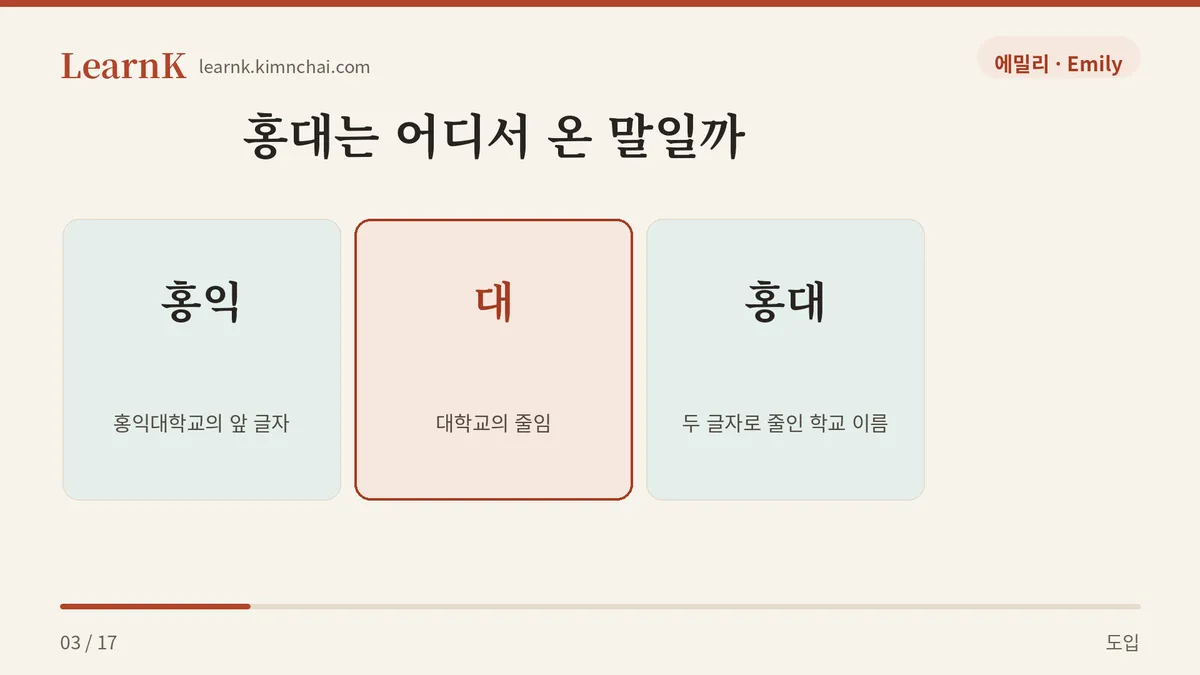
홍대 (Hongdae) is originally a shortened way of saying ‘홍익대학교 (Hongik University)’ in Seoul. You just take the first two syllables of Hongik University and call it 홍대 (Hongdae). In Korea, shortening a university name to two syllables like this is very common. Korea University becomes 고대 (Godae), and Konkuk University becomes 건대 (Geondae), and so on.
But when Koreans today say “홍대 가자 (let’s go to Hongdae),” it almost never means going to a campus to study. Here, 홍대 (Hongdae) refers not to the school, but to the entire neighborhood that stretches out around the school. The streets centered on Hongik University Station on subway Line 2, the cafés and clothing shops packed into every alley, the clubs, and even the indie bands that play every night — the name that bundles all these scenes of youth into a single word is exactly 홍대 (Hongdae).
So the nuance of this word is less about a simple ‘location’ and closer to a ‘feeling.’ If someone says “나 홍대 스타일 좋아해 (I like the Hongdae style),” it means they like a young sensibility that’s free, a little hip, and artistic. The place name ends up being used almost like an adjective.
Seeing It in a Real Conversation
Situation: Saturday afternoon, in front of Exit 9 of Hongik University Station. It’s their meeting spot, but there are so many people that they can’t find each other and are on the phone.
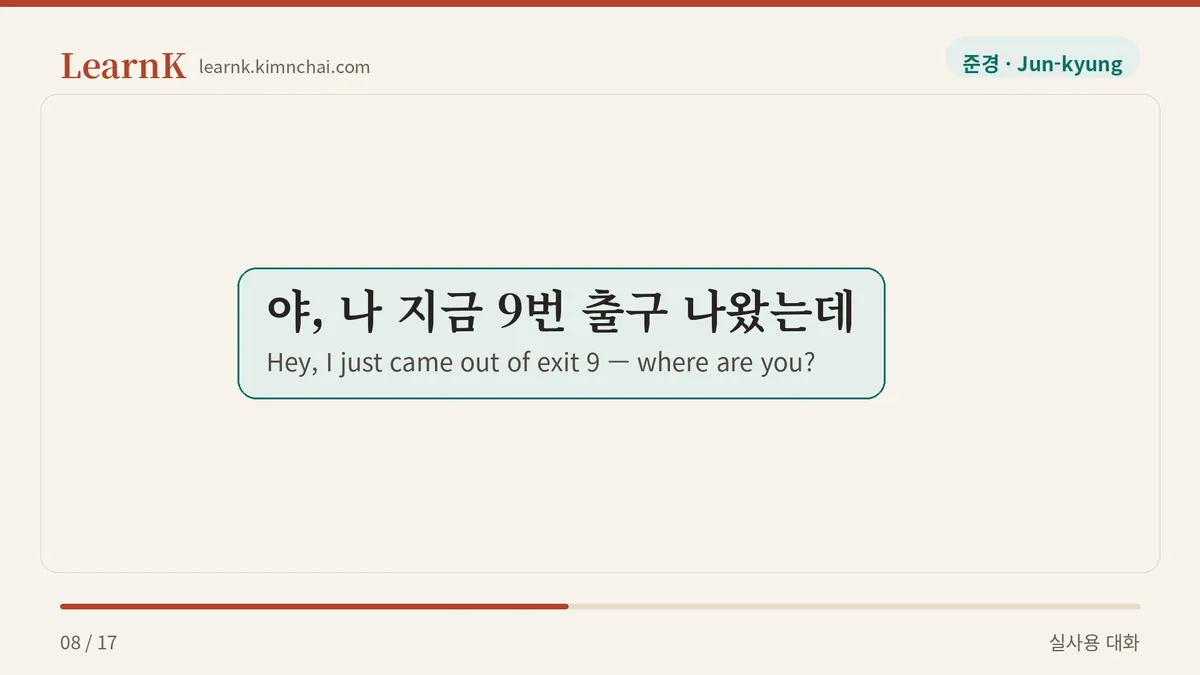
Jun-kyung: 야, 나 지금 9번 출구 딱 나왔는데, 너 어디야? Hey, I just came out of exit 9 — where are you?
Emily: 나도 홍대 도착했어! 근데 사람 진짜 미쳤다. 너 안 보여. I’m at Hongdae too! But it’s insanely crowded. I can’t see you.
Jun-kyung: 그니까. 주말 홍대는 원래 이래. 저기 버스킹하는 쪽으로 와. I know. Weekend Hongdae is always like this. Come toward where they’re busking.
Emily: 아, 노래 들리는 데? 알았어, 금방 갈게. Oh, where the music’s coming from? Got it, I’ll be right there.
Jun-kyung: 오늘 클럽 갈래, 아니면 그냥 골목 구경할래? You wanna hit a club today, or just wander the alleys?
Emily: 걷자, 걷자. 나 홍대 골목 구경하는 게 제일 좋더라. Let’s walk, let’s walk. Honestly wandering the Hongdae alleys is my favorite.
Example Sentences by Situation
1. When making plans
홍대에서 볼까? (Hongdae-eseo bolkka?) — “홍대에서 볼까?” means “Shall we meet at Hongdae?” It’s one of the first things young Koreans blurt out when deciding on a place to meet. Because it’s easy to get to and has so much to do, ‘let’s just do Hongdae’ works almost like a default setting.
2. When explaining your taste
저는 홍대 감성을 좋아해요. (Jeoneun Hongdae gamseong-eul joahaeyo.) — This means you like the free, artistic atmosphere. Here, 감성 (gamseong) refers to a ‘vibe or mood,’ and it’s used very often these days.
3. When talking about nightlife
주말엔 홍대가 밤새 시끌시끌해요. (Jumar-en Hongdae-ga bamsae sikkeulsikkeulhaeyo.) — This means that on weekend nights the streets of Hongdae bustle with people and music until late.
Polite vs. Casual Speech, and Similar Expressions
홍대 (Hongdae) itself is a place name, so it doesn’t have a polite-vs-casual distinction. Instead, the verb you use with it determines the tone. To a friend you’d say “홍대 가자! (Hongdae gaja!)”, while to someone older or someone you’re meeting for the first time you’d say “홍대 쪽으로 가시겠어요? (Hongdae jjogeuro gasigess-eoyo?)”.
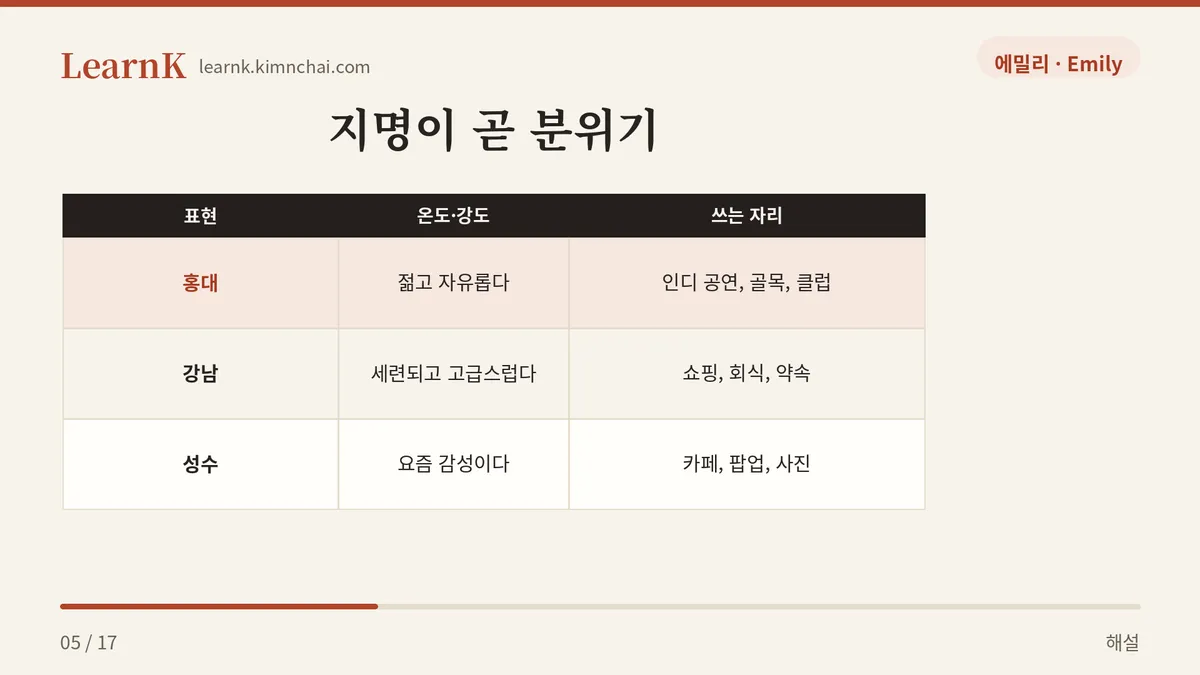
Similar expressions where ‘a neighborhood name has become a culture in itself’ include 강남 (Gangnam), 이태원 (Itaewon), and 성수 (Seongsu). If 강남 (Gangnam) has a polished, upscale feel, then the biggest difference is that 홍대 (Hongdae) has a young, free feel. Even within the same Seoul, each neighborhood has its own temperature.
Cultural Background
홍대 (Hongdae) came to have its current image thanks to Hongik University, which is famous for its art programs. As art students gathered, distinctive shops, galleries, and small performance venues naturally sprang up, and from the 1990s it became the center of Korean indie music and club culture. Even now, on weekend nights, you can commonly see ‘busking (버스킹)’ — unknown bands and dancers putting on shows all over the streets.
In Korean dramas and variety shows, too, the streets of Hongdae often appear as a backdrop when they want to show the free-spiritedness of youth — scenes where the main characters walk the alleys late into the night and share stories in a small bar. That’s why, for foreign travelers, 홍대 (Hongdae) is known as the easiest place to encounter the ‘living nightlife of Seoul.‘
Closing Quiz
A friend asks you, “이번 주말에 홍대 갈래? (Wanna go to Hongdae this weekend?)” What does the ‘홍대’ your friend mentioned point to? (a) Studying together at the Hongik University library (b) Hanging out on the lively streets around Hongik University
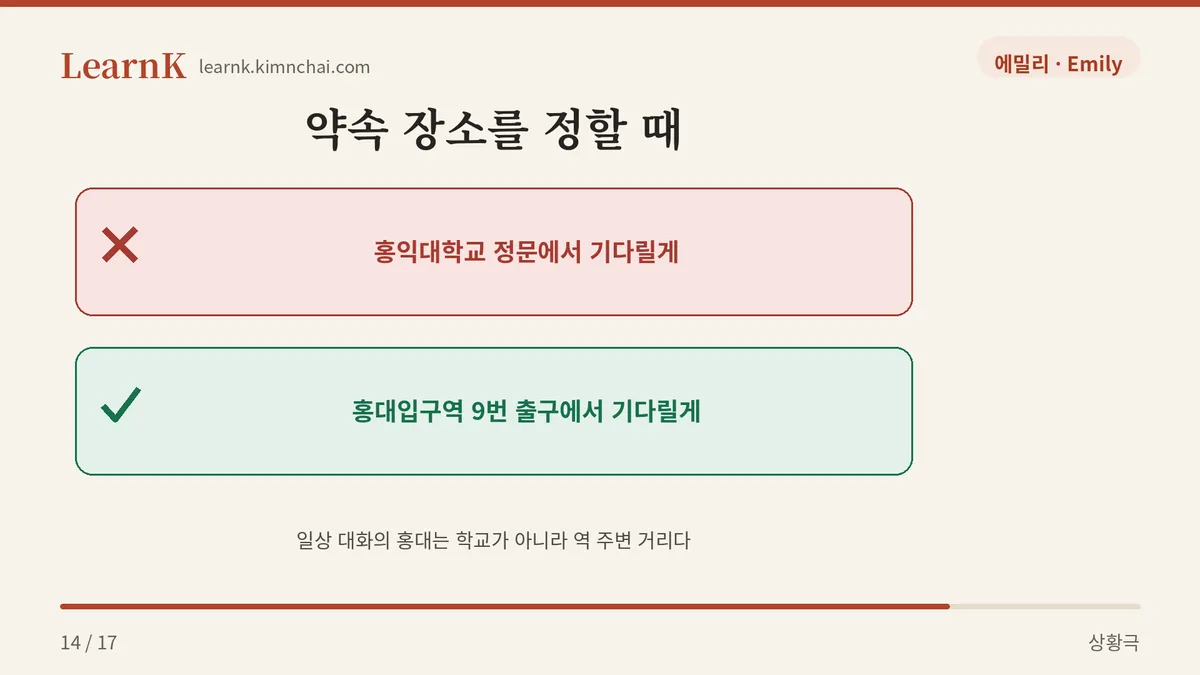
The answer is (b)! As we learned today, in everyday conversation 홍대 (Hongdae) means not the school, but the whole free-spirited atmosphere of that neighborhood. Next time you’re in Seoul, be sure to give it a shout in front of Exit 9: “우리 홍대에서 봐! (Let’s meet at Hongdae!)”