환승 (hwanseung): The Word the Station Announcements Teach You Every Day
환승
Once the subway doors close, almost every single time the same announcement comes on. “이번 역은 ○○역입니다. △호선으로 갈아타실 분은 이번 역에서 내리시기 바랍니다.” (“This stop is ○○ Station. Passengers transferring to Line △, please exit at this station.”) One of the Korean words you’ll hear most often in a single day when you’ve just arrived in Korea is exactly this one: 환승 (hwanseung). 환승 means changing over to a different line or a different mode of transportation. Subway to subway, bus to subway, international flight to domestic flight — it’s the word for when you can’t reach your destination in one go and have to board something else along the way.
It’s hard to avoid this word in Korea. It’s on the signs hanging from station ceilings, in the route directions in transit apps, and in the little voice the bus card reader makes when it says “환승입니다” (“This is a transfer”). So knowing the meaning alone isn’t enough. You’ll only sound like a Korean speaker once you also know when to use this word and when to use 갈아타다 (garatada) instead.
Let’s start with parts of speech. 환승 (hwanseung) is a noun, and adding ‘-하다’ to it gives you the verb 환승하다 (hwanseunghada). So you say things like “사당역에서 환승해요 (Sadang-yeogeseo hwanseunghaeyo)” — “I transfer at Sadang Station.” Because it’s a noun, another characteristic is that it pairs easily with other words. There are a great many set phrases built around it: 환승역 (hwanseungyeok), a transfer station; 환승 할인 (hwanseung harin), the system that discounts your fare when you transfer; 환승 통로 (hwanseung tongno), the underground passage connecting one line to another; 무료 환승 (muryo hwanseung), a free transfer.
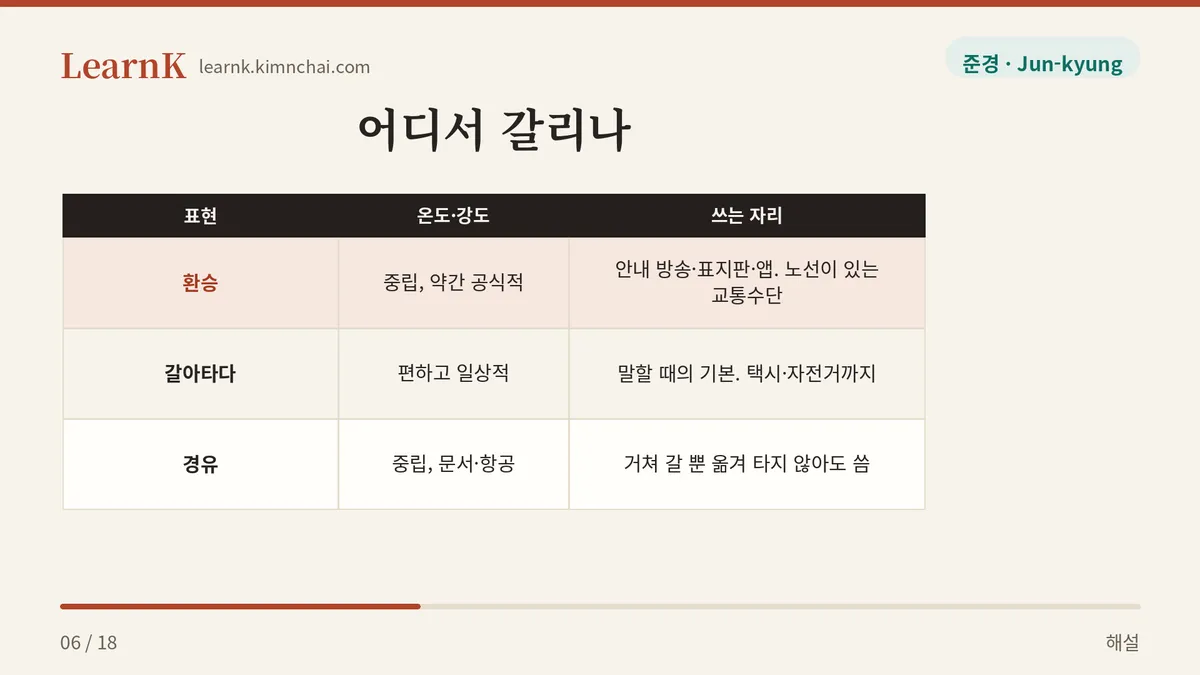
The tone is neutral and slightly official. It belongs to the world of “things the system says” — announcements, signs, app screens. When friends are chatting casually, they’re more likely to say “거기서 갈아타” (“Switch there”). That said, these days people mix it into everyday conversation too, as in “나 3호선으로 환승해야 돼” (“I have to transfer to line 3”), so neither one is wrong. I’ll lay out the difference in a table further down.
Checking the National Institute of Korean Language Dictionary
First, let’s look at exactly how the dictionary compiled by the national language institute defines this word.
환승 (noun) 다른 노선이나 교통수단으로 갈아탐. (The act of changing to another route or means of transportation.) [en] transfer; change — An act of switching to another route or means of transportation. [ja] のりかえ【乗り換え】 — 他の路線や交通手段に乗り継ぐこと。 [es] transferencia — Acción de conmutarse a otra ruta o medio de transporte. [zh] 换乘 — 改乘其它路线或交通手段。 — National Institute of Korean Language, Basic Korean Dictionary (krdict.korean.go.kr)
Notice that the definition ends in “갈아탐.” That’s the form made by attaching the nominalizing ending ‘-ㅁ’, which means the word points to the act itself. That’s why it can slot straight into subject or object position, as in “환승이 편하다” (“The transfer is convenient”) or “환승에 십 분 걸린다” (“The transfer takes ten minutes”).
(The Portuguese definition isn’t included in the dictionary, so we’ve added our own translation — [pt] baldeação; transferência — Ato de mudar para outra linha ou meio de transporte.)
Now let’s go through the actual usage examples listed in the dictionary one by one.
시민들이 환승하기 편하도록 지하철역에서 가까운 곳에 버스 정류장이 들어섰다. (A bus stop was built close to the subway station so that citizens could transfer easily.) — National Institute of Korean Language, Basic Korean Dictionary (krdict.korean.go.kr)
This is the kind of sentence you’d see in urban planning documents or news articles. Shortening the walk from the bus stop to the subway station is something Korea takes very seriously. In fact, in front of many major Seoul stations, the bus stop sits right on top of the subway exit.
교통 카드의 환승 할인 제도를 통해서 교통비를 절약할 수 있다. (You can save on transportation costs through the transit card’s transfer discount system.) — National Institute of Korean Language, Basic Korean Dictionary (krdict.korean.go.kr)
This is the example foreign learners feel firsthand the fastest. When you get off a bus and switch to the subway, using a transit card means you aren’t charged a brand-new fare — you only pay a bit more based on the distance traveled. That system is the 환승 할인 (hwanseung harin).
지하철 삼 호선으로 환승하려면 이번 역에서 내리라는 안내 방송이 나왔다. (An announcement came on saying that to transfer to subway line 3, you should get off at this station.) — National Institute of Korean Language, Basic Korean Dictionary (krdict.korean.go.kr)
This is that very announcement I mentioned at the start. It’s also worth learning that line numbers are read with Sino-Korean numbers (일, 이, 삼…), as in “삼 호선.” Line 2 is ‘이호선’ and line 4 is ‘사호선’.
직장 동료인 그와 나는 출근길 중도에 있는 환승역에서 우연히 마주쳤다. (My coworker and I happened to run into each other at a transfer station partway through our morning commute.) — National Institute of Korean Language, Basic Korean Dictionary (krdict.korean.go.kr)
Here’s an example using 환승역 (hwanseungyeok). Tens of thousands of people pass through big transfer stations like Sadang, Sindorim, Wangsimni, and Express Bus Terminal every morning. Running into a familiar face in a place like that really does happen fairly often.
국내선으로 환승하다. / 국철로 환승하다. (To transfer to a domestic flight. / To transfer to the national railway.) — National Institute of Korean Language, Basic Korean Dictionary (krdict.korean.go.kr)
What these two short examples teach you is the particle. The thing you’re transferring to takes ’-(으)로’ in front of 환승하다: “4호선으로 환승하다,” “버스로 환승하다.” Get this one particle into your muscle memory and you can apply it to any mode of transportation.
See It in a Real Conversation
Scene: Friday evening, on the subway. Emily is on her way to Jun-kyung’s housewarming party, but she has a feeling she got on the wrong line.
Jun-kyung: 어디쯤이야? 다들 왔는데 너만 없어. Where are you? Everyone’s here except you.
Emily: 나 지금 2호선인데… 뭔가 반대로 가는 느낌인데? I’m on line 2 right now… but it kinda feels like I’m going the wrong way?
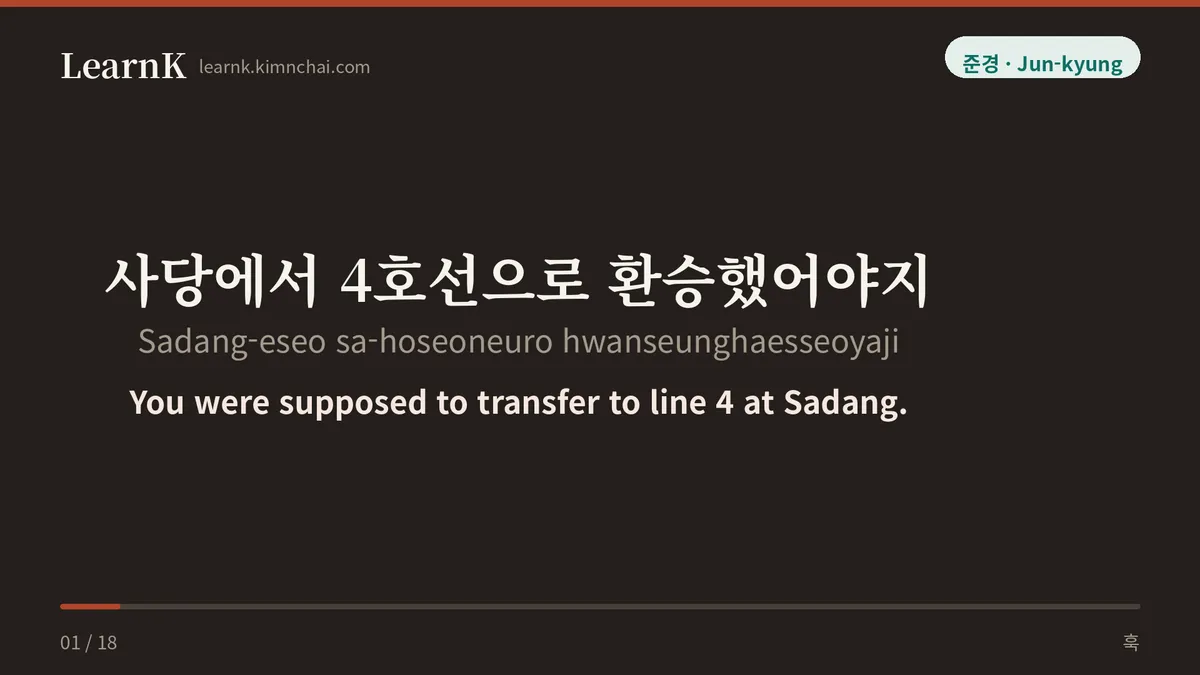
Jun-kyung: 어? 2호선 탔어? 사당에서 4호선으로 환승했어야지. Huh? You got on line 2? You were supposed to transfer to line 4 at Sadang.
Emily: 아 진짜… 안내 방송 나올 때 폰 보고 있었어. 지금이라도 갈아타면 돼? Oh no… I was looking at my phone when the announcement came on. Can I still switch now?
Jun-kyung: 응, 교대에서 3호선으로 환승해. 거기 환승 통로가 좀 긴데 그래도 십 분이면 와. Yeah, transfer to line 3 at Gyodae. The transfer passage there is kinda long, but you’ll still make it in ten minutes.
Emily: 오케이. 근데 나 버스에서 내린 지 삼십 분 넘었는데, 환승 할인은 날아갔겠지? Okay. But it’s been over thirty minutes since I got off the bus — the transfer discount’s gone, right?
Jun-kyung: 날아갔지 뭐. 그냥 빨리 와, 고기 다 식어. Yeah, that’s gone. Just hurry up, the meat’s getting cold.
When It Sounds Off
✗ (to a friend who changed jobs) 오, 너 회사 환승했네? (“Oh, you transferred companies?”) ✓ (to a friend who changed jobs) 오, 너 이직했구나! 축하해. (“Oh, you switched jobs! Congrats.”) → In Korea these days, using 환승 figuratively about a person reads almost exclusively as a story about romance. The term 환승 이별 (hwanseung ibyeol) — meaning someone moved on to the next partner before even breaking up — has spread widely, so saying “환승했네” about a job change doesn’t sound like congratulations. It sounds like a light jab.
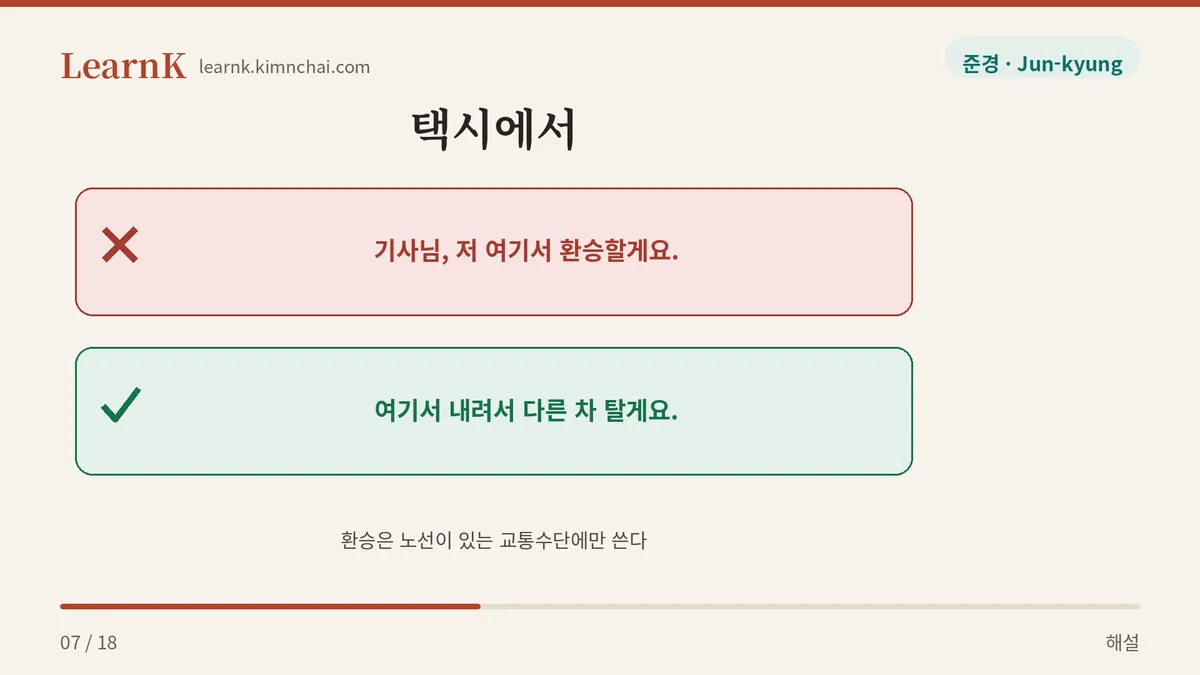
✗ (getting out of a taxi) 기사님, 저 여기서 환승할게요. (“Driver, I’ll transfer here.”) ✓ (getting out of a taxi) 기사님, 여기서 내려서 다른 차 탈게요. (“Driver, I’ll get out here and take another car.”) → 환승 is a word for transit systems that have ‘lines’. It doesn’t attach to moving between taxis, where there’s no fixed route, no transfer passage, and no transfer discount. In cases like this, the broader 갈아타다 (garatada) is the more natural choice.
Example Sentences by Situation
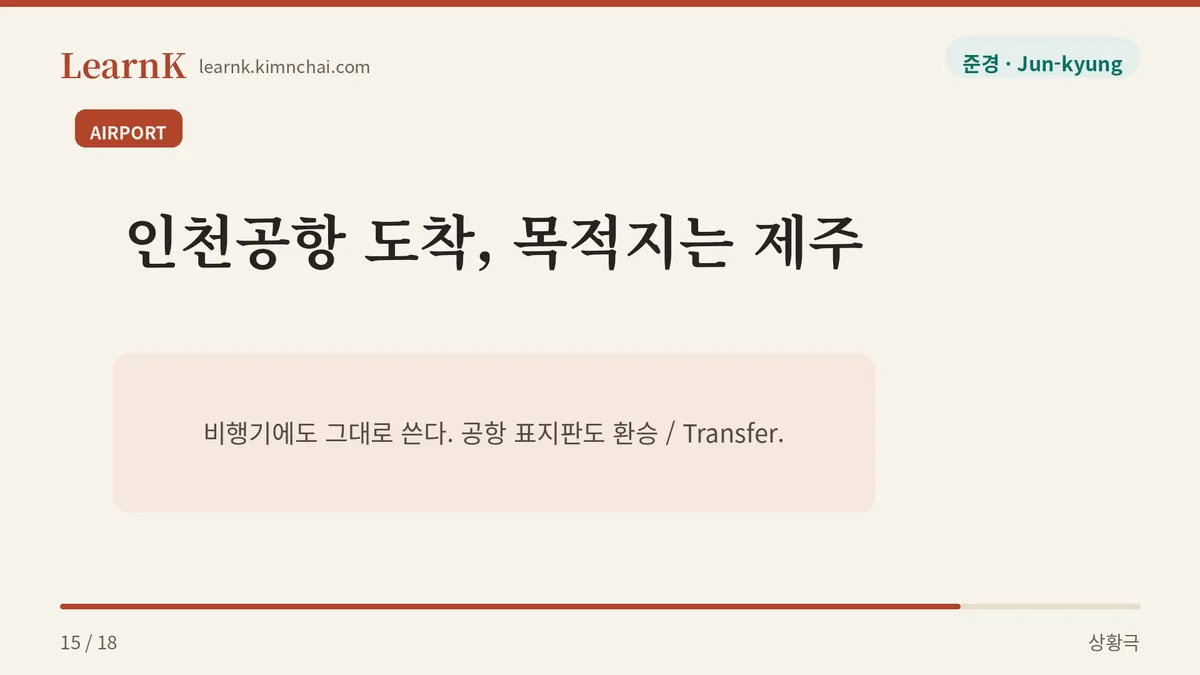
① At airport arrivals, for a traveler whose final destination is Jeju
This is what you say when you’ve landed at Incheon but the journey isn’t over.
- 인천에서 국내선으로 환승해야 해서 세 시간 기다려요. (Incheoneseo gungnaeseoneuro hwanseunghaeya haeseo se sigan gidaryeoyo.) — I have to transfer to a domestic flight at Incheon, so I’m waiting three hours.
Remember that the word applies to planes just the same. Airport signs read ‘환승 / Transfer’ side by side.
② When answering someone asking for directions
Ask for directions in Korea and nine times out of ten, transfer information is what comes back.
- 홍대입구까지 가시려면 신도림에서 2호선으로 환승하세요. (Hongdaeipgukkaji gasiryeomyeon Sindorimeseo i-hoseoneuro hwanseunghaseyo.) — To get to Hongdae Entrance, transfer to line 2 at Sindorim.
The ’-(으)려면 … -(으)세요’ structure is the basic frame for giving directions. Memorize it as a chunk and you can use it as is.
③ When you’re going to be late
Transfers eat up time. That’s why they show up so often as the reason someone’s running behind.
- 환승 두 번이라 생각보다 오래 걸리네요. 십 분만 늦을게요. (Hwanseung du beonira saenggakboda orae geollineyo. Sip bunman neujeulgeyo.) — There are two transfers, so it’s taking longer than I thought. I’ll be about ten minutes late.
Here 환승 is used almost like a counting unit for ‘number of times you change trains’. “환승 없이 한 번에 가요” (“I go straight there with no transfers”) is another common phrase.
Formal, Casual, and Related Expressions
Just change the ending and the politeness level shifts right along with it.
- Casual: 여기서 환승해. (Yeogiseo hwanseunghae.)
- Polite: 여기서 환승하세요. (Yeogiseo hwanseunghaseyo.)
- Announcement style: ○○ 방면으로 환승하실 분은 이번 역에서 내리시기 바랍니다. (…hwanseunghasil buneun ibeon yeogeseo naerisigi baramnida.)
That last ‘-시기 바랍니다’ is an extremely formal form used when an institution speaks, not a person. Use it with a friend and it sounds like a joke.
Here’s how it splits from similar expressions.
| Expression | Tone / intensity | Where it’s used |
|---|---|---|
| 환승 (hwanseung) | Neutral, slightly formal | Announcements, signs, apps. Transportation that runs on fixed routes |
| 갈아타다 (garatada) | Easygoing, everyday | The default in speech. Broad enough to cover taxis and bikes |
| 경유 (gyeongyu) | Neutral, documents and aviation | The passing-through itself. Used even when you don’t change vehicles |
| 직행·직통 (jikhaeng·jiktong) | Neutral | The opposite of 환승. “직통으로 가요” (“I’m going direct”) |
People get especially confused about 경유. If a plane just stops briefly at an intermediate airport and continues on the same aircraft, that’s 경유; if you move to a different aircraft, that’s 환승. The 직통 (jiktong) and 직행 (jikhaeng) that appear in dictionary examples refer to cases where no transfer is needed at all.
Cultural Background — A City Stitched Together by Transfers
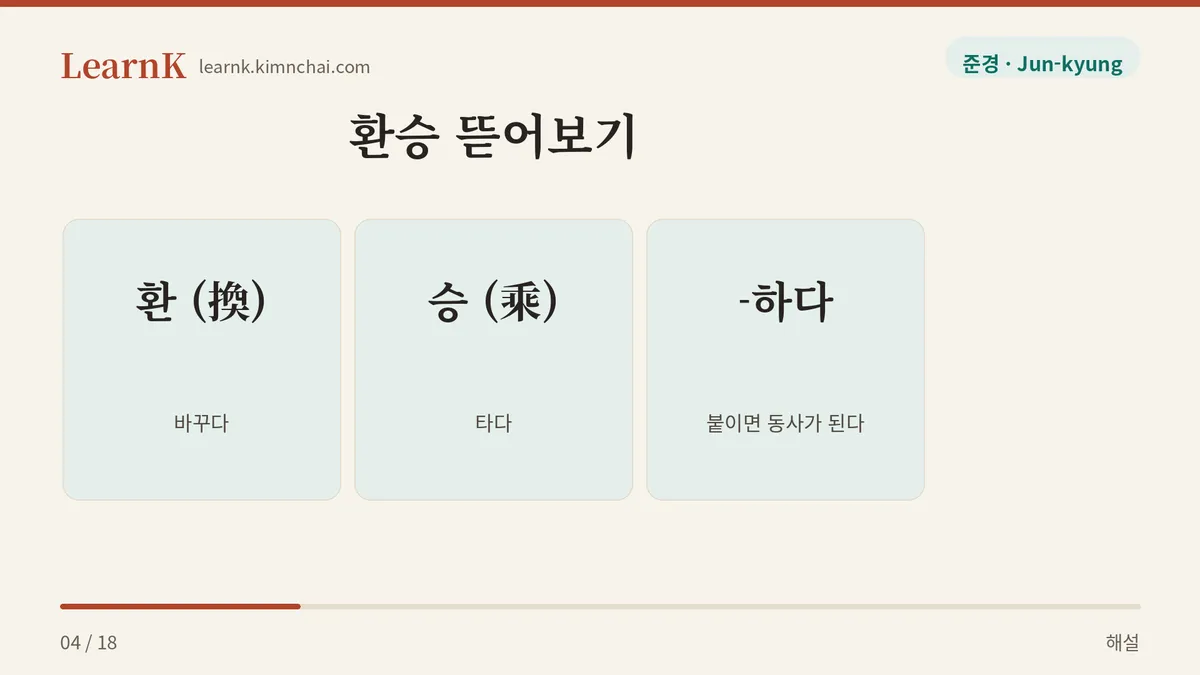
환승 is a Sino-Korean word. 換 (change) and 乘 (ride) combine to mean ‘change and ride’. Because it’s so literal, there’s no room for the meaning to drift, which is why it attaches to subways, buses, planes, and trains alike.
There’s a specific reason this word became part of everyday Korean speech. In 2004, the Seoul city government substantially overhauled its public transportation system and introduced an integrated transfer discount that bundled bus and subway fares together. Before that, you paid a fresh fare every time you switched from bus to subway; afterward, you’re charged once, based on the distance you traveled. But there’s a condition attached — you have to board your next ride within a set window after getting off (usually thirty minutes, or an hour late at night). That’s exactly why Emily in the dialogue asks, “환승 할인 날아갔겠지?”
So when you ask for directions in Seoul, people give you transfer information almost reflexively. “몇 호선 타서 어디서 갈아타세요” (“Take line such-and-such and transfer at such-and-such”) is the basic sentence of Korean-style directions. Big transfer stations even become places in their own right. Spots like Sadang, Sindorim, and Express Bus Terminal are both meeting points people agree on and small labyrinths where you have to walk more than five minutes through underground corridors.
That’s also why Korean dramas love this space. Two people who’ve broken up brushing past each other going opposite directions in a transfer passage, someone sprinting up the stairs to catch the last train — these are long-standing images in Korean romance. In a city where you walk the same corridor as thousands of strangers twice a day, the place where you change trains reads as somewhere meeting and missing each other happen at the same time.
Finally, let’s look again at the 환승 이별 (hwanseung ibyeol) mentioned earlier. It’s a coinage born from the image of a transfer, where the previous ride and the next one connect without a break. A transit term migrated into the vocabulary of dating — and the very fact that the metaphor lands shows just how familiar an experience transferring is for Koreans.
Today’s Quiz
Which of these three sentences is the awkward place to use 환승?
① 인천공항에서 국내선으로 환승했어요. ② 사당역에서 4호선으로 환승하세요. ③ (to a friend who changed jobs) 오, 너 회사 환승했네?
Show the answer
The answer is ③. 환승 is a word for transportation that runs on fixed routes, and using it figuratively about a person brings 환승 이별 to mind, so it sounds like teasing rather than congratulations. “오, 이직했구나! 축하해” is the right thing to say. 환승 works perfectly naturally for planes, as in ①, and for subways, as in ②.
Definitions and example sentences are from the National Institute of Korean Language’s Basic Korean Dictionary (krdict.korean.go.kr); that portion of this post, including our translations, is licensed under CC BY-SA 2.0 KR.