인연 (inyeon) — The Korean Word That Gives a Meeting a Reason
인연
인연 (inyeon) means the relationship formed between people, or between a person and a thing — and it points to the reason or the backstory behind that relationship as well. Koreans reach for this single word when they think back on someone they’ve parted from, when they stand in front of someone they’ve run into by chance, when they introduce a long-standing acquaintance to a third person. Think of it as the word that comes out right when the temperature of a conversation rises a notch.
Translate it as “relationship” or “connection” and the meaning crosses over, but about half the weight gets left behind. “Relationship” stops at naming a state that already exists, whereas 인연 carries inside it the question “why did we come to meet?” That’s why calling someone you traded business cards with today your 인연 sounds awkward, while calling someone you happen to run into ten years later in another city your 인연 fits exactly.
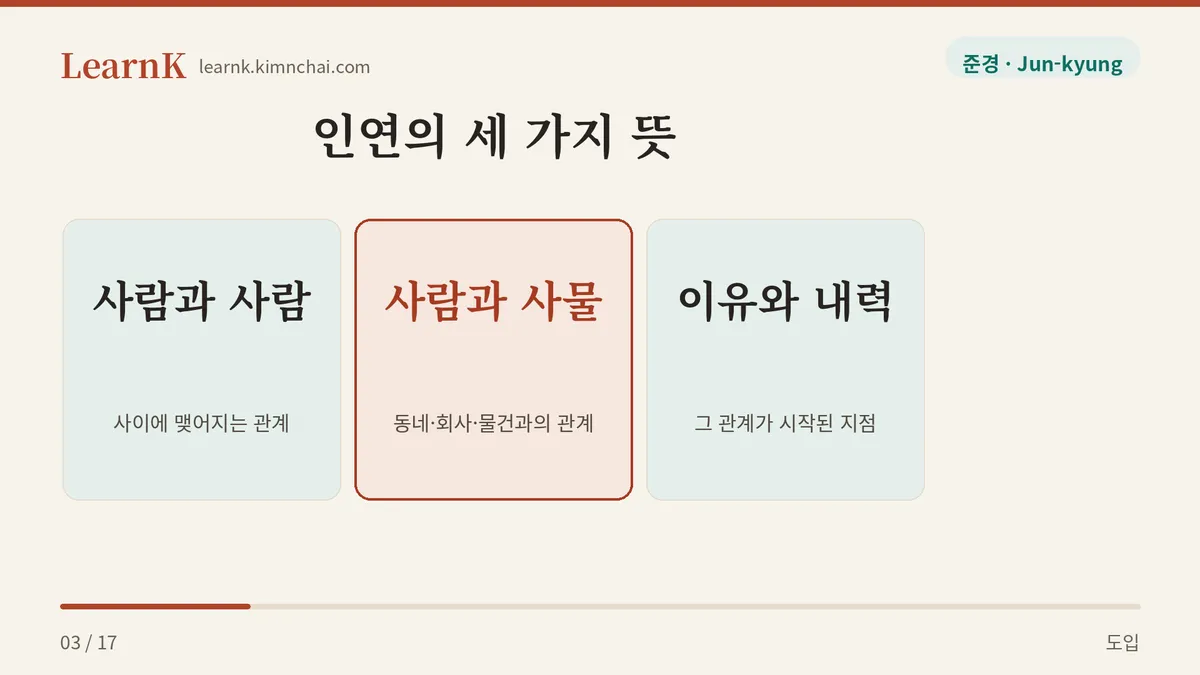
The meaning splits three ways, but the root is one. The first is a relationship between people — by far the most common use. The second is a relationship between a person and a thing, or a person and a place, as in 이 동네와 인연이 깊다 (i dongnaewa inyeoni gipda), “I have deep ties with this neighborhood,” or 그 회사와는 인연이 없었다 (geu hoesawaneun inyeoni eopseotda), “that company and I were never meant to be.” The third is the reason or history behind something — the use that points at the very spot where a relationship began, which is where the expression 인연의 고리 (inyeonui gori), “the link of 인연,” belongs.
The reason these three live inside one word is that 인연 holds the result (the relationship that formed) and the cause (how it came to be that way) at once. Saying 인연 in Korean is less “we know each other” and closer to “there’s a story behind how we came to know each other.” Let’s clear up one misunderstanding in advance: 인연 is a romantic word, but it is not romance-only. It attaches to teacher and student, shop owner and regular, even to a camera you’ve used for fifteen years.
Checking it in the National Institute of Korean Language dictionary
The Basic Korean Dictionary, published by the government body the National Institute of Korean Language, explains 인연 this way.
인연 (inyeon) [noun]
- 사람들 사이에 맺어지는 관계. — A relationship formed between people.
[en] relationship; connection — A relationship between people.
[ja] いんねん【因縁】。えん【縁】 — 人々の間で結ばれる関係。
[es] conexión, relación — Relación ligada entre personas.
[zh] 缘分 — 人与人之间缔结的关系。
- 어떤 사물과 맺어지는 관계. — A relationship formed with some object.
[en] connection — A relationship with something.
[ja] いんねん【因縁】。えん【縁】 — ある事物と結ばれる関係。
[es] conexión, enlace, juntura — Relación ligada a un objeto.
[zh] 缘分 — 与某种事物缔结的关系。
- 어떤 일의 이유나 내력. — The reason for, or the history behind, some matter.
- [en] reason; relationship; connection — A reason for, or the history of, something.
- [ja] えん【縁】。きっかけ — ある物事の理由・来歴。
- [es] relación — Origen o razón de un hecho.
- [zh] 缘分 — 某事的理由或来历。
— National Institute of Korean Language, Basic Korean Dictionary (krdict.korean.go.kr)
The Portuguese gloss is not carried in this dictionary. For reference, it would come out as something like conexão, relação, laço — but we should note that this rendering is ours, not the dictionary’s.
Here are five real usage examples from the same dictionary, quoted as they appear.
- 또 좋은 인연이 찾아오겠지. 너무 상심하지 마. (Tto joeun inyeoni chajaogetji. Neomu sangsimhaji ma.) — “Another good 인연 will come along. Don’t take it too hard.”
- 정말 특별하고 소중한 인연이네요. (Jeongmal teukbyeolhago sojunghan inyeonineyo.) — “That really is a special and precious 인연.”
- 잃어버린 지갑을 찾아 준 일이 두 사람의 인연의 고리가 되어 결혼까지 하게 되었다. (Ireobeorin jigabeul chaja jun iri du saramui inyeonui goriga doeeo gyeolhonkkaji hage doeeotda.) — “Returning a lost wallet became the link of 인연 between the two of them, and they even ended up getting married.”
- 나는 속세와의 모든 인연을 끊고 구도자의 길을 걷고 있다. (Naneun soksewaui modeun inyeoneul kkeunko gudojaui gireul geotgo itda.) — “I have cut every 인연 with the secular world and walk the path of a seeker.”
- 자연스레 좋은 인연이 생길 테니 너무 조급해 하지 마. (Jayeonseure joeun inyeoni saenggil teni neomu jogeuphae haji ma.) — “A good 인연 will come along naturally, so don’t be in such a rush.”
— National Institute of Korean Language, Basic Korean Dictionary (krdict.korean.go.kr)
Let’s look at the setting each of these sentences comes out of.
- 또 좋은 인연이 찾아오겠지. This is comforting a friend after a breakup. It treats 인연 as something that comes to find you — not something you make, but something that arrives from the other side. That’s exactly why it consoles: it means it isn’t that you fell short, only that it hasn’t arrived yet.
- 정말 특별하고 소중한 인연이네요. This is polite speech. It’s the admiring response you offer after hearing someone else’s story, and you’ll hear it often at weddings and in broadcast interviews.
- 잃어버린 지갑을 찾아 준 일이 두 사람의 인연의 고리가 되어… This is the third meaning, the “reason and history” use. It says that one event — returning the wallet — became the first link joining the two people.
- 나는 속세와의 모든 인연을 끊고… 인연을 끊다 (inyeoneul kkeunta) means cutting a relationship off yourself. This sentence carries the voice of someone leaving the world for monastic life, and it shows plainly that 인연 came out of Buddhism.
- 자연스레 좋은 인연이 생길 테니 너무 조급해 하지 마. This is what you say to someone being pressured about marriage, or to someone rushing themselves. Notice how it travels alongside 자연스레 (“naturally”). Korean carries a built-in sense that 인연 is not something you can hurry along.
Seeing it in real conversation
Setting: Saturday afternoon, in front of an apartment building’s main gate. Jun-kyung has come out to sell a camping chair through a secondhand app, and of all people, the buyer turns out to be Emily.
Jun-kyung: 어? 야, 네가 ‘초록모자’야? Huh? Wait, you’re “Green Hat”?
Emily: 헐, 대박. 판매자가 너였어? 이게 무슨 인연이야. No way. You’re the seller? What are the odds — talk about 인연.
Jun-kyung: 나 이 의자 3년 썼거든. 아무한테나 보내기 싫더라고. I used this chair for three years. I didn’t want it going to just anyone.
Emily: 나는 이거 두 달을 찾아다녔어. 이 정도면 인연 맞지. And I’ve been hunting for it for two months. That’s got to count as 인연.
Jun-kyung: 근데 저번에 사려던 그 자전거는? 결국 못 샀다며. By the way, what about that bike you wanted? I heard you missed it.
Emily: 응, 그건 인연이 아니었나 봐. 5분 차이로 팔렸어. Yeah, that one just wasn’t meant to be. Sold five minutes before I got there.
That last line shows the word’s use better than anything. Missing the bike was simply a matter of being late, but Korean files the situation away as 인연이 아니었다 — “it wasn’t 인연.” It’s a word that turns regret into the natural order of things instead of self-blame.
This is where it sounds off
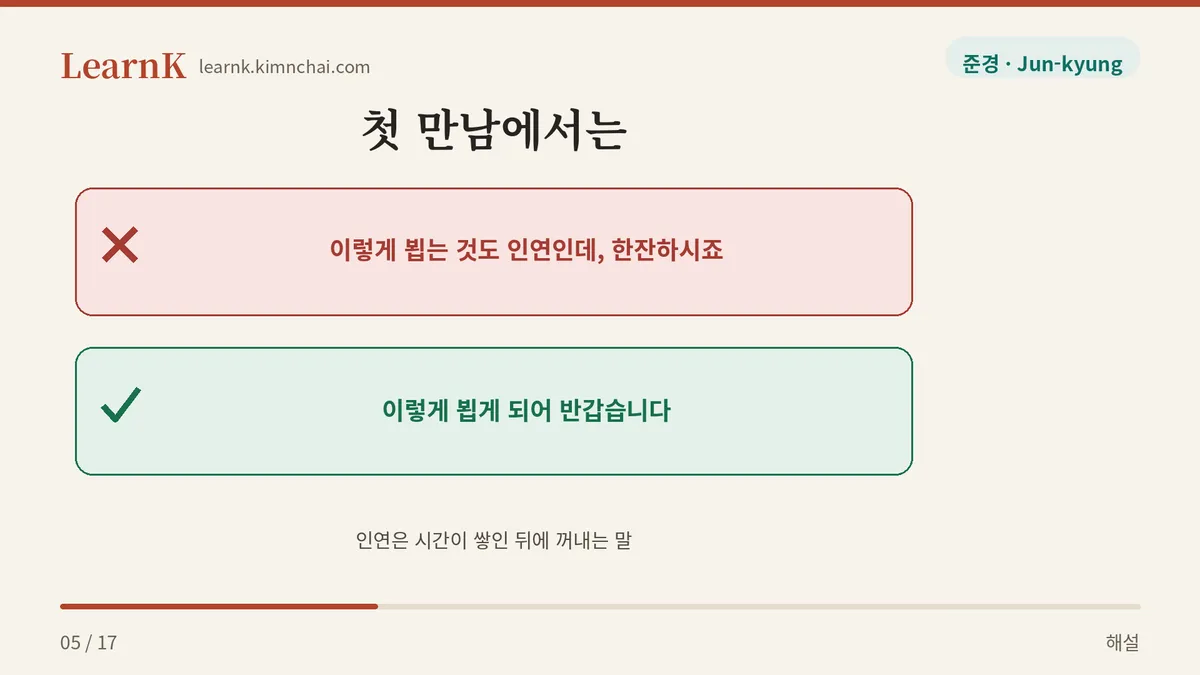
✗ (to a client contact you’re meeting for the first time today) 이렇게 뵙는 것도 인연인데, 저녁에 한잔하시죠. — “Meeting like this is 인연 too, so let’s grab a drink tonight.” ✓ (to a client contact you’re meeting for the first time today) 이렇게 뵙게 되어 반갑습니다. 앞으로 잘 부탁드립니다. — “It’s a pleasure to meet you. I look forward to working with you.” → 인연 is a word that needs accumulated time behind it. Pulled out at a first meeting, it reads as a signal that you’re dragging a work relationship toward the personal, so the other person feels put on the spot — or takes it as a pickup line.
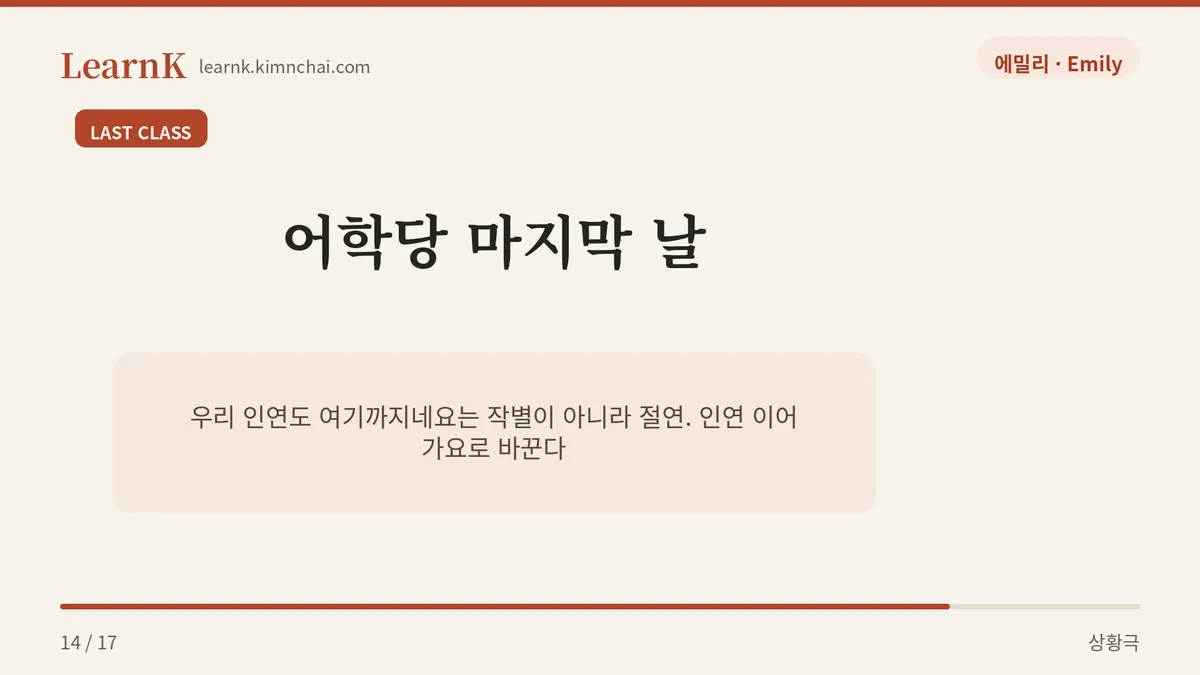
✗ (to a coworker who is leaving the company) 이제 우리 인연도 여기까지네요. — “So our 인연 ends here.” ✓ (to a coworker who is leaving the company) 나가서도 인연 이어 가요. 꼭 연락해요. — “Let’s keep our 인연 going after you leave. Definitely stay in touch.” → “인연이 여기까지” is close to a declaration that you’re cutting the relationship off. As we saw in the dictionary example above, severing an 인연 is what you say when you’re leaving the world behind. Used at a bittersweet goodbye, it turns into a notice that you’re withdrawing your affection.
Example sentences by situation
1) At an alumni dinner twenty years on, seeing your old teacher again
선생님, 이렇게 또 뵙네요. 저희가 인연이 참 깊습니다. (Seonsaengnim, ireoke tto boepneyo. Jeohuiga inyeoni cham gipseumnida.) — “Teacher, here we are meeting again. We really do have a deep 인연.”
인연이 깊다 (inyeoni gipda) means the relationship is long and rich. The “shallow” version is rarely used; the opposite side is usually expressed as 인연이 없다 (“there’s no 인연”).
2) The day after a blind date, reporting back to a friend
좋은 사람인데, 인연은 아닌 것 같아. (Joeun saramindae, inyeoneun anin geot gata.) — “They’re a good person, but I don’t think it’s 인연.”
This is a cushioning expression that avoids pinning the reason for a rejection on the other person’s flaws. It means nobody was at fault, things simply didn’t mesh — which makes it one of the most widely used ways to turn someone down in Korea.
3) Chatting with a neighbor in a neighborhood you’ve just moved into
저는 이 동네와 인연이 좀 있어요. 스무 살 때 첫 자취를 여기서 했거든요. (Jeoneun i dongnaewa inyeoni jom isseoyo. Seumu sal ttae cheot jachwireul yeogiseo haetgeodeunnyo.) — “I have a bit of an 인연 with this neighborhood. I lived on my own here for the first time when I was twenty.”
This is definition 2 in the dictionary — a relationship formed with an object or a place. Keep in mind that 인연 can attach not only to people but to neighborhoods, schools, companies, and things.
Polite and casual forms, and similar words
인연 is a noun, so it carries no honorific level by itself; the predicate that follows decides the register. Casually it’s 우리 인연인가 봐 (uri inyeoninga bwa), “I guess we’re 인연”; politely it’s 참 좋은 인연입니다 (cham joeun inyeonimnida), “this is a truly good 인연.” One form that shows up especially often in formal settings is 인연이 닿다 (inyeoni datda), “for an 인연 to reach” — used to leave the next meeting open, as in 인연이 닿으면 또 뵙겠습니다 (“if our 인연 reaches, I’ll see you again”).
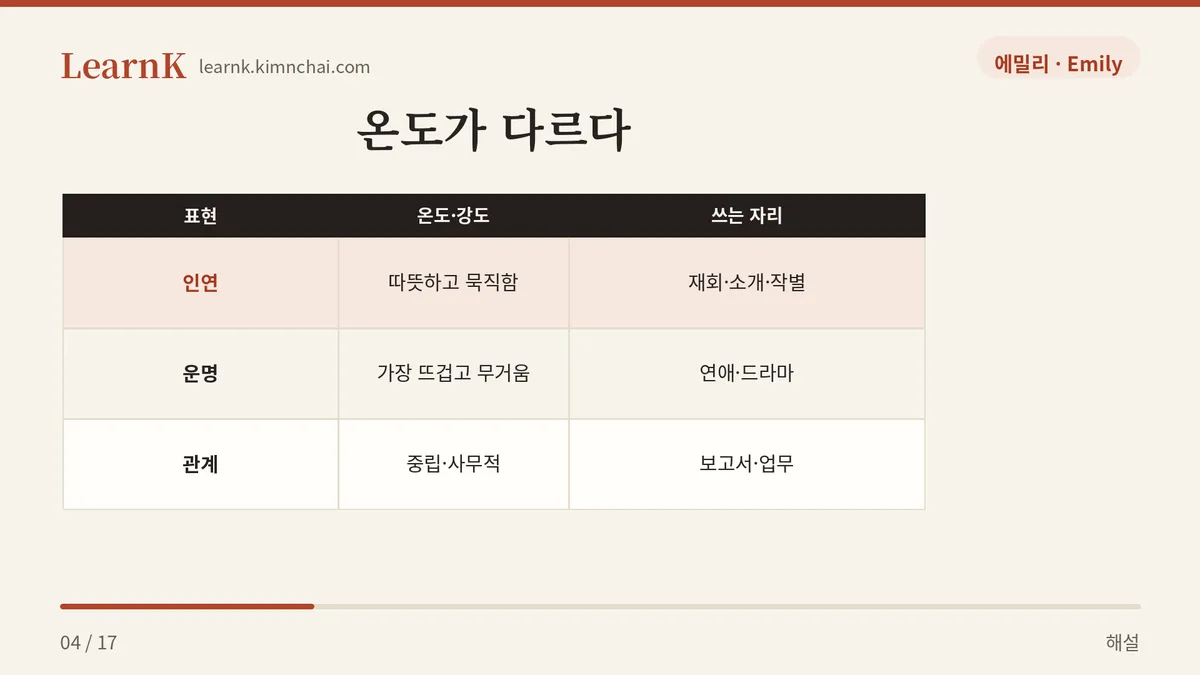
| Expression | Temperature / intensity | Where it’s used |
|---|---|---|
| 인연 (inyeon) | Warm and weighty. Lays meaning on top of coincidence | Reunions, introductions, farewells. Not used at first meetings |
| 운명 (unmyeong) | The hottest and heaviest. A nuance of being unavoidable | Romance and dramas. Sounds like an exaggeration in everyday talk |
| 관계 (gwangye) | Neutral, businesslike. No emotion loaded in | Reports, news, work conversations |
| 사이 (sai) | Light and familiar | Everyday speech, like 우리 사이에 뭘 (“come on, it’s us”) |
The same situation changes completely depending on which word you pick. 우리 관계 is a statement of fact, 우리 사이 is a confirmation of closeness, 우리 인연 assigns meaning to the meeting, and 우리 운명 is a drama.
Cultural background — even a brush of the sleeve
인연 comes from the Chinese characters 因緣. 因 is the direct cause, like a seed; 緣 is the conditions that help that seed sprout — the soil, the water, the sunlight. It originally belonged to Buddhism, explaining that “nothing happens from a single cause; the conditions have to line up too.” As it moved into Korean, almost all of the religious color wore off and it became an everyday word. People with no religion at all use it several times a day.
There’s a famous proverb paired with this word: 옷깃만 스쳐도 인연이다 (otgitman seuchyeodo inyeonida), “even a brush of the sleeve is 인연.” For two people’s collars to actually graze, they have to pass very close to each other. The idea embedded in the proverb is that even that brief brush isn’t a coincidence. It’s often quoted to mean you should show at least basic courtesy even to strangers.
The scenes where 인연 turns up most in Korean dramas are fixed. The reunion scene where two people who parted end up standing in the same spot years later — and the scene that explains that coincidence by tracing it all the way back to a past life. That’s part of why works spanning long stretches of time, like Goblin or Mr. Sunshine, are so loved. The very story structure of attaching a past reason to a present meeting is the same structure as the word 인연 itself.
In daily life it’s used far more modestly. In a wedding officiant’s speech, walking through the story of how the two came to meet. Telling a coworker leaving the company 인연 이어 가자 (“let’s keep our 인연 going”). Feeling wistful when the shop you’ve frequented for years closes down and saying 이 집과도 인연이 다했다 (“my 인연 with this place has run its course”). When you’re learning Korean, the moment you first hear this word is usually in a drama — but the places you’ll actually meet it most are these ordinary moments of parting and reunion.
Today’s quiz
Which of the following uses 인연 most naturally?
- 오늘 처음 뵀는데 우리 인연인 것 같아요. 연락처 좀 주세요.
- 10년 만에 공항에서 옛 담임 선생님을 만났다. 이런 게 인연인가 보다.
- 편의점에서 삼각김밥을 샀는데, 그것도 하나의 인연이다.
Answer: 2. 인연 draws its power from the overlap of accumulated time and coincidence. Number 2, where a span of ten years meets the unexpected setting of an airport, is exactly where this word sits most naturally. Number 1 uses it at a first meeting, which makes it an uncomfortable approach, and number 3 attaches it to something with no weight at all, so it only works as a joke. 인연 isn’t a word you can stick anywhere — it’s a word that, the moment you attach it, gives that meeting a reason.
Definitions and example sentences are from the National Institute of Korean Language’s Basic Korean Dictionary (krdict.korean.go.kr); that portion of this post, including our translations, is licensed under CC BY-SA 2.0 KR.