재회 (jaehoe) — The Word That Took Ten Years to Meet Again
재회
재회 (jaehoe) means “a meeting again, or a second meeting.” Going by the definition alone, bumping into someone today whom you already saw yesterday would count as 재회 — but in actual Korean, the spot where these two syllables belong is far narrower. There has to be a gap of years, sometimes decades. The two people have to have had no news of each other in the meantime. And at the moment they finally come face to face, tears have to arrive before words. That is the only kind of meeting this word is for.
That is why you notice it in news reports and drama teaser captions long before you ever hear it in everyday conversation. An airport arrivals hall, one old photograph, a caption at the bottom of the screen reading 5년 후 (5-nyeon hu, “five years later”). If you watch Korean dramas, you have already seen the scene many times over: a long stretch of time passes, and then two people collide on a street. 재회 is that entire scene summed up in a single word.
재회 is a noun. So when you put it into a sentence, you attach 하다 to make 재회하다 (jaehoehada), or you bundle it with other words, as in 재회의 기쁨 (jaehoe-ui gippeum), “the joy of reunion,” or 극적인 재회 (geukjeogin jaehoe), “a dramatic reunion.” And in front of it there is almost always a span of time — 십 년 만에 (sip-nyeon mane, “after ten years”), 30년 만에 (samsip-nyeon mane), 68년 만에 (yuksippal-nyeon mane). That 만에 (mane) is what decides how much a 재회 weighs. When the span is short, the word hangs loose; the longer the span, the tighter it pulls.
The word doesn’t have only one temperature. Its second meaning, “meeting for a second time,” lives in places where the emotion has been stripped out. Sports writing is the clearest case: 두 팀은 4년 만에 결승에서 재회했다 (du timeun 4-nyeon mane gyeolseungeseo jaehoehaetda), “the two teams met again in the final after four years.” Here 재회 doesn’t mean gladness; it means “they face off again.” Whether it’s deep emotion or a showdown is decided not by the word itself but by the context around it.
Checking It in the National Institute of Korean Language Dictionary
재회 (jaehoe) (noun)
- 다시 만남. 또는 두 번째로 만남. (dasi mannam. ttoneun du beonjjaero mannam.) — Meeting again. Or meeting for a second time.
- [en] meeting again — The act of meeting someone again or for a second time.
- [ja] さいかい【再会】 — 再び会うこと。また、2度目に会うこと。
- [es] reencuentro — Acción de volver a encontrarse. O segundo encuentro.
- [zh] 重逢,再会 — 再次相逢;或指第二次见面。 — National Institute of Korean Language, Basic Korean Dictionary (krdict.korean.go.kr)
A Portuguese definition is not listed in the dictionary. What follows is not a dictionary quotation but our own translation — reencontro: o ato de encontrar alguém novamente ou pela segunda vez.
The dictionary’s real usage examples make it clear at a glance what kind of sentence this word lives inside.
두 사람은 헤어진 지 십 년 만에 우연히 공항에서 극적인 재회를 했다. (du sarameun heeojin ji sip-nyeon mane uyeonhi gonghangeseo geukjeogin jaehoereul haetda.) Ten years after they parted, the two of them happened to run into each other at the airport for a dramatic reunion. — National Institute of Korean Language, Basic Korean Dictionary (krdict.korean.go.kr)
The whole typical skeleton of a 재회 is in there: the gap in 헤어진 지 십 년 만에 (“ten years after parting”), the unplannedness of 우연히 (“by chance”), and the setting, 공항 (“the airport”). Take away any one of the three and the sentence loses its force.
30년 만에 재회한 형제가 서로를 보듬고 눈물을 흘렸다. (samsip-nyeon mane jaehoehan hyeongjega seororeul bodeumgo nunmureul heullyeotda.) The brothers, reunited after thirty years, held each other and wept. — National Institute of Korean Language, Basic Korean Dictionary (krdict.korean.go.kr)
As in 재회한 형제 (“the reunited brothers”), 재회하다 also works nicely as a modifier for the person who follows it. And it’s no accident that tears show up right alongside it. 재회 is a word that pairs with a physical reaction.
이산가족인 할아버지와 할머니는 서로 부둥켜안고 울면서 재회의 기쁨을 나누었다. (isangajogin harabeojiwa halmeonineun seoro budungkyeoango ulmyeonseo jaehoe-ui gippeumeul nanueotda.) The grandfather and grandmother, both members of families separated by the war, threw their arms around each other and wept as they shared the joy of reunion. — National Institute of Korean Language, Basic Korean Dictionary (krdict.korean.go.kr)
This is the place where the word 재회 sits most heavily of all in Korea: 이산가족 (isan gajok), families separated by the Korean War. 재회의 기쁨을 나누다 (jaehoe-ui gippeumeul nanuda) is used almost as a set phrase in news coverage, so it’s worth memorizing as a single chunk.
십여 년 만에 그들은 처지가 완전히 반전한 채로 재회하게 되었다. (sibyeo nyeon mane geudeureun cheojiga wanjeonhi banjeonhan chaero jaehoehage doeeotda.) After more than ten years, they met again with their circumstances completely reversed. — National Institute of Korean Language, Basic Korean Dictionary (krdict.korean.go.kr)
Proof that a 재회 isn’t always warm. Two people whose standing has flipped upside down over ten years meet again — this is exactly the point where a drama’s revenge plot begins.
감격적으로 재회하다. / 감격적 재회. / 극적인 재회. / 생부와 재회하다. (gamgyeokjeogeuro jaehoehada. / gamgyeokjeok jaehoe. / geukjeogin jaehoe. / saengbuwa jaehoehada.) To be reunited movingly. / A moving reunion. / A dramatic reunion. / To be reunited with one’s birth father. — National Institute of Korean Language, Basic Korean Dictionary (krdict.korean.go.kr)
The short chunks are worth a close look too. The modifiers that go in front of 재회 are almost fixed — 감격적 (gamgyeokjeok, “deeply moving”), 극적 (geukjeok, “dramatic”) — and the particle that follows is ~와/과 재회하다 (~wa/gwa jaehoehada). Learn just this frame and your sentences will come out natural.
See It in a Real Conversation
Situation: The first night of the Chuseok holiday. A rerun of a documentary special on separated-family reunions is playing on the TV in the living room.
Jun-kyung: 이거 나 초등학생 때도 봤는데 또 하네. 볼 때마다 콧물 나. I watched this back in elementary school and here it is again. Gets me every single time.
Emily: 저 할머니 손 떠는 거 봐. 몇 년 만이라는 거야? Look at that grandmother’s hands shaking. How many years has it been?
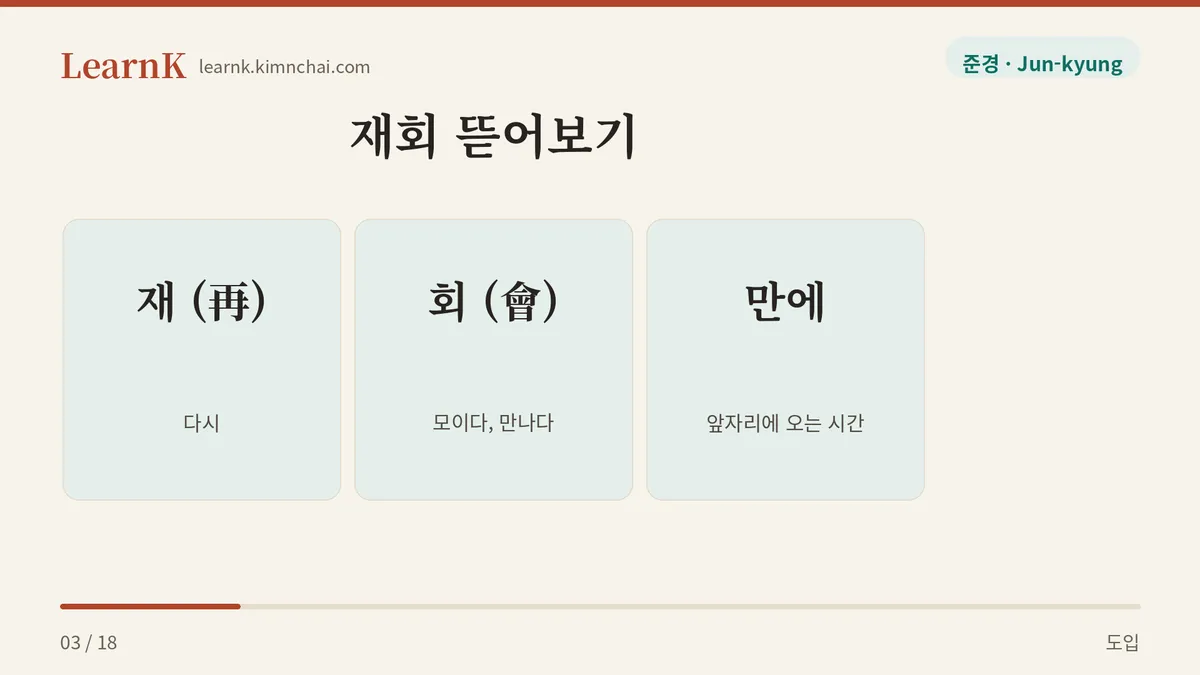
Jun-kyung: 68년. 저런 게 진짜 재회지. Sixty-eight years. That is what a real reunion looks like.
Emily: 나 지난달에 캐나다 친구 만난 거 재회했다고 했다가 다들 웃었어. Last month I said I had a reunion with my friend from Canada and everyone laughed at me.
Jun-kyung: 3년 만이잖아, 3년. 그건 그냥 오랜만에 만났다고 하면 돼. It had only been three years. Three. For that you just say you met after a long time.
Emily: 무게가 다르구나. 아, 어렵다 진짜. So the weight is different. Ugh, this language.
This Is Where It Sounds Off
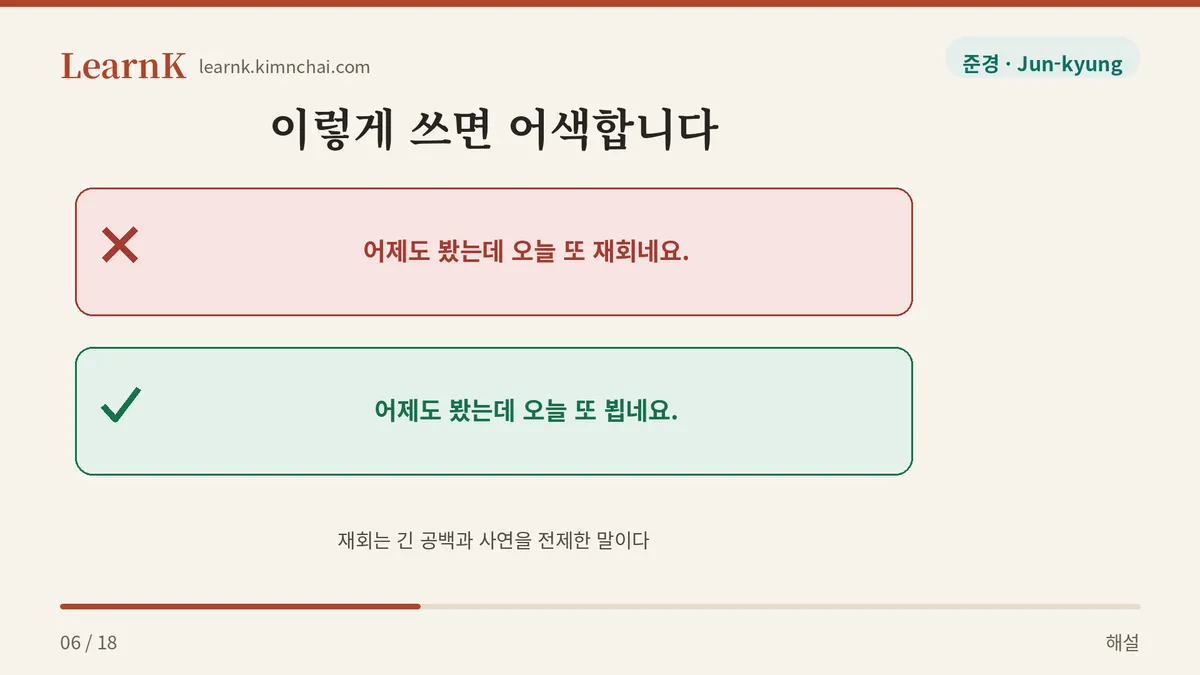
✗ (to a coworker you saw yesterday) 어제도 봤는데 오늘 또 재회네요. ✓ (to a coworker you saw yesterday) 어제도 봤는데 오늘 또 뵙네요. → 재회 presupposes a long gap and a backstory. Use it after a single day and it sounds like a deliberately inflated joke — and when the moment isn’t right for a joke, it just sounds awkward.
✗ (said directly to an ex) 우리 다시 재회하자. ✓ (said directly to an ex) 우리 다시 만나자. / 우리 다시 시작하자. → 재회 is a word a third party puts on a meeting from the outside, so when one of the two people involved proposes it to the other, it comes out sounding like a news anchor. On top of that, a couple or a married pair getting back together has its own dedicated word: 재결합 (jaegyeolhap).
Example Sentences by Situation
1. Airport arrivals hall — the day a daughter comes home after three years of studying abroad
3년 만에 공항에서 딸과 재회한 어머니는 한동안 말을 잇지 못했다. (3-nyeon mane gonghangeseo ttalgwa jaehoehan eomeonineun handongan mareul itji motaetda.) It means the mother met her daughter again at the airport after three years and couldn’t get a word out for quite a while. This is a sentence that could run as-is in a newspaper article or a broadcast caption. When you follow 누구와 재회하다 (“to be reunited with someone”) with a physical reaction — 말을 잇지 못하다 (“to be unable to speak”), 눈물을 흘리다 (“to shed tears”) — the sentence feels finished.
2. Animal shelter — the day a dog lost two years ago turns up
잃어버린 지 2년 만에 보호소에서 강아지와 재회했어요. (ireobeorin ji i-nyeon mane bohososeo gangajiwa jaehoehaesseoyo.) 재회 isn’t a word only for people. If the separation was long and the moment of meeting again is genuinely moving, you can use it for a pet too. On the other hand, you wouldn’t use it for the neighbor’s dog you said goodbye to on yesterday’s walk. The standard is always time and backstory.
3. Industry event — running into a former boss, now the CEO of a rival company
십 년 전 제 사수였던 분과 이번엔 경쟁사 대표로 재회했습니다. (sip-nyeon jeon je sasuyeotdeon bungwa ibeonen gyeongjeongsa daepyoro jaehoehaetseumnida.) This has the same grain as the dictionary example 처지가 완전히 반전한 채로 재회하다 (“to meet again with circumstances completely reversed”). 재회 works even in a moment where gladness is mixed with tension — in fact, that’s when the word becomes most interesting.
Polite and Casual Forms, and Similar Expressions
재회 itself carries no built-in honorific level. Because it’s a noun, politeness is decided by the predicate attached after it. With friends: 재회했어 (jaehoehaesseo). In ordinary polite speech: 재회했어요 (jaehoehaesseoyo). In formal settings or in writing: 재회했습니다 (jaehoehaetseumnida). To raise the person you’re speaking about, you slip in -시- (-si-), as in 재회하셨다면서요 (jaehoehasyeotdamyeonseoyo).
There are several similar words, and they differ in weight and in where they belong.
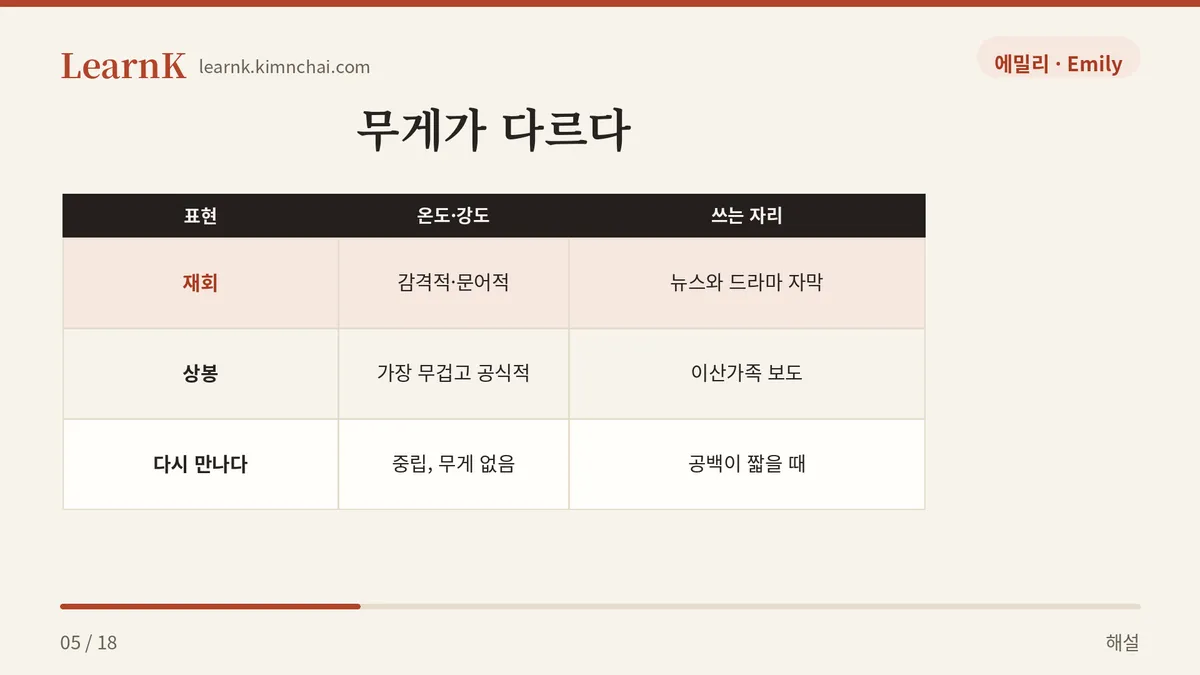
| Expression | Temperature / intensity | Where it’s used |
|---|---|---|
| 재회 (jaehoe) | Emotional and literary | News and drama captions; people who were apart a long time. Rare in everyday chatter |
| 상봉 (sangbong) | The heaviest and most official | Almost entirely separated-family coverage. Seldom used between private individuals |
| 재결합 (jaegyeolhap) | The core sense is forming a relationship again | Ex-couples and spouses; a disbanded group re-forming |
| 해후 (haehu) | Literary; an unexpected meeting | Novels and essays. Said aloud, it gives the impression of an old book |
| 다시 만나다 (dasi mannada) | Neutral. No weight | Anywhere. When the gap is short, this is the right answer |
The spot where foreign learners slip most often is the border between 재회 and 다시 만나다. When you’re unsure, this test will get you there almost every time: if telling someone about the meeting would make them say 와, 정말요? (“Wow, really?”), it’s 재회; if they’d just say 그렇구나 (“Ah, I see”), it’s 다시 만나다.
Cultural Background — A Word That Crossed Sixty-Eight Years
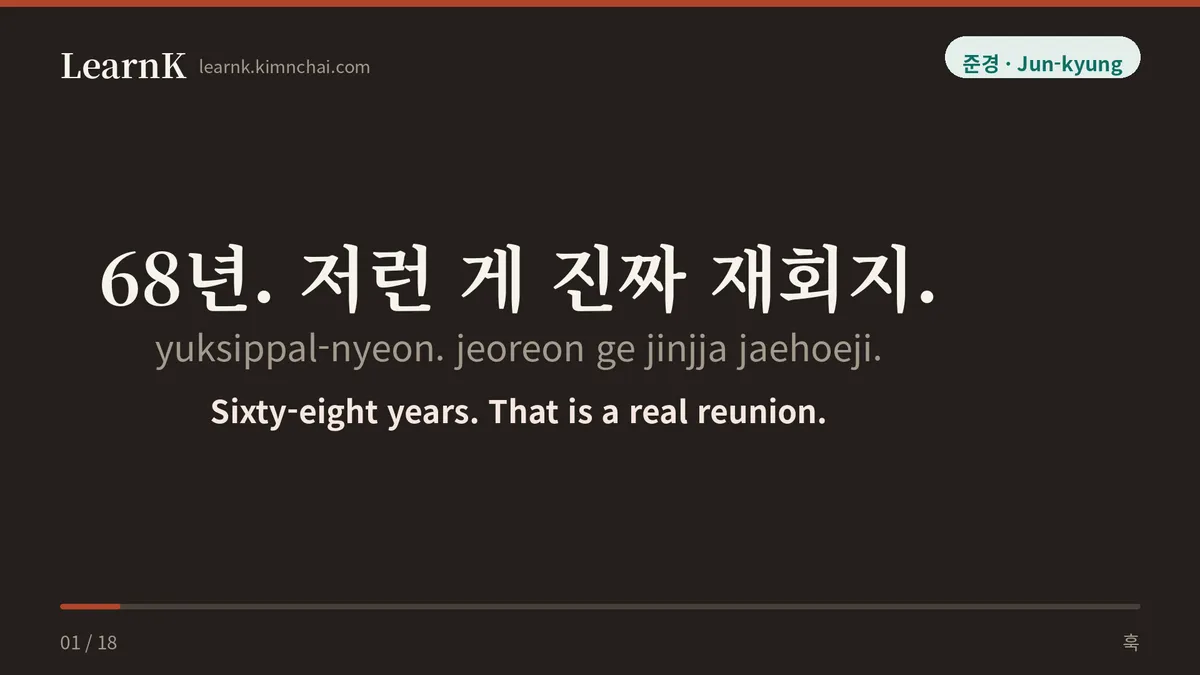
재회 is a Sino-Korean word. 再 (재) means “again,” and 會 (회) means “to gather, to meet.” Read the two characters straight through and you get “gathering again.” This 會 is the same character as the 회 in 회의 (hoeui, “a meeting”), 회식 (hoesik, “a company dinner”), and 동창회 (dongchanghoe, “a class reunion”). So for learners who know hanja, this word almost unlocks itself.
The reason it sits so heavily in Korea lies in history. In 1983, KBS launched a special live broadcast called 〈이산가족을 찾습니다〉 (Isan Gajogeul Chatseumnida, “Finding Dispersed Families”), and it ran for 138 days. The footage of people packed in front of the broadcasting station holding up sheets of paper with names and hometowns written on them was inscribed on the UNESCO Memory of the World Register in 2015. Families torn apart by the war identifying one another decades later — for Koreans, the word 재회 summons that footage before it summons any dictionary definition. That’s why, in the conversation above, Jun-kyung told Emily not to use 재회 for a meeting after three years. That scale of time is already carved into the word.
Things are much the same on the drama side. Korean dramas have long been fond of a structure that puts a gap of several years between characters and then brings them back together. A first love returns as a different person; a brother who disappeared is now sitting in the enemy’s chair. The teaser caption for that episode will flash these two syllables almost without exception. For anyone who watches a lot of Korean dramas, 재회 is also a signal that the story is about to turn over.
And a 재회 on a much smaller scale comes around twice a year. 설 (Seol, Lunar New Year) and 추석 (Chuseok) — the days when a family scattered across the country gathers around one table. On these occasions people usually say 오랜만에 다 모였네 (“everyone’s finally together after so long”) and stop short of the word 재회. But when the cousin who hasn’t made it back in years opens the door and walks in, for that one moment someone just might laugh and say it — 이거 완전 재회다, 재회 (“this is a full-on reunion, a reunion”).
Today’s Quiz
Which of these three sentences sounds off with 재회 in it?
- 두 팀은 4년 만에 결승에서 재회했다. (The two teams met again in the final after four years.)
- 유학 간 아들과 5년 만에 공항에서 재회했다. (I was reunited at the airport with my son, who had been studying abroad, after five years.)
- 어제 만난 친구와 오늘 또 재회했다. (I was reunited today with the friend I met yesterday.)
Answer: number 3. 재회 presupposes a long gap, so it doesn’t attach to a meeting one day later. For 3, 어제 만난 친구를 오늘 또 만났다 (“I met the friend I saw yesterday again today”) is the natural way to say it. Sentence 1 uses the word in the sense of “facing off a second time” rather than as an emotion, and sentence 2 is the single most typical use of 재회 there is.
Definitions and example sentences are from the National Institute of Korean Language’s Basic Korean Dictionary (krdict.korean.go.kr); that portion of this post, including our translations, is licensed under CC BY-SA 2.0 KR.