"잘 부탁드립니다" — The Korean Greeting That Opens the Door to a Relationship
One of the very first — and most frequent — phrases a newcomer to Korea will hear. On the first day of a new semester in the classroom, at the office on your first day of work, at a meeting where business cards are exchanged, even at your neighbor’s door on moving day — it comes up without fail. That phrase is “잘 부탁드립니다.” Put it into a translation app and you’ll get something like “Please take care of me,” but that single line can’t capture the real role this expression plays in Korean society. Today, let’s really dig into the nuance hidden inside this short little greeting.
잘 부탁드립니다 (jal butakdeurimnida)
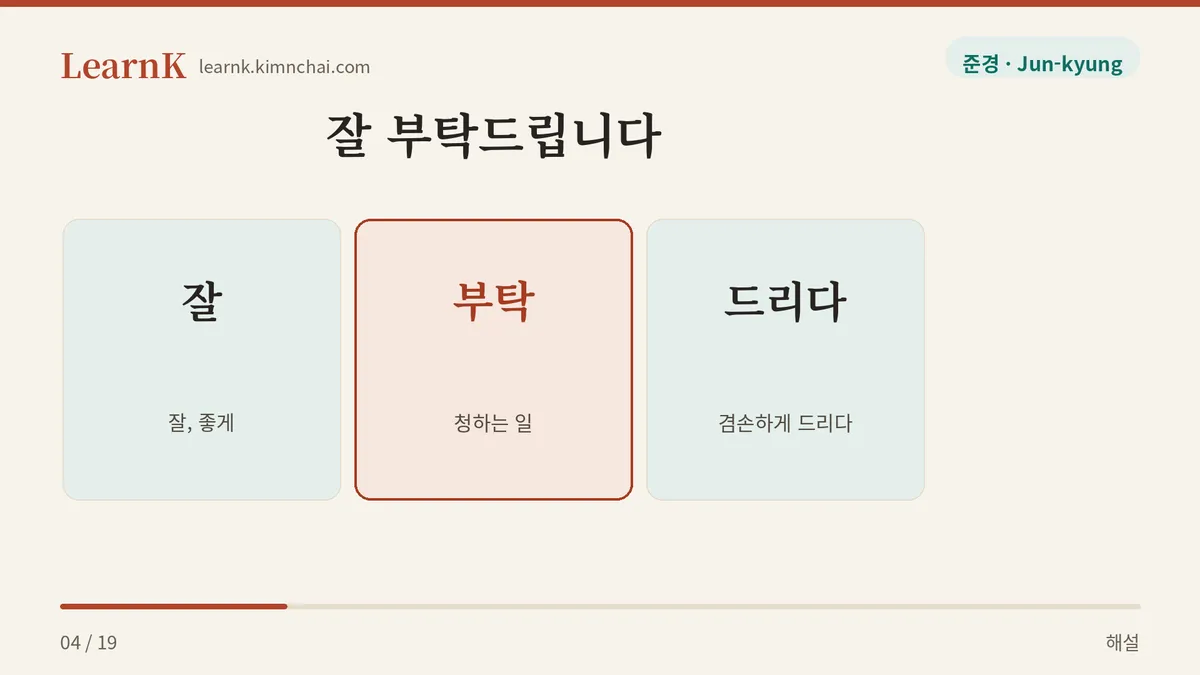
잘 부탁드립니다 (jal butakdeurimnida) is a combination of “잘 (well) + 부탁 (a request/favor) + 드리다 (to give, humbly) + -ㅂ니다 (formal sentence ending).” Translated literally, it’s “I humbly give you a request that things go well” — in other words, “I politely ask that you look kindly upon my work, and on me myself.”
The key point is that the ‘부탁’ here isn’t necessarily a specific favor. You use it even when there’s no clear request like “please do this for me.” It’s a greeting that hands over your feelings about the entire relationship you’re about to build — “please take good care of me, let’s get along well” — all in one go. That’s why this one phrase tags along at almost every new beginning.
Another thing worth noticing is ‘드리다.’ If you express the same meaning with ‘부탁하다,’ it’s just an ordinary phrase — but the moment you attach ‘드리다,’ a humble tone appears in which ‘I raise the other person up and lower myself.’ That’s why this expression is a star player of the honorific (높임말) — exactly today’s category. It’s a tool for lowering yourself just a notch in front of someone senior, someone you’re meeting for the first time, or someone you’ll be indebted to going forward.
Seeing It in a Real Conversation
Situation: Emily starts at her new job tomorrow — her first day. In the evening, Jun-kyung is helping her practice her self-introduction.
Jun-kyung: 에밀리, 너 내일 첫 출근이지? 자기소개 연습은 해 봤어? Emily, tomorrow’s your first day, right? Did you practice your self-intro?
Emily: 어. 근데 마지막을 어떻게 끝내야 자연스러운지 모르겠어. Yeah. But I don’t know how to end it naturally.
Jun-kyung: 그럴 땐 그냥 “앞으로 잘 부탁드립니다” 한마디면 딱 끝나. 이게 국룰이야. In that case, just “I look forward to working with you” wraps it right up. It’s the standard move.
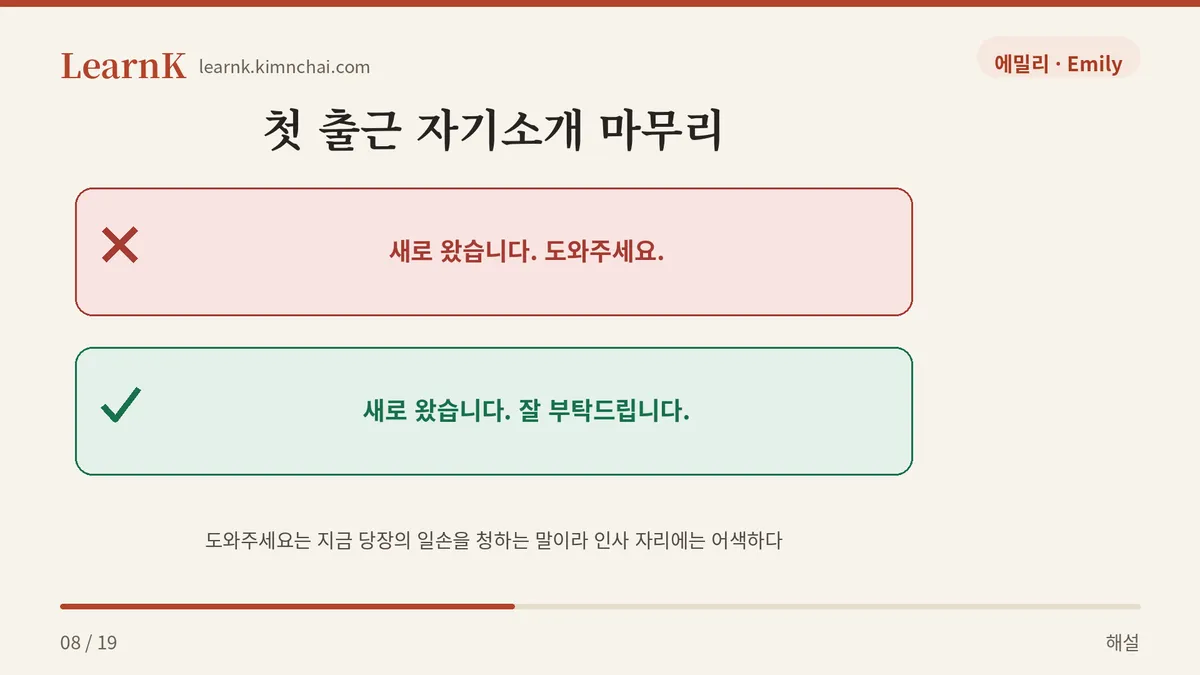
Emily: 아, 그거! 안녕하세요, 이번에 새로 온 에밀리입니다. 잘 부탁드립니다. 이렇게? Oh, that one! “Hello, I’m Emily, the new hire. I look forward to working with you.” Like this?
Jun-kyung: 완벽해. 고개 살짝 숙이면서 하면 더 진심처럼 보이고. Perfect. And if you bow your head a little while saying it, it looks more sincere.
Emily: 오케이. 팀장님 앞에서는 “잘 부탁드리겠습니다”로 조금 더 공손하게 가야겠다. Okay. In front of the team lead I’ll go a bit more polite with “jal butakdeurigetseumnida.”
Example Sentences by Situation
-
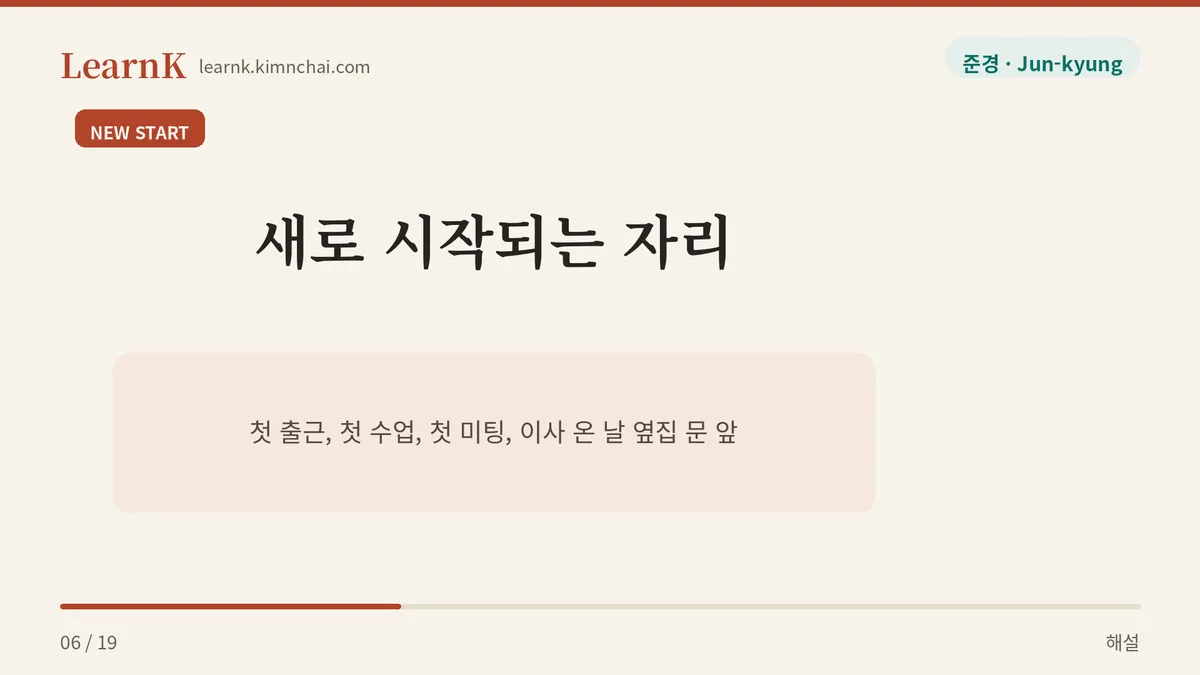
처음 뵙겠습니다. 잘 부탁드립니다 (cheoeum boepgetseumnida. jal butakdeurimnida) — The safest set for wrapping up a self-introduction on a blind date, in an interview, or at a first meeting. You open with “처음 뵙겠습니다” as your first greeting, and close by entrusting the relationship with “잘 부탁드립니다.”
-
이 건은 좀 잘 부탁드립니다 (i geoneun jom jal butakdeurimnida) — Something you say when handing an important task to a colleague or a business partner. Adding ‘좀’ carries both a touch of apology and trust — “I know I’m putting a burden on you, but still” — which makes it much softer.
-
그럼 잘 부탁드리겠습니다 (geureom jal butakdeurigetseumnida) — A go-to phrase for closing out emails or messages. Because ‘-겠-’ makes it a future form, it adds the feeling of “I’ll be counting on you for that going forward,” making it the polite sign-off you’ll see most often in the workplace.
Formal/Informal Speech and Similar Expressions
The same sentiment changes clothes depending on who you’re talking to.
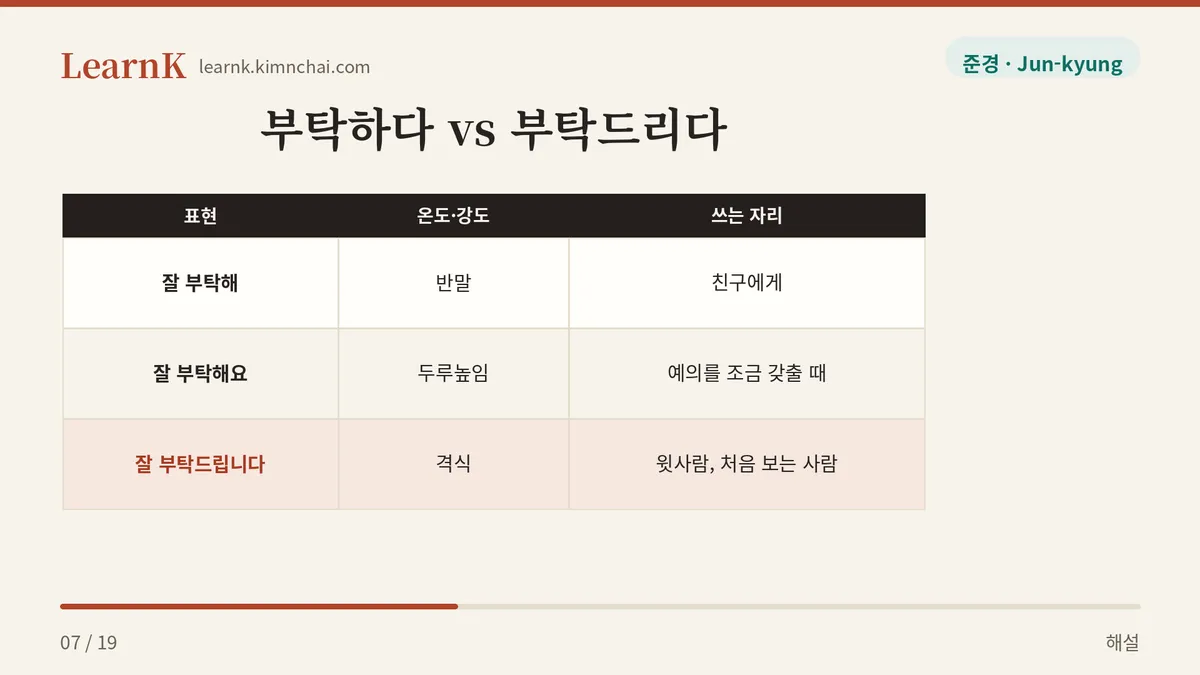
- To a friend: 잘 부탁해 (jal butakhae) — informal (반말).
- When you want a bit of politeness: 잘 부탁해요 (jal butakhaeyo) — general polite (두루높임).
- In a formal setting: 잘 부탁드립니다 / 잘 부탁드리겠습니다 — the most polite.
도와주세요 (dowajuseyo) may look similar, but it’s a concrete request — “help me with this task right now” — so it has a different feel from “잘 부탁드립니다,” which entrusts the whole relationship. If you want to emphasize your sense of being indebted, you might add 신세 좀 지겠습니다 (sinse jom jigetseumnida) alongside it.
Cultural Background
In Korea, this expression is ‘the key that opens the door to a relationship.’ In the old days, when you moved to a new neighborhood, there was a custom of handing out rice cakes and greeting people with “앞으로 잘 부탁드립니다,” and even now this phrase never fails to appear the moment you hand over a business card with both hands, or clink your first glass at a company dinner. In workplace dramas, too, the scene where a new hire opens the office door, bows their head, and offers this greeting shows up almost like a formula — and that short little phrase conveys the character’s nervousness and courtesy at a glance. In a single line, it compactly conveys the attitude of “I’m still the junior here, and I’ll learn well.”
Closing Quiz
Which is the most fitting greeting to offer while handing out rice cakes to your neighbors after moving to a new neighborhood? ① 수고하셨습니다 ② 앞으로 잘 부탁드립니다 ③ 잘 먹겠습니다
(Answer: ② — because it’s a moment for expressing the wish that you’ll get along well as neighbors from now on!)
Definitions and example sentences are from the National Institute of Korean Language’s Basic Korean Dictionary (krdict.korean.go.kr); that portion of this post, including our translations, is licensed under CC BY-SA 2.0 KR.