The Mealtime Greeting Koreans Never Skip: Everything About 잘 먹겠습니다
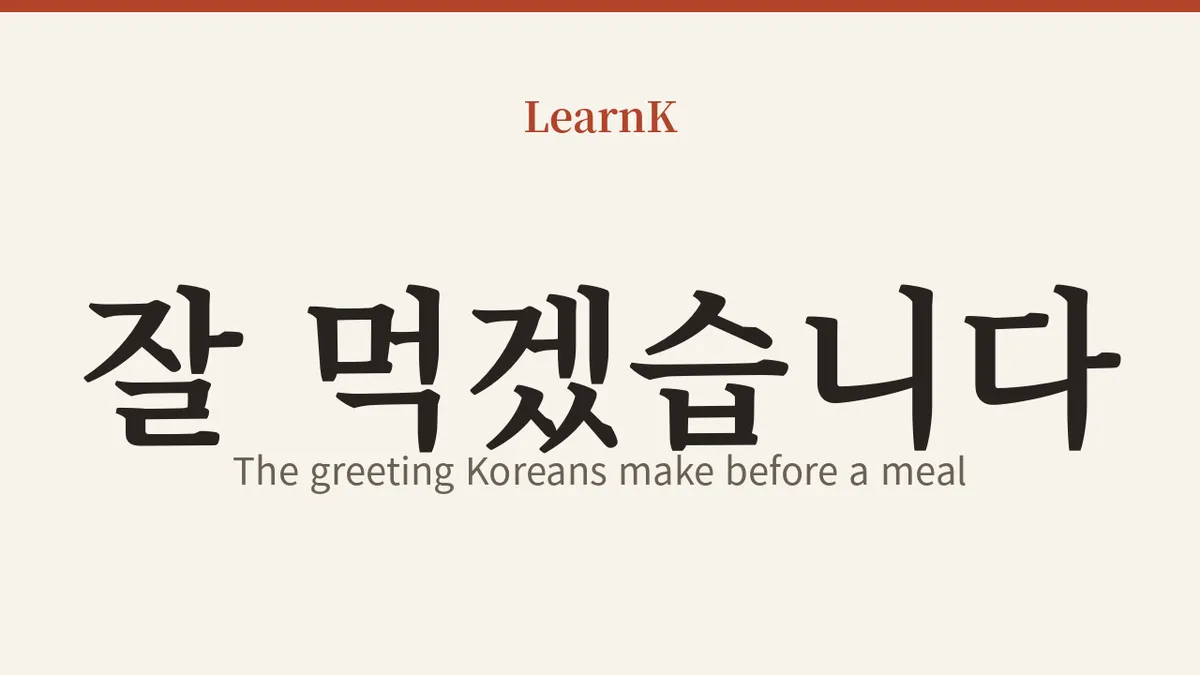
The Mealtime Greeting Koreans Never Skip: 잘 먹겠습니다
If you watch enough Korean dramas, you’ll often catch this moment right before the characters pick up their chopsticks — they bring their hands together or dip their head slightly and offer a short greeting. That’s 잘 먹겠습니다 (jal meokgetseumnida). It’s a word of thanks for the person who cooked the food, the person who paid for it, or simply everyone who made this one meal possible. Today, let’s take a closer look at an expression Koreans use several times a day.
잘 먹겠습니다
잘 먹겠습니다 (jal meokgetseumnida) breaks down into three parts. 잘 (jal) is an adverb meaning “well, nicely,” 먹다 (meokda) is the verb “to eat,” and -겠습니다 (-getseumnida) is an ending that politely expresses your intention or resolve about what you’re about to do. So the literal meaning is “(I’m now going to) eat well” — a promise to enjoy this food with gratitude, and a greeting all at once.
There’s no exact English equivalent, but it occupies the same space as the French bon appétit or the Japanese いただきます (itadakimasu). There’s one crucial difference, though. Bon appétit is said to the other person, like “enjoy your meal.” But 잘 먹겠습니다 is a grateful promise made by the person who is about to eat, directed at whoever cooked or hosted.
When do you say it?
The key is “right before the meal begins.” You say it just as the food is set out, right before you pick up your spoon and chopsticks. And this expression always assumes someone to thank — the mother who cooked, the senior colleague who bought lunch, the friend’s parents who invited you over. Koreans don’t really use it when eating alone; it comes out naturally when someone’s effort or kindness is behind the meal.
Example sentences by situation
Situation 1 — Invited to a friend’s house for dinner, just before eating
어머니, 정성껏 차려 주셔서 감사합니다. 잘 먹겠습니다! (eomeoni, jeongseonggeot charyeo jusyeoseo gamsahamnida. jal meokgetseumnida!) “Thank you for putting so much care into this meal. I’ll eat well!”
This is the scene where you thank your friend’s mother in front of the table she prepared with her own hands. Adding a word of thanks before the phrase makes it sound far more polite and warm.
Situation 2 — When a senior colleague buys you lunch
선배님, 잘 먹겠습니다. 다음엔 제가 살게요. (seonbaenim, jal meokgetseumnida. da-eumen jega salgeyo.) “Thank you for the meal, seonbae. Next time it’s on me.”
When someone treats you, this one line is the baseline of good manners. Add a promise for next time and you become the thoughtful junior colleague everyone likes.
Situation 3 — When the food arrives at a restaurant (with family)
우와, 맛있겠다. 잘 먹겠습니다~ (uwa, masitgetda. jal meokgetseumnida~) “Wow, this looks delicious. Let’s eat~”
Even when nobody is treating you, Koreans use it as a light expression of delight when the food arrives looking good. Here it’s less of a greeting and closer to a cheerful “Alright, let’s dig in!”
Let’s see it in a real conversation
Scene: Emily’s housewarming party. The japchae she’s been making since morning has just been set on the table.
Jun-kyung: 우와, 냄새 미쳤다. 이거 설마 네가 다 한 거야? Whoa, that smells insane. Don’t tell me you made all of this yourself.
Emily: 아침부터 당면 불렸거든. 식기 전에 얼른 앉아. I’ve been soaking the noodles since this morning. Sit down before it gets cold.
Jun-kyung: 그럼 뭐… 잘 먹겠습니다. Well then… I’ll eat well. (thank you for the food)
Emily: 야, 갑자기 왜 존댓말이야? 그냥 잘 먹을게 하면 되지. Hey, why so formal all of a sudden? You can just say the casual version.
Jun-kyung: 이 정도 상 받으면 존댓말 나와. (한 입 먹고) …어? 너 우리 엄마보다 잘한다. A spread like this deserves formality. (takes a bite) …Wait. You’re better at this than my mom.
Emily: 그치? 나 잡채는 좀 늘었지. 많이 먹어, 부엌에 더 있어. Right? I’ve really gotten better at japchae. Eat up, there’s more in the kitchen.
Jun-kyung: 오늘 제대로 먹는다. 다음엔 내가 살게, 고기로. I’m going all in today. Next time it’s on me — meat.
Emily: 콜. 근데 다 먹고 잘 먹었습니다까지 해야 진짜야. Deal. But it only counts if you say the after-meal one when you’re done, too.
Polite vs. casual, and the phrase that pairs with it
잘 먹겠습니다 (jal meokgetseumnida) is the polite form. With friends or people younger than you, you switch to the casual form: 잘 먹을게 (jal meogeulge).
And there’s a partner phrase you absolutely have to learn alongside it — the greeting you say after the meal, 잘 먹었습니다 (jal meogeotseumnida). At the start, the future-leaning -겠- gives you 먹겠습니다; once you’ve finished, the past-tense -었- gives you 먹었습니다. Learn this pair as a set and you’ve mastered half of Korean table manners.
Cultural background — the heart set on the table
In Korean culture, “eating together” is more than just a meal. 밥 한번 먹자 (bap hanbeon meokja), “let’s grab a meal sometime,” is used almost as a greeting — that’s how much sharing food is an act of sharing relationships and 정 (jeong), that warm sense of connection. So 잘 먹겠습니다 at the table means you’re gratefully receiving not just the food, but the heart that went into it.
In dramas, this expression is often used as a device to reveal a character’s personality or a relationship. When a gruff, closed-off character quietly says it for the first time in front of a meal someone else prepared, viewers feel that he’s beginning to open up. It’s a short line, but it holds politeness, gratitude, and affection all at once.
Closing quiz
Which of the following is the thank-you greeting you say after finishing your meal, as you set your bowl down?
- 잘 먹겠습니다 (jal meokgetseumnida)
- 잘 먹었습니다 (jal meogeotseumnida)
- 맛있게 드세요 (masitge deuseyo)
See the answer
The answer is number 2, 잘 먹었습니다 (jal meogeotseumnida). At the start it’s the future form 먹겠습니다, and at the end it’s the past form 먹었습니다! Be sure to say today’s pair out loud at your next meal.