잡채 (japchae) — The Name That Sits in the Middle of the Table on a Celebration Day
잡채 (japchae)
잡채 (japchae) means a dish made by cutting a variety of vegetables and meat into thin strips, stir-frying them in oil, and mixing them together with glass noodles. When you open the front door of a Korean home and a wave of sesame oil and soy sauce hits you, that day is usually not an ordinary day. It’s a housewarming, a holiday, or the day someone you haven’t seen in a long time is coming over. And nine times out of ten, the source of that smell is 잡채 (japchae).
People learning Korean usually memorize this word as something like “stir-fried noodles made with glass noodles” and move on. That’s not wrong. But if that’s all you memorize, it doesn’t explain why a Korean person’s face brightens just a little when they say it.
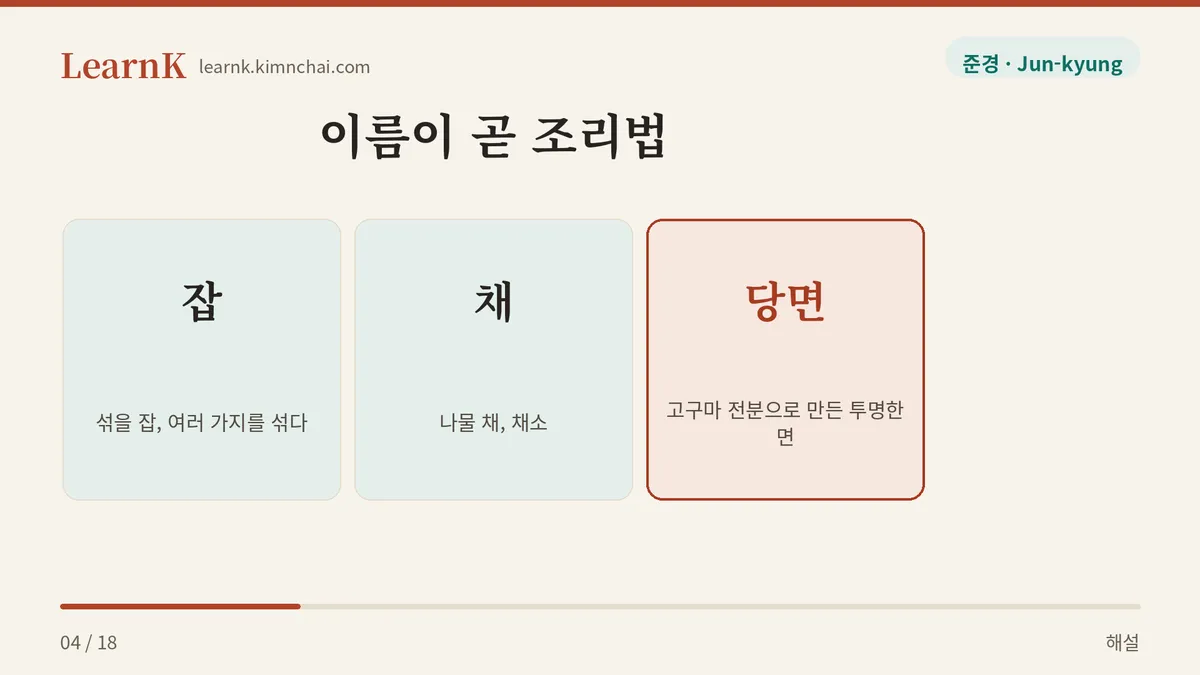
Start with the name. The 잡 (jap) in 잡채 is the character 雜, “to mix,” and 채 (chae) is 菜, “greens, vegetables.” Literally, “an assortment of mixed vegetables” — and the way it’s made follows the name exactly. Spinach on its own, carrots on their own, onion on its own, mushrooms on their own, meat on its own. Each ingredient is stir-fried separately so that its color and texture stay alive, then everything goes into a big bowl together with boiled, seasoned 당면 (dangmyeon) — sweet potato starch noodles — and gets mixed by hand at the very end. This is not a dish you finish with one frying pan.
So this word carries one more piece of information that never makes it into the definition: “someone spent their time on me.” You make 라면 (ramyeon) or 볶음밥 (bokkeumbap) because you’re hungry, but you make japchae because people are coming. That’s also why Korean dramas so often show a big platter of japchae being set down in the middle of the table. That platter is food and, at the same time, a subtitle that reads “today is a special day.”
Checking the National Institute of Korean Language dictionary
First, here is exactly how the Basic Korean Dictionary, published by the government’s National Institute of Korean Language, defines this word.
잡채 (japchae) (noun) A dish made by mixing glass noodles with various vegetables, meat, and so on that have been cut into thin strips and stir-fried in oil. — National Institute of Korean Language, Basic Korean Dictionary (krdict.korean.go.kr)
The same dictionary provides these translations in other languages.
[English] japchae — A Korean dish made by mixing sweet potato noodles with thin slices of stir-fried various vegetables, meat, etc. [Japanese] チャプチェ — 千切りにした肉や種々の野菜などを油で炒めたものを春雨に混ぜて作った料理。 [Spanish] japchae, plato de fideo de patata en polvo con verduras y carnes — Comida mixta con fideo de patata en polvo y varias verduras y carnes que se cortan delgadamente y se tuestan en aceite. [Chinese] 什锦炒粉条,什锦大杂烩 — 将各种蔬菜和肉类等食材切丝后在油锅里炒熟,再放入粉条拌匀而成的食物。 — National Institute of Korean Language, Basic Korean Dictionary (krdict.korean.go.kr)
(There is no Portuguese translation in this dictionary. For reference, it would come out to something like japchae, prato coreano de macarrão de batata-doce com legumes e carne salteados — but that one line is our own translation, not a quotation from the dictionary.)
Put the definitions in those four languages side by side and a pattern appears. Not one of them flatly calls it a “noodle dish.” Every single one insists on including these three actions: “cut into thin strips,” “stir-fried in oil,” and “mixed together.” In other words, the heart of this word is not the ingredients but the handling.
Now let’s look at the actual example sentences in the same dictionary.
저녁 때 손님이 오신다고 불고기에다가 잡채까지 준비하게요? (jeonyeok ttae sonnimi osindago bulgogi-edaga japchae-kkaji junbihage-yo?) “Guests are coming this evening, so you’re making japchae on top of bulgogi?” — National Institute of Korean Language, Basic Korean Dictionary (krdict.korean.go.kr)
This one line contains japchae’s entire social position. Saying “불고기에다가 잡채까지” (bulgogi, and japchae on top of that) means bumping the whole spread up a level, and the “-게요?” at the end of the sentence carries a note of surprise, as in “그렇게까지 하려고요? (geureoke-kkaji haryeogo-yo?)” — “You’re going to go that far?” The sentence only works if the speaker and the listener already share the knowledge that japchae takes a lot of work.
어머니는 몇 가지 채소와 고기를 넣어서 고추잡채를 만들어 주셨다. (eomeoni-neun myeot gaji chaeso-wa gogi-reul neoeoseo gochujapchae-reul mandeureo jusyeotda.) “My mother made gochujapchae for me with a few vegetables and some meat.” — National Institute of Korean Language, Basic Korean Dictionary (krdict.korean.go.kr)
Here a different word shows up: 고추잡채 (gochujapchae). The name overlaps with japchae, but it is not the same dish. We’ll come back to it.
나는 중국집에 가서 매콤한 고추잡채를 흰 빵과 같이 먹었다. (naneun jungguk-jibe gaseo maekomhan gochujapchae-reul huin ppang-gwa gachi meogeotda.) “I went to a Chinese restaurant and ate spicy gochujapchae with white buns.” — National Institute of Korean Language, Basic Korean Dictionary (krdict.korean.go.kr)
“중국집 (jungguk-jip, Korean-Chinese restaurant)” and “흰 빵 (huin ppang, white bread/buns)” are the decisive clues. The white buns here refer to 꽃빵 (kkotppang), the soft white steamed buns served alongside gochujapchae at Korean-Chinese restaurants. In other words, the setting of this sentence is not a celebration table in a Korean home — it’s a Korean-style Chinese restaurant.
고추잡채가 맵다. (gochujapchae-ga maepda.) “Gochujapchae is spicy.” — National Institute of Korean Language, Basic Korean Dictionary (krdict.korean.go.kr)
Short, but important. The fact that the dictionary includes an example sentence for “고추잡채가 맵다” and none for “잡채가 맵다” is itself information. The japchae we’re talking about is, fundamentally, not a spicy food.
In a real conversation
Situation: Saturday evening, the day of Jun-kyung’s housewarming. The moment Emily steps into the entryway, the smell of sesame oil comes drifting from the kitchen.
Jun-kyung: 어, 왔어? 신발 아무 데나 벗어. 나 지금 손에 기름 묻어서 못 나가. Oh, you’re here? Just leave your shoes anywhere. My hands are covered in oil, I can’t come out.
Emily: 잠깐만… 이 냄새 뭐야. 너 설마 잡채 했어? Hold on… what is this smell. Don’t tell me you made japchae?
Jun-kyung: 했지. 집들이에 잡채 없으면 좀 섭섭하잖아. Of course I did. A housewarming without japchae feels like something’s missing.
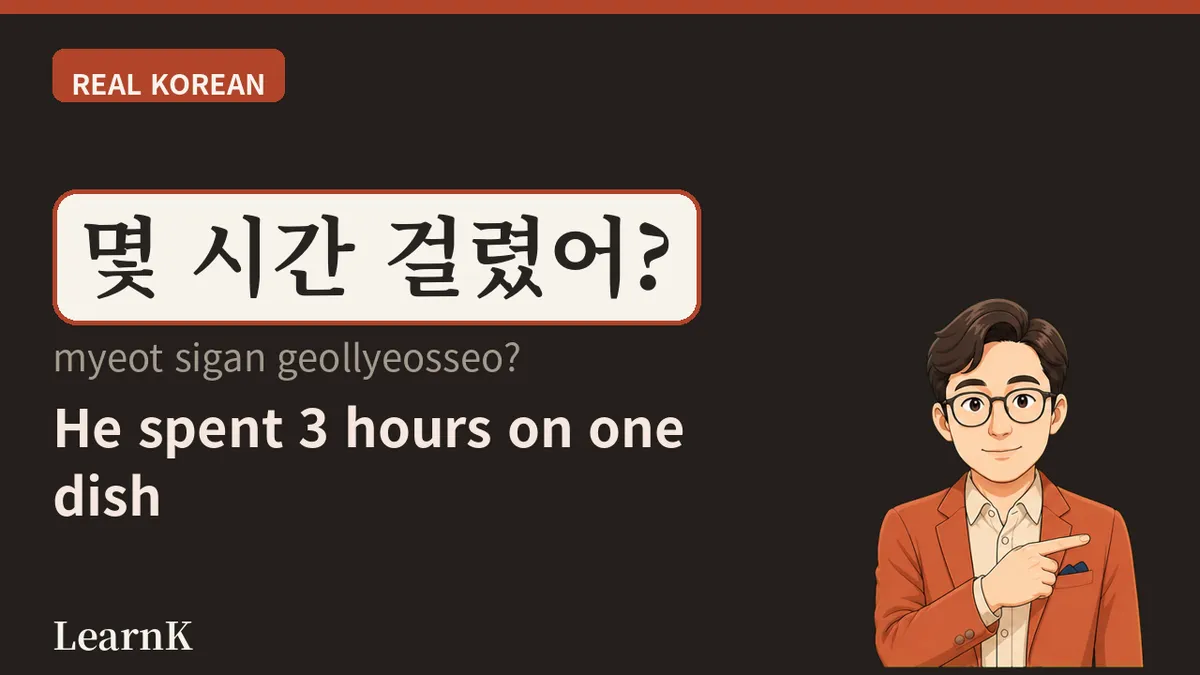
Emily: 야, 이거 채소 다 따로 볶아야 되는 거잖아. 몇 시간 걸렸어? Dude, you have to stir-fry every vegetable separately for this. How many hours did it take?
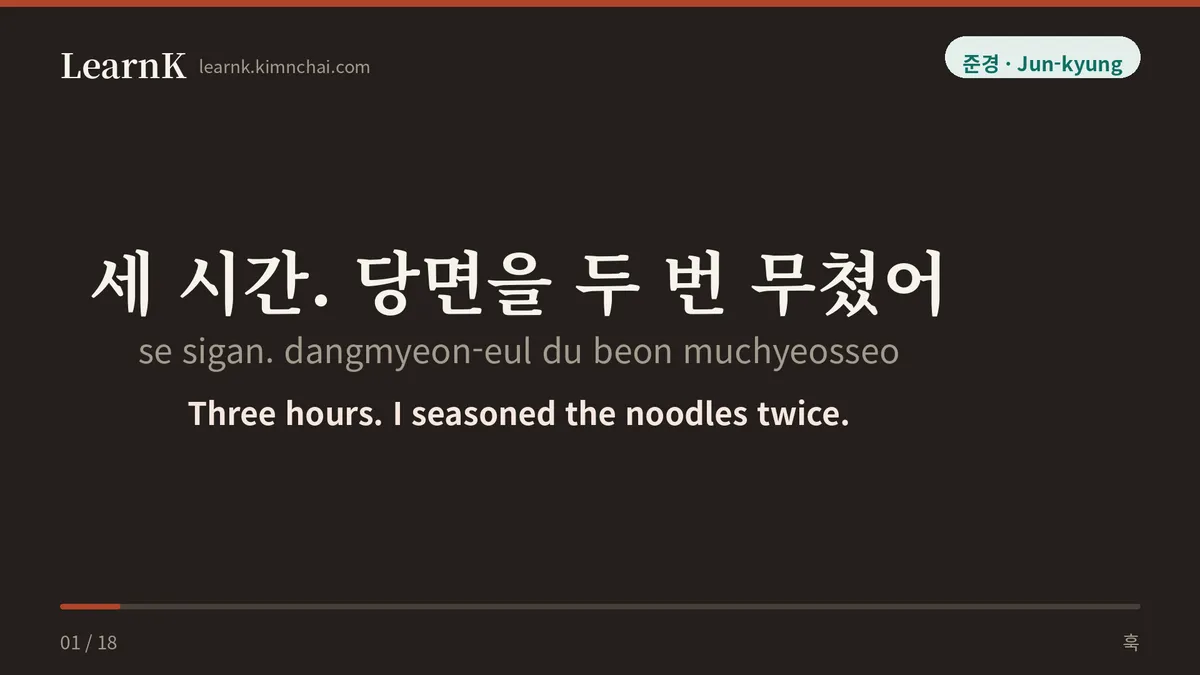
Jun-kyung: 세 시간. 엄마가 전화로 계속 참견하셔서 당면을 두 번 무쳤어. Three hours. My mom kept butting in on the phone so I ended up seasoning the noodles twice.
Emily: (한 입 먹고) …아, 됐다. 나 오늘 밥 안 먹고 잡채만 먹을래. (takes a bite) …Okay, that’s it. Forget rice, I’m just eating japchae tonight.
This is where it sounds off
Japchae is the name of an object, so unlike verb endings it doesn’t shift depending on whether you’re using 존댓말 (jondaenmal, polite speech) or 반말 (banmal, casual speech). Instead, here are two misunderstandings that learners really do trip over.
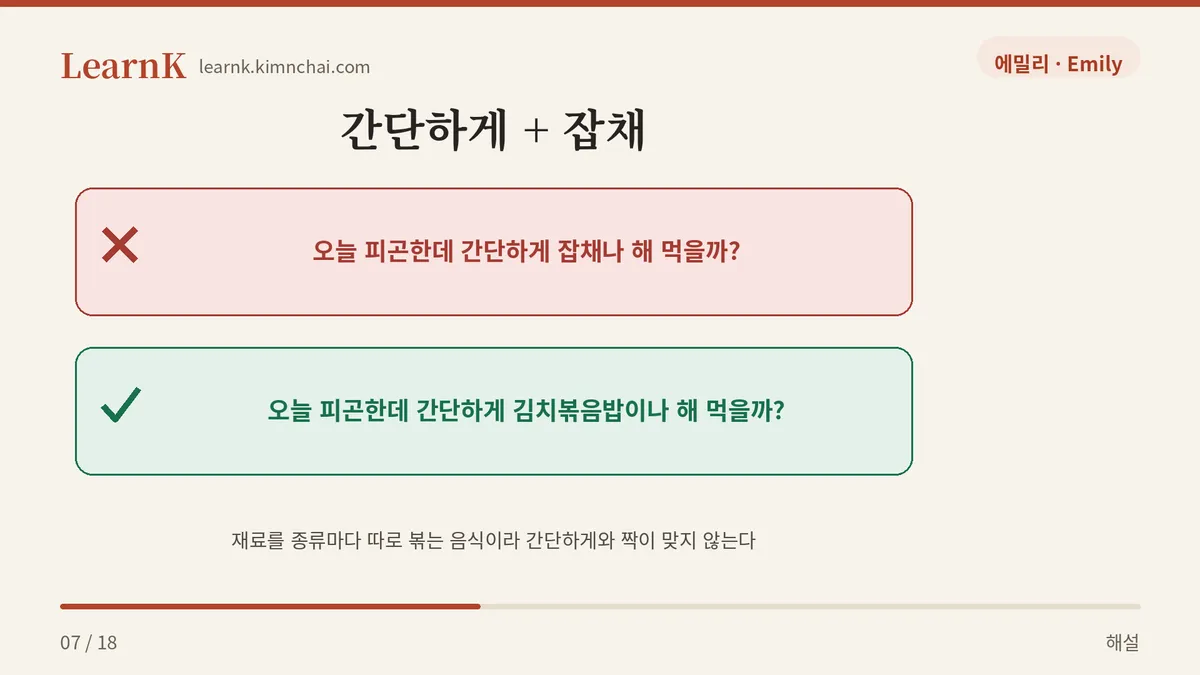
✗ 오늘 피곤한데 간단하게 잡채나 해 먹을까? (oneul pigonhande gandanhage japchae-na hae meogeulkka?) — “I’m tired today, should we just whip up something simple like japchae?” ✓ 오늘 피곤한데 간단하게 **김치볶음밥 (kimchi-bokkeumbap)**이나 해 먹을까? (oneul pigonhande gandanhage kimchi-bokkeumbap-ina hae meogeulkka?) — “I’m tired today, should we just whip up some kimchi fried rice?” → “간단하게 (gandanhage, simply / quickly)” and japchae cannot stand together. Because every type of ingredient has to be stir-fried separately, to a Korean ear it sounds like “간단하게 갈비찜이나 할까? (gandanhage galbijjim-ina halkka?)” — “Should we just quickly braise some short ribs?” It’s not that you won’t be understood; it’s that it sounds like a joke.
✗ (at a Korean-Chinese restaurant) 여기요, 잡채 하나 주세요. (yeogiyo, japchae hana juseyo.) — “Excuse me, one japchae, please.” ✓ (at a Korean-Chinese restaurant) 여기요, 고추잡채 (gochujapchae) 하나 주세요. (yeogiyo, gochujapchae hana juseyo.) — “Excuse me, one gochujapchae, please.” → What’s on the menu at a Korean-style Chinese restaurant is not 잡채 but 고추잡채. It’s a different dish — bell peppers and pork stir-fried with a spicy kick, eaten with steamed buns — and the glass-noodle japchae you have in mind will not arrive. This is the single most common mix-up caused by the overlapping names.
Example sentences by situation
1. On hearing that guests are coming (a daughter-in-law to her husband)
어머님 오신다는데 잡채라도 해 놓을까 (japchae-rado hae noeulkka)? “Your mother’s coming over — should I at least make some japchae?”
The thing to notice here is -라도 (-rado). Normally “-라도” means “it isn’t enough, but at least this,” so it’s a way of downplaying what you’re offering — and yet Koreans attach this particle even to a labor-intensive dish like japchae. The modesty of calling a three-hour job “잡채라도” is the temperature of this sentence.
2. The morning after a holiday, opening the fridge
잡채 남은 거 밥에 비벼 먹으면 진짜 맛있어 (japchae nameun geo bap-e bibyeo meogeumyeon jinjja masisseo). “Leftover japchae mixed into rice is seriously delicious.”
Japchae is a dish where the leftovers are part of the plan. Nobody makes just one plate of it, so the day after a holiday this line is practically guaranteed. Piling cold japchae onto warm rice and mixing it together is the standard move — and turning exactly that into a menu item is how Korean-Chinese restaurants got 잡채밥 (japchaebap).
3. Choosing from a menu at a restaurant (polite speech)
저기요, 여기 잡채도 되나요 (japchae-do doenayo)? “Excuse me, do you do japchae here too?”
“되나요? (doenayo?)” means “do you sell it? / can I order it?” and is extremely common in restaurants. It sounds softer than “있나요? (innayo?)”, which makes it a good choice at a place you’re visiting for the first time.
Polite and casual speech, and related expressions
Japchae itself is a noun, so its form doesn’t change. Politeness and casualness are decided by the verb you use with it. When offering some to someone older, it’s 잡채 좀 드세요 (japchae jom deuseyo); to a friend, it’s 잡채 좀 먹어 봐 (japchae jom meogeo bwa). And when you talk about making it, using 잡채를 무치다 (japchae-reul muchida) instead of 만들다 (mandeulda, to make) will make you sound far more like a native speaker. 무치다 means to add seasoning and mix it evenly by hand — the verb points directly at japchae’s final step.
Here are the similarly named words that tend to get confused, sorted out.
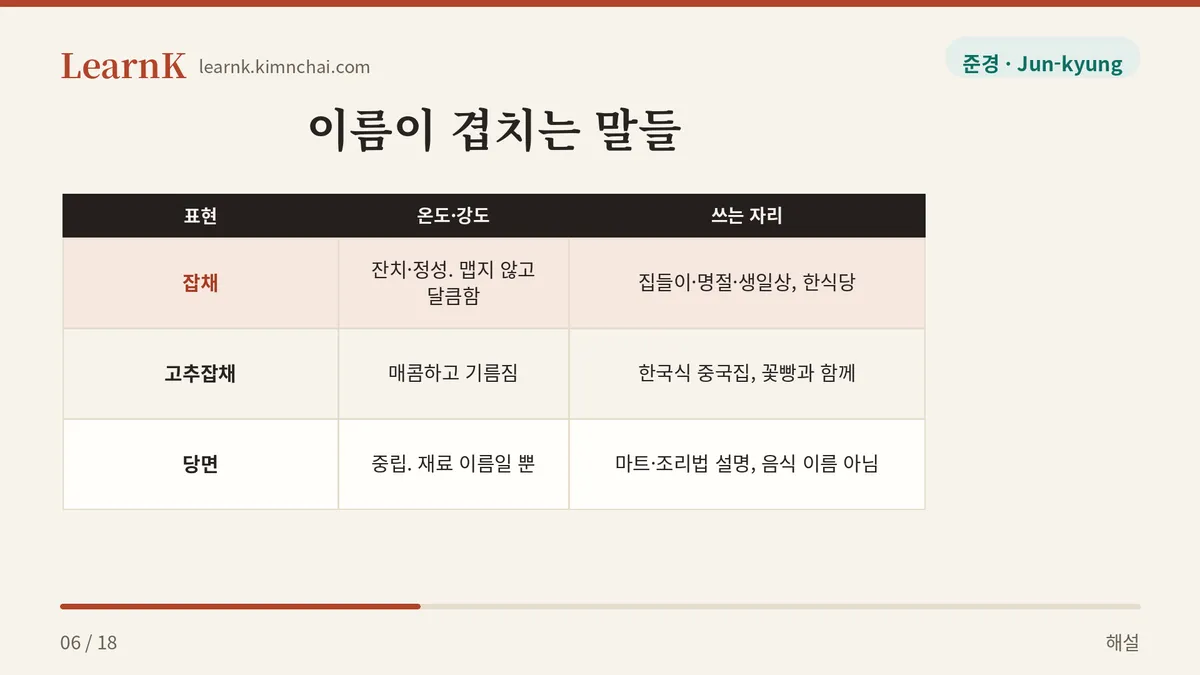
| Expression | Tone / intensity | Where it’s used |
|---|---|---|
| 잡채 (japchae) | Celebration and care. Not spicy, lightly sweet | Housewarmings, holidays, birthday tables. Korean restaurants |
| 고추잡채 (gochujapchae) | Spicy and rich with oil | Korean-style Chinese restaurants. Served with 꽃빵 (kkotppang) |
| 잡채밥 (japchaebap) | A hearty full meal | Served over rice at Korean-Chinese restaurants |
| 당면 (dangmyeon) | Neutral. Just an ingredient name | Supermarkets, recipe explanations. Not the name of a dish |
Be especially careful with that last row. 당면 is the name of an ingredient — the translucent noodles made from sweet potato starch themselves — so if you say “당면 주세요 (dangmyeon juseyo)” in a restaurant, you’re asking for the raw ingredient, not a dish.
Cultural background — the platter that goes in the middle of the table
A Korean table has a hierarchy of positions. There’s the rice and soup set down in front of each person, and there are the plates placed in the center that everyone reaches their chopsticks toward. Japchae is almost always the latter — and it’s usually in the biggest dish of all, planted dead center.
What’s interesting is that this food didn’t always look the way it does now. As the name tells you, the original star of japchae wasn’t noodles but an assortment of vegetables. The translucent glass noodles now treated as japchae’s signature only entered the picture in the twentieth century, once dangmyeon factories were established in Korea. So japchae is a dish with an old name and a comparatively recent shape — which is why “traditional food” and “essential housewarming menu item” both fit it at the same time.
Watch any drama and you’ll notice this platter turns up in the same kinds of scenes. The day a grown child comes home after a long absence, the day the in-laws visit for the first time, the day people are invited over to a newly moved-into home. Without a line of dialogue explaining it, viewers see japchae on the table and know that this household is receiving guests today. Conversely, you almost never see japchae on the table of a character who lives alone. Not many people spend three hours cooking just for themselves.
These days supermarkets sell ready-made japchae, and meal kits are everywhere. Even so, when the holidays come around, plenty of households still mix it by hand. It isn’t only about the difference in taste. The mere fact that the big bowl for mixing japchae is out on the kitchen counter is itself a signal: “people are coming to our house today.” For a Korean learner, truly knowing this word means being able to read that signal too.
Today’s quiz
A friend has come over to your studio apartment. There are only two eggs and some kimchi in the fridge, you’re both hungry, and you’re both exhausted. Which line fits least well in this moment?
① 그냥 라면이나 끓여 먹을까? (geunyang ramyeon-ina kkeurhyeo meogeulkka?) — “Should we just make some ramyeon?” ② 김치볶음밥 해 줄게, 금방 돼. (kimchi-bokkeumbap hae julge, geumbang dwae.) — “I’ll make kimchi fried rice, it’ll be quick.” ③ 간단하게 **잡채 (japchae)**나 해 먹자. (gandanhage japchae-na hae meokja.) — “Let’s just whip up some japchae, nice and simple.” ④ 귀찮은데 배달시키자. (gwichanheunde baedal-sikija.) — “Too much hassle — let’s order delivery.”
Answer: ③
Japchae ranks among the most labor-intensive dishes there is: every vegetable stir-fried by type, the glass noodles boiled and then seasoned and mixed. It never pairs with “간단하게 (gandanhage)” in the first place, and more to the point, a fridge holding nothing but eggs and kimchi doesn’t even let you begin. Japchae isn’t food you throw together on a tired day — it’s food you make on the day you’ve decided to invite someone over.
Definitions and example sentences are from the National Institute of Korean Language’s Basic Korean Dictionary (krdict.korean.go.kr); that portion of this post, including our translations, is licensed under CC BY-SA 2.0 KR.