잡수시다 (japsusida) — The Highest Honorific for '먹다 (meokda),' the One That Only Comes Out at Grandma's Table
잡수시다
잡수시다 (japsusida) is the honorific form of 먹다 (meokda), “to eat” — the word used when an elder is having a meal and you want to raise that person as high as the language allows. If you’ve ever seen a holiday-morning scene in a Korean drama, the picture comes together fast. The daughter-in-law carries in the meal table, sets it down in front of Grandma, says “진지 잡수세요 (jinji japsuseyo),” and steps back. Yet a few seconds later, that same person tells her own child “밥 먹어 (bap meogeo),” and asks the husband sitting next to her “밥 먹었어? (bap meogeosseo?)” At one single table, the verb for the exact same action changed three times.
Korean honorifics are not just a device that changes the end of a sentence. When the other person ranks high enough, the entire word gets swapped out. 잡수시다 stands at the spot where that swap happens most dramatically.
What’s interesting is that if you crack this word open, the honor comes in two layers. The dictionary defines 잡수시다 as “(honorific) 잡수다.” In other words, 잡수다 (japsuda) is already an honorific form of 먹다, and 잡수시다 is that word with the honorific pre-final ending -시- (-si-) stacked on top of it one more time. It’s honorifics wrapped in honorifics — so among all the ways to say “eat,” it inevitably carries the most weight.
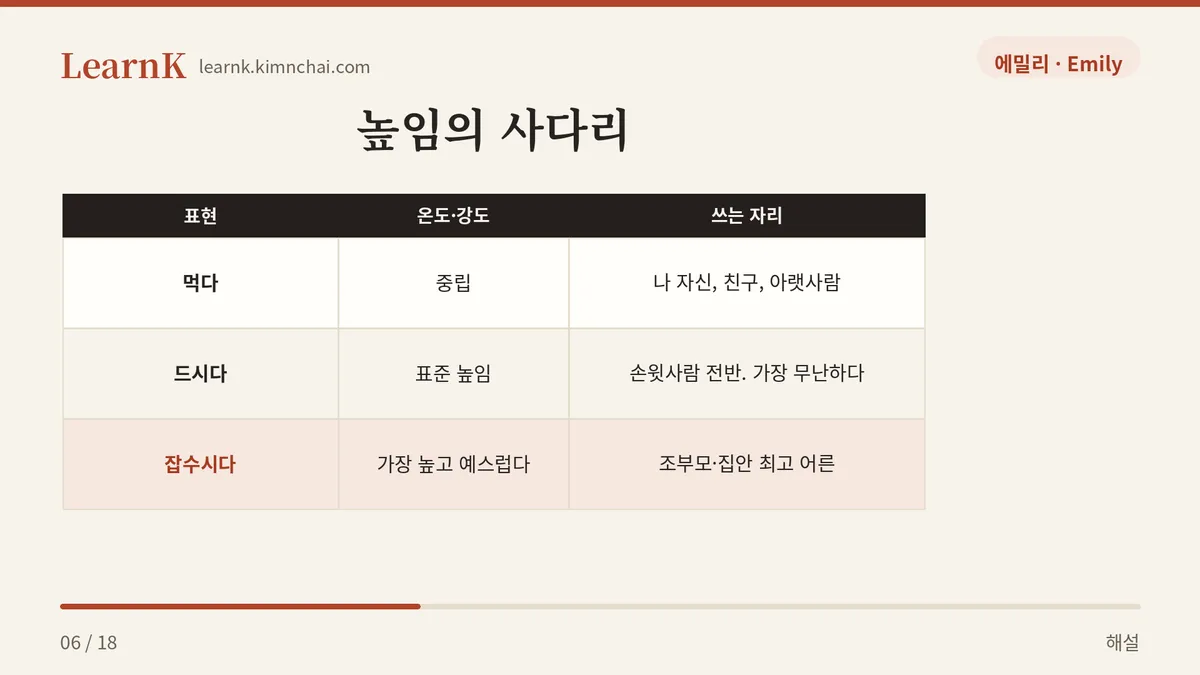
Which is exactly why its real-world range is narrower than you’d expect. If you set up a ladder — 먹다 (meokda) → 드시다 (deusida) → 잡수시다 (japsusida) — the standard polite form used with someone older than you in daily life mostly stops at 드시다. 잡수시다 is the rung above that: the word you bring out for the grandparents’ generation, for the most senior elder in the family, for someone well along in years.
It helps to learn the conjugations in advance. 잡수세요 (japsuseyo) — the invitation, equivalent to 드세요 (deuseyo); 잡수셨어요? (japsusyeosseoyo?) — equivalent to 드셨어요? (deusyeosseoyo?); 잡수십니다 (japsusimnida) — the formal declarative; 잡수시겠어요? (japsusigesseoyo?) — a polite offer. In actual conversation, the first two dominate by far.
Checking the National Institute of Korean Language dictionary
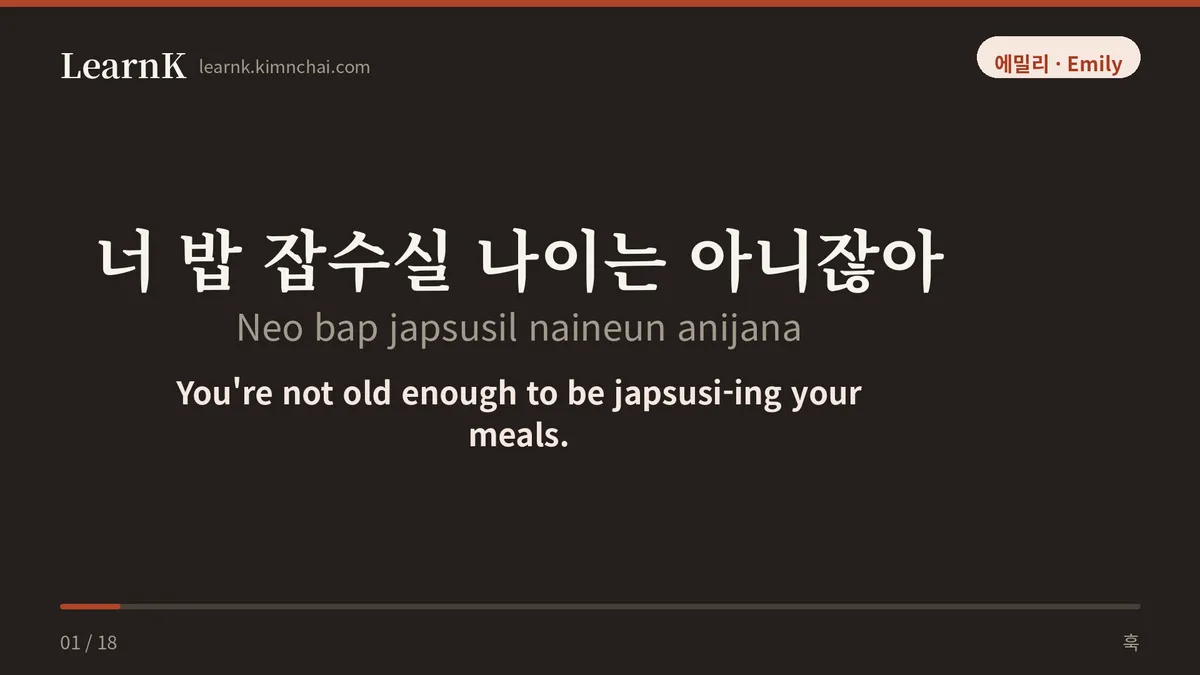
The National Institute of Korean Language’s Basic Korean Dictionary lists 잡수시다 like this.
잡수시다 (japsusida) 「동사」 (verb)
(높임말로) 잡수다. — (As an honorific) 잡수다.
[en] eat; have — (honorific) To eat.
[ja] めしあがる【召し上がる】 — 「食べる」の尊敬語。
[es] ingerir — (TRATAMIENTO HONORÍFICO) Comer alimento.
[zh] 吃 — (尊称)把食物放在嘴里吞咽。
— National Institute of Korean Language, Basic Korean Dictionary (krdict.korean.go.kr)
A Portuguese definition is not included in this dictionary. For our Brazilian and Portuguese readers, our own rendering would be roughly comer (tratamento honorífico) — and we want to be clear that this one line is our own translation, not a quotation from the dictionary.
Notice that the definition is just a few syllables long: “(높임말로) 잡수다,” “(as an honorific) 잡수다.” Rather than explaining the meaning anew, the dictionary simply points to 잡수다. That tells you the meaning is identical and only one more layer of honor has been stacked on top.
Here are the usage examples the same dictionary provides.
‘먹다’라는 단어의 높임말은 ‘드시다’와 ‘잡수시다’이다. (‘meokda’raneun daneoui nopimmareun ‘deusida’wa ‘japsusida’ida.) The honorific forms of the word 먹다 are 드시다 and 잡수시다.
아침을 잡수시다. (achimeul japsusida.) to eat breakfast (honorific)
약주를 잡수시다. (yakjureul japsusida.) to drink alcohol (honorific)
진지를 잡수시다. (jinjireul japsusida.) to eat a meal (honorific)
맛있게 잡수시다. (masitge japsusida.) to eat with enjoyment (honorific)
— National Institute of Korean Language, Basic Korean Dictionary (krdict.korean.go.kr)
Let’s walk through the situation each example captures.
- ‘먹다’라는 단어의 높임말은 ‘드시다’와 ‘잡수시다’이다. — This is the dictionary drawing you a map directly. There isn’t one honorific form but two, and they stand side by side — a national institution’s dictionary states it explicitly. The difference between those two words, which we’ll get to later in this post, starts right here.
- 아침을 잡수시다 (achimeul japsusida) — In Korea, asking after someone starts with food. “아침 잡수셨어요? (achim japsusyeosseoyo?)” asks whether they’ve had breakfast, and at the same time means “I hope nothing was wrong through the night.” It’s the most common form of first greeting offered to an elder.
- 약주를 잡수시다 (yakjureul japsusida) — What deserves attention here is the object. It isn’t 술 (sul), “alcohol” — it’s 약주 (yakju). 약주 is the honorific word for alcohol, so when the verb goes up, the object goes up with it. With an elder, “약주 잡수셨어요? (yakju japsusyeosseoyo?)” fits the register better than “술 드셨어요? (sul deusyeosseoyo?)”
- 진지를 잡수시다 (jinjireul japsusida) — 진지 (jinji) is the honorific word for 밥 (bap), a meal or cooked rice. “진지 잡수세요 (jinji japsuseyo)” is close to a fixed formula at the Korean dinner table. You can think of it as the signature sentence for this expression — what the person who set the table says when calling the elders over.
- 맛있게 잡수시다 (masitge japsusida) — This is what the person serving the food says. “맛있게 잡수세요 (masitge japsuseyo)” is the greeting a restaurant owner uses while setting dishes down in front of an elderly customer, or that a daughter-in-law uses while nudging a side dish toward her parents-in-law.
A real conversation
The scene: It’s Jun-kyung’s grandmother’s birthday. Emily, carrying dishes out of the kitchen, catches Jun-kyung.
Jun-kyung: 할머니 곧 나오셔. 국 식겠다, 빨리 놔. Grandma’s coming out soon. The soup’s getting cold—put it down, hurry.
Emily: 야, 잠깐만. 나 “많이 드세요” 하려고 했는데, 아까 너희 어머니는 “잡수세요” 하시더라? Hey, hold on. I was going to say “deuseyo,” but earlier your mom said “japsuseyo.”
Jun-kyung: 아, 그거? 할머니한테는 그게 더 자연스러워. 우리 엄마도 할머니 앞에서만 그렇게 해. Ah, that? For Grandma that just sounds more natural. Even my mom only does it in front of Grandma.
Emily: 그럼 나도 “잡수세요” 해도 돼? 너무 옛날말 같지 않아? Then can I say “japsuseyo” too? Doesn’t it sound too old-fashioned?
Jun-kyung: 아니야, 할머니 진짜 좋아하실걸. 그 말 들으면 제대로 대접받는 기분 나시거든. Not at all, Grandma will love it. That word makes her feel properly honored.
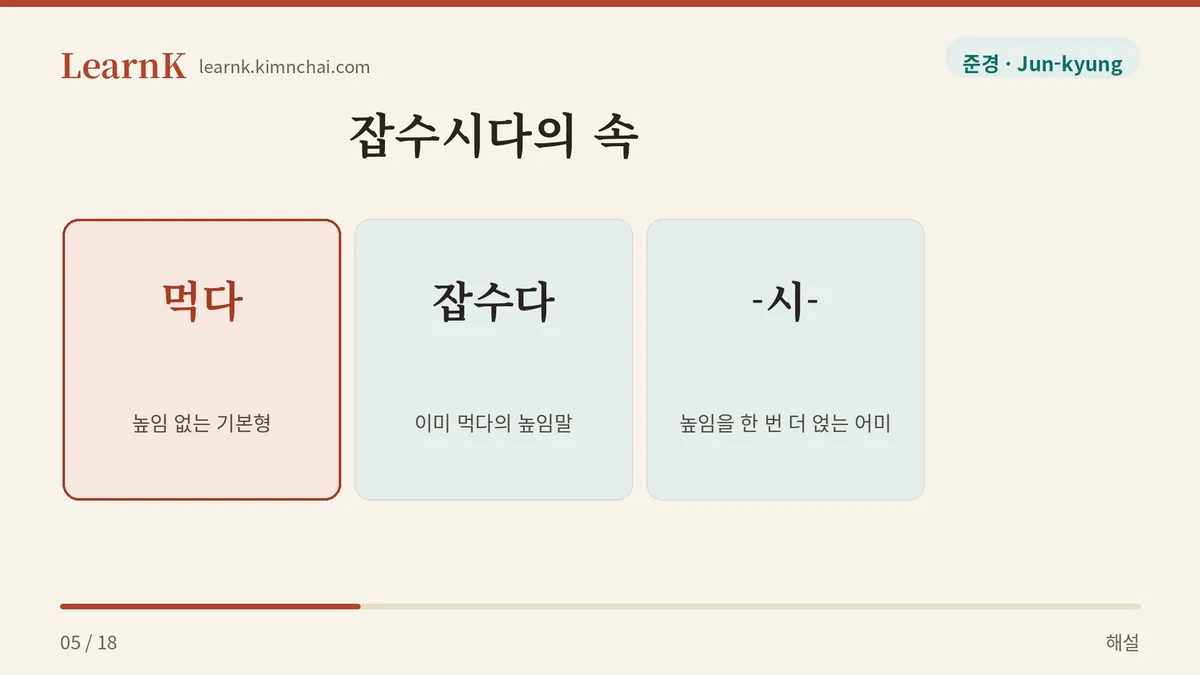
Emily: 오케이. 근데 너한텐 절대 안 써. 너 밥 잡수실 나이는 아니잖아. Okay. But I’m never using it on you. You’re not old enough to be “japsusi-”ing your meals.
Jun-kyung: …야. …Hey.
Using it this way sounds off
✗ (to a senior colleague two years older) 선배, 점심 잡수셨어요? (Seonbae, jeomsim japsusyeosseoyo?) ✓ (to a senior colleague two years older) 선배, 점심 드셨어요? (Seonbae, jeomsim deusyeosseoyo?) → 잡수시다 carries the weight of the grandparents’ generation. Used on a colleague in their thirties, it’s like adding twenty years to their age — so instead of sounding polite, it sounds like teasing.
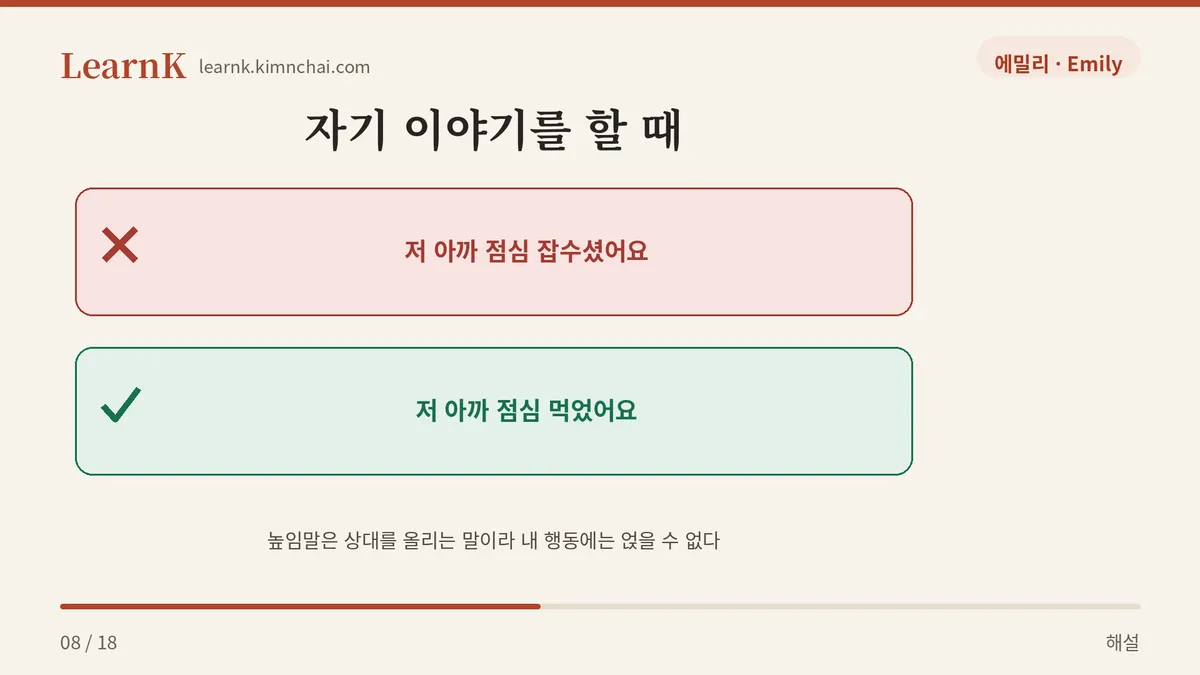
✗ (talking about yourself) 저 아까 점심 잡수셨어요. (Jeo akka jeomsim japsusyeosseoyo.) ✓ (talking about yourself) 저 아까 점심 먹었어요. (Jeo akka jeomsim meogeosseoyo.) → Honorifics exist to lift up the other person, so you can’t attach them to your own actions. No matter how politely you want to speak, what you ate is simply “먹었어요 (meogeosseoyo).” This is the mistake learners make most often, and the one Koreans catch fastest.
Example sentences by situation
1. In front of the birthday table
The whole family has gathered for Grandma’s birthday. The seaweed soup has been made and placed in the center of the table, and it’s the moment to call Grandma, who is still in her room. Here, even 밥 (bap) becomes not 밥 but 진지 (jinji).
할머니, 진지 잡수세요. 국 식기 전에요. (Halmeoni, jinji japsuseyo. Guk sikgi jeone-yo.) Grandma, please come eat. Before the soup gets cold.
2. At a hospital visit or while caregiving
When you visit an elder who’s been admitted to the hospital, the first question is almost fixed. For someone who is unwell, how much they eat is their recovery, so asking “how much did you eat” is the most concrete way to ask “are you doing all right?”
아버님, 오늘 아침은 좀 잡수셨어요? (Abeonim, oneul achimeun jom japsusyeosseoyo?) Father, did you manage to eat a little this morning?
3. When offering something to an elder in the neighborhood
This is what a market vendor says while handing a tangerine to a regular customer, or what you say while sharing holiday food with an elderly neighbor. Even outside formal settings, the other person’s age alone makes this expression come out naturally.
어르신, 이거 하나 잡수시고 가세요. (Eoreusin, igeo hana japsusigo gaseyo.) Sir/Ma’am, have one of these before you go.
Related expressions in polite and casual speech
| Expression | Temperature / intensity | Where it’s used |
|---|---|---|
| 먹다 (meokda) | Neutral. No honorific | Yourself, friends, people younger or below you |
| 드시다 (deusida) | Standard honorific | Anyone older or above you — your boss, guests, an adult you’re meeting for the first time. The safest choice |
| 잡수시다 (japsusida) | The highest, and old-fashioned in flavor | Grandparents, the most senior elder in the family, people well along in years. Birthday tables, holidays, hospital visits |
| 자시다 (jasida) | Honorific, but archaic and regionally flavored | Historical-drama dialogue or the speech of elders. Learners don’t need to be the first to use it |
There are two lines a foreign learner should remember for real-life use. If you can’t decide, use 드시다 and you’ll be right 90 percent of the time. And if the person in front of you looks like they’re a generation above your own parents, that’s when you bring out 잡수시다.
Cultural background — matching word pairs at the table
Korean honorifics have one layer that changes verb endings and a separate layer that swaps out whole words. Gather up the pairs belonging to that second layer and the pattern comes into view. 밥 (bap) becomes 진지 (jinji), 술 (sul) becomes 약주 (yakju), 자다 (jada) becomes 주무시다 (jumusida), 있다 (itda) becomes 계시다 (gyesida), 나이 (nai) becomes 연세 (yeonse), 집 (jip) becomes 댁 (daek), and 말 (mal) becomes 말씀 (malsseum). And 먹다 becomes 잡수시다.
The dictionary example we saw earlier, 약주를 잡수시다, shows this principle exactly. Once you’ve raised the verb to its highest level, the object has to rise with it for the whole sentence to hold its register. This instinct for keeping the height of honor even within a single sentence is why Korean honorific speech isn’t just a matter of ending rules. The word 조반 (joban), which belongs to this same old-fashioned family, is likewise a Sino-Korean word for breakfast (朝飯) and is rarely used these days. It’s no accident that the words that travel alongside 잡수시다 all carry the scent of older written language.
As a result, 잡수시다 sounds today like a kind of generational marker. Koreans in their twenties and thirties speak to one another — and even to people older than them — with 드시다 almost across the board. The people who put 잡수시다 in their mouths naturally are usually from an older generation, or are in a position where they attend to a family elder with particular care. That’s also why the word is heard so often in Korean dramas about holiday mornings: a single line of dialogue can show the household’s hierarchy and atmosphere in one stroke.
Flip that around, and it means the effect is considerable when a foreign learner uses this word in exactly the right place. To Korean elders, “진지 잡수세요” reads not as simple grammatical accuracy but as a signal that “this person knows our ways.” But because the effect is so large, you have to pick your moment. As the misuse examples above showed, if the target is even slightly off, it immediately sounds like a joke.
Today’s quiz
Which of the following sentences sounds off?
① 할아버지, 약주 좀 잡수셨어요? (Harabeoji, yakju jom japsusyeosseoyo?) — Grandfather, have you had some alcohol? ② 어머니, 진지 잡수세요. (Eomeoni, jinji japsuseyo.) — Mother, please eat. ③ 저는 아까 점심을 잡수셨어요. (Jeoneun akka jeomsimeul japsusyeosseoyo.) — I ate lunch a little while ago. ④ 할머니께서 아침을 잡수시고 나가셨어요. (Halmeonikkeseo achimeul japsusigo nagasyeosseoyo.) — Grandmother ate breakfast and went out.
Answer: ③
Honorifics exist to elevate the other person, so they can’t be used for your own actions. “저는 아까 점심을 먹었어요 (Jeoneun akka jeomsimeul meogeosseoyo)” is the correct form. In ①, the verb pairs properly with 약주, the honorific word for alcohol; in ②, it pairs properly with 진지, the honorific word for a meal; and in ④, the honorific subject marker 께서 (kkeseo) is attached to the subject, keeping the level of honor even throughout the whole sentence.
Definitions and example sentences are from the National Institute of Korean Language’s Basic Korean Dictionary (krdict.korean.go.kr); that portion of this post, including our translations, is licensed under CC BY-SA 2.0 KR.