저기요 (jeogiyo) — The Three Syllables for Calling Someone Whose Name You Don't Know
저기요 (jeogiyo)
저기요 (jeogiyo) is what you say when you want to politely get the attention of someone whose name or title you don’t know — it’s the closest Korean equivalent of “Excuse me.” Calling over a server who hasn’t come to take your order, speaking to a stranger on the street, telling the person in front of you that they dropped their wallet — spend a day in Korea and it’s genuinely hard to get through it without hearing these three syllables at least once.
And yet this is also one of the last phrases Korean learners actually get comfortable saying out loud. Not because the grammar is hard. 저기요 (jeogiyo) is a two-syllable demonstrative with one polite ending attached — grammatically, it’s first-week material. What’s difficult isn’t the grammar; it’s the action. Making a sound in the direction of a stranger feels foreign in itself, which is why so many learners end up staring at the menu for ten solid minutes.
Meaning and Nuance
The uses of 저기요 (jeogiyo) split into two main branches.
The first is calling someone. It’s a signal that pulls the gaze of someone whose name you don’t know over to you. Courtesy is already built into it: the final ‘요 (yo)’ is a politeness marker, so the moment you use this word, you’ve drawn a line saying you don’t intend to treat the other person carelessly. That makes it the safest default for one adult addressing another adult for the first time.
The second is a light brake. When someone’s words or behavior have crossed a line, you use it to pause the moment for a beat instead of protesting head-on. Placed at the front of a sentence, as in 저기요, 그건 좀 아닌 것 같은데요. (jeogiyo, geugeon jom anin geot gatteundeyo.), it comes closer to “Hold on, let’s address that.”
Same three syllables — what divides the meanings is intonation. Stretch the ending long and let it rise (저기요~) and it’s a soft summons; clip it short and drop it hard (저기요!) and it’s a complaint. Koreans have never been taught this difference, yet they distinguish it precisely. What learners need is this sense of temperature more than a definition.
A Real Conversation
Scene: A 국밥 (gukbap) restaurant just after the lunch rush. They’ve been seated for over ten minutes and nobody has come to take their order.
Jun-kyung: 야, 너 왜 아까부터 메뉴판만 보고 있어. 다 골랐다며. Hey, why have you been staring at the menu this whole time? You said you’d decided.
Emily: 아니… 부르기가 좀 그래서. 다들 바빠 보이잖아. Well… it feels awkward to call them. They all look busy.
Jun-kyung: 그럴 땐 그냥 저기요 하면 돼. 봐 봐. 저기요~ 여기 주문이요! Just say “jeogiyo” in that case. Watch. “Excuse me — we’d like to order over here!”
Emily: 헐, 목소리 완전 크다. 나도 저렇게 해야 돼? Whoa, that was loud. Do I have to do it like that?
Jun-kyung: 크게 안 해도 돼. 눈만 마주치고 저기요 한 번이면 다 알아들으셔. You don’t have to be loud. Catch their eye and say “jeogiyo” once — they’ll get it.
Emily: 알았어. 다음 집 가면 내가 부른다. Got it. Next place, I’m doing the calling.
Where It Sounds Off
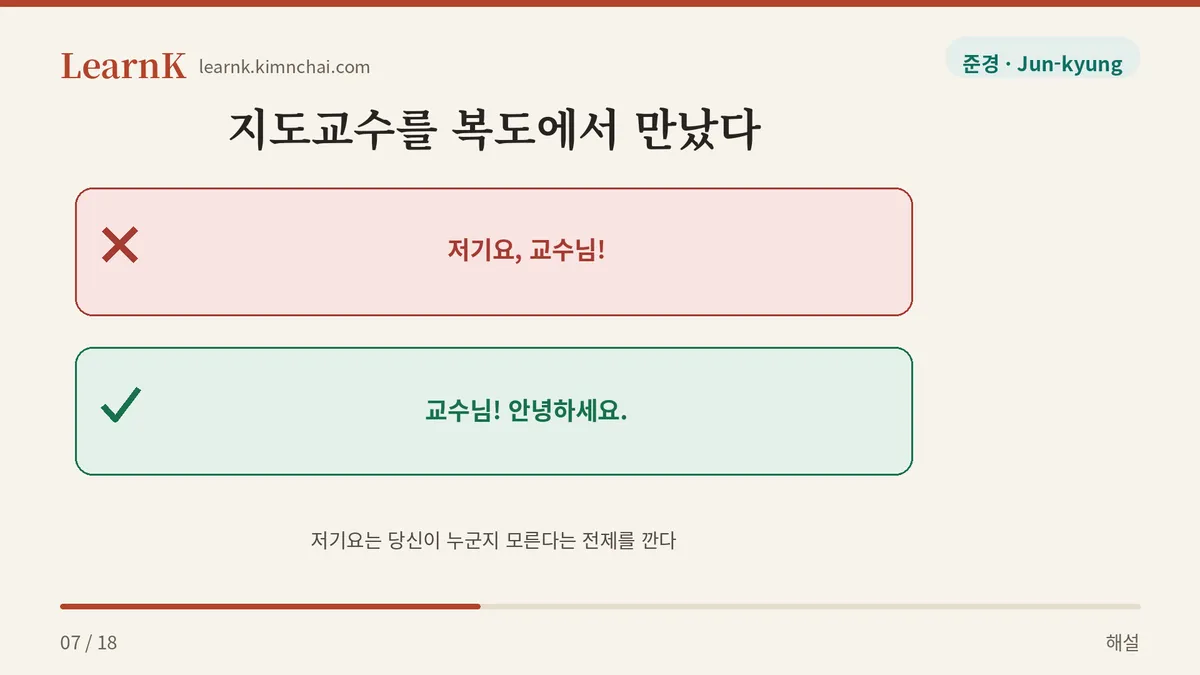
✗ (Spotting your academic advisor in the hallway) 저기요, 교수님! ✓ (Spotting your academic advisor in the hallway) 교수님! 안녕하세요. → 저기요 (jeogiyo) carries the built-in premise of “I don’t know who you are.” Use it with someone whose title or name you do know and it implies you failed to recognize them, which comes across as rude. If there’s a name or a title available to call them by, that’s always the better choice.
✗ (Calling to a friend across the way) 저기요! 나 여기 있어! ✓ (Calling to a friend across the way) 야! 나 여기 있어! → Using 저기요 (jeogiyo) with someone close to you means suddenly acting like a stranger, so it reads as either a joke or a sign that you’re sulking. In fact, Koreans will deliberately call out “저기요~” when a friend has hurt their feelings, playacting at putting distance between them.
Example Sentences by Situation
1. Ordering at a restaurant — the most common setting of all. Make eye contact with the staff and say it clearly, just once.
저기요, 여기 주문 좀 받아 주세요. (jeogiyo, yeogi jumun jom badajuseyo.) Excuse me, could you take our order over here?
Many Korean restaurants have a call button at every table, but plenty of places still have no button, or a broken one. In that case, calling out with your voice isn’t rudeness — it’s the normal procedure. If anything, waiting without calling means the server keeps walking past, assuming, “They must not have decided yet.”
2. Letting a stranger know something on the street — urgent, but you mustn’t startle them.
저기요, 이거 떨어뜨리셨어요. (jeogiyo, igeo tteoreotteurisyeosseoyo.) Excuse me, you dropped this.
Leading with this one line is far safer than suddenly tapping someone on the shoulder from behind. Once they turn around, you hold the item out to them.
3. When someone cuts in line — here the intonation gets short and firm.
저기요, 여기 줄 서 있는데요. (jeogiyo, yeogi jul seo inneundeyo.) Excuse me, there’s a line here.
The trick is closing with ‘-는데요 (-neundeyo)’ so the sentence trails off. It’s less aggressive than “여기 줄 서 있어요!” while still saying everything that needs saying. In Korean, the less you push a complaint all the way to the end of the sentence, the more grown-up it sounds.
Similar Expressions, Polite and Casual
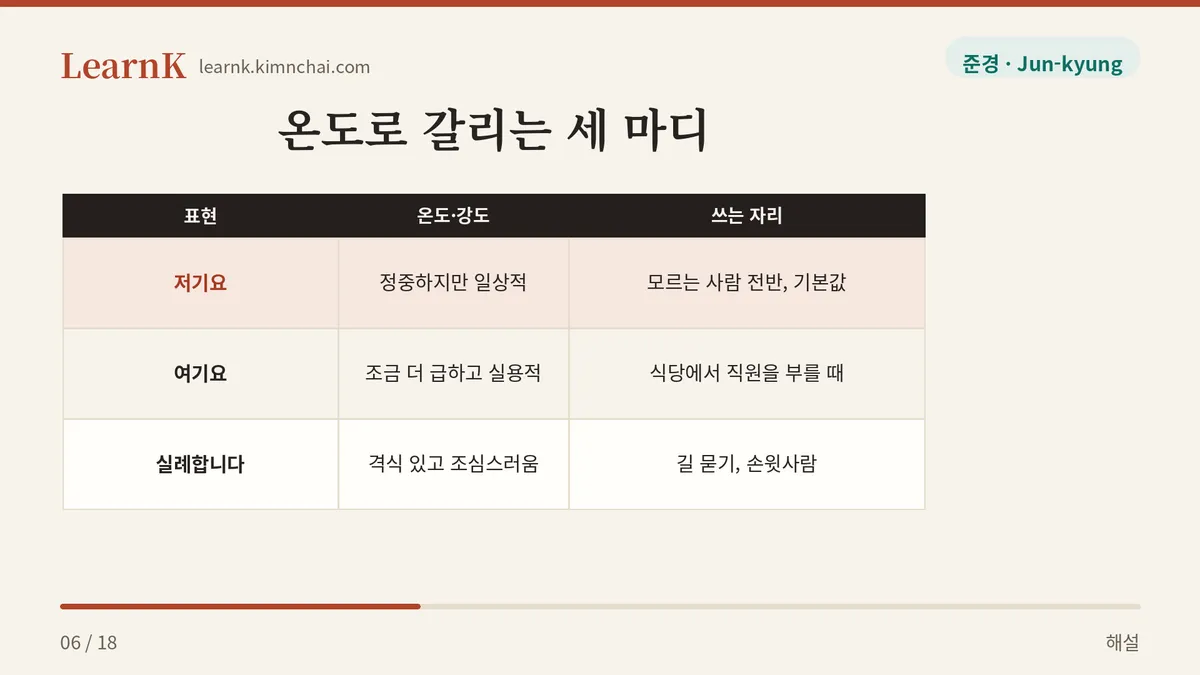
| Expression | Temperature / Intensity | Where it’s used |
|---|---|---|
| 저기요 (jeogiyo) | Polite but everyday | Strangers in general. The safest default |
| 여기요 (yeogiyo) | A bit more urgent and practical | Calling staff at a restaurant or café. Closer to “Come over this way, please” |
| 실례합니다 (sillyehamnida) | Formal and careful | Asking directions, official settings, addressing someone older or senior |
| 사장님 / 이모님 (sajangnim / imonim) | Warm, with a note of deference | Shop owners or restaurant staff. Common at a place you frequent |
| 야 / 어이 (ya / eoi) | Casual speech, rough | Between friends only. Use it on a stranger and you’ll start a fight |
The casual-speech counterpart is 저기 (jeogi). You use it when broaching something gingerly with a friend, as in “저기, 나 할 말 있어. (jeogi, na hal mal isseo.)” What’s interesting is that dropping that single ‘요 (yo)’ turns it from a word that calls someone into a word that stalls before saying something.
Cultural Background — A Word That Calls the Place Instead of the Name
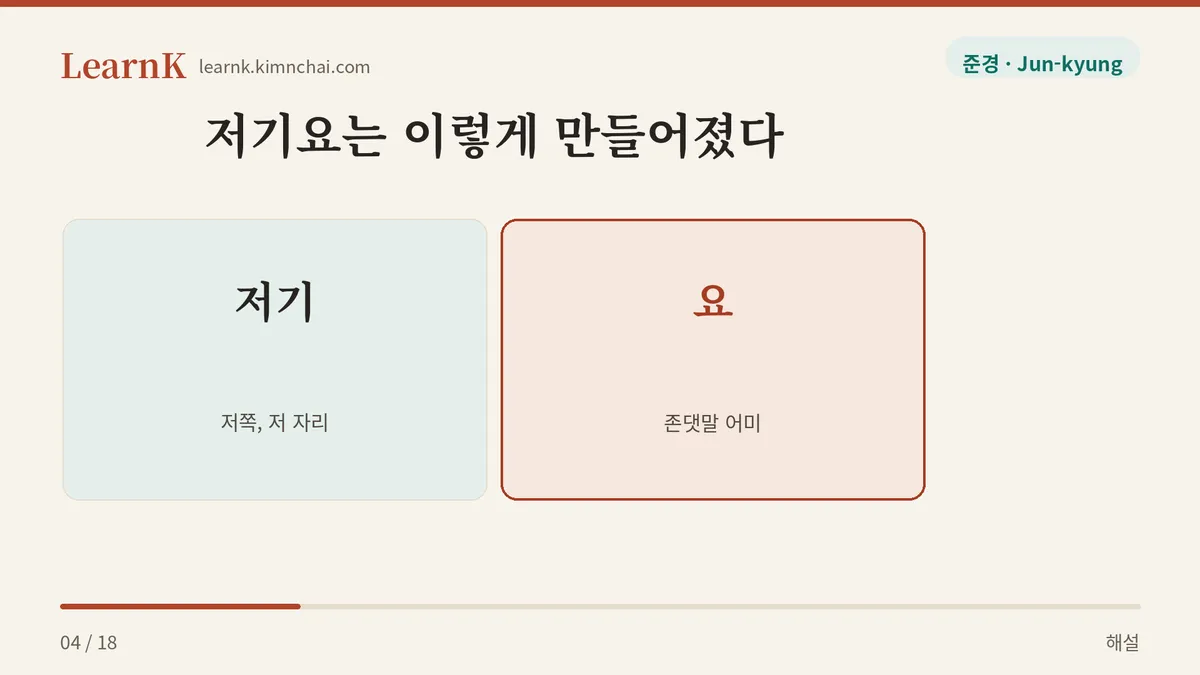
저기요 (jeogiyo) is built from ‘저기 (jeogi)’ — over there, that spot — plus ‘요 (yo)’, the polite ending. Read literally, it isn’t calling a person at all; it’s calling a place. And that lays bare something about how Korean works.
Korean has essentially no second-person pronoun you can use with anyone the way English uses “you.” There is ‘당신 (dangsin)’, but it belongs to married couples, ad copy, or picking a fight, so using it on someone you’ve just met turns the air cold. So a workaround was needed: don’t point at the person directly, call the spot where that person is standing. By the same principle, 여기요 (yeogiyo) points to the spot where I am and thus means “Please come over here.” 저기 and 여기 simply split according to where the speaker is; the underlying idea is one and the same.
It’s also why so many Korean dramas open the leads’ first meeting with this word. For two people who don’t yet know each other’s names, 저기요 (jeogiyo) is the only form of address available. That single word — called out while running after someone who left something on the subway, or tossed off while helping gather scattered papers after a collision — becomes the starting point of a relationship. The moment names are exchanged, the word is discarded on the spot. Which means 저기요 (jeogiyo) is also a word that exists only in the one narrow window right before a relationship begins.
Today’s Quiz
Which of the following is the most appropriate situation for using 저기요 (jeogiyo)?
- Calling over the friend you came to the café with
- When the passenger next to you on the subway is about to get off and leave their umbrella behind
- Asking your department head a question during a meeting
- Calling your mother on the phone
Answer: 2
It’s a situation where you have to urgently speak to someone whose name and title you don’t know, so 저기요 (jeogiyo) fits perfectly. For 1, calling their name or saying “야” is plenty; for 3, you should use the title, as in “부장님, 질문 있습니다.” For 4, using 저기요 (jeogiyo) where “엄마” belongs makes it sound like you’re talking to a stranger. To sum up — if there’s a name or a title to call them by, use that; only when there isn’t do you use 저기요 (jeogiyo).