전통시장 (jeontong sijang) — Where the Free Extra Comes Before the Price

전통시장 (jeontong sijang)
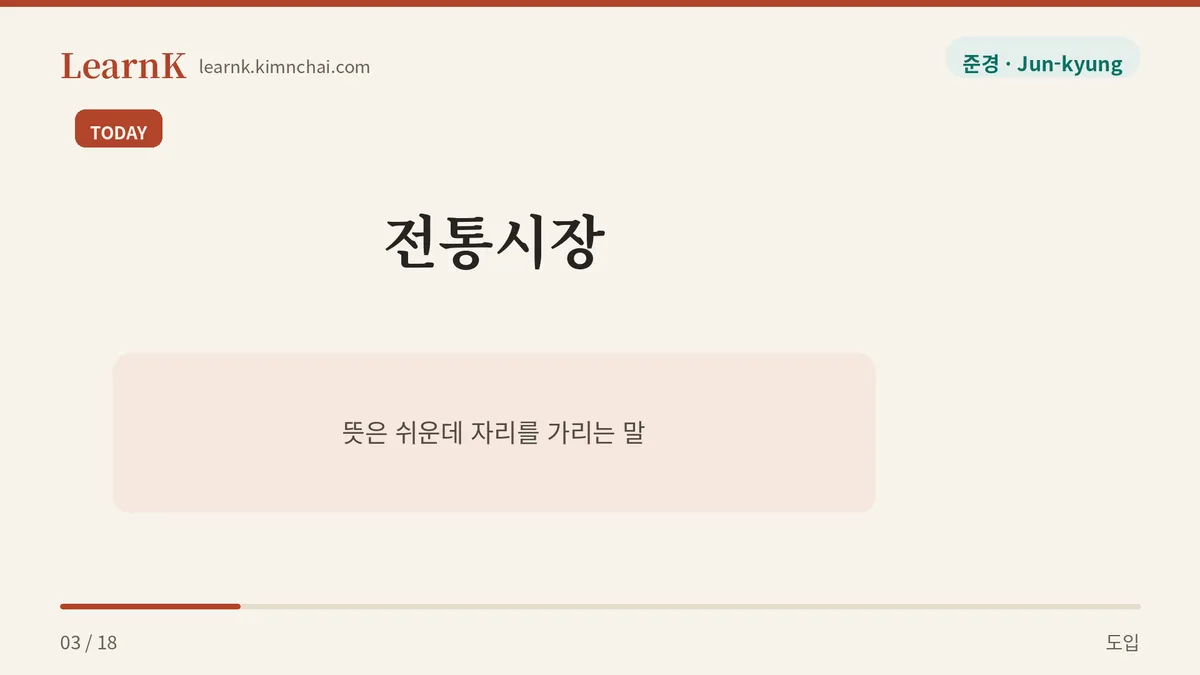
전통시장 (jeontong sijang) means a traditional-style market: merchants who have been rooted in one neighborhood for a long time open small shops along the alleys, and the person selling and the person buying stand face to face, haggle over the price, and trade. It doesn’t mean one big store built by a single company — it means a market formed by dozens or hundreds of individual merchants, each moving into one small stall of their own.
Come to Korea and you’ll see this word constantly. It’s in the tourist brochures. It’s on the subway exit signs. It’s on the evening news. And yet Koreans themselves almost never use it with each other. Say to a friend “나 전통시장 갔다 올게” (na jeontong sijang gatda olge) — “I’m going to the traditional market” — and it lands stiff, like you’re doing an impression of a news anchor. That gap is exactly what we’re covering today: the meaning is easy, but the word is picky about where it belongs.
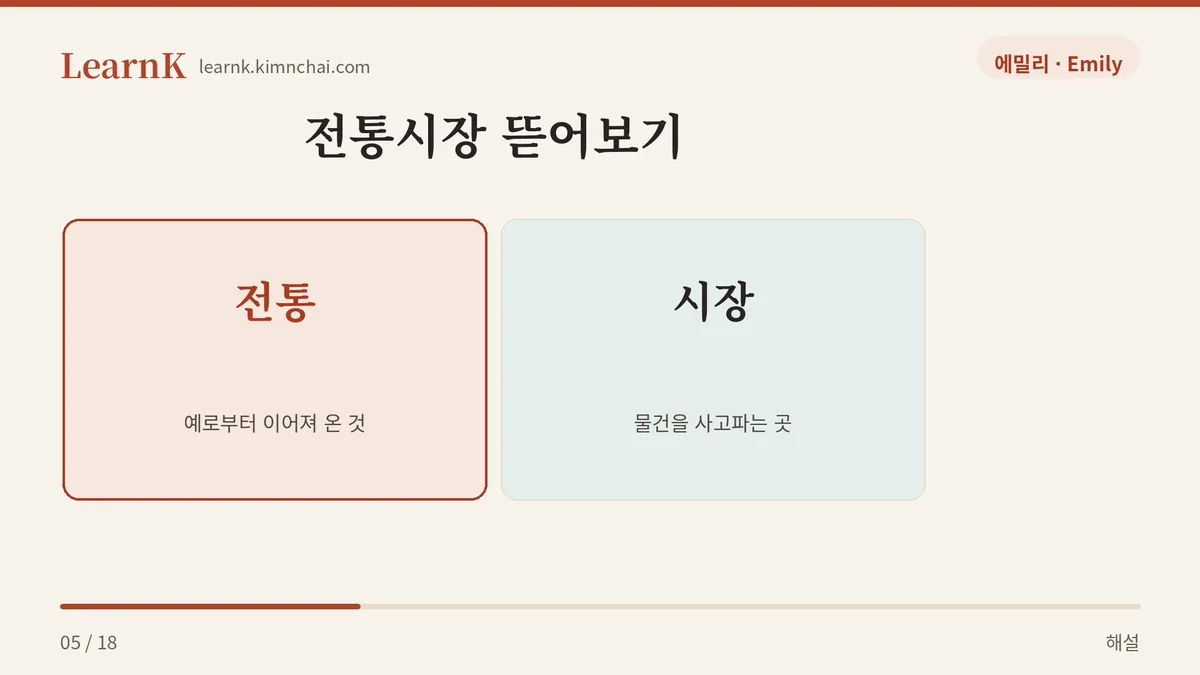
Break the characters apart and you get 전통 (傳統, something handed down from long ago) + 시장 (市場, a place where things are bought and sold). 시장 (sijang) alone already carries the full meaning — but the moment 전통 gets attached in front, the word stops being a place name and becomes a category label. A category set against what? Against big-box marts, department stores, and online shopping. So wherever the word 전통시장 turns up, its opposite is almost always standing right there beside it. Things like “마트 말고 전통시장에서 사세요” (mateu malgo jeontong sijang-eseo saseyo), “Buy it at the traditional market, not the mart,” or “전통시장을 살립시다” (jeontong sijang-eul sallipsida), “Let’s save our traditional markets.”
The nuance comes in two layers. One is warmth — the press of the crowd, the smell of frying, a merchant knocking a bit off the price with a grin. The other is a little heavier: a policy flavor, the sense of something to be protected and kept alive. It’s that second layer that makes this word fit public settings better than a light conversation between friends.
Seeing It in a Real Conversation
Scene: Saturday morning just before Chuseok, at the entrance to a neighborhood market. Two people are standing there, each holding a shopping basket.
Jun-kyung: 야, 여기서부터는 카트 못 들어가. 장바구니 하나씩 들자. Hey, carts can’t get in past this point. Let’s each take a basket.
Emily: 나 이런 데 진짜 오랜만이야. 전통시장은 사람 구경이 반이잖아. It’s been ages since I’ve been somewhere like this. Half the fun of a traditional market is watching the people.
Jun-kyung: 그치. 근데 오늘은 나물이랑 전 부칠 재료만. 딴 데 새지 마. Right. But today it’s just the greens and the ingredients for the jeon. Don’t wander off.
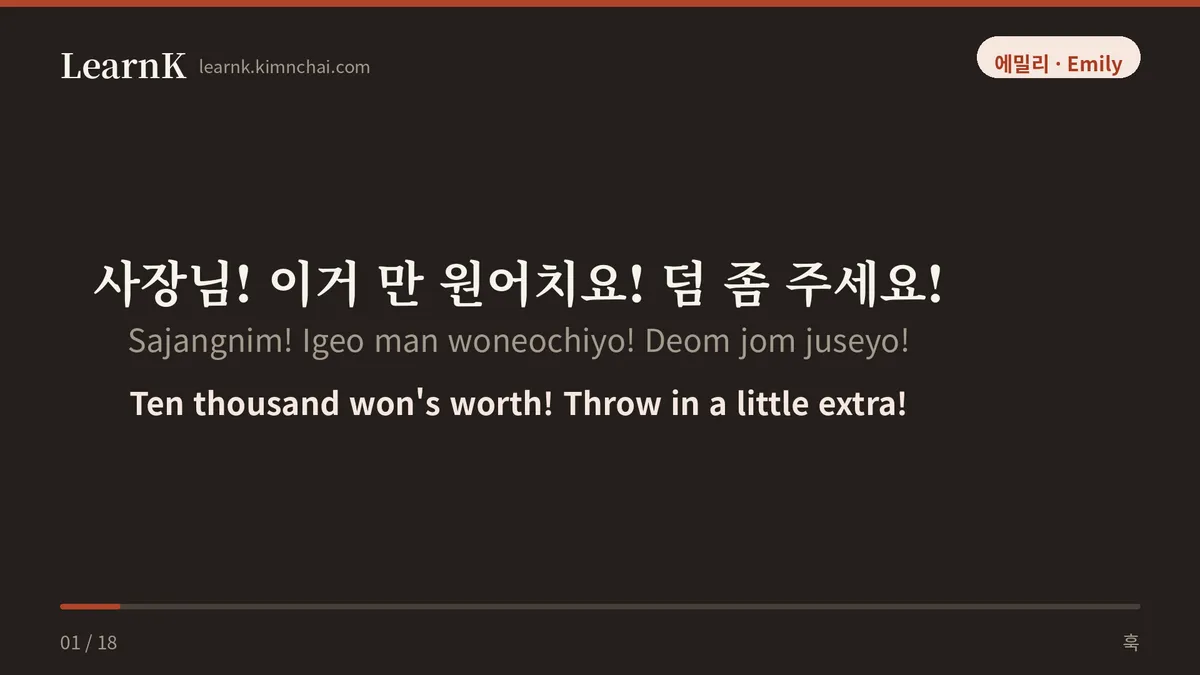
Emily: 어? 근데 저 집 튀김 냄새 뭐야… 사장님! 이거 만 원어치요! 덤 좀 주세요! Huh? But what is that fried-food smell over there… Sir! Ten thousand won’s worth of this, please! And throw in a little extra!
Jun-kyung: 봐, 벌써 샜잖아. 이래서 너랑 전통시장 오면 시간이 두 배 걸려. See, you’ve already wandered off. This is why coming to a traditional market with you takes twice as long.
Emily: 대신 저녁거리 나왔잖아. 이 맛에 시장 오는 거지. But look, we’ve got dinner now. This is why you come to the market.
Look at that last line. Emily said 전통시장 earlier, but in the final sentence — the one carrying real feeling — she just says 시장 (sijang). A Korean speaker’s mouth moves in exactly this way.
These Sound Unnatural
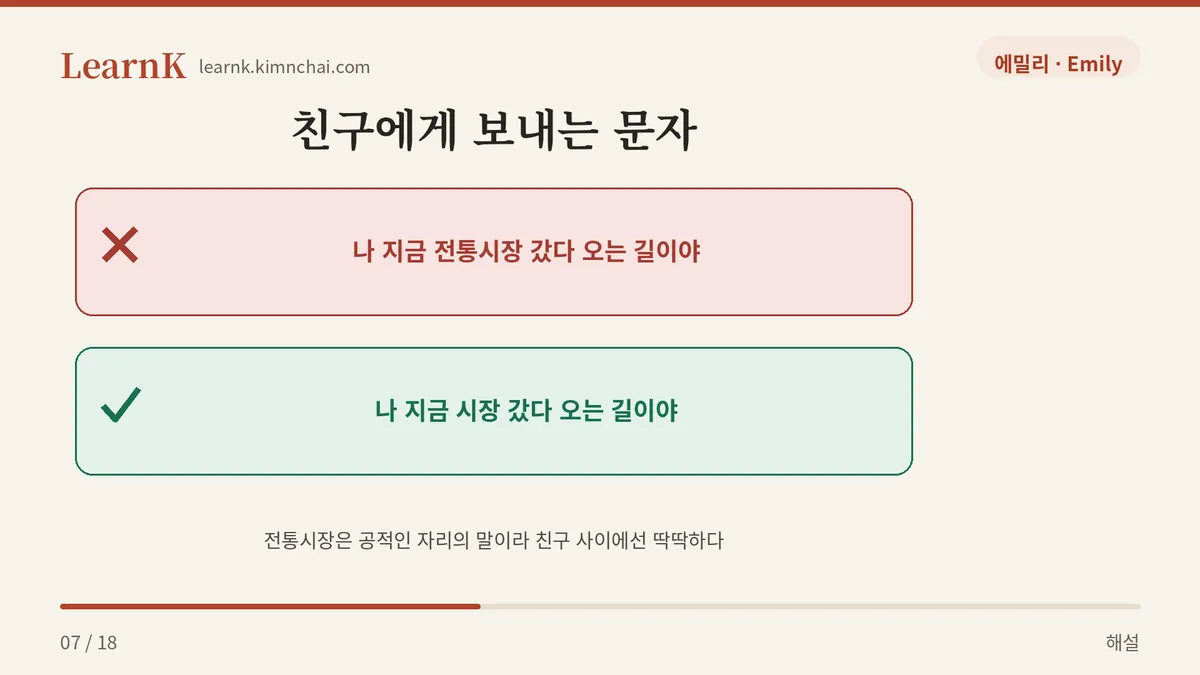
✗ (texting a friend) 나 지금 전통시장 갔다 오는 길이야. (na jigeum jeontong sijang gatda oneun giriya.) ✓ (texting a friend) 나 지금 시장 갔다 오는 길이야. (na jigeum sijang gatda oneun giriya.) → The grammar is perfect. The problem is that 전통시장 belongs to public settings — news, government notices, tourist information — so between friends it sounds as stiff as reading a press release aloud. In everyday life it’s just 시장.
✗ 어제 서울 남대문 전통시장에 갔어요. (eoje Seoul Namdaemun jeontong sijang-e gasseoyo.) ✓ 어제 서울 남대문시장에 갔어요. (eoje Seoul Namdaemun sijang-e gasseoyo.) → 전통시장 isn’t the name of any individual market; it’s the umbrella word for a type. 광장시장 (Gwangjang sijang), 남대문시장 (Namdaemun sijang), and 통인시장 (Tongin sijang) are all traditional markets, but when you call them by name it’s always “○○시장.” You only pair the two when you’re explaining the category, as in “남대문시장 같은 전통시장” (Namdaemun sijang gateun jeontong sijang) — “a traditional market like Namdaemun Market.”
Example Sentences by Situation
1. Giving travel advice to a friend coming to Korea — this is where the word sits most naturally. If the person you’re talking to is a foreigner, 전통시장 is actually kinder than plain 시장, because the word itself tells them what kind of place it is.
서울 오시면 전통시장 한 곳은 꼭 가 보세요. 마트에는 없는 게 많거든요. (Seoul osimyeon jeontong sijang han goseun kkok ga boseyo. Mateue-neun eomneun ge mantageodeunyo.) If you come to Seoul, make sure you visit at least one traditional market. There’s a lot there you won’t find at the mart.
2. In news reports or official notices — this is the word’s home turf. Policy, discount events, gift certificates: this word shows up in all of it, without exception.
정부가 추석을 앞두고 전통시장 상품권 할인율을 높였습니다. (Jeongbuga chuseogeul apdugo jeontong sijang sangpumgwon halinyureul nopyeotseumnida.) Ahead of Chuseok, the government has increased the discount rate on traditional market gift certificates.
3. Talking about generational differences — in a sentence that sets it side by side with the mart, 전통시장 sounds natural even in everyday conversation. Give a category label something to compare against, and it starts doing its job.
어머니는 아직도 마트보다 전통시장을 더 편해하세요. (Eomeoni-neun ajikdo mateuboda jeontong sijang-eul deo pyeonhaehaseyo.) My mother is still more comfortable at a traditional market than at the mart.
Politeness Levels and Similar Expressions
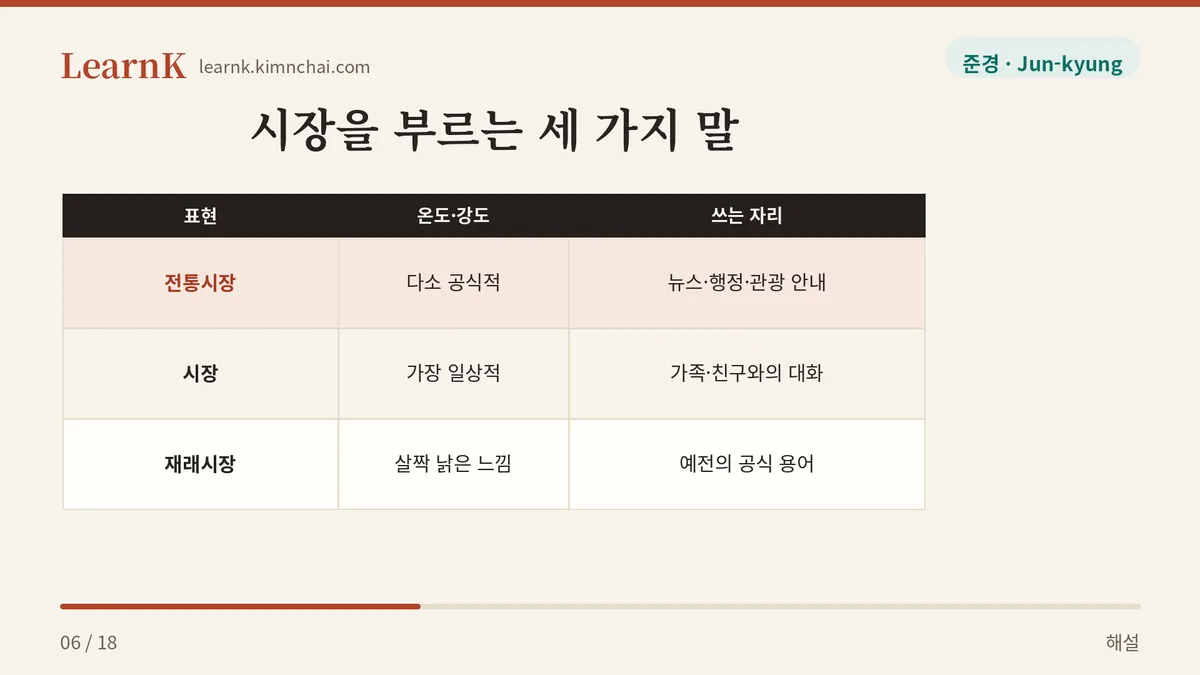
전통시장 is the name of a thing, so it has no polite or casual form of its own. The politeness level is set by the verb you use with it. To an elder it becomes “시장에 다녀오겠습니다” (sijange danyeoogetseumnida); to a friend it’s “시장 갔다 올게” (sijang gatda olge). What does change dramatically with this word is its temperature depending on the setting you use it in — so lining it up next to related words is far more useful.
| Expression | Temperature / Intensity | Where it’s used |
|---|---|---|
| 전통시장 (jeontong sijang) | Neutral, somewhat formal | News, government, tourist information. Explaining to foreigners |
| 시장 (sijang) | The most everyday | Talking with family and friends. “시장 갔다 올게” |
| 재래시장 (jaerae sijang) | Slightly dated feel | The old official term. Still understood, but the tone feels old |
| 오일장 (oiljang) | Homey and local | The market that opens every five days. Countryside and travel talk |
| 마트 (mateu) | Neutral, modern | The big-box mart. The contrast word paired with 전통시장 |
Cultural Background — The Math of 덤 (deom)
This word has a history of being renamed. The official term used to be 재래시장 (jaerae sijang). 재래 (在來) means “existing since long ago,” so it wasn’t wrong — but in practice it gave the impression of “outdated.” So in 2009, when the relevant law was retitled the Special Act on the Development of Traditional Markets and Shopping Districts (전통시장 및 상점가 육성을 위한 특별법), 전통시장 settled in as the official name. All they changed was one name for the same place, and the whole feeling shifted from “an old place” to “a place worth protecting.”
Go to one in person and the biggest difference from a mart isn’t the price — it’s the math. Here, getting something added on is more natural than getting the price knocked down. Which brings us to the word to take away today: 덤 (deom) — the extra handful the merchant piles on after you’ve paid. “좀 많이 주세요” (jom mani juseyo), “give me a lot,” and “덤 좀 주세요” (deom jom juseyo), “throw in a little extra,” are both far more common than “깎아 주세요” (kkakka juseyo), “give me a discount” — and merchants prefer them too. Unloading whatever’s left cheap at closing time has its own word: 떨이 (tteori).
Beyond the permanent markets of the cities, the countryside has the 오일장 (oiljang). It’s a market that opens once every five days — on the 3rd and 8th, or the 5th and 10th, and so on. On market-day morning, a quiet little town suddenly sprouts rows of tents, and as the sun goes down they vanish just as they came.
The famous ones for travelers are Seoul’s 광장시장 (Gwangjang sijang) — bindaetteok and gimbap — 통인시장 (Tongin sijang), where you buy brass coins and fill a lunchbox with side dishes, and 남대문시장 (Namdaemun sijang). There’s also a gift certificate usable only at traditional markets, the 온누리상품권 (Onnuri sangpumgwon), and every holiday season there’s guaranteed to be a news story about it going on sale at a discount.
In TV dramas, the market is drawn less as “a place with things to buy” than as “a place where people get tangled up with each other.” The best example is Reply 1988 (응답하라 1988, tvN, 2015), which portrays a 1980s neighborhood where people carried side dishes to each other across a single alley. In that show, the shopping scenes are less about buying things than about asking after one another. That’s roughly the temperature Koreans feel when they hear the word 전통시장.
Today’s Quiz
Which is the most natural KakaoTalk message to send a friend?
- 나 지금 전통시장 갔다 오는 길이야.
- 나 지금 시장 갔다 오는 길이야.
- 나 지금 재래시장 갔다 오는 길이야.
The answer is 2. All three are grammatically correct, but 1 is as stiff as a news sentence, and 3 sounds dated. 전통시장 shines when you’re comparing it to the mart or explaining it to a foreigner; for a friend, plain 시장 is plenty. This is exactly where the person who only knows a word’s meaning parts ways with the person who also knows where it belongs.
Definitions and example sentences are from the National Institute of Korean Language’s Basic Korean Dictionary (krdict.korean.go.kr); that portion of this post, including our translations, is licensed under CC BY-SA 2.0 KR.