짬뽕 (jjamppong) — One Bowl of Red Broth, and a Word That Also Means "All Mixed Up"
The moving truck has pulled away, and the living room is still a maze of unopened boxes. People spread newspaper on the floor, sit down, and the very first thing they do is call the neighborhood Chinese restaurant. And before anyone picks up the receiver, one question — repeated in Korea for decades now — goes around the room: “짬뽕 (jjamppong) 먹을래, 자장면 먹을래? (jjamppong meogeullae, jajangmyeon meogeullae?)” — “Jjamppong or jjajangmyeon?”
If you watch Korean dramas, you’ve surely seen that red-broth noodle dish heaped with mussels and squid. But here’s the thing: you’ll hear this word plenty of times outside a restaurant, too. Today let’s really get to know 짬뽕 (jjamppong) — a word that moves freely between the menu and everyday conversation.
짬뽕
짬뽕 (jjamppong) has two faces.
The first is the food. It’s a Chinese-style noodle dish made by stir-frying seafood and vegetables over high heat, then pouring a spicy broth over the top. Along with 자장면 (jajangmyeon), it forms one of the two great pillars of the menu at a Korean-Chinese restaurant, and people crave it especially on cold days or the morning after drinking.
The second is the figurative meaning. When different things are jumbled together in a mess, Koreans call that state 짬뽕 (jjamppong). The image of every ingredient under the sun going into a single bowl simply became a word. Used this way, it carries a slightly negative temperature — a sense of “this is a mess and it’s causing me trouble.”
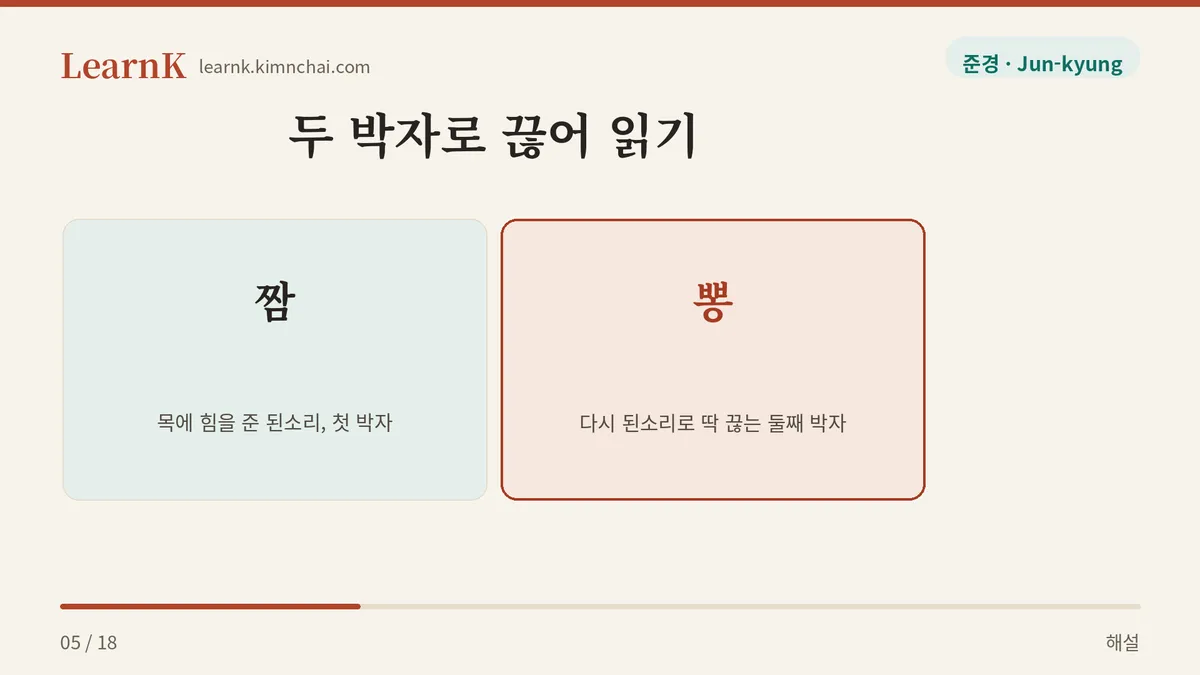
As for pronunciation, both the first and the middle consonants are tense sounds. It’s not “잠봉 (jambong)” — tighten your throat and say 짬뽕 (jjam-ppong), snapping it off cleanly in two beats.
Checking the National Institute of Korean Language dictionary
짬뽕 (jjamppong) 「noun」
- A Chinese-style noodle dish made by stir-frying various kinds of seafood and vegetables and pouring a spicy broth over the noodles. [en] jjamppong — Chinese-style noodle dish made by pouring a spicy stock of stir-fried vegetables and seafood over noodles. [ja] チャンポン — 色々な魚介類や野菜を炒めて辛いスープを入れて作った中華風そば。 [es] Fideos al estilo chino que se preparan echando un caldo picante con varios mariscos y verduras salteadas. [zh] 韩式炒码面,韩式海鲜辣汤面 — 将各种海鲜和蔬菜炒熟,并倒入辣汤煮至而成的中式面条。 — National Institute of Korean Language, Basic Korean Dictionary (krdict.korean.go.kr)
짬뽕 (jjamppong) 「noun」 2. The mixing together of different things. [en] mixture — A combination of different things. [ja] ちゃんぽん — 種類の異なるものを混ぜ合わせること。 [es] mezcla, mixtura — Que están revueltas y combinadas diferentes cosas. [zh] 混合,大杂烩 — 把不同的东西搅拌到一起。 — National Institute of Korean Language, Basic Korean Dictionary (krdict.korean.go.kr)
The dictionary doesn’t include a Portuguese definition, so we’ve translated one ourselves to help you out (macarrão picante à moda chinesa com frutos do mar / mistura).
Let’s also look at the real usage examples the dictionary gives.
자장면 먹을래, 짬뽕 먹을래? (jajangmyeon meogeullae, jjamppong meogeullae?) Do you want jjajangmyeon, or jjamppong? — National Institute of Korean Language, Basic Korean Dictionary (krdict.korean.go.kr)
This is the national question, asked the moment you walk through the door of a Chinese restaurant. It’s in casual speech, so it’s the tone you’d use with friends or family.
추운데 짬뽕 한 사발 어때? 근처에 맛있는 짬뽕 가게가 있어. (chuunde jjamppong han sabal eottae? geuncheoe masinneun jjamppong gageaga isseo.) It’s cold — how about a bowl of jjamppong? There’s a good jjamppong place nearby. — National Institute of Korean Language, Basic Korean Dictionary (krdict.korean.go.kr)
Here someone is offering hot broth on a cold day. The counter 한 사발 (han sabal, “one big bowl”) paints a picture of a generous, brimming serving.
얼큰한 짬뽕 국물을 한 숟가락 먹자 입은 불이 날 것처럼 얼얼했고, 땀이 비 오듯 쏟아졌다. (eolkeunhan jjamppong gungmureul han sutgarak meokja ibeun buri nal geotcheoreom eoreolhaetgo, ttami bi odeut ssodajyeotda.) One spoonful of the fiery jjamppong broth left my mouth tingling as if it were on fire, and the sweat poured down like rain. — National Institute of Korean Language, Basic Korean Dictionary (krdict.korean.go.kr)
This sentence describes the heat. It’s worth memorizing spice words like 얼큰하다 (eolkeunhada, “pleasantly fiery”) and 얼얼하다 (eoreolhada, “tingling, numb from spice”) together.
혼자서 짬뽕 곱빼기를 먹으려니 배가 불러 도저히 못 먹겠다. (honjaseo jjamppong gopppaegireul meogeuryeoni baega bulleo dojeohi mot meokgetda.) Trying to eat a double portion of jjamppong by myself, I’m so full I really can’t finish it. — National Institute of Korean Language, Basic Korean Dictionary (krdict.korean.go.kr)
곱빼기 (gopppaegi) means a double serving. An essential word at any Chinese restaurant.
A real conversation
Situation: The evening of moving day. Two people sit on newspaper spread across an empty living room piled high with boxes.
Jun-kyung: 이삿날은 무조건 중국집이지. 너 자장면? 짬뽕? Moving day means Chinese food, no question. Jjajangmyeon or jjamppong for you?
Emily: 나 짬뽕. 손 시려워 죽겠어, 뜨거운 국물 먹고 싶어. Jjamppong for me. My hands are freezing — I want something hot and soupy.
Jun-kyung: 오, 15년차 다 됐네. 매운 거 진짜 잘 먹더라? Wow, fifteen years here really shows. You handle spicy food well, huh?
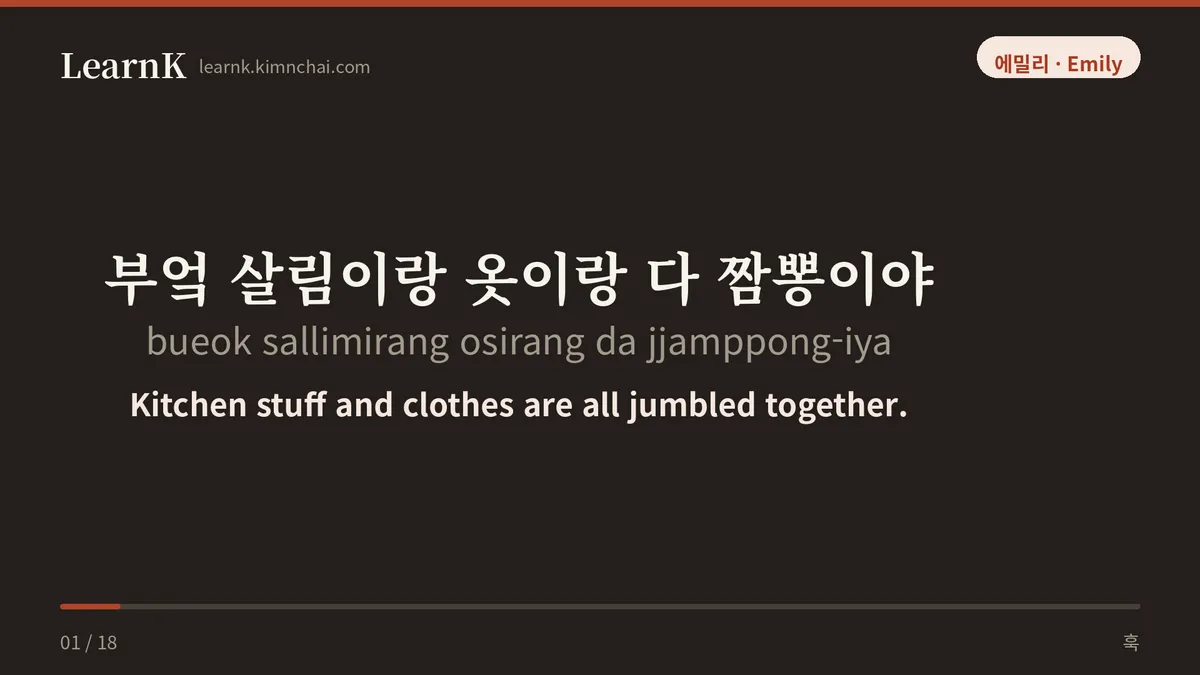
Emily: 근데 상자에 뭐가 어디 있는지 하나도 몰라. 부엌 살림이랑 옷이랑 다 짬뽕이야. But I have no clue what’s in which box. Kitchen stuff and clothes are all jumbled together.
Jun-kyung: 야, 너 그 뜻까지 쓰네. 이제 진짜 한국말 다 했다. Hey, you’re using that meaning too. Your Korean is the real deal now.
Emily: 문제는 젓가락도 저 짬뽕된 상자 어딘가에 있다는 거지. The problem is the chopsticks are somewhere in that jumbled box too.
Try it, situation by situation
① The morning after a work dinner, to the coworker face-down on their desk “어제 소주에 맥주에 짬뽕해서 마셨더니 머리가 깨질 것 같아. (eoje sojue maekjue jjamppong-haeseo masyeotdeoni meoriga kkaejil geot gata.)” I mixed soju and beer last night and now my head feels like it’s splitting. — Mixing your drinks is also called 짬뽕 (jjamppong). This is one of the usages you’ll hear most often in Korea.
② On the day of the first snow, while choosing what to have for lunch “오늘같이 추운 날엔 짬뽕 국물이 딱이죠. (oneulgachi chuun naren jjamppong gungmuri ttagijyo.)” On a cold day like today, jjamppong broth hits the spot. — 딱이다 (ttagida) means “it’s just right, perfect for the occasion.” It’s in polite speech, so you can use it with a senior colleague or your boss.
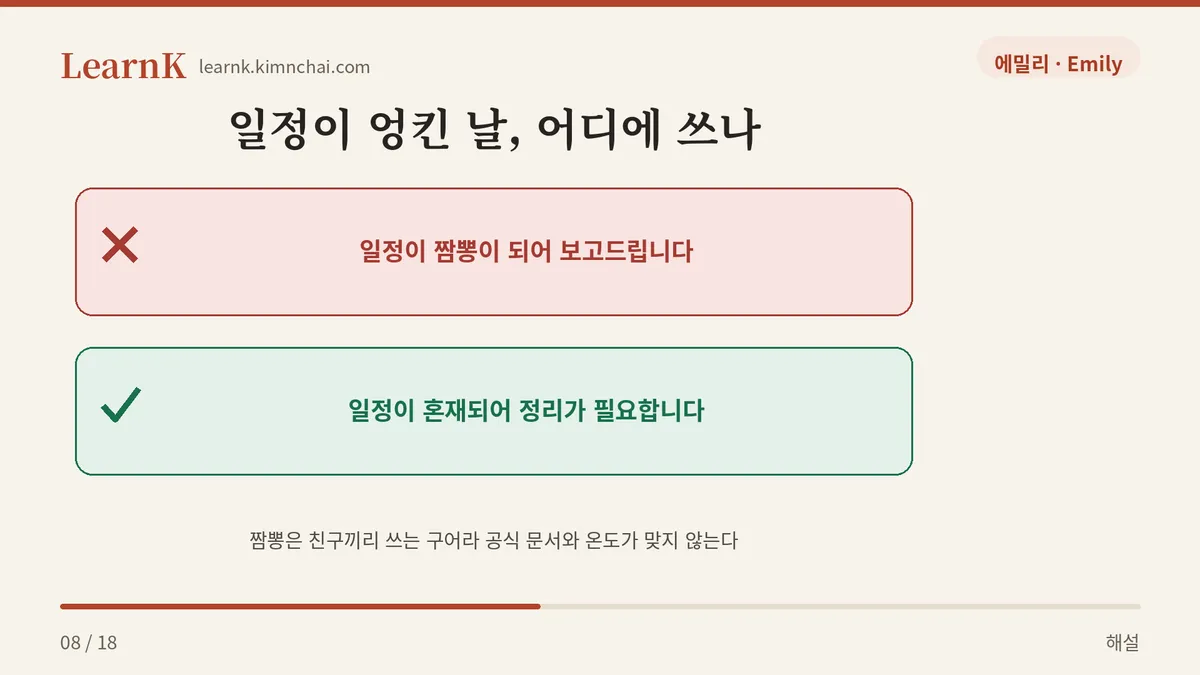
③ On a day when your schedule has come completely undone “일정이 짬뽕이 돼서 뭐부터 해야 할지 모르겠어요. (iljeongi jjamppong-i dwaeseo mwobuteo haeya halji moreugesseoyo.)” My schedule is all jumbled up and I don’t know what to do first. — This is the second meaning. It’s casual, conversational language for people you’re comfortable with, so don’t use it in a report or an official document.
Polite and casual speech, plus similar expressions
짬뽕 (jjamppong) is a noun, so its form doesn’t change — the politeness is carried by the verb that follows it.
- Casual: 짬뽕 먹을래? (jjamppong meogeullae?)
- Polite: 짬뽕 드시겠어요? (jjamppong deusigesseoyo?)
Here are some words you can swap in when you’re using the “jumbled up” meaning.
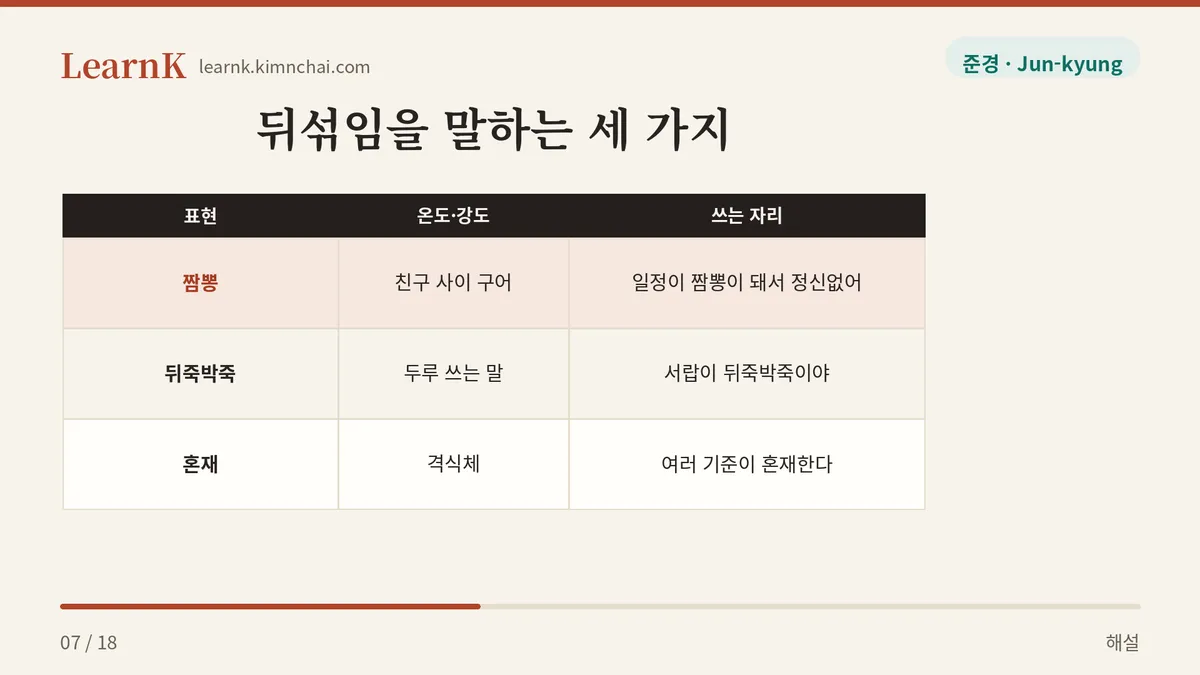
- 뒤죽박죽 (dwijukbakjuk): A state of being tangled up with no order. It’s the closest match to 짬뽕 and is even more widely used.
- 뒤섞다 (dwiseokda): A verb pointing to the act of mixing itself.
- 혼재 (honjae): Formal register. It suits news articles and reports. 짬뽕 sits at exactly the opposite end — it’s a word for friends.
Cultural background — moving day and the hangover table
Korean dramas return again and again to the same cliché: people sitting on the bare floor of an empty apartment, eating delivery food. Behind that image is the Chinese-restaurant custom of delivering food in real dishes that you then set back outside your door. For people who can never quite decide between 자장면 (jajangmyeon) and 짬뽕 (jjamppong), there’s even a menu item called 짬짜면 (jjamjjamyeon) that serves you half of each. And the day after drinking, at the 해장 (haejang) table where a fiery broth soothes your stomach, this name comes up without fail. In other words, 짬뽕 is a word attached both to the moment of choosing and to the moment of recovering.
Today’s quiz
A friend says, “어제 소주랑 맥주랑 짬뽕했더니 죽겠다 (eoje sojurang maekjurang jjamppong-haetdeoni jukgetda).” What did this friend do yesterday?
- Ate jjamppong at a Chinese restaurant
- Drank two kinds of alcohol mixed together
- Ate spicy food and broke a sweat
The answer is 2. Here the word is used in its second sense — “the mixing together of different things.” You learned the name of one dish, and suddenly you can follow a conversation over drinks. That’s exactly where the fun of Korean lies.
Definitions and example sentences are from the National Institute of Korean Language’s Basic Korean Dictionary (krdict.korean.go.kr); that portion of this post, including our translations, is licensed under CC BY-SA 2.0 KR.