짜파구리 (jjapaguri) — Put Two Packets in One Pot and It Earns a Name
짜파구리
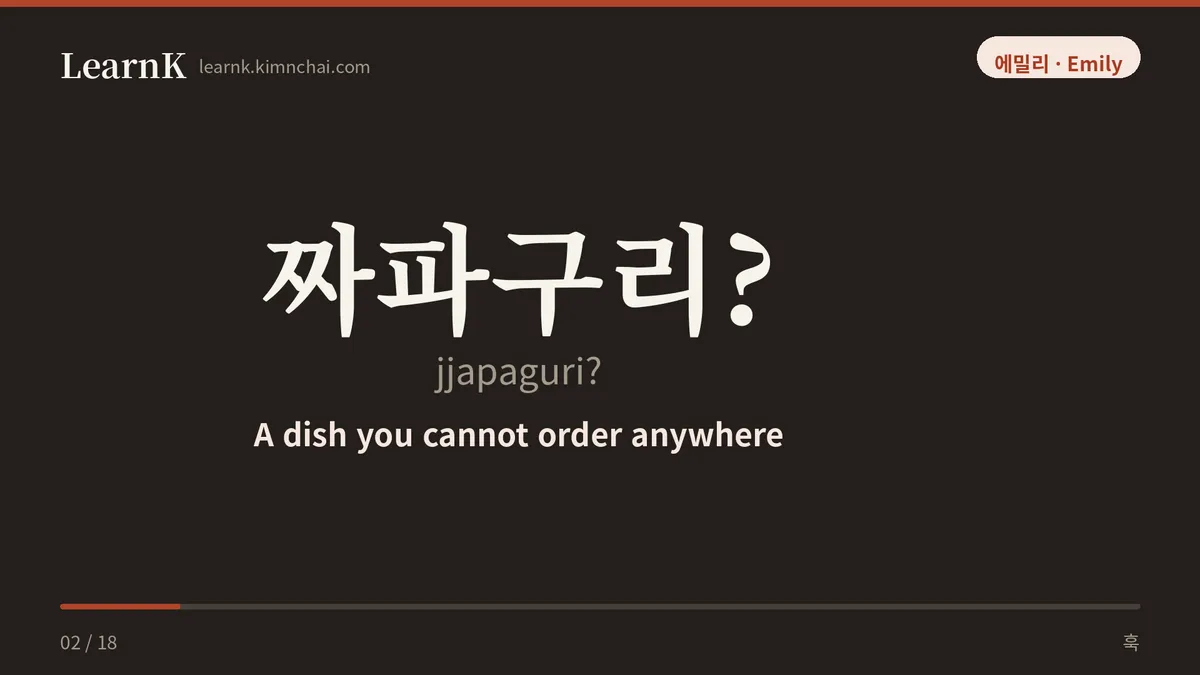
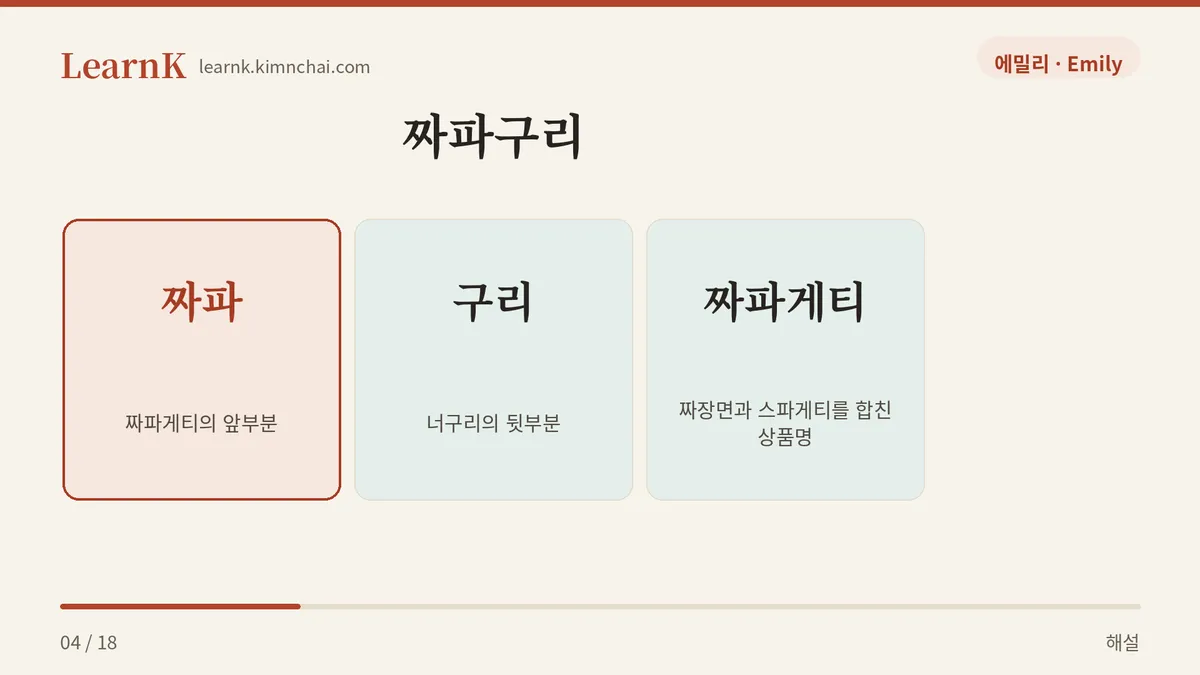
짜파구리 (jjapaguri) is a Korean instant-ramyeon dish made by boiling two products together in a single pot: 짜파게티 (jjapagetti), a black-bean-sauce ramyeon, and 너구리 (neoguri), a spicy seafood ramyeon. The word was made by slicing the front off one product name and the back off the other and gluing them together, so it’s the name of a dish and, at the same time, the name of a game — the game of mixing things.
In Korea, the places this word shows up are pretty much fixed. In front of the ramyeon shelf at a convenience store at eleven at night; in a студent’s one-room apartment right after finals; on a Saturday afternoon when a friend drops by out of nowhere. When someone asks “오늘 뭐 먹지 (oneul mwo meokji)” — “what should we eat today?” — and the answer is “그냥 짜파구리 하자 (geunyang jjapaguri haja),” that isn’t just picking a menu item. It’s closer to a proposal: let’s keep it lazy today, but make it fun. Because this isn’t food you order at a restaurant — it’s food two people make in a kitchen with one pot between them.
The way you make it explains the word’s nuance all by itself. You boil the two ramyeon together, pour off most of the water, add 짜파게티’s black-bean powder and oil, then stir in only about half of the 너구리 soup packet. The sweetness of the 짜장 (jjajang) sauce and the heat of the seafood broth overlap into a flavor that is neither one nor the other — and that “neither one nor the other” spot is exactly the part people love. That’s why Koreans talking about 짜파구리 reach for the word “조합 (johap)” — combination — far more often than “레시피 (resipi)” — recipe.
Grammatically it’s a noun, but in practice it almost always drags a verb along with it. The three most common are 짜파구리 하다 (jjapaguri hada), 짜파구리 끓이다 (jjapaguri kkeurida), and 짜파구리 해 먹다 (jjapaguri hae meokda). Of these, “짜파구리 하다” looks a little odd grammatically, but to a Korean speaker it feels completely natural. It’s the same old habit behind 라면 하다 (ramyeon hada) and 삼겹살 하다 (samgyeopsal hada) — attaching 하다 to a food name to mean “let’s make and eat that.”
See It in Real Conversation
Scene: 11 p.m., in front of the ramyeon shelf at the neighborhood convenience store. Picking out a late-night snack.
Jun-kyung: 야, 뭐 먹을래? 그냥 신라면 두 개 살까? Hey, what do you want? Should we just grab two Shin Ramyuns?
Emily: 에이, 재미없어. 우리 짜파구리 하자. Nah, boring. Let’s do jjapaguri.
Jun-kyung: 오케이. 그럼 짜파게티랑 너구리 하나씩 집어. Okay. Then grab one Chapagetti and one Neoguri.
Emily: 근데 너구리 스프 다 넣으면 너무 짜지 않아? But isn’t it too salty if you put in the whole Neoguri soup packet?
Jun-kyung: 반만 넣으면 돼. 나 짜파구리 끓이는 거 진짜 잘해. Just use half. I’m actually really good at making jjapaguri.
Emily: 말은. 지난번엔 물 안 버려서 죽 됐잖아. Yeah, sure. Last time you didn’t drain the water and it turned into porridge.
This Sounds Off
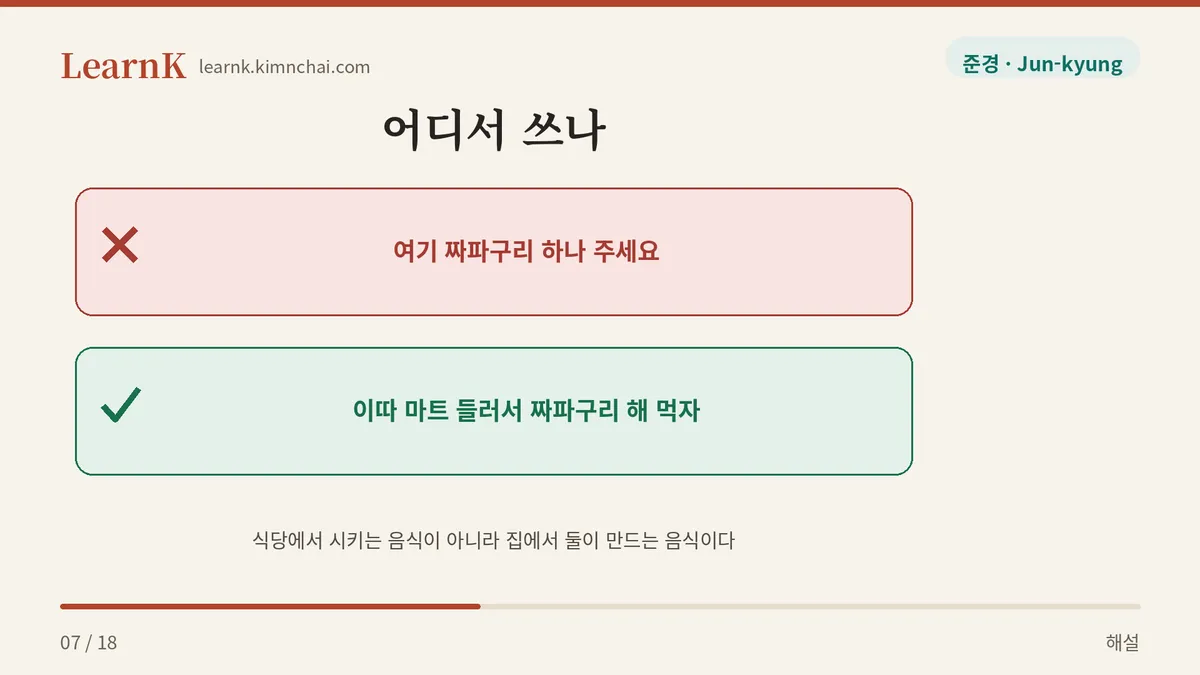
✗ (to a server at a Korean restaurant) 여기 짜파구리 하나 주세요. (yeogi jjapaguri hana juseyo.) ✓ (to a friend) 이따 마트 들러서 짜파구리 해 먹자. (itta mateu deulleoseo jjapaguri hae meokja.) → 짜파구리 is not a menu-board word; it’s a kitchen word. It’s food you make at home after buying two packets of ramyeon, so ordering it at an ordinary restaurant will just confuse the server. (After the movie hit, cup-ramyeon versions and a few shops selling it did appear — but the default is still “something you make at home.”)
✗ 우리 오늘 저녁에 람돈 먹을까? (uri oneul jeonyeoge ramdon meogeulkka?) ✓ 우리 오늘 저녁에 짜파구리 먹을까? (uri oneul jeonyeoge jjapaguri meogeulkka?) → “Ram-don,” which caught on widely in English, is a word the translator coined for the English subtitles of the film Parasite to help foreign audiences. It’s a blend of ramyeon and udon, so the meaning comes across fine — but say it in Korea and nobody will know what you mean. With Korean speakers, it has to be 짜파구리.
Example Sentences by Situation
1. When a friend suddenly comes over (casual speech)
오늘 저녁은 그냥 짜파구리나 해 먹자. (oneul jeonyeogeun geunyang jjapagurina hae meokja) Let’s just make jjapaguri for dinner tonight.
Adding the particle ~나 (~na) gives it a “nothing fancy, but let’s go with this” feel. It signals don’t set out a big spread, let’s keep it easy, which is why it’s especially common between close friends. Be careful using it when you’re hosting a guest, though — it can come across as not making an effort.
2. Chatting about the weekend over lunch at work (polite speech)
저 어제 처음으로 짜파구리 끓여 봤는데 완전 망했어요. (jeo eoje cheoeumeuro jjapaguri kkeullyeo bwanneunde wanjeon manghaesseoyo) I tried making jjapaguri for the first time yesterday and totally messed it up.
짜파구리 is one of the few foods where the failure story is the conversation material. Not draining enough water, dumping in the whole soup packet and making it too salty — nearly every Korean can relate to these, so they’re surprisingly useful for breaking the ice in an awkward moment.
3. Wheedling your parents a little (casual speech)
엄마, 오늘 저녁에 짜파구리 해 주면 안 돼? (eomma, oneul jeonyeoge jjapaguri hae jumyeon an dwae?) Mom, could you make jjapaguri for dinner tonight?
~해 주면 안 돼? (~hae jumyeon an dwae?) is literally a negative question — “would it be not-okay to make it for me?” — but in practice it’s a soft way of begging. Since 짜파구리 has become firmly established as a kids’ favorite, you’ll hear this sentence constantly in Korean households.
Formality Levels and Similar Expressions
짜파구리 itself has no honorific form, because it’s the name of a thing. The politeness level shifts in the verb that follows instead. To a friend: “짜파구리 하자 (jjapaguri haja).” To someone older or senior: “짜파구리 한번 해 보세요 (jjapaguri hanbeon hae boseyo).” And in a truly formal setting, the natural move is simply not to bring the word up at all. Nobody proposes 짜파구리 at dinner with the company chairman.
Lining it up against other “combination food” names of a similar flavor makes its place clearer.
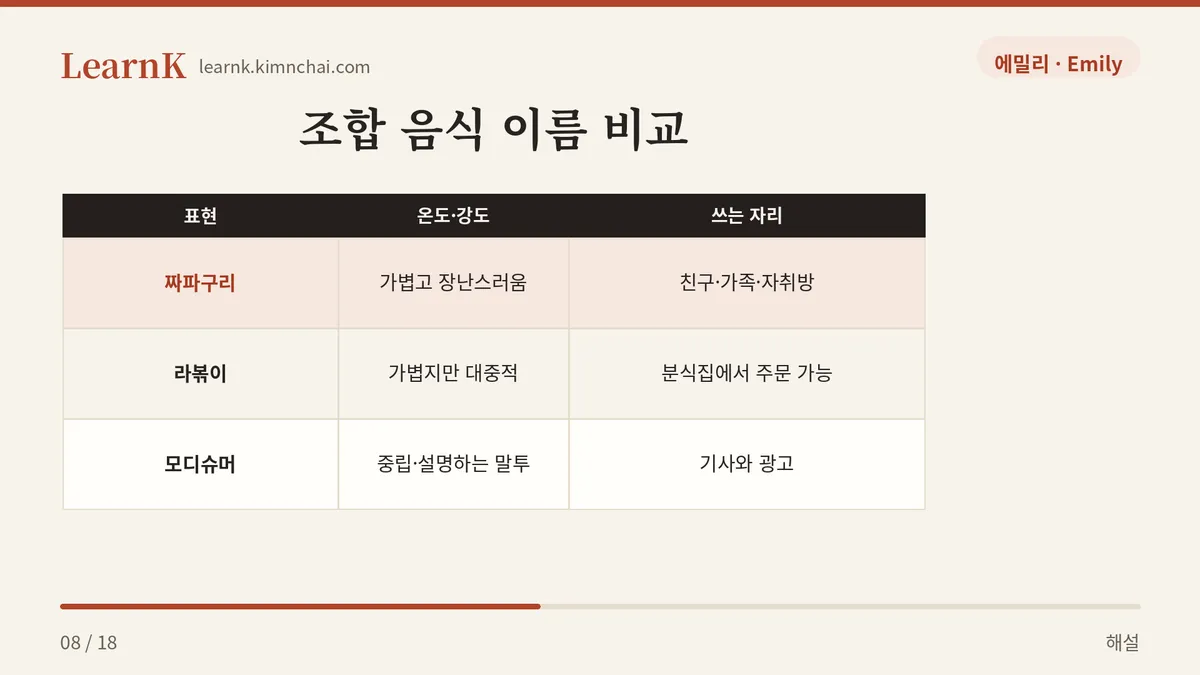
| Expression | Tone / Intensity | Where It’s Used |
|---|---|---|
| 짜파구리 (jjapaguri) | Light, playful | Friends, family, a студent’s studio apartment. Not used at formal meals |
| 라볶이 (rabokki) | Light but mainstream | Also on 분식집 (bunsikjip) menus. You can order it |
| 모디슈머 (modisyumeo) | Neutral, explanatory register | Articles and marketing copy. Almost never in everyday talk |
| 비빔면 (bibimmyeon) | Neutral | Anywhere. It’s an official product name |
라볶이 is a blend of 라면 (ramyeon) and 떡볶이 (tteokbokki), but unlike 짜파구리 it settled into 분식집 menus as a proper item long ago, so you can just order it at a shop. 모디슈머 (modify + consumer) refers to consumers who invent combination dishes like these; you see it constantly in newspaper articles and advertising, but nobody says “우리 모디슈머 하자 (uri modisyumeo haja)” to their friends. Once you feel that difference, you get a sense of what register 짜파구리 lives in — somewhere between an official name and a nickname, a name the people made first and the company followed later.
Cultural Background — A Name Made by Two Packets
The origin of the name is unusually transparent: the front of 짜파게티, “짜파,” plus the back of 너구리, “구리.” What’s fun, though, is that “짜파게티” is already a blend itself. It’s a product name made by overlapping the 짜장 of 짜장면 (jjajangmyeon) with 스파게티 (seupagetti, spaghetti) — which makes 짜파구리 a blend stacked on top of a blend. It’s a two-layer example of Korean’s favorite method for making new names: cutting flesh off two words and fusing them together.
The thing that made this combination known nationwide was the 2013 MBC variety show 《아빠! 어디가? (Appa! Eodiga?)》 — Dad! Where Are We Going? After a scene aired of one of the children mixing the two ramyeon together, both products sold out side by side at supermarkets. Originally it was something people had been quietly making on their own in the army or in dorms; this was the moment it got a name and became official.
The second turning point was Bong Joon-ho’s 2019 film 《기생충 (Gisaengchung)》 — Parasite. The wealthy lady of the house heads home unexpectedly and phones ahead to order 짜파구리, and the housekeeper hurriedly boils it up, laying expensive Korean beef sirloin on top. In that single image — premium beef sitting on cheap instant noodles — the whole class story the film was telling fit into one pot. When the film won its Academy Awards, the scene spread worldwide, and viewers in country after country started hunting for the two products at their local supermarkets. That’s also when the manufacturer began posting cooking videos in multiple languages.
So 짜파구리 has two faces for Koreans. One is the late-night-snack face — something you throw together when you’re hungry at midnight. The other is a slightly proud face: “the thing we just used to make for ourselves, and now the whole world knows about it.” That’s exactly why knowing this word makes conversations go smoothly for Korean learners. A single food name touches variety TV, a movie, and the supermarket shelf all at once.
Today’s Quiz
Your friend from Canada is sitting in a Korean restaurant, looking at the menu, and says: “여기 짜파구리 있어요? 없으면 람돈이라도 주문할게요. (yeogi jjapaguri isseoyo? eopseumyeon ramdonirado jumunhalgeyo.)” — “Do you have jjapaguri here? If not, I’ll order ram-don instead.” There are two things that sound off in this. What are they?
See the answer
First, 짜파구리 isn’t an item on an ordinary restaurant’s menu — it’s food you make at home by mixing two packets of ramyeon, so you can’t order it at a restaurant. Second, “람돈 (ram-don)” is a translation coined for the English subtitles of 《기생충》 (Parasite), so it doesn’t work in Korea. A natural fix would be something like “우리 이따가 집에 가서 짜파구리 해 먹을까? (uri ittaga jibe gaseo jjapaguri hae meogeulkka?)” — “Should we go home later and make jjapaguri?”
Definitions and example sentences are from the National Institute of Korean Language’s Basic Korean Dictionary (krdict.korean.go.kr); that portion of this post, including our translations, is licensed under CC BY-SA 2.0 KR.