존맛탱 (JMT): How Koreans Shout 'This Is SO Good!'
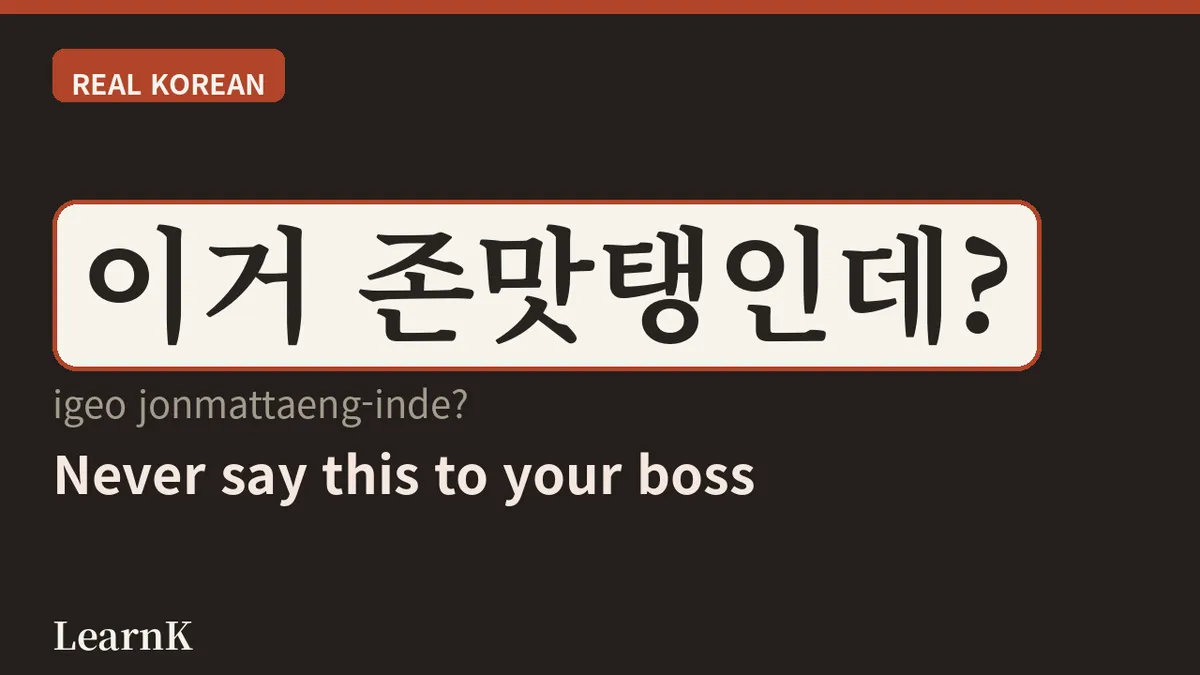
존맛탱 (JMT)
Have you ever watched a friend take their first spoonful at a Korean restaurant, eyes going wide, and shout: “이거 존맛탱이야! (igeo jonmattaeng-iya!)”? Or a mukbang YouTuber slurping down a mouthful of ramyeon, then flashing a thumbs-up at the camera and yelling “JMT!”? It’s the same thing. 존맛탱 is the go-to slang young Koreans reach for when they want to say something is ‘REALLY, seriously, insanely delicious.’ You won’t find it in a textbook, but it pops up dozens of times a day on social media, YouTube, and in chats with friends — it’s a living, breathing word.
Meaning and Nuance
존맛탱 (jonmattaeng) is made of three pieces. The first part, ‘존 (jon),’ is an intensifying prefix meaning ‘really / super’ (it comes from slang with a vulgar origin, so be careful using it in formal settings). The middle part, ‘맛 (mat),’ simply means taste. And the last part, ‘탱 (taeng),’ is a punchy little tail that cranks up the emphasis. Put them together and you get ‘the taste has hit its absolute peak’ — in other words, the ultimate deliciousness.
Among English-speaking fans, it’s better known by its initials, JMT. In chat windows, hashtags, or review comments, just slapping on #JMT sends the signal: ‘the food here is amazing.’ The nuance runs way hotter and more excited than a plain ‘it’s tasty.’ If 맛있다 (masitda) is a quiet compliment, then 존맛탱 is closer to a cheer you shout while banging on the table.
Example Sentences by Situation
Situation 1 — The moment you order delivery food for the first time
이 집 양념치킨 진짜 존맛탱이다, 다음에 또 시키자!
(i jip yangnyeom-chikin jinjja jonmattaeng-ida, daeume tto sikija!)
This place’s seasoned fried chicken is SO good — let’s order it again next time!
Here you’re eating a late-night snack with a friend, so blown away that you’re already booking the reorder. Adding ‘진짜 (jinjja, really)’ out front pumps up the excitement one more notch.
Situation 2 — Posting a great vacation-spot restaurant on social media
부산 돼지국밥 JMT… 여기 오면 무조건 먹어야 함.
(Busan dwaeji-gukbap JMT… yeogi omyeon mujogeon meogeoya ham.)
Busan dwaeji-gukbap is JMT… if you come here, you absolutely have to eat it.
This is a classic photo caption. Leaving the sentence unfinished and trailing off with ‘JMT…’ is very much the social-media mood.
Situation 3 — Cooking for yourself and patting yourself on the back
내가 만들었지만 이거 좀 존맛탱인데?
(naega mandeureotjiman igeo jom jonmattaeng-inde?)
I made it myself, but this is kind of JMT, isn’t it?
Adding ‘좀 (jom, a little)’ lets you pretend to be modest while actually bragging — it’s a playful, teasing tone.
Comparing Polite vs. Casual Speech and Similar Expressions
존맛탱 is fundamentally a casual, informal (반말, banmal) expression, so it’s only safe to use with friends, peers, or online. It’s best not to use it with your boss or with elders. If you want to say it politely, switch it up like this:
- Formal / polite: 정말 맛있어요 (jeongmal masisseoyo) — the standard expression, safe with anyone.
- A bit casual: 완전 맛있어 (wanjeon masisseo) — easygoing casual speech among friends.
- Top-tier slang: 존맛탱 / JMT (jonmattaeng) — for peers and social media only, maximum excitement.
In the same family, there’s also 꿀맛 (kkulmat, ‘honey taste = super delicious’) and 핵맛 (haengmat, ‘nuclear + taste = explosively delicious’). On the flip side, when something tastes bad you say 노맛 (nomat, no + taste) — worth memorizing together!
Cultural Background
A big part of why 존맛탱 spread so far is Korea’s 먹방 (meokbang, eating-broadcast) and delivery-food culture. As scenes of on-screen stars taking one bite and instantly bursting out with a strong exclamation got repeated over and over, demand grew for short, intense expressions of amazement. You’ll often see the same thing in drama scenes at company dinners or over late-night snacks, where characters are moved by the food — and those moments of exaggerated expressions and awe are exactly the kind of setting where 존맛탱 comes alive. That said, because the word started out from vulgar slang, part of being a true master is also developing a feel for swapping it out for ‘정말 맛있다 (jeongmal masitda)’ in public writing or formal settings.
Closing Quiz
At a company lunch gathering, you want to compliment food that your department head (부장님, bujangnim) made. Which of the following is the most appropriate expression?
- 부장님, 이거 존맛탱이에요! (bujangnim, igeo jonmattaeng-ieyo!)
- 부장님, 이거 정말 맛있어요! (bujangnim, igeo jeongmal masisseoyo!)
- 부장님, 이거 노맛이네요. (bujangnim, igeo nomat-ineyo.)
(Answer: Number 2. 존맛탱 is only for peers and informal situations; with someone senior, 정말 맛있어요 (jeongmal masisseoyo) is the safe choice. Number 3 means ‘this tastes bad,’ so absolutely never use it!)
The definitions, example sentences, and explanations in this post are all original works written by the author, and do not quote any external material such as dictionaries.