저격 (jeogyeok) — the post that never names anyone, yet everyone knows who it's about
저격 (jeogyeok)
저격 (jeogyeok) means “aiming at a target and firing a gun.” Open the National Institute of Korean Language dictionary and that one line is the entire definition — and the example sentences are full of guns, politicians, and terrible incidents. Yet if you ask a twenty-year-old in Seoul today what 저격 means, nine out of ten will not talk about guns. They will think of a post that went up on a fan community at 3 a.m.: the one that never mentions a name, but everyone knows exactly who it is about.
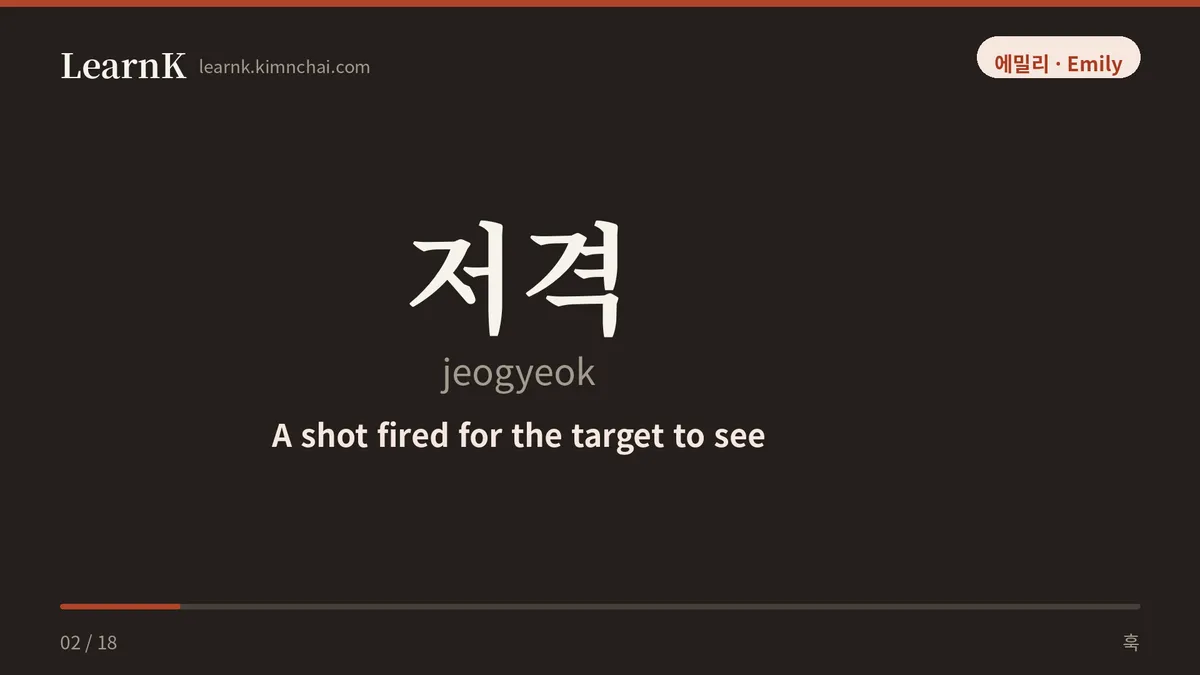
On the internet and in fandom, 저격하다 (jeogyeokhada) means “to publicly criticize a specific person while aiming squarely at them, without naming them.” Three conditions come attached. First, it goes up somewhere public. Second, no name is used. Third, everyone in the know knows anyway. That last point is exactly where it parts ways with 뒷담화 (dwitdamhwa), badmouthing someone behind their back — 저격 is a shot fired for the target to see. That is why saying “저격글 (jeogyeok-geul) 올렸다 (someone posted a callout)” always comes with a chill in the air.
There is a sunnier face to the word, too. 취향 저격 (chwihyang jeogyeok) is a compliment: “this hits my taste exactly.” Same word — one is an attack, the other is admiration. It is easiest to grasp if you picture the single image underneath both, taking aim and hitting dead-on, splitting into two branches.
Checking it in the National Institute of Korean Language dictionary
저격 (jeogyeok) 「noun」 어떤 대상을 겨냥하여 총을 쏨. (eotteon daesangeul gyeonyanghayeo chongeul ssom.) [en] shooting — The act of firing a gun at someone. [ja] そげき【狙撃】 — 銃で、ある対象を狙って撃つこと。 [es] disparo, descarga, tiro — Acción de apuntar y disparar contra cierto sujeto. [zh] 狙击 — 瞄准某个对象射击。 — National Institute of Korean Language, Basic Korean Dictionary (krdict.korean.go.kr)
The Portuguese definition is not carried in this dictionary, so we translated it ourselves: tiro — ato de mirar e atirar em alguém. (This is our own translation, not the dictionary’s original text.)
Let’s also look at the real usage examples the dictionary records. Seeing where the word originally lived gives you a feel for where today’s internet meaning rolled out from.
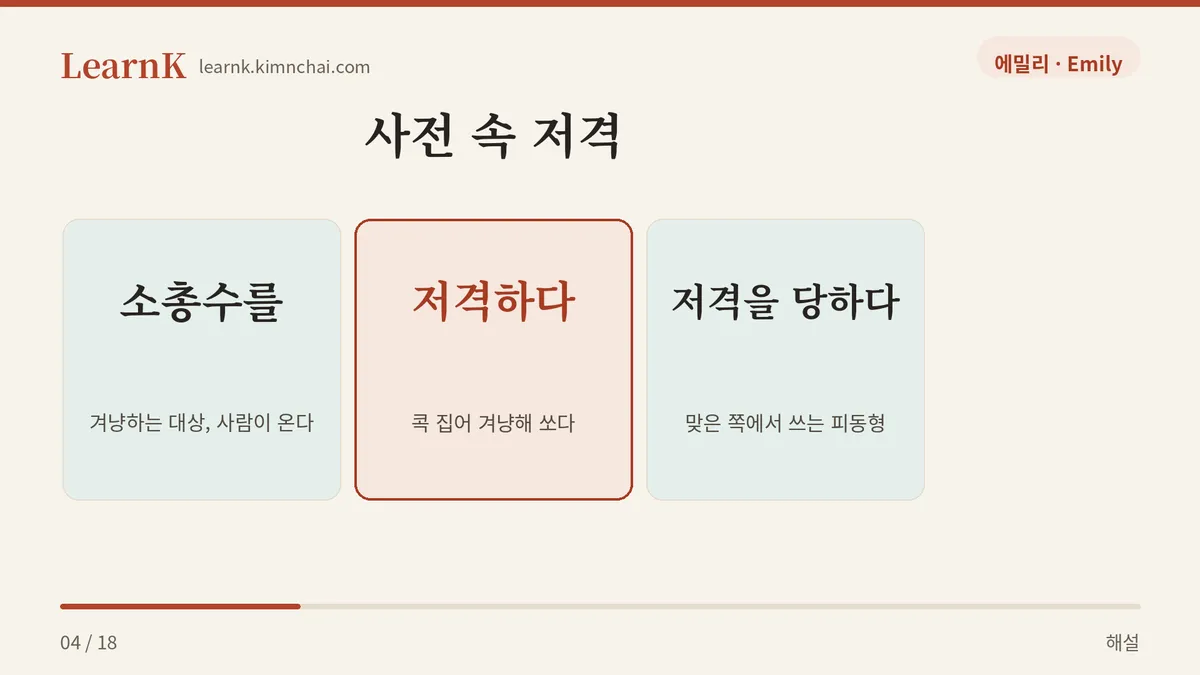
소총수를 저격하다. (sochongsureul jeogyeokhada.) — National Institute of Korean Language, Basic Korean Dictionary (krdict.korean.go.kr)
소총수를 저격하다 (sochongsureul jeogyeokhada) — “to snipe a rifleman.” This is a military situation transcribed word for word. A person sits in the object slot, and the structure of singling that person out and taking aim is built right here. That whole structure moved over to the internet intact and became “누구를 저격하다 (nugureul jeogyeokhada),” to take aim at someone.
어제는 대낮에 시내에서 시민이 저격을 당해 죽는 끔찍한 사건이 있었다. (eojeneun daenaje sinaeeseo simini jeogyeogeul danghae jungneun kkeumjjikhan sageoni itteotda.) — National Institute of Korean Language, Basic Korean Dictionary (krdict.korean.go.kr)
This is a news sentence reporting an incident. 저격을 당하다 (jeogyeogeul danghada) — when you speak from the side that got hit, you use this passive form. The very shape people use today when they say “나 저격당한 것 같아 (I think that was aimed at me)” is already sitting right here.
대통령은 부인과 함께 길거리에서 행차를 하는 도중 저격을 당했다. (daetongnyeongeun buingwa hamkke gilgeorieseo haengchareul haneun dojung jeogyeogeul danghatda.) — National Institute of Korean Language, Basic Korean Dictionary (krdict.korean.go.kr)
Here a public figure is targeted in a public place. This example shows nicely how the word 저격 carries a sense of publicness — “in front of many watching eyes.” It is also exactly why fandom callout posts reached for this particular word.
저격으로 사망한 것으로 알려진 정치인 있잖아? 사실은 그게 아니라는 소문이 있더라. (jeogyeogeuro samanghan geoseuro allyeojin jeongchiin itjanha? sasireun geuge anirneun somuni itdeora.) — National Institute of Korean Language, Basic Korean Dictionary (krdict.korean.go.kr)
This one is written in the way friends actually talk to each other. It is the only casual, conversational example in the dictionary entry, which tells us this word rolls around outside of stiff news copy too.
Seeing it in a real conversation
Scene: three hours before the concert, in line at the merch booth. The line is not moving and both of them are staring at their phones.
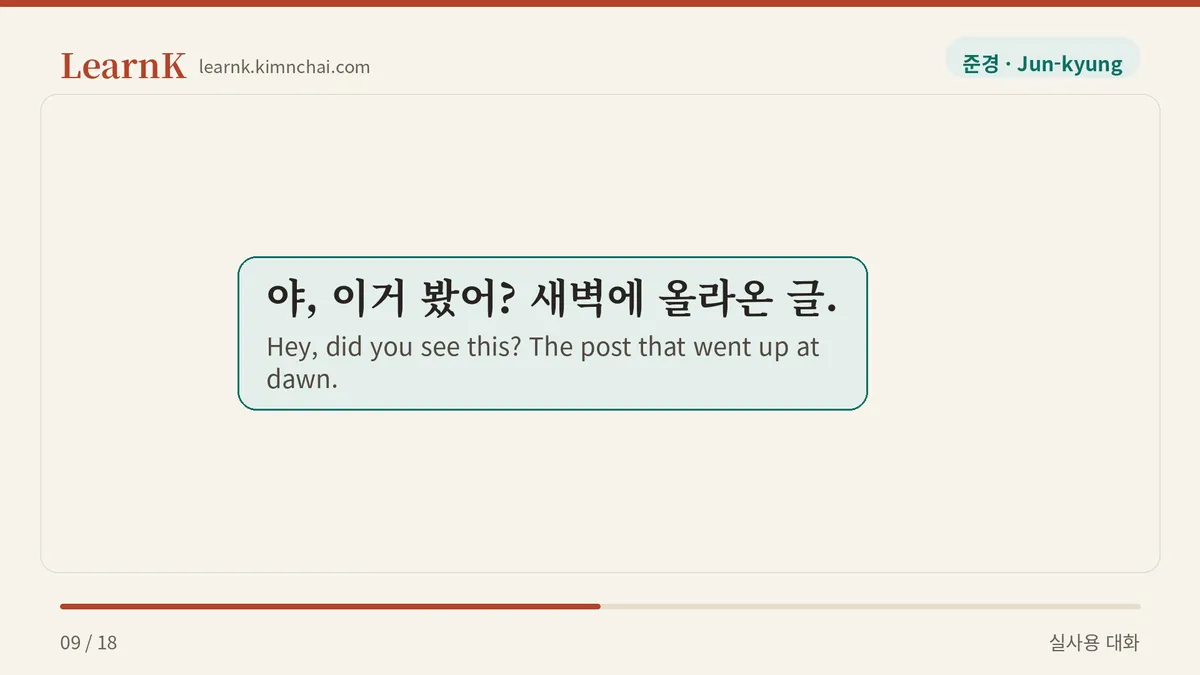
Jun-kyung: 야, 이거 봤어? 새벽에 올라온 글. Hey, did you see this? The post that went up before dawn.
Emily: 봤지. 이름은 하나도 안 썼는데 딱 봐도 저격이던데. Of course I saw it. Not a single name in it, but one look and it’s obviously a callout.
Jun-kyung: 그치? 근데 진짜 그 사람 맞나? 우리가 넘겨짚는 걸 수도 있잖아. Right? But is it really about that person? We might be jumping to conclusions.
Emily: 그래서 저격글이 무서운 거야. 아무 상관 없는 사람까지 저격당한 기분 들거든. That’s exactly why callout posts are scary. Even people who have nothing to do with it end up feeling targeted.
Jun-kyung: 하긴. 댓글창 벌써 난리 났더라. Fair. The comment section is already a mess.
Emily: 오늘은 그냥 굿즈나 사자. 이번 포토카드 완전 내 취향 저격이야. Let’s just buy merch today. This photocard hits my taste dead-on.
This is where it sounds off
✗ (right after a team meeting, to your manager) 부장님, 아까 그 말씀 저 저격하신 거예요? (bujangnim, akka geu malsseum jeo jeogyeokhasin geoyeyo?) ✓ (right after a team meeting, to your manager) 부장님, 아까 하신 말씀이 혹시 제 얘기였을까요? (bujangnim, akka hasin malsseumi hoksi je yaegiyeosseulkkayo?) → 저격 is an accusation: “you secretly took aim and fired.” Thrown at someone above you, it stops being a gentle check and becomes a head-on confrontation. If you just want to confirm something, “제 얘기였을까요 (was that about me?)” is the safe route.
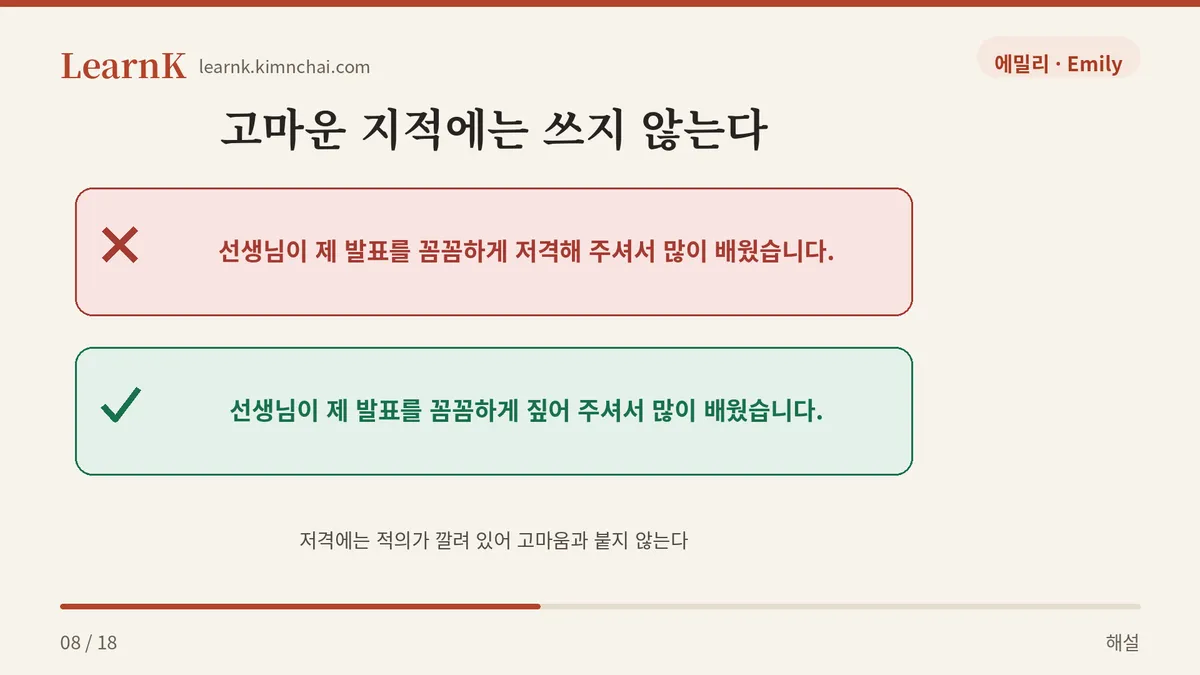
✗ 선생님이 제 발표를 꼼꼼하게 저격해 주셔서 많이 배웠습니다. (seonsaengnimi je balpyoreul kkomkkomhage jeogyeokhae jusyeoseo mani baewotseumnida.) ✓ 선생님이 제 발표를 꼼꼼하게 짚어 주셔서 많이 배웠습니다. (seonsaengnimi je balpyoreul kkomkkomhage jipeo jusyeoseo mani baewotseumnida.) → 저격 has hostility baked into it. Attach it to feedback you are grateful for and you end up saying “my teacher had it out for me.” For helpful criticism, use 짚어 주다 (jipeo juda, to point out) or 지적해 주다 (jijeokhae juda, to note/critique).
Example sentences by situation
1. When another group comes up in a fan community
이거 대놓고 우리 팀 저격 아니야? igeo daenoko uri tim jeogyeok aniya? Isn’t this an obvious dig at our group?
Use this when no name appears but the context makes it obvious. “대놓고 (daenoko)” means “right out in the open,” and it sums up 저격’s core condition — nobody wrote it, but everybody knows — in a single word.
2. In the hallway with a coworker after a meeting
아침에 부장님 하신 말씀, 나 저격당한 느낌이었어. achime bujangnim hasin malsseum, na jeogyeokdanghan neukkimieosseo. That thing the manager said this morning — I felt like it was aimed at me.
This is what you say when you are not certain but it stung. By stepping back one layer — “저격당한 느낌이었어 (it felt like I was targeted)” instead of “저격당했어 (I was targeted)” — you can convey the hurt without declaring it as fact. This is by far the most common form you’ll actually hear in a Korean workplace.
3. When you love the new album concept
이번 앨범 콘셉트 완전 내 취향 저격이야. ibeon aelbeom konsepteu wanjeon nae chwihyang jeogyeogiya. This album concept hits my taste perfectly.
Same word, but here it is 100% praise. Even with 저격 attached at the end, putting 취향 (chwihyang, taste) in front dissolves the aggression entirely. An easy rule to memorize: a person’s name in front means attack; words like 취향 (taste), 입맛 (palate), or 눈길 (one’s eye) in front mean admiration.
Polite and casual forms, plus similar expressions
Just change the ending and it becomes polite speech. But remember that as you go down the list, the weight of the accusation — “you did that to me” — grows heavier.
- Casual: 그거 나 저격한 거야? (geugeo na jeogyeokhan geoya?)
- Polite: 그거 저 저격하신 거예요? (geugeo jeo jeogyeokhasin geoyeyo?)
- Softly: 혹시 제 얘기였을까요? (hoksi je yaegiyeosseulkkayo?)
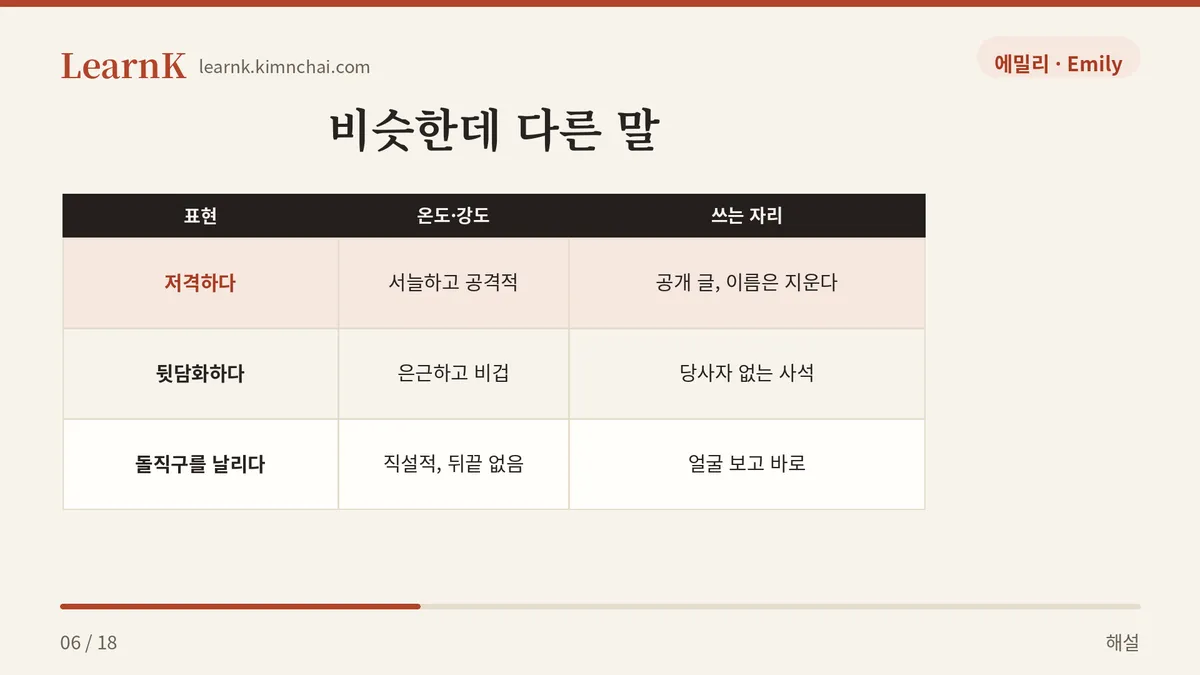
| Expression | Temperature & intensity | Where it’s used |
|---|---|---|
| 저격하다 (jeogyeokhada) | Cold and aggressive | Public posts online, fandom. Written for the target to read |
| 뒷담화하다 (dwitdamhwahada) | Sly and cowardly | In private, where the person isn’t. Never made public |
| 디스하다 (diseuhada) | Sharp but light and playful | Among peers, hip-hop culture. Often names the person outright |
| 돌직구를 날리다 (doljikgureul nallida) | Blunt but no lingering grudge | Said face to face, on the spot. Hiding nothing is the point |
| 취향 저격 (chwihyang jeogyeok) | Bright and excited | Admiration. When it hits your taste, not a person |
Read the table top to bottom and the differences jump out. 뒷담화 happens out of sight, 돌직구 happens face to face, 디스 calls the name out loud, and 저격 erases the name while standing in full public view. 저격 is the only one with that awkward combination — public and anonymized — and that is precisely why it is the most reliable spark for a fight on the Korean internet.
Cultural background — the space where the name was erased
The word-building itself is not hard. A military term for taking aim and firing carried straight over into metaphor. A post instead of a gun, a person instead of a target. Exactly one thing changed in the move, and that thing is the name. A real sniper knows precisely who the target is; an internet callout post deliberately blurs the target. That blur is what lets the writer slip away with “I never said that.” That escape hatch is what adds the chill to the word 저격.
The brighter usage was spread far and wide by pop music. In 2015 iKON released a song titled 〈취향저격 (Chwihyang Jeogyeok)〉 — exactly what the title says, a song about someone hitting your taste dead-on — and as it grew popular, 취향 저격 turned into everyday vocabulary. Now people attach it to food, clothes, and dramas without a second thought.
저격 shows up constantly in Korean dramas, too. Especially in workplace and school settings, there is now an almost formulaic sequence: a character posts something on social media with the name left out, and in the next scene the office air freezes over. The camera pans across the text on screen, then cuts one by one to the faces of the people reading it. Nobody says a name, yet everyone thinks it’s about them — those few seconds explain the meaning of 저격 without a single line of dialogue.
There is one more reason this word matters for learners of Korean. Read through Korean fandom communities and 저격 comes up several times a day, but look it up in a dictionary and all you get is guns. So you stop and think, “why is there a gun in this idol conversation?” Words where the dictionary meaning and the street meaning have drifted this far apart are not common.
Today’s quiz
Which of the following uses 저격 unnaturally?
- 이 글 대놓고 우리 팀 저격이잖아. (i geul daenoko uri tim jeogyeogijanha.)
- 이번 앨범 콘셉트 완전 내 취향 저격이야. (ibeon aelbeom konsepteu wanjeon nae chwihyang jeogyeogiya.)
- 교수님이 제 논문을 친절하게 저격해 주셔서 큰 도움이 됐습니다. (gyosunimi je nonmuneul chinjeolhage jeogyeokhae jusyeoseo keun doumi dwaetseumnida.)
The answer is number 3. 저격 has hostility and quiet aggression underneath it, so attaching it to guidance you’re thankful for turns the sentence into “my professor had it out for me.” What belongs here is “꼼꼼히 짚어 주셔서 (for going through it so carefully)” or “세심하게 지적해 주셔서 (for pointing things out so thoughtfully).” Number 1 is the textbook usage — a public post that takes aim without naming anyone — and number 2 is a compliment about something hitting your taste exactly.
Definitions and example sentences are from the National Institute of Korean Language’s Basic Korean Dictionary (krdict.korean.go.kr); that portion of this post, including our translations, is licensed under CC BY-SA 2.0 KR.