Today's Korean: '김치찌개 (gimchijjigae)' — How to Cook, Eat, and Miss Korea's Ultimate Soul Food
When you watch Korean dramas, there’s one scene that comes up over and over: the characters gathered around a single bubbling red pot in the middle of the table, sharing a meal. The star of that pot is today’s expression, 김치찌개 (gimchijjigae). It’s the first Korean dish name that study-abroad students learn, and it’s the symbol of ‘집밥 (jipbap)’ — home cooking — that Koreans think of first when they’re worn out or feeling a little empty inside. Today, let’s dig deep into this one word.
김치찌개
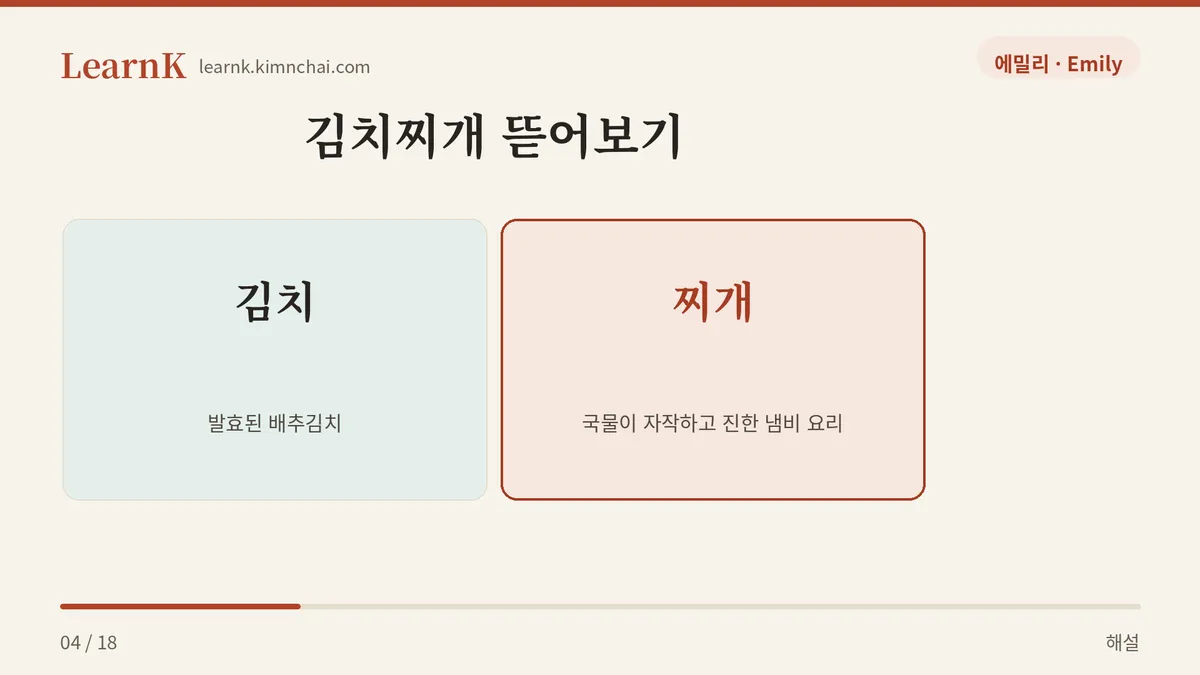
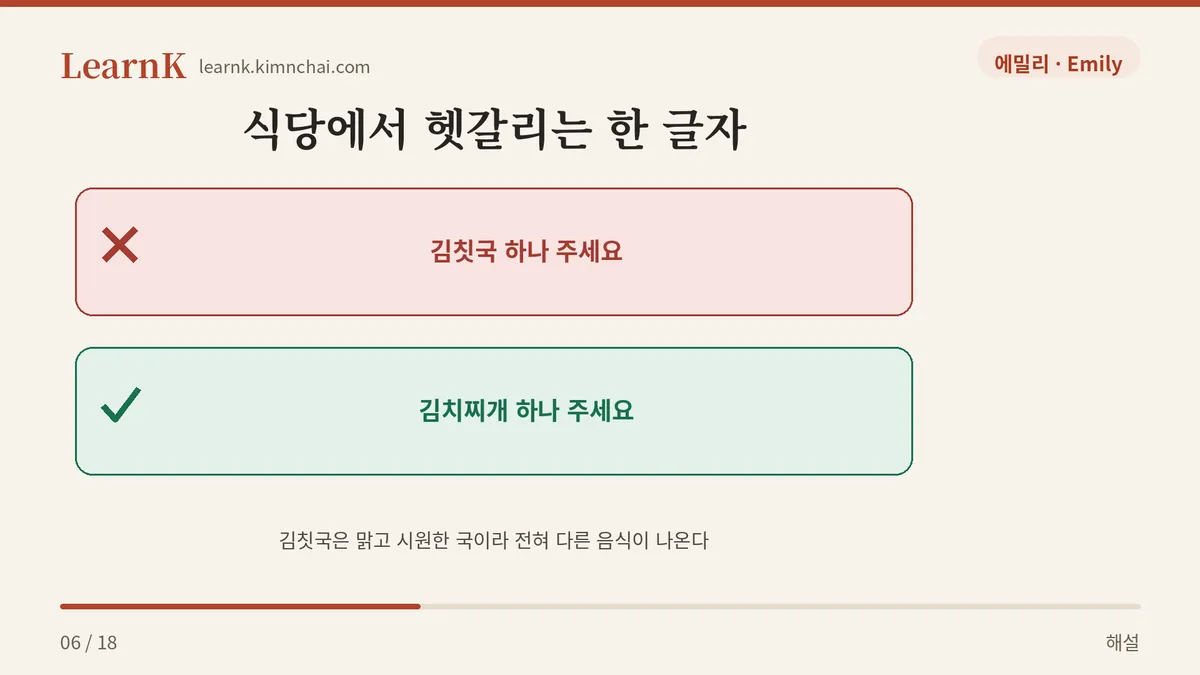
김치찌개 (gimchijjigae) is a combination of ‘김치 (gimchi)’ and ‘찌개 (jjigae).’ Here, 찌개 (jjigae) refers to a dish simmered down thick, with a modest amount of rich broth, cooked together with hearty ingredients. It’s different from 국 (guk), which has plenty of clear, light broth. So 김치찌개 is a very straightforward name meaning ‘a jjigae richly simmered with kimchi added.’
The nuance matters. 김치찌개 isn’t a fancy dish — it’s the most ordinary and familiar everyday food. That’s why it carries feelings of nostalgia and warmth, as in ‘the 김치찌개 my mother used to make,’ and at restaurants it’s known as ‘the menu item you order most casually.’ Spicy and savory, it’s the kind of dish that makes you want to eat more rice — a true 밥도둑 (bapdoduk), a ‘rice thief.‘
Checking with the National Institute of Korean Language Dictionary
The National Institute of Korean Language’s Basic Korean Dictionary defines the word like this.
김치찌개 [Noun] A jjigae boiled with kimchi added. [en] kimchi jjigae — Jjigae, stew, boiled with kimchi. [ja] キムチチゲ — キムチを入れて作ったチゲ料理。 [es] kimchijjigae, estofado de kimchi — Estofado de kimchi. [zh] 辛奇汤 — 以辛奇为主材煮制而成的汤。 — National Institute of Korean Language, Basic Korean Dictionary (krdict.korean.go.kr)
Shall we also look at the real usage examples in the dictionary? I’ll give you the original sentences as they are and explain the situations.
김치찌개 먹었는데 양치를 못 했어요. — National Institute of Korean Language, Basic Korean Dictionary (krdict.korean.go.kr)
This is a situation where the smell of kimchi lingers and you feel self-conscious about it. It naturally shows that 김치찌개 is a food with a strong smell.
부엌에서 풍겨오는 김치찌개 냄새가 구미를 돋우었다. — National Institute of Korean Language, Basic Korean Dictionary (krdict.korean.go.kr)
‘구미를 돋우다 (gumireul doduda)’ means ‘to whet one’s appetite.’ It’s a scene where just the smell of it simmering makes you hungry.
김치찌개를 끓이려고 나는 돼지고기 이백 그램을 샀다. — National Institute of Korean Language, Basic Korean Dictionary (krdict.korean.go.kr)
This shows that it’s common to add pork to 김치찌개. If you add tuna, it becomes 참치김치찌개 (chamchi-gimchijjigae).
요즘따라 어머니께서 해 주시던 김치찌개가 너무 그립다. — National Institute of Korean Language, Basic Korean Dictionary (krdict.korean.go.kr)
This is a sentence that captures exactly the ‘nostalgia for home cooking’ we mentioned earlier. 김치찌개 often becomes an object of longing like this.
By the way, this dictionary has no Portuguese translation, so if I translate it myself, I could introduce it as roughly 김치찌개 = ensopado de kimchi (estufado picante de kimchi). (I’m noting that this is my own translation and not dictionary material.)
Practical Example Sentences by Situation
Now let’s build a feel for real use with some sentences I made myself.
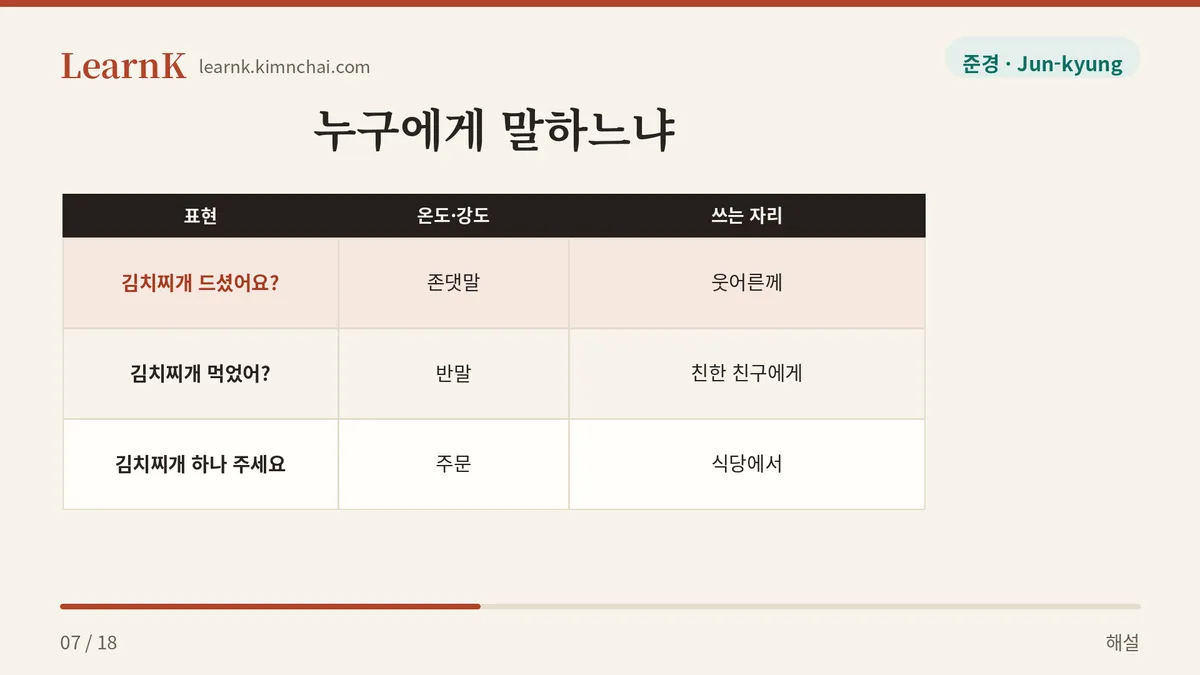
- When ordering at a restaurant — “저는 김치찌개 하나 주세요 (gimchijjigae hana juseyo).” This is the most basic ordering expression. ‘하나 주세요 (hana juseyo)’ means ‘one, please,’ so it works anywhere.
- When commenting on the taste — “이 집 김치찌개가 진짜 맛있어요 (gimchijjigaega jinjja masisseoyo).” This is the dictionary example ‘김치찌개가 맛있다’ turned into real conversational speech.
- When asking how spicy it is — “김치찌개 많이 매워요? (gimchijjigae mani maewoyo?)” This is the sentence a foreign friend who’s weak with spicy food is bound to ask. It connects to the dictionary example ‘김치찌개가 맵다.‘
Comparing Polite/Casual Speech and Similar Expressions
The food name ‘김치찌개’ itself has no polite or casual form, but the verb you use with it changes.
- Polite: 김치찌개 드셨어요? (gimchijjigae deusyeosseoyo?) — using ‘드시다 (deusida),’ the honorific form of ‘먹다 (meokda), to eat.’
- Casual: 김치찌개 먹었어? (gimchijjigae meogeosseo?) — the relaxed way of speaking between friends.
Shall we also sort out some easily confused neighboring words? 김칫국 (gimchitguk) is a ‘guk’ with clear, refreshing broth, and 부대찌개 (budaejjigae) is a jjigae made with ham and sausage. 된장찌개 (doenjangjjigae) is like a cousin, flavored with soybean paste instead of kimchi. They all share the same ‘jjigae’ cooking method, but the main ingredients differ.
Cultural Background
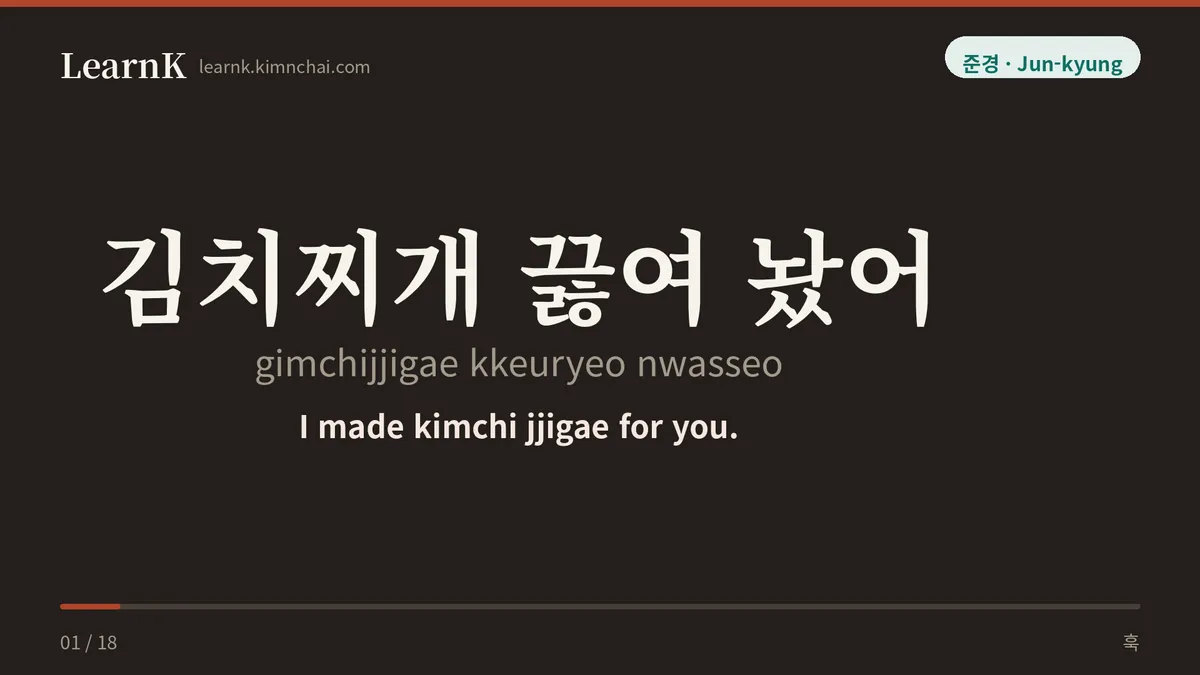
김치찌개 often shows up as a prop symbolizing the ‘family dinner table’ in dramas. Like the scene where the tired main character comes home late at night, and mom says, “밥은 먹었니? 김치찌개 끓여 놨어 (Have you eaten? I made some kimchi jjigae).” Rather than a quote from any particular show, this kind of line is a typical situation that plays out in any Korean household. That’s how strongly 김치찌개 is connected to ‘the warm heart of someone cooking for you.’ Because sour kimchi is said to give a deeper flavor, people sometimes deliberately set aside well-aged kimchi just for making jjigae.
Closing Quiz
Shall we check what we learned today?
You asked a friend in casual speech, “너 김치찌개 먹었어? (Did you eat kimchi jjigae?)” How would you say this in polite speech to an elder?
(Answer: 김치찌개 드셨어요? (gimchijjigae deusyeosseoyo?) — you change ‘먹다’ into its honorific form ‘드시다.’)
Did you enjoy today’s tasty bowl of Korean? See you again in the next expression!
Definitions and example sentences are from the National Institute of Korean Language’s Basic Korean Dictionary (krdict.korean.go.kr); that portion of this post, including our translations, is licensed under CC BY-SA 2.0 KR.