Read but No Reply? Master '읽씹', the Essential Slang of the KakaoTalk Generation
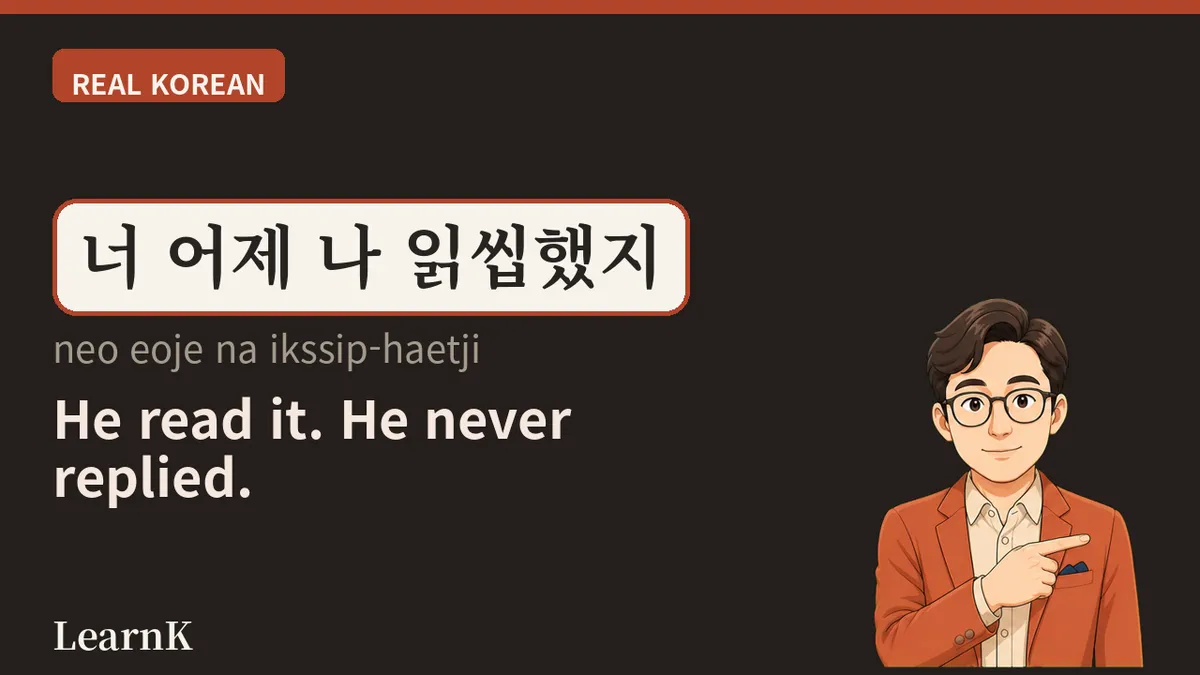
You sent your friend a message on KakaoTalk. A moment later, the number 1 next to your message disappears. That means they’ve definitely read it. But… hours go by, a whole day goes by, and still no reply. Koreans capture this agonizing situation in just two syllables. Today’s expression: 읽씹 (ikssip).
Let’s fully master this new slang word — one you could never figure out without understanding Korea’s messenger culture — today, with plenty of examples.
읽씹
읽씹 (ikssip) is a blend of two words. It combines the ‘읽’ from 읽다 (ikda, 읽다 = to read) with the ‘씹’ from 씹다 (ssipda), a slangy word meaning “to ignore” or “to brush off as if chewing something up and swallowing it.” Translated literally, it means “to read and chew,” in other words, the act of reading a message and then not replying to it.
It carries almost exactly the same nuance as the English “to leave someone on read.” On KakaoTalk, the number 1 disappears once the other person checks your message, so someone who’s been 읽씹-ed is left stewing: “I know for sure they read it — so why no reply?”
Meaning and Nuance
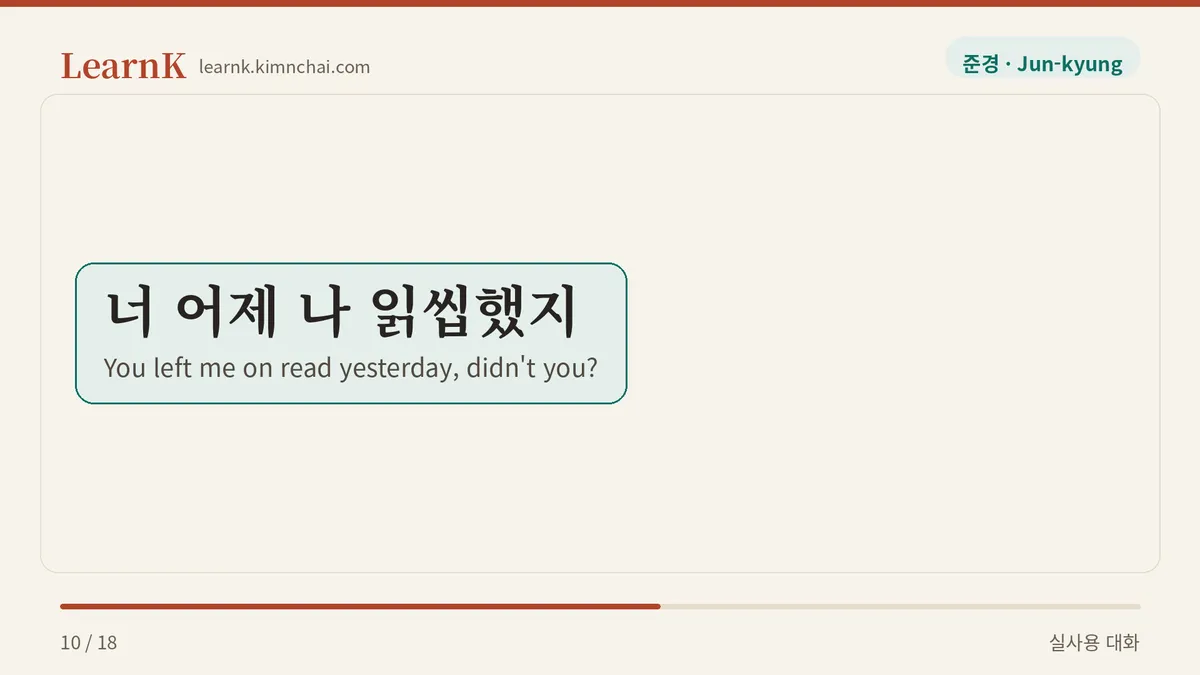
- Part of speech / character: A new slang word used as both a noun and a verb. It conjugates as ‘읽씹하다 (ikssip-hada)’ and ‘읽씹당하다 (ikssip-danghada)’.
- Emotional color: It generally carries a sense of hurt, frustration, and feeling ignored. It can be used as a light joke or to express genuine disappointment.
- A note of caution: Because the word ‘씹다’ itself is somewhat coarse, it’s best not to use 읽씹 in very formal settings or with people senior to you. It’s casual language for friends and peers.
💡 Dictionary note: ‘읽씹’ is a recently coined internet slang word, so it isn’t yet listed as an entry in the National Institute of Korean Language’s Basic Korean Dictionary. That’s why we’ve put together today’s definition ourselves, based on how the word is actually used.
Examples by Situation
Example 1 — Venting your hurt feelings
나 어제 3시간 동안 읽씹당했어 (ikssip-danghaesseo). 진짜 서운해. (I got left on read for three hours yesterday. I’m honestly hurt.)
This is when a blind-date match or a friend reads your message but leaves you hanging for hours, and you’re pouring out your complaints to a friend. Adding ‘당하다’ emphasizes that you’re the victim who got ignored.
Example 2 — Making an excuse or apologizing
미안, 일부러 읽씹한 (ikssip-han) 거 아니야! 답장하려다가 깜빡했어. (Sorry, I didn’t leave you on read on purpose! I meant to reply and totally forgot.)
This is how you explain, “I didn’t ignore you deliberately,” when you got busy and forgot to reply. 읽씹 easily leads to misunderstandings, so scrambling to make an excuse like this is a common occurrence.
Example 3 — Teasing playfully
또 읽씹이야? 너 요즘 왜 이렇게 답장이 늦어~ (Leaving me on read again? Why are you so slow to reply these days~)
This is used between couples or best friends as a cutesy little complaint. It’s not that you’re actually angry — you’re just tossing it out playfully.
Comparison with Polite Speech and Similar Expressions
Since 읽씹 is slang, it’s awkward to convert it directly into polite speech (존댓말). To say it politely, you spell it out.
- Casual (slang): 왜 읽씹해? (wae ikssip-hae?)
- Polite version: 메시지를 확인하시고 답장을 안 주셨네요 (…dapjang-eul an jusyeonneyo) (I see you checked my message but didn’t reply.)
There’s also a companion expression worth knowing.
- 안읽씹 (an-ikssip): When ‘안’ is added, it means leaving a message completely unread and unattended. That’s the state where the number 1 next to the message stays put. It can feel even more indifferent than plain 읽씹.
- 읽씹 vs 안읽씹: 읽씹 is “read it but didn’t reply,” while 안읽씹 is “didn’t even read it.” Which of the two stings more is a matter people disagree on!
Cultural Background
The decisive reason the word ‘읽씹’ came to exist is KakaoTalk’s read-receipt feature. Because the number 1 disappears once the other person checks a message, in Korea it’s plain to see “whether it’s been read or not.” As a result, a subtle psychological game around whether or not someone replies became part of everyday life, and this culture gave birth to the new word ‘읽씹’.
In Korean dramas and webtoons, too, you’ll often see the main character anxiously staring at their phone screen, waiting for the other person’s reply. The number 1 that won’t disappear — or the screen that stays silent even after it does — has become a staple ingredient of modern Korean romance. That’s just how much 읽씹 can be called a word that compresses the emotions of Koreans in the digital age.
Closing Quiz
Your friend left your message completely unread and ignored it all day. Which expression best fits this situation?
- 읽씹당했어
- 안읽씹당했어
- 답장했어
(Answer: #2, 안읽씹당했어. Since they didn’t read it at all, you add ‘안’! If they had read it and then didn’t reply, #1 ‘읽씹당했어’ would be the right answer.)
Today we learned 읽씹, the essential slang of the KakaoTalk generation. Now you too can tell your Korean friends, “읽씹하지 마! (ikssip-haji ma!)” (Don’t leave me on read!), right? 😉