The Korean Word That Won't Translate — 정 (jeong): Through Both Affection and Annoyance
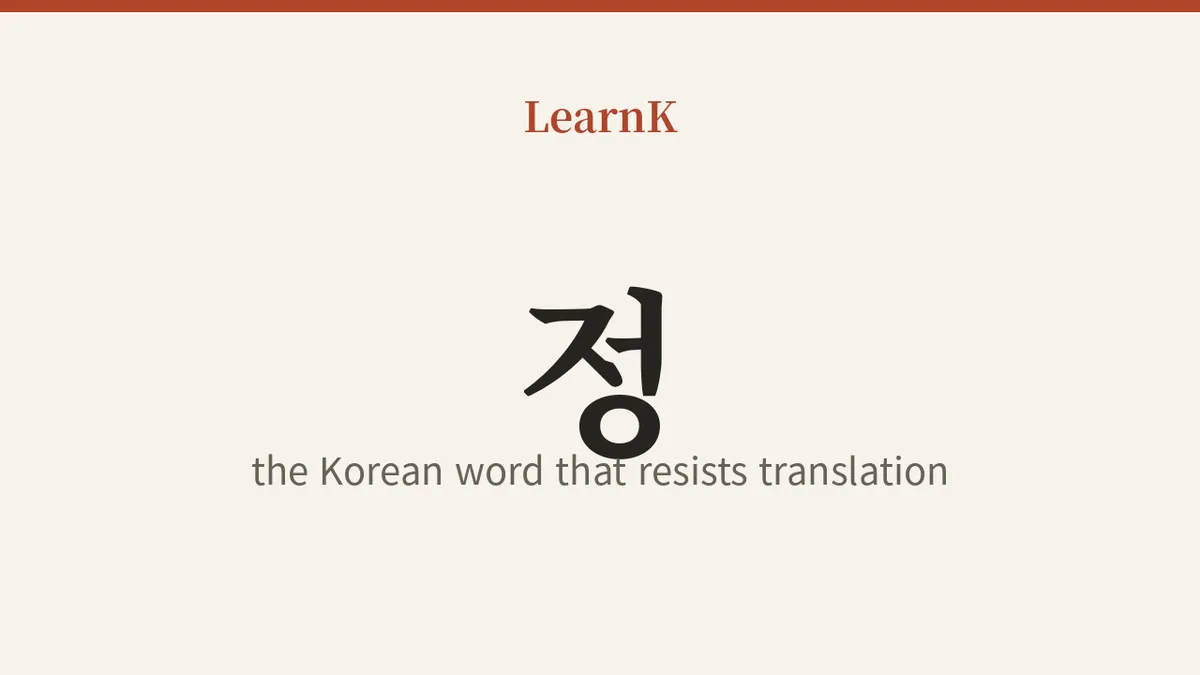
Foreigners who have lived in Korea for a long time tend to agree on one word: “This is the one word I just can’t translate.” Today’s expression is 정 (jeong). When a neighbor passes a dish of side dishes over the fence, when the grandmother at the market tosses in an extra handful of bean sprouts for free, when a coworker you only ever bickered with is leaving and you feel strangely sad about it — Koreans explain all of these feelings with a single syllable. “It’s because of jeong, that’s all.”
정
정 (jeong) is the tender feeling that slowly builds up as you spend time with people, animals, objects, and places. There are three key nuances. First, jeong does not form at first sight. Time is its ingredient. Second, it isn’t limited to people. You can develop jeong for an old car or a neighborhood you’ve lived in for a long time. Third, it isn’t only a good feeling. There’s 미운 정 (miun jeong) — the jeong that builds up even as you fight and resent each other — which is why there’s even a saying, “미운 정 고운 정 다 들었다” (I’ve grown both the resentful jeong and the fond jeong).
Checking with the National Institute of Korean Language Dictionary
The National Institute of Korean Language’s Basic Korean Dictionary defines the noun ‘정’ like this.
정 “noun” 1. A state of mind that forms when one feels something. — English: jeong; bond; feeling — “A state of mind that forms when one feels something.” — Spanish: afecto, cariño — Chinese: 情 2. A feeling of love or closeness. — English: jeong — “A feeling of love or closeness.” — Spanish: afecto, cariño, inclinación — Chinese: 情, 情意 — National Institute of Korean Language, Basic Korean Dictionary (krdict.korean.go.kr)
What’s striking is that the English definition uses the romanized jeong as-is instead of a translation. The very fact that they had no choice but to transliterate the sound shows just how unique this word is. There’s no Portuguese translation in the dictionary, so we add our own: afeto, carinho (our own translation). One thing to note: the dictionary example sentences that came up alongside this lookup were actually for other words that merely sound the same — the 정 of ‘결정 (決定, decision)’ and the -가 (家) of ‘정치가 (politician)’ — so we’ve left them out. All the example sentences below are ones we wrote ourselves.
Example Sentences by Situation
- “그동안 정이 많이 들었는데, 가신다니 섭섭해요. (Geudongan jeong-i mani deureonneunde, gasindani seopseopaeyo.)” — Something you’d say to a neighbor who’s moving away or a coworker who’s leaving. ‘정이 들다’ is the basic form.
- “이 차 낡았지만 십 년을 탔더니 정이 들어서 못 팔겠어. (I cha nalgatjiman sip nyeon-eul tatdeoni jeong-i deureoseo mot palgesseo.)” — You can develop jeong for objects, too.
- “우리 단골집 사장님은 정이 많아서 늘 반찬을 더 주셔. (Uri dangoljip sajangnim-eun jeong-i manaseo neul banchan-eul deo jusyeo.)” — ‘정이 많다’ is a compliment for a warm-hearted nature.
- “그 거짓말을 듣고 정이 뚝 떨어졌어. (Geu geojinmal-eul deutgo jeong-i ttuk tteoreojyeosseo.)” — Conversely, when your feelings cool off, you use ‘정(이) 떨어지다’.
Seeing It in a Real Conversation
Situation: Saturday afternoon, the meeting spot for a secondhand sale. Jun-kyung has come out to sell a bicycle he’s ridden for over ten years, and Emily has come to buy it.
Jun-kyung: 아, 여기 있습니다. 사진보다 실물이 좀 낡았죠…? Oh, here it is. It looks a bit more worn in person than in the photo, right…?
Emily: 아니요, 관리 진짜 잘 하셨네요. 근데 파는 분 표정이 왜 이렇게 어두워요. No, you’ve really taken good care of it. But why does the seller look so gloomy?
Jun-kyung: 하하, 티 나요? 십 년을 탄 거라 막상 넘기려니까 정이 들어서 좀 그러네요. Haha, is it that obvious? I rode it for ten years, so now that I’m actually handing it over, I’ve grown attached to it — it’s a little hard.
Emily: 아, 그 마음 알죠. 저 여기 산 지 15년인데 그런 거 한두 번 겪은 게 아니라. Ah, I know that feeling. I’ve lived here fifteen years — I’ve been through that more than a few times.
Jun-kyung: 어, 한국말 진짜 잘하시네요. 사실 정 같은 말은 외국분들이 제일 어려워하던데. Oh, your Korean is really good. Honestly, a word like jeong is the one foreigners usually struggle with the most.
Emily: 처음엔 그냥 ‘사랑’인 줄 알았어요. 근데 살다 보니 다르더라고요. 자전거한테까지 정 든 분이면 믿고 살게요. At first I thought it just meant “love.” But after living here a while, I realized it’s different. If you’ve grown attached even to a bicycle, I’ll buy it with confidence.
Formal vs. Casual Speech, and How It Differs from Similar Words
‘정’ itself has nothing to do with politeness levels, so you only need to change the verb ending. In formal speech it’s “정이 들었어요 (jeong-i deureosseoyo)”, and to a friend, “정 들었네 (jeong deureonne)”. Comparing it with similar words makes its outline clearer. 사랑 (sarang) is hot and intense and can happen at first sight, but jeong is a feeling like broth simmered gently for a long time. 우정 (ujeong) is the name of a relationship — ‘between friends’ — but jeong doesn’t distinguish between people, animals, and objects. That’s why the saying older folks have holds true: “Even when love cools, we stay together because of jeong.”
Cultural Background — Choco Pie and Evenings in the Alley
In Korea, ‘정’ is even printed on a snack brand. The large Chinese character ‘情’ written on Choco Pie packaging, along with the ad slogan “말하지 않아도 알아요 (You know it even without words)”, made this word a symbol of national sentiment for decades. In the drama Reply 1988 (tvN, 2015), the scene where the neighbors of Ssangmun-dong carry plates of side dishes to each other’s homes every evening is considered a masterpiece that shows what jeong is without a single line of dialogue. Is there a word in your country for this kind of ‘neighborly feeling’, too?
Closing Quiz
On the day you leave a company you’ve worked at for 10 years, stroking your old desk, which is the most natural thing to say?
① “책상아, 정이 많이 들었는데 아쉽다.” (Desk, I’ve grown so much jeong for you — I’ll miss you.) ② “책상아, 우정이 많이 들었는데 아쉽다.” (Desk, I’ve grown so much friendship for you — I’ll miss you.) ③ “책상아, 사랑이 많이 들었는데 아쉽다.” (Desk, I’ve grown so much love for you — I’ll miss you.)
The answer is ①. For the feeling created by the time you spent with an object, ‘정’ is the right word. Tell us in the comments about an object you’ve grown jeong for!
Definitions and example sentences are from the National Institute of Korean Language’s Basic Korean Dictionary (krdict.korean.go.kr); that portion of this post, including our translations, is licensed under CC BY-SA 2.0 KR.