Learn Korean Through a Single Bowl of Ramyeon — '라면', Korea's Soul Food
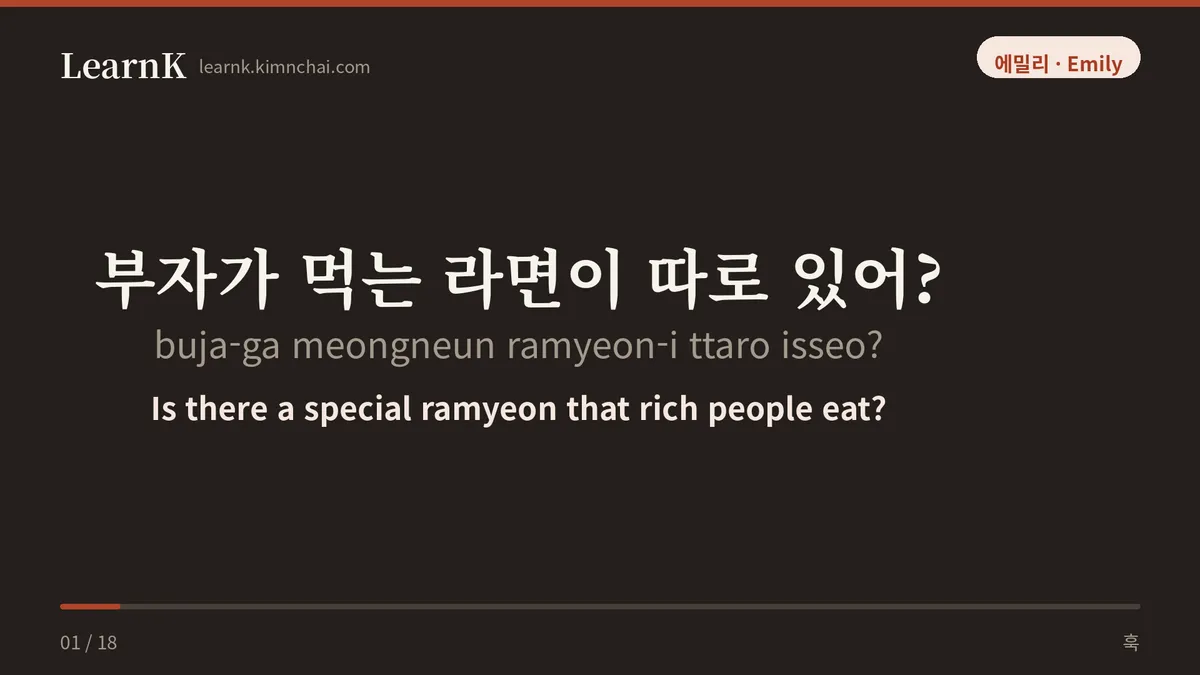
Late at night, clutching a growling stomach and setting a pot of water on the stove — every Korean has done it. The moment you drop the squiggly noodles and the red soup powder into the bubbling water, that smell spreads through the whole house — and that’s today’s expression, 라면 (ramyeon). If you watch K-dramas, you’ll notice characters asking “라면 먹을래? (ramyeon meogeullae?)” all the time. More than just instant food, 라면 is a soul food filled with the everyday life and warm affection (情) of Korean people.
라면
‘라면’ is a convenient food you make simply by putting deep-fried, dried noodles and powdered soup into water and boiling it. Since it first appeared in Korea in 1963, it has been a beloved national food for over 60 years. In English it’s instant noodles, and although the name comes from the Japanese ramen (ラーメン), today Korea’s ‘라면’ has developed into its own distinct dish, characterized by a spicy, red broth. It’s pronounced [라면] and written ramyeon in romanization.
Checking with the National Institute of Korean Language Dictionary
라면 「noun」 A food made of deep-fried, dried noodles and powdered soup, which can be prepared conveniently by simply boiling it in water. — National Institute of Korean Language, Basic Korean Dictionary (krdict.korean.go.kr)
The multilingual translations the dictionary provides are as follows.
ramen; instant noodles (English) / インスタントラーメン【即席ラーメン】 (Japanese) / fideo instantáneo, ramen instantáneo (Spanish) / 方便面 (Chinese) — National Institute of Korean Language, Basic Korean Dictionary (krdict.korean.go.kr)
A Portuguese translation isn’t provided in the dictionary, so rendering it ourselves gives something like macarrão instantâneo. (Not in the dictionary; translated by us.)
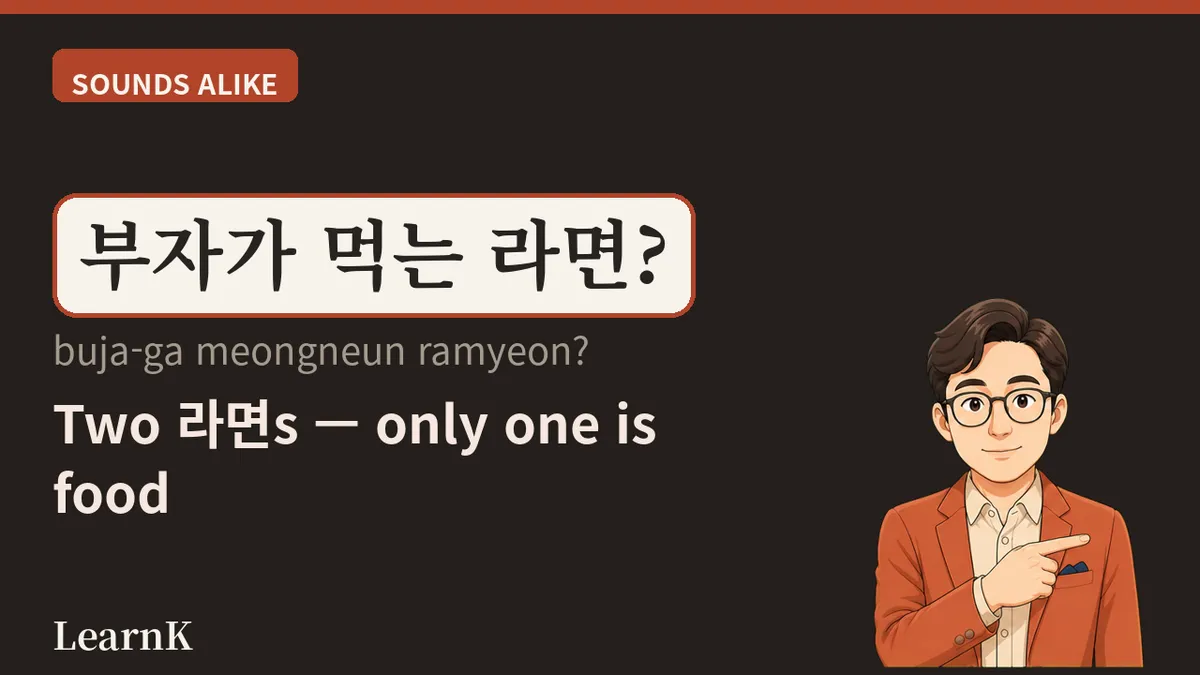
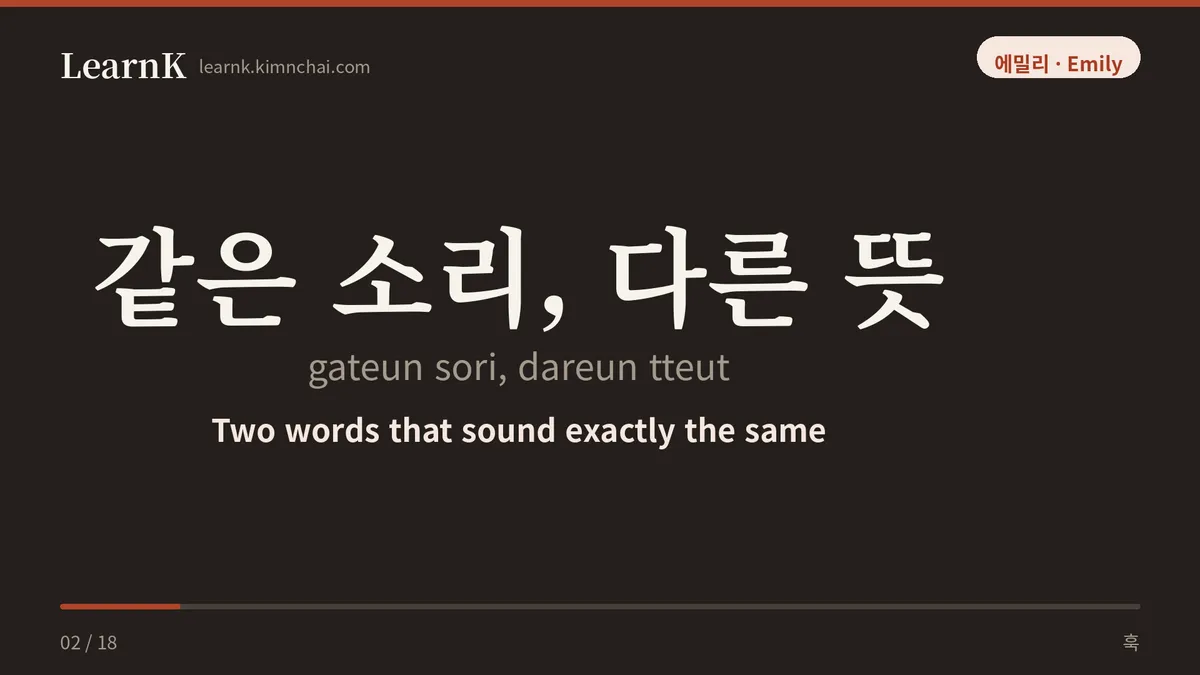
Here’s one interesting point — the actual usage examples the dictionary shows alongside it don’t feature the ‘라면’ that means food, but rather a grammatical expression that’s spelled exactly the same, -(이)라면 (meaning ‘if ~’). The pronunciation and spelling are identical but the meanings are completely different — a case of homonyms, which makes for an excellent point of comparison for learners.
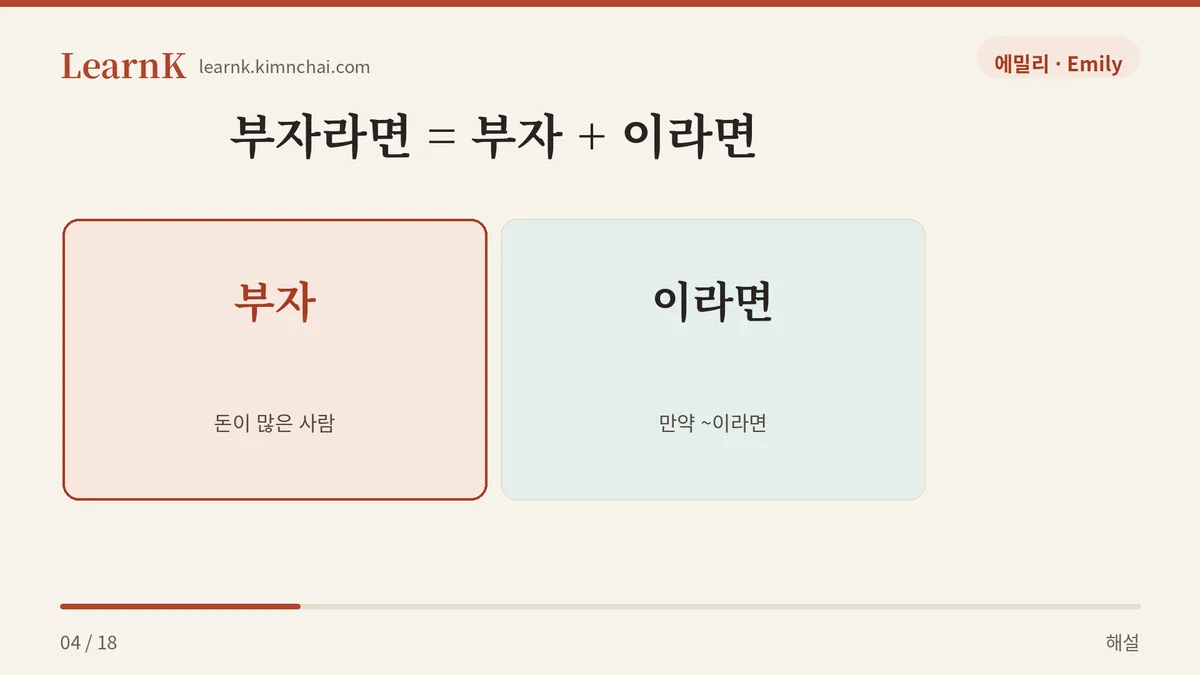
가령 내가 부자라면 힘든 사람들을 위해 많은 돈을 기부할 거야. — National Institute of Korean Language, Basic Korean Dictionary (krdict.korean.go.kr)
This sentence expresses the hypothetical ‘if I were rich,’ and here ‘부자라면 (bujaramyeon)’ is ‘부자 (buja) + 이라면 (iramyeon).’
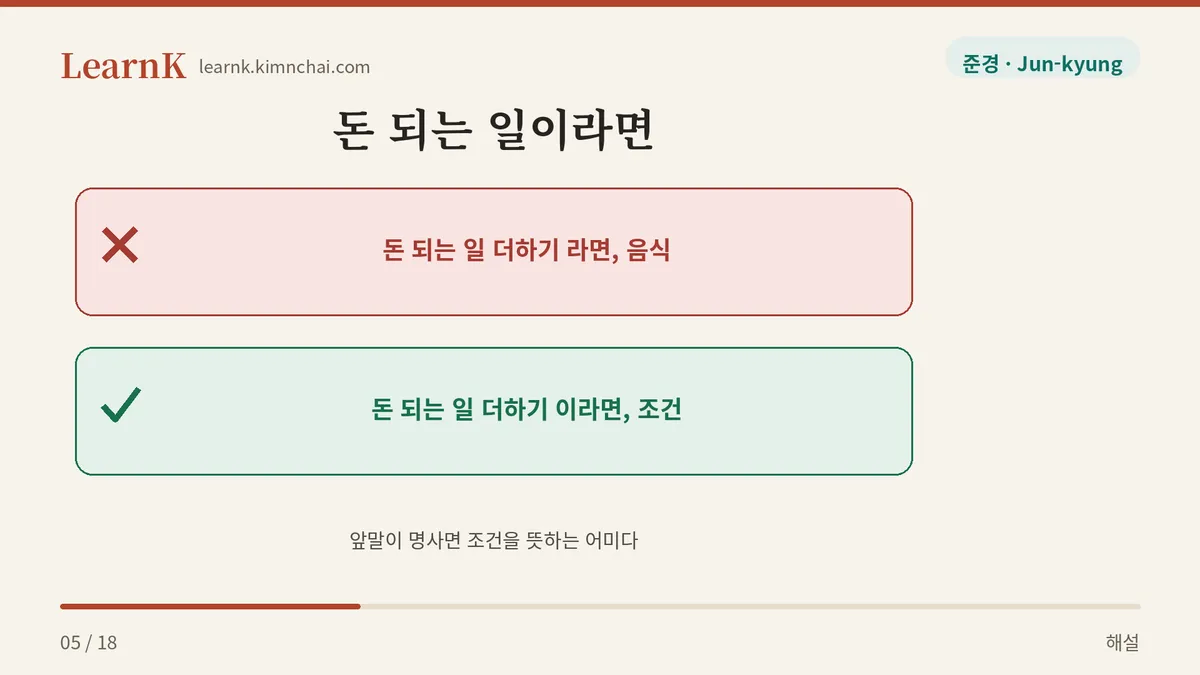
그는 돈 되는 일이라면 좋고 나쁨을 가리지 않고 아무 일이나 다 한다. — National Institute of Korean Language, Basic Korean Dictionary (krdict.korean.go.kr)
This is an expression emphasizing the condition ‘as long as it’s something that makes money.’
자신을 방어하기 위해 어쩔 수 없이 한 일이라면 정당방위로 인정됩니다. — National Institute of Korean Language, Basic Korean Dictionary (krdict.korean.go.kr)
This is a sentence explaining a legal condition, where ‘~한 일이라면 (~han iriramyeon = ~한 것이라면)’ introduces a conditional clause. In other words, even when you search for the food ‘라면,’ a grammatical element spelled the same way gets caught alongside it — so it’s essential to practice distinguishing them by context.
Example Sentences by Situation
- When you’re peckish late at night — “출출한데 라면 하나 끓여 먹을까? (chulchulhande ramyeon hana kkeuryeo meogeulkka?)” : the most common way to suggest 라면 as a late-night snack.
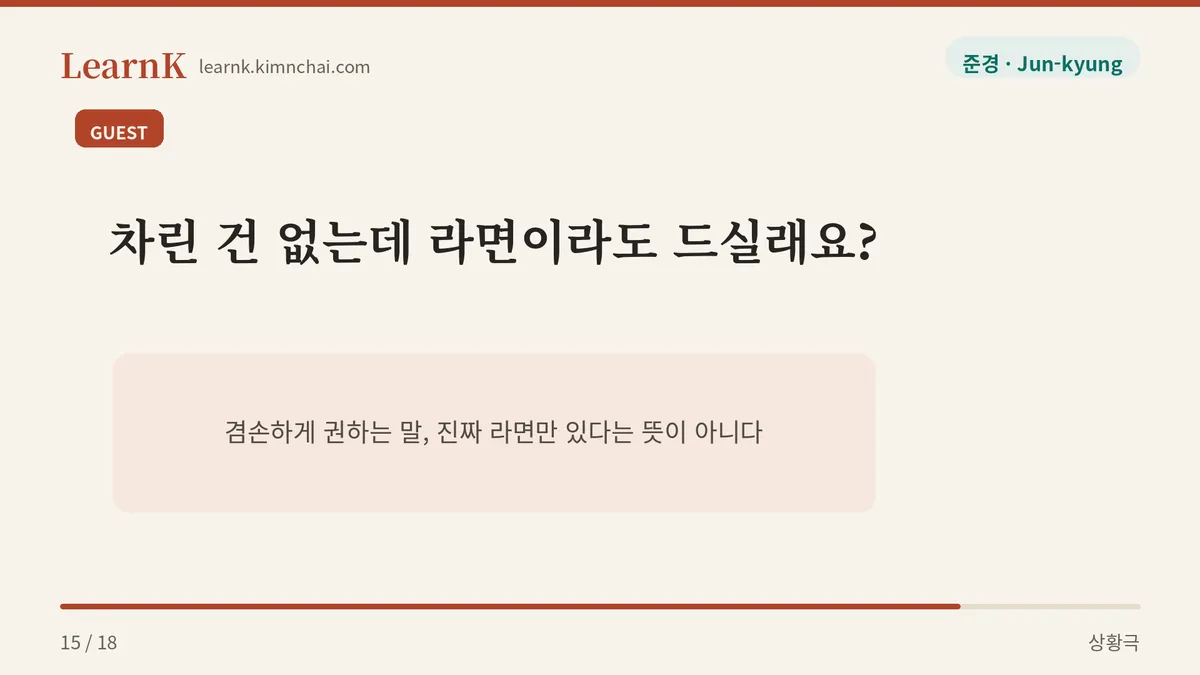
- When offering it to a guest — “차린 건 없는데 라면이라도 드실래요? (ramyeon-irado deusillaeyo?)” : offering 라면 with a touch of apology for not having anything fancier to serve.
- When talking about your preference — “저는 라면을 꼬들꼬들하게 끓이는 걸 좋아해요. (jeoneun ramyeon-eul kkodeul-kkodeulhage kkeurineun geol joahaeyo.)” : expressing a preference for cooking the noodles less so they stay chewy.
Formal & Informal Speech and Similar Expressions
- Informal: “라면 먹을래? (ramyeon meogeullae?)”
- Formal: “라면 드실래요? (ramyeon deusillaeyo?)” — this uses ‘드시다 (deusida),’ the honorific form of ‘먹다 (meokda).’
Related expressions include 컵라면 (keop-ramyeon) — instant 라면 in a cup, 봉지라면 (bongji-ramyeon) — 라면 that comes in a packet, and 라볶이 (rabokki) — a dish combining 라면 and 떡볶이 (tteokbokki).
Cultural Background
In Korea, the phrase “라면 먹고 갈래요? (ramyeon meokgo gallaeyo?)” has come to carry a nuance beyond a simple invitation to eat. This expression became famous thanks to the film One Fine Spring Day (봄날은 간다).
라면 먹고 갈래요? — Film One Fine Spring Day (봄날은 간다) (2001)
This single line went on to be widely used as an ‘indirect expression of romantic interest,’ becoming a meme in its own right. In this way, 라면 is both a food that soothes hunger for Korean people and a medium for opening one’s heart.
Closing Quiz
In the informal sentence “라면 ( )?”, what should go in the blank to suggest to a friend that you eat 라면 together? (Hint: the propositive form of ‘먹다’) Leave your answer in the comments!
Definitions and example sentences are from the National Institute of Korean Language’s Basic Korean Dictionary (krdict.korean.go.kr); that portion of this post, including our translations, is licensed under CC BY-SA 2.0 KR.