라떼는 말이야 (latte-neun mariya) — The Best Slang for Mocking "Back in My Day"
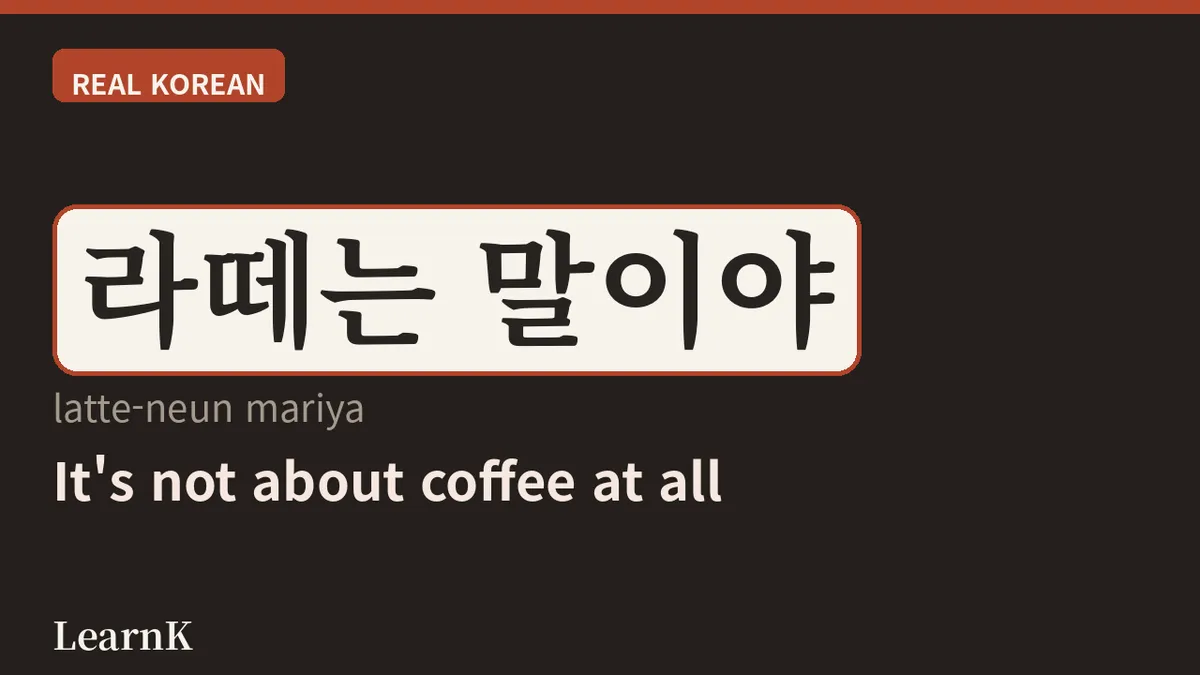
라떼는 말이야 (latte-neun mariya)
Picture a company dinner in Korea. A senior manager, well along in years, lifts his glass of soju and opens with: “Back when I was a new hire…” In that instant, the younger employees’ faces go a little funny. Here come the “war stories from the old days” again. The expression that pinpoints and pokes fun at exactly this moment is 라떼는 말이야 (latte-neun mariya). It has nothing to do with the café drink “latte” — so why latte of all things? Today we dig deep into this witty piece of slang.
Why “latte” of all words — the secret of the pun
The heart of this expression is a similarity in pronunciation. People who reminisce about the old days and launch into a lecture habitually begin with 나 때는 말이야 (na ttae-neun mariya) — meaning “back when I was young…” But if you say that 나 때 (na ttae) quickly, it starts to sound like the coffee drink 라떼 (latte).
On top of that, the 말 (mal) in the following 말이야 (mariya) is written the same as the word for the animal 말 (mal, horse). So online, a joke spread that translating ‘라떼는 말이야’ into English literally gives the ridiculous “Latte is a horse.” It’s a pun stacked on top of a pun — humor that’s very Korean at heart.
To sum it up, here’s what it means:
라떼는 말이야 (latte-neun mariya): A slang phrase that twists ‘나 때는 말이야 (na ttae-neun mariya)’ by how it sounds, lightly mocking the older generation’s habit of lecturing others while putting their own experience front and center.
(Because this is newly coined slang, it isn’t listed as a headword in the Standard Korean Dictionary or the Basic Korean Dictionary, so the definition here is drawn from how the phrase is actually used.)
The word it pairs up with — ‘꼰대 (kkondae)’
This expression travels hand in hand with the word 꼰대 (kkondae). A 꼰대 is an older person — or a boss — who throws their authority around and forces their own opinions on others. ‘라떼는 말이야’ is basically the signature line of that very 꼰대, so the two are used as a set.
Example sentences by situation
① Imitating a boss’s verbal habit
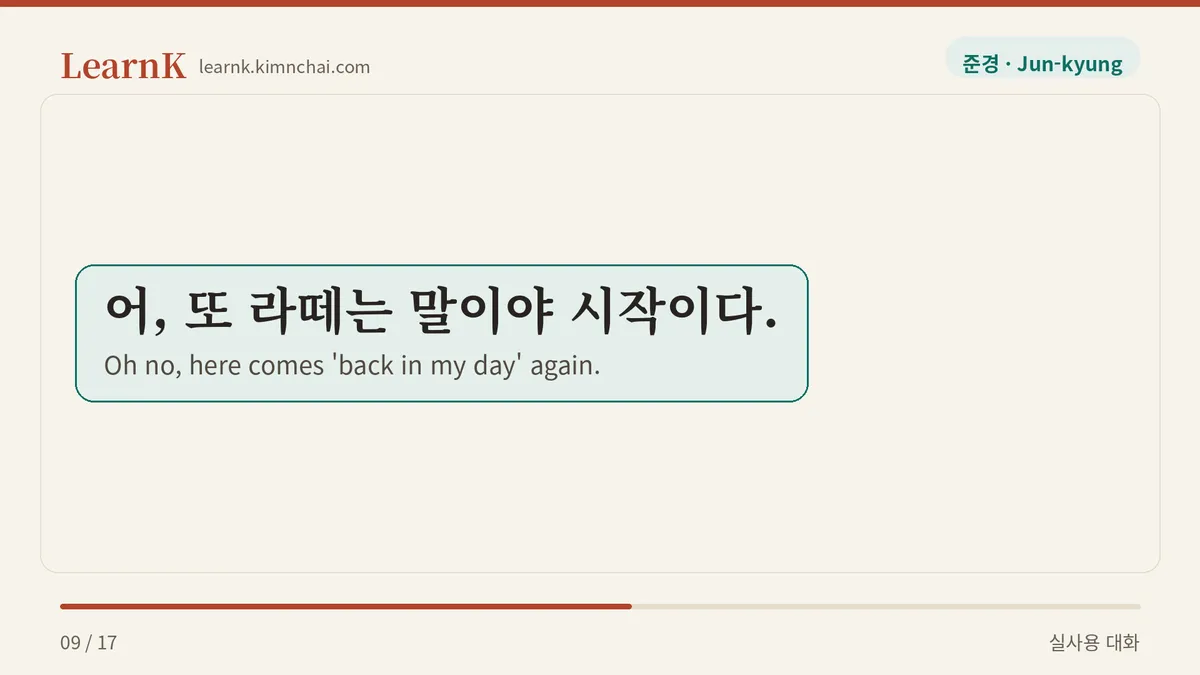
Assistant Manager Kim: “부장님, 또 ‘라떼는 말이야’ 시작하셨어. (latte-neun mariya)” (“The manager’s off on his ‘back in my day’ thing again.”)
The meeting drags on, the boss starts reaching for an old story, and the junior staff trade glances and whisper among themselves. They can’t say it to his face, so they poke a little fun with the slang instead.
② Making a self-deprecating joke
“라떼는 말이야, 하고 싶지만 참을게요. 꼰대 되기 싫거든요. (latte-neun mariya)” (“I’d love to go ‘back in my day,’ but I’ll hold back — I don’t want to be a 꼰대.”)
Here someone a bit older starts to offer advice, then stops themselves — a bit of self-satire. It carries the tactful attitude of “I won’t act like a 꼰대.”
③ Talking about the generation gap
“요즘은 ‘라떼는 말이야’ 하는 순간 대화가 끝나요. (latte-neun mariya)” (“These days, the moment you go ‘back in my day,’ the conversation’s over.”)
This sentence points out that communication which respects each other’s experiences matters more than one-sided lecturing.
Casual vs. polite speech, and similar expressions
Since this is slang, it’s used in relaxed conversation among friends and colleagues rather than in polite, formal settings. If you really wanted to put it politely, it would become something like “제가 예전에 겪어 보니까요 (je-ga yejeon-e gyeokeo bo-nikkayo)” (“From what I experienced in the past…”) — a courteous way of sharing experience — but then the humorous flavor disappears.
As for related expressions, it has a different feel from 어이가 없네 (eoi-ga eomne), which conveys shock or disbelief. It overlaps more in meaning with words like 꼰대력 (kkondae-ryeok, one’s “꼰대 index”) and 틀딱 (teulttak, a derogatory slur for the elderly — very rude, so use with caution). Of these, ‘라떼는 말이야’ is on the gentlest and wittiest end of the scale.
Cultural background — the slang that even conquered advertising
‘라떼는 말이야’ spread explosively online around 2018–2019, and it truly cemented itself in the mainstream when a credit card company’s ad brought in an actual horse (말, mal) and parodied “라떼는 말이야” outright. By wrapping the rather heavy subject of generational conflict in laughter, it’s a piece of slang that nicely shows how Korean society handles humor. When a workplace-boss character in a drama launches into an old story, it’s become such familiar shorthand that viewers recognize it without any subtitles: “Ah, that’s a 라떼 moment.”
Closing quiz
In ‘라떼는 말이야’, what did ‘라떼’ originally twist from?
① Coffee latte ② 나 때 (na ttae) ③ 말 (mal, horse) ④ The manager
(Answer: ② 나 때 (na ttae) — the pun comes from ‘나 때’ (“when I was young”) sounding similar to the coffee drink ‘라떼 (latte)’.)
Next time someone in a Korean drama or variety show goes on and on about the old days, try quietly shouting it in your head: “아, 라떼는 말이야! (Ah, latte-neun mariya!)”