막차 (makcha) — The Ten Minutes Before Midnight, and the Last Chance
막차
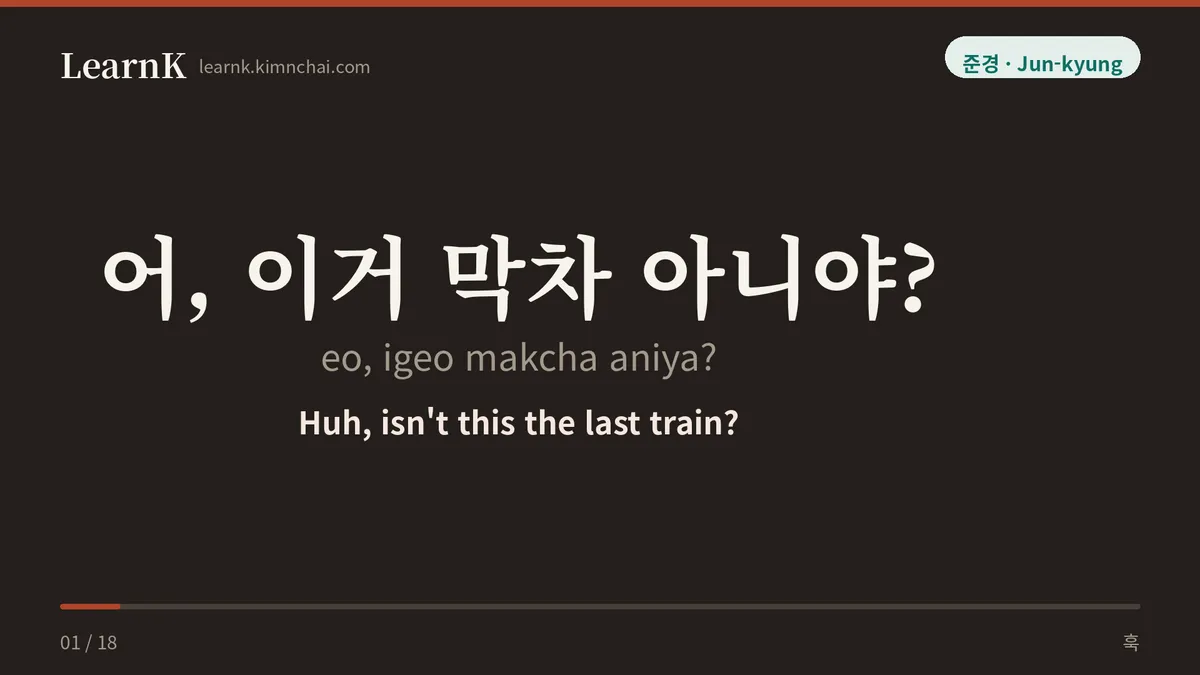
막차 (makcha) means “the last vehicle to run on a given day.” Picture 11:30 at night: at a drinking get-together, someone suddenly pulls out their phone, checks the time, and springs to their feet. What comes out of their mouth is almost always the same — 나 막차 타야 돼 (na makcha taya dwae), “I have to catch the last train.” Watch enough Korean dramas and you’ll notice this word popping up right alongside the shot of the train doors sliding shut on the platform. 막차 (makcha) carries the urgency of that exact moment.
By definition it’s a simple noun: whichever bus, subway, or train runs last that day. But in real conversation it carries more than schedule information. The moment 막차 (makcha) enters the room, the gathering becomes a gathering that’s ending. You may want to keep hanging out, but now you have to get up — and if you don’t, you’d better be ready to pay for a taxi. So in Korea, 막차 (makcha) is a timetable word and a deadline word at the same time. It’s less a fact than a signal: this is where the day actually ends.
The tone is neutral. It works in polite speech and casual speech alike, and even in a formal meeting, 막차 시간이 있어서 먼저 일어나겠습니다 (makcha sigani isseoseo meonjeo ireonagetseumnida) — “I have a last train to catch, so I’ll head out first” — doesn’t sound the least bit awkward. If anything, in Korean workplace culture, 막차 (makcha) is the safest and most legitimate reason there is for leaving. Nobody argues with it.
Checking the National Institute of Korean Language dictionary
막차 (makcha) 「noun」 그날 마지막으로 운행되는 차. The last vehicle to run on a given day. [en] last bus; last train — The last bus or train for the day. [ja] しゅうしゃ【終車】 — その日の最後に運行される車。 [es] último transporte — Último transporte que opera en un día. [zh] 末班车 — 当天的最后一班车。 — National Institute of Korean Language, Basic Korean Dictionary (krdict.korean.go.kr)
A Portuguese gloss isn’t included in this dictionary. What follows is not a dictionary quotation but our own translation — último transporte: o último ônibus ou trem que circula no dia.
Let’s walk through the dictionary’s real usage examples one by one. They’re short, but together they show every sentence frame this word likes to sit in.
막차가 끊어지다. The last train stops running. — National Institute of Korean Language, Basic Korean Dictionary (krdict.korean.go.kr)
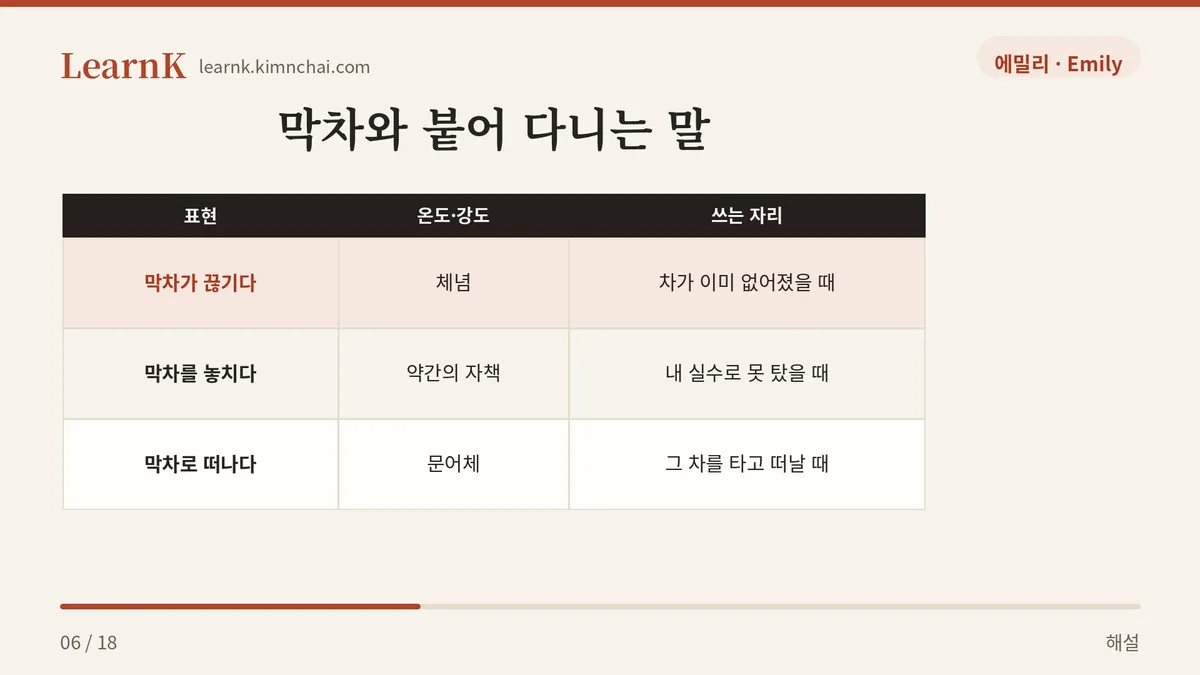
막차가 끊어지다 (makcha-ga kkeuneojida). The verb that keeps 막차 (makcha) company most often is 끊어지다 (kkeuneojida), “to be cut off.” It’s interesting that Korean says the vehicle was cut off rather than that it simply stopped — the image is of a line that connected you to home being snipped clean through. In everyday speech, people more often say the shorter form 끊기다 (kkeungida).
막차 시간이 지났네. 어떻게 하지? 갈 데도 없고. The last train’s already gone. What do I do? I don’t even have anywhere to go. — National Institute of Korean Language, Basic Korean Dictionary (krdict.korean.go.kr)
막차 시간이 지났네 (makcha sigani jinatne). This one sounds almost like talking to yourself. The moment of glancing at a clock and realizing the situation, plus the helplessness that follows immediately after, are fused into a single lump. The phrase 갈 데도 없고 (gal dedo eopgo), “nowhere to go, either,” shows the emotional core of this word exactly — what’s left for someone who missed the last train is the feeling that the options are gone.
막차를 놓치다. To miss the last train. — National Institute of Korean Language, Basic Korean Dictionary (krdict.korean.go.kr)
막차를 놓치다 (makcha-reul nochida). If 끊어지다 (kkeuneojida) is the vehicle’s side of the story, 놓치다 (nochida) is your own mistake. You dawdled, or you caved when someone said “just one more drink.” That’s why this expression comes with a faint dusting of self-blame.
저 버스가 막차인데 놓쳤으니 어떻게 하지? That bus was the last one and I missed it — what am I supposed to do? — National Institute of Korean Language, Basic Korean Dictionary (krdict.korean.go.kr)
저 버스가 막차인데 (jeo beoseu-ga makcha-inde). This is what you say while pointing at the vehicle pulling away in front of your eyes. It shows that naming a specific vehicle — “A is the 막차” — is a perfectly natural construction too.
막차로 떠나다. To leave on the last train. — National Institute of Korean Language, Basic Korean Dictionary (krdict.korean.go.kr)
막차로 떠나다 (makcha-ro tteonada). Here 막차 (makcha) is the means of travel. Attaching the particle -로 (-ro) gives you “riding that vehicle.” It’s a literary phrasing that suits novels and drama voice-overs — the scene where someone leaves the city on a night train.
Seeing it in real conversation
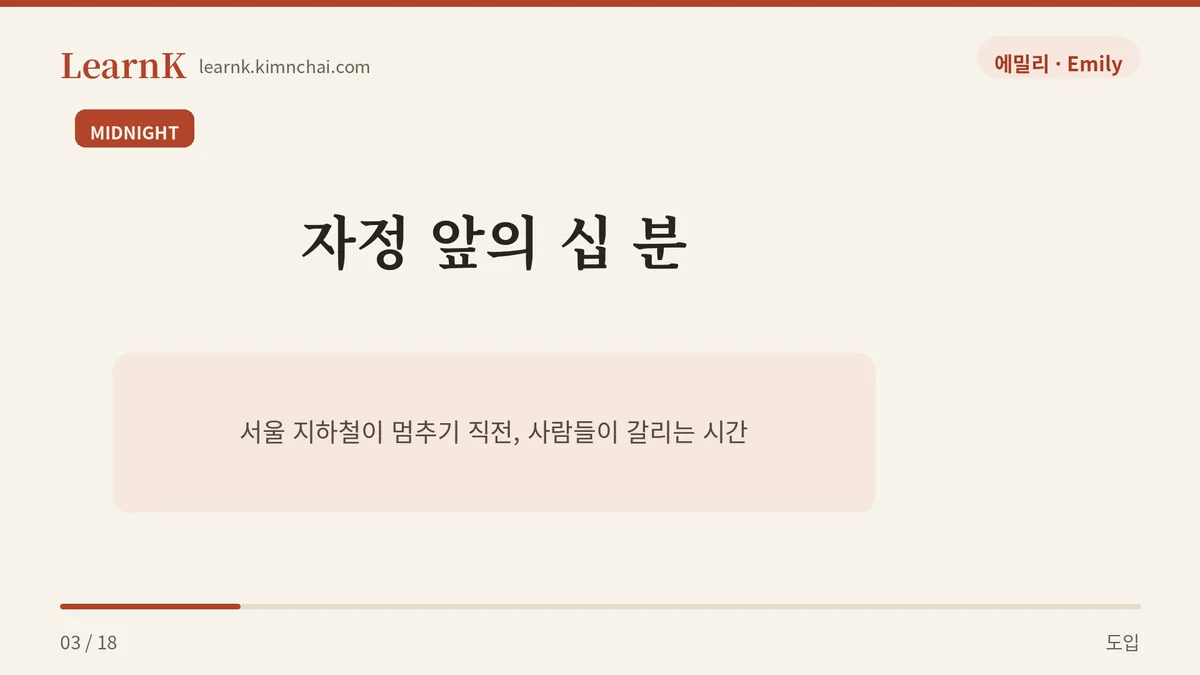
Setting: 11:50 p.m. on a Friday. The company dinner has wrapped up and everyone’s on the subway platform. The arrival board is blinking.
Jun-kyung: 어, 이거 막차 아니야? 전광판에 그렇게 떴는데. Huh, isn’t this the last train? That’s what the board says.
Emily: 맞네. 나 저번 주에도 막차 놓쳐서 택시비 삼만 원 나갔잖아. Yeah. I missed the last train last week too and blew 30,000 won on a taxi.
Jun-kyung: 삼만 원? 야, 그냥 심야버스 타지 그랬어. 30,000 won? Come on, you should’ve just taken the night bus.
Emily: 정류장 찾다가 그것도 놓쳤어. 그날 진짜 별 보면서 걸었다. I was looking for the stop and missed that too. I literally walked home under the stars.
Jun-kyung: 아이고… 오늘은 무조건 타자. 부장님한테 인사는 했지? Oh man… we’re definitely getting on today. You said goodbye to the manager, right?
Emily: 했어, 했어. 근데 우리 막차에서까지 회사 얘기 하는 거 아니다? I did, I did. But no work talk on the last train, deal?
This is where it sounds off
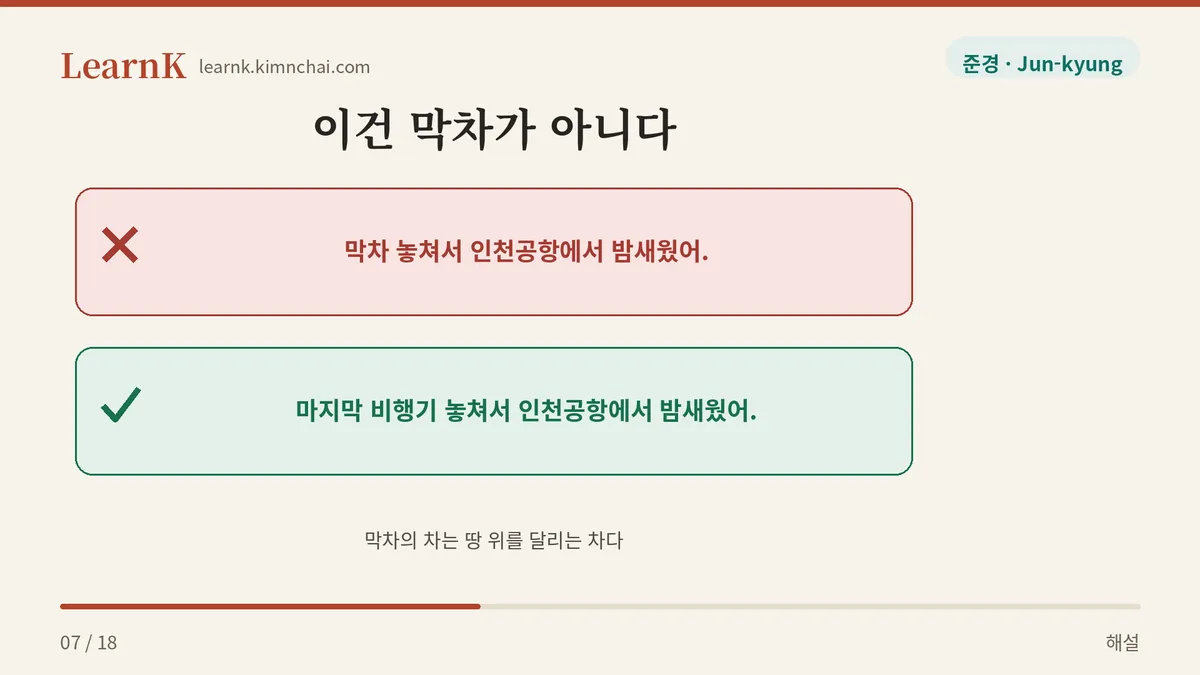
✗ 오늘 막차 놓쳐서 인천공항에서 밤새웠어. ✓ 오늘 마지막 비행기 놓쳐서 인천공항에서 밤새웠어. → (I missed the last flight today, so I stayed up all night at Incheon Airport.) The 차 (cha) in 막차 (makcha) means a vehicle that rolls along the ground. Buses, subways, trains, and even taxis qualify — planes don’t. Boats do get called 막배 (makbae), but for planes you spell it out as 마지막 비행기 (majimak bihaenggi), “the last flight.”
✗ (to a manager who just got promoted) 부장님, 이번에 막차 타셨네요. ✓ (to a peer) 야, 너 이번에 막차 탔다. 운 좋았네. → (Hey, you caught the last train on that one. Lucky you.) Used figuratively, 막차를 타다 (makcha-reul tada) means “you barely squeaked through and grabbed the very last chance.” It implies you got there on luck rather than merit, so aimed at someone senior it lands as a scratch instead of congratulations. With a superior, a simple 축하드립니다 (chukhadeurimnida) is the safe move.
Example sentences by situation
1) Slipping out of a drinking gathering
The mood is great, but the clock says 11:30. This is the most inoffensive exit line Koreans reach for.
나 막차 시간 다 됐어. 먼저 일어날게. (na makcha sigan da dwaesseo. meonjeo ireonalge.) My last train’s about to go. I’ll head out first.
2) Sending an SOS to a friend once it’s already too late
This is the after-the-fact sentence. If you want to save on the taxi fare, say it fast.
막차 끊겼어. 너희 집에서 하루만 자도 돼? (makcha kkeunkyeosseo. neohui jibeseo haruman jado dwae?) The last train’s gone. Can I crash at your place for one night?
3) Saying it politely at a company dinner
Same reason, formal register. This sentence works as-is in front of your boss.
죄송한데 막차 시간이 있어서 먼저 가 보겠습니다. (joesonghande makcha sigani isseoseo meonjeo ga bogetseumnida.) Sorry, I have a last train to catch, so I’ll be heading off first.
Politeness levels and similar expressions
막차 (makcha) is a noun, so it has no separate honorific form. Polite and casual speech are decided purely by the ending that follows — 막차 끊겼어 (makcha kkeunkyeosseo) (casual) versus 막차가 끊겼습니다 (makcha-ga kkeunkyeotseumnida) (polite). Here’s how it compares to the neighboring words that are easy to mix up.
| Expression | Tone & intensity | Where it’s used |
|---|---|---|
| 막차 (makcha) | Neutral, with a touch of urgency | Everyday conversation across the board; polite and casual alike |
| 첫차 (cheotcha) | Neutral. The opposite of 막차 | The first vehicle of the early morning. “첫차 타고 갈게” |
| 마지막 차 (majimak cha) | Explanatory, spelled-out feel | Official announcements, or explaining the meaning to a foreigner |
| 막판 (makpan) | Strong sense of tension | The final phase of a game or a task. Nothing to do with vehicles |
| 심야버스 (simya beoseu) | Purely informational, no emotion | Talking about your options after the last train is gone |
The difference between 마지막 차 (majimak cha) and 막차 (makcha) is especially worth remembering. The meaning is identical, but 마지막 차 (majimak cha) is a description while 막차 (makcha) is a living, everyday word. Tell a friend “마지막 차 타야 돼” and they’ll understand you, but it lands with a faintly translated ring to it.
Cultural background — the ten minutes before midnight
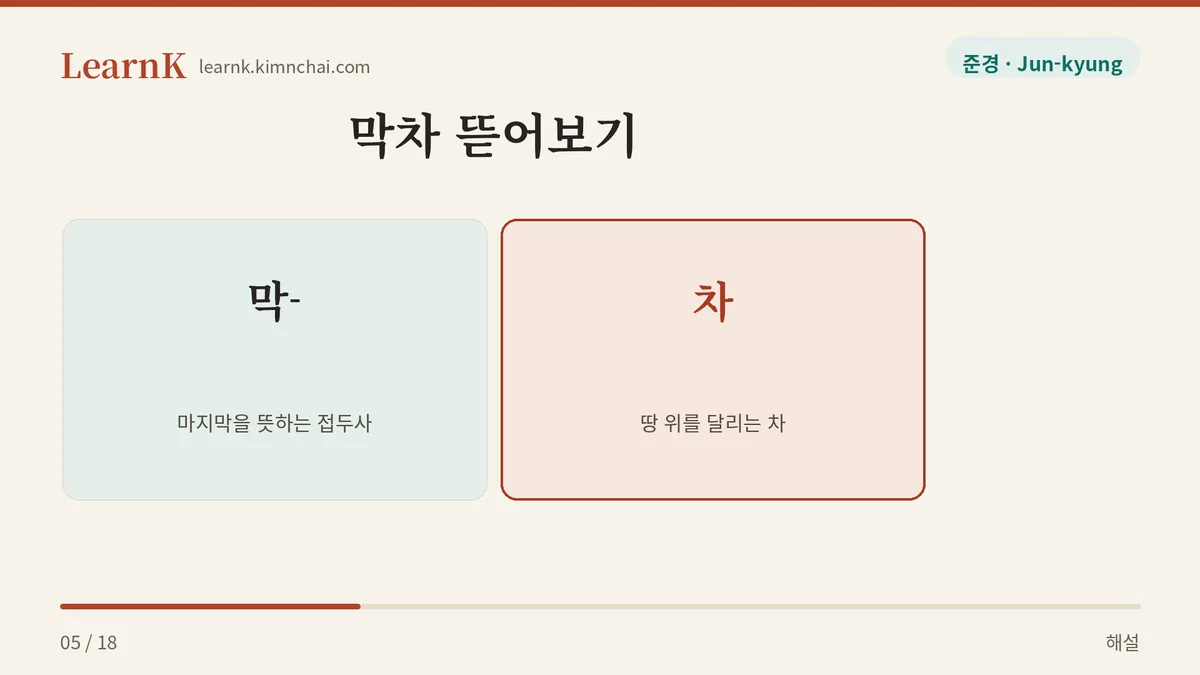
The 막- (mak-) in 막차 (makcha) is a prefix meaning “last.” 막내 (maknae) (the last-born child), 막판 (makpan) (the last round), and 막바지 (makbaji) (the final stretch) are all part of the same family. Learn this one syllable and a single word buys you several.
Seoul’s subway generally shuts down around midnight. It varies by line and direction, but once it’s past eleven, people start checking arrival times on their phones one by one. That ten- to twenty-minute window is a strangely dramatic stretch of Korean nightlife. It’s where people split into two groups: those who stand up, and those who say “오늘은 그냥 새벽까지 가자 (oneureun geunyang saebyeokkkaji gaja)” — “let’s just go till dawn today.” For the second group, Seoul has night buses that run after midnight (routes beginning with N), plus 24-hour cafés and jjimjilbang saunas. The very fact that someone who missed the last train still has somewhere to go is one of the scenes of Korean city life.
That’s also why Korean dramas and films love this word. The doors close on the platform, and one person is left behind on the other side of the glass. Without a single line of dialogue, the shot can show you that a relationship has just ended — or just begun. In romance, deliberately letting the last train go is a stronger line than any confession: someone who has removed their own way home has already given their answer.
And there’s that one more figurative use we saw earlier. Someone who barely managed to buy a home right before prices shot up, or who submitted an application just before the deadline, gets told 막차 탔다 (makcha tatda) — “you caught the last train.” It carries relief, admiration, and a little envy all at once, so before using it on someone else it’s worth reading the person and the room first.
Today’s quiz
It’s 11:50 p.m. and you’re out drinking with a friend. You check your phone: the subway home is about to stop running. What’s the most natural thing to say as you get up?
- 나 첫차 타야 돼. 먼저 갈게.
- 나 막차 시간 다 됐어. 먼저 갈게.
- 나 막판 놓치겠다. 먼저 갈게.
- 나 마지막 비행기 끊기겠다. 먼저 갈게.
Show the answer
Answer: 2. 막차 시간 다 됐어 (makcha sigan da dwaesseo) is the right call for this situation. In option 1, 첫차 (cheotcha) is the first vehicle of the early morning — the exact opposite. In option 3, 막판 (makpan) means the final phase of a game or a task and isn’t used for transportation. Option 4 swaps the subway out for an airplane.
Tonight, if you’re watching a Korean drama and someone glances at the clock and rises from their seat, listen closely to what they say. It’s probably 막차 (makcha).
Definitions and example sentences are from the National Institute of Korean Language’s Basic Korean Dictionary (krdict.korean.go.kr); that portion of this post, including our translations, is licensed under CC BY-SA 2.0 KR.