막국수 (makguksu) — buckwheat noodles in cold broth, summer in a single bowl
막국수
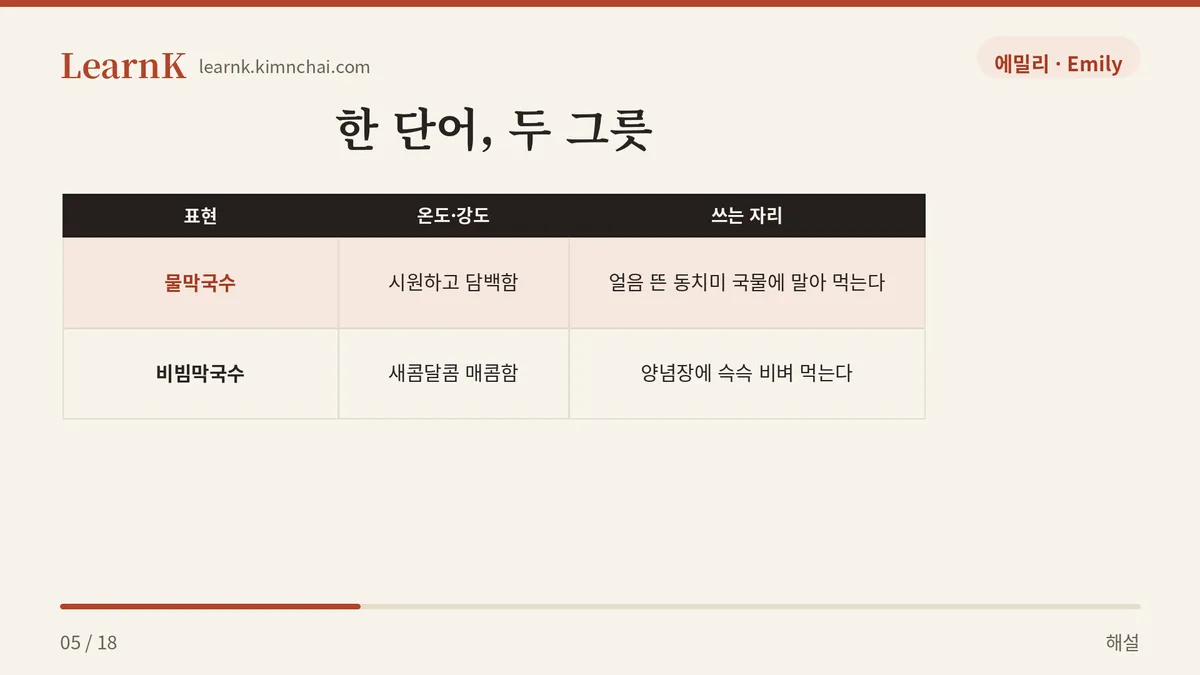
막국수 (makguksu) means noodles made from buckwheat flour, served in kimchi broth or meat stock. On a midsummer afternoon, when even the air conditioner just isn’t cutting it, this is the bowl Koreans think of. Sometimes the noodles arrive swimming in an icy broth (물막국수 (mul-makguksu)), sometimes they’re tossed with a sweet-and-tangy sauce (비빔막국수 (bibim-makguksu)). Go to Gangwon Province — Chuncheon above all — and makguksu signs line every main road. Plenty of people ride the train an hour or so from Seoul just to eat one bowl and turn right back around.
Korean food names usually take their ingredients or their cooking method straight into the name. 김치찌개 (kimchi-jjigae) is a stew simmered with kimchi; 비빔밥 (bibimbap) is rice you mix. But with 막국수 (makguksu), the name shows you neither the ingredient nor the method. That’s why learners tend to shrug and file it under “some kind of noodle” — but the heart of this word is exactly one thing: 메밀 (memil), buckwheat. Instead of the springy chew of wheat noodles, you get a texture that snaps off cleanly, and a toasty, nutty aroma that grows the more you chew. In temperature alone it sits on the opposite side of the world from 잔치국수 (janchi-guksu) or 라면 (ramyeon), which you blow on to cool. So this isn’t a word that shows up evenly across the four seasons — it tends to arrive together with three companions: heat, travel, and region.
Checking the National Institute of Korean Language dictionary
First, here is how the national institute’s dictionary lays the word out, word for word.
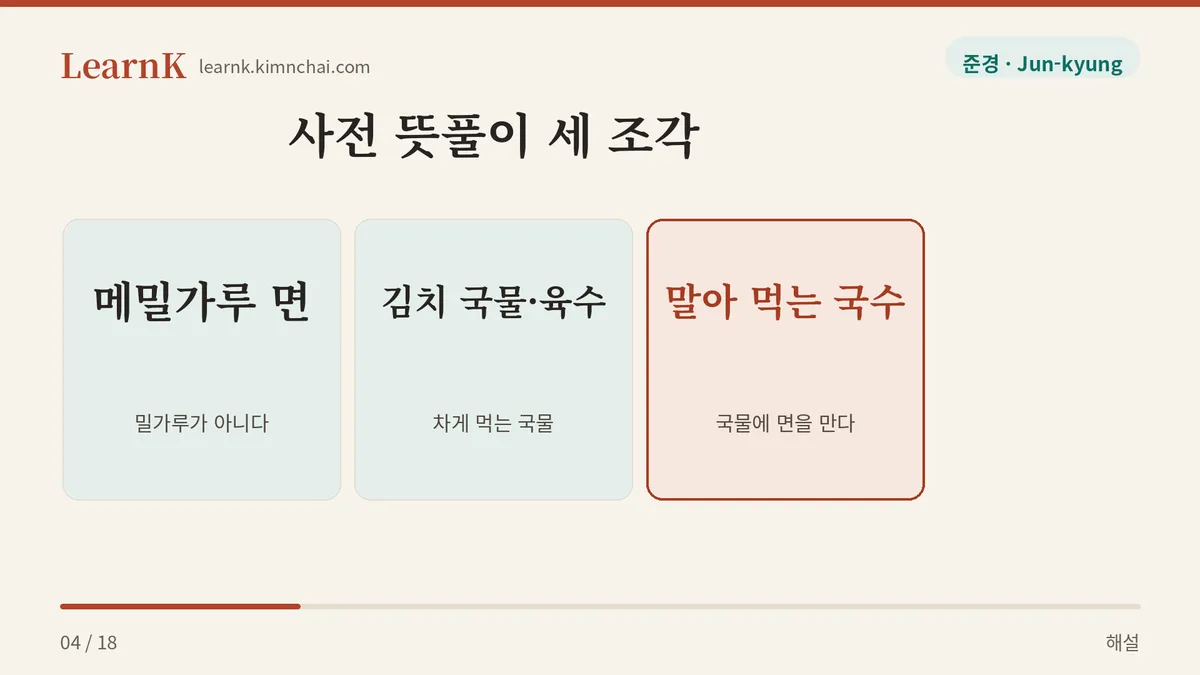
막국수 「noun」 메밀가루로 만든 면을 김치 국물이나 육수 등에 말아 먹는 국수. (memilgaruro mandeun myeoneul kimchi gungmurina yuksu deunge mara meokneun guksu.) Noodles made from buckwheat flour, served in kimchi broth, meat stock, or the like. — National Institute of Korean Language, Basic Korean Dictionary (krdict.korean.go.kr)
The whole identity of the dish is inside that definition. ① The noodles are made from buckwheat flour. ② The liquid is kimchi broth or meat stock. ③ It’s a noodle dish you serve in that liquid. Remember those three and you’ll never be lost in front of a menu.
The dictionary carries definitions in other languages too.
[en] makguksu — Buckwheat noodles, made of buckwheat and eaten in kimchi liquid or broth. [ja] マッククス。まぜそば【混ぜそば】 — 蕎麦粉で作った麺をトンチミ(キムチの汁)、または肉をゆでた汁などに入れて食べる麺料理。 [es] makguksu — Platillo de fideos de alforfón que se sirve en caldo de kimchi o de carne. [zh] 荞麦凉面 — 荞面焯水之后,拌入辛奇汤汁或肉汤食用的面条。 — National Institute of Korean Language, Basic Korean Dictionary (krdict.korean.go.kr)
There is no Portuguese definition in the dictionary. For reference, here is our own rendering — makguksu: macarrão de trigo-sarraceno servido em caldo de kimchi ou de carne. (Noting clearly that this is our own translation, not part of the dictionary entry.)
Now let’s go through the real usage examples the dictionary gives, one by one.
춘천은 막국수가 맛있기로 유명하다. (Chuncheoneun makguksuga masitgiro yumyeonghada.) (Chuncheon is famous for its delicious makguksu.) — National Institute of Korean Language, Basic Korean Dictionary (krdict.korean.go.kr)
Learn this word and one place name follows almost inevitably: Chuncheon. The dictionary example pins down the city by name — that’s how tightly makguksu is tied to a particular region. The pattern “~는 ~이/가 맛있기로 유명하다” (~neun ~i/ga masitgiro yumyeonghada) can be lifted straight into any introduction of a regional food, so it’s worth memorizing whole.
날도 더운데 우리 시원한 막국수 한 그릇 먹으러 갈까? (naldo deounde uri siwonhan makguksu han geureut meogeureo galkka?) (It’s hot out — should we go get a cool bowl of makguksu?) — National Institute of Korean Language, Basic Korean Dictionary (krdict.korean.go.kr)
This is someone suggesting lunch to a friend or coworker in casual speech. The reason (날도 더운데, “since it’s hot out”), the modifier (시원한, “cool”), and the counter (한 그릇, “one bowl”) are all packed into a single sentence. It’s the most typical example there is of what kind of weather summons this word.
그 막국수 전문점은 주인이 메밀가루를 이용해 직접 손으로 면을 만든다고 한다. (geu makguksu jeonmunjeomeun juini memilgarureul iyonghae jikjeop soneuro myeoneul mandeundago handa.) (They say the owner of that makguksu specialty restaurant makes the noodles by hand from buckwheat flour.) — National Institute of Korean Language, Basic Korean Dictionary (krdict.korean.go.kr)
This is how you’d talk when introducing or recommending a restaurant. Notice that 메밀가루 (memilgaru), buckwheat flour, turns up again. This one sentence tells you that the standard by which a makguksu place is judged comes down, in the end, to the noodles.
막국수를 팔다. (makguksureul palda.) (to sell makguksu) — National Institute of Korean Language, Basic Korean Dictionary (krdict.korean.go.kr)
This is the basic collocation the dictionary shows. Put the noun in the object slot and attach 팔다 (palda, sell), 먹다 (meokda, eat), 만들다 (mandeulda, make), 시키다 (sikida, order). Short as it is, it’s the skeleton that shows you how this noun moves inside a sentence.
Seeing it in a real conversation

Scene: a Saturday afternoon in August, outside an old makguksu place in Chuncheon. They’ve written their names on the waiting list and are standing in the shade.
Jun-kyung: 야, 이십 분은 기다려야 된대. 그냥 딴 데 갈까? Hey, they say it’s a twenty-minute wait. Should we just go somewhere else?
Emily: 무슨 소리야, 여기 오려고 기차까지 탔는데. 막국수는 줄 서서 먹어야 제맛이지. What are you talking about? We took the train all the way here. Makguksu tastes best after you’ve stood in line for it.
Jun-kyung: 너 진짜 한국 사람 다 됐다. 근데 비빔으로 시킬 거야, 물로 시킬 거야? You’ve really become Korean. Anyway, are you getting the mixed one or the broth one?
Emily: 난 물. 이 더위에 동치미 국물 안 마시면 좀 억울하잖아. Broth for me. It’d be a shame not to drink that cold kimchi broth in this heat.
Jun-kyung: 그럼 난 비빔. 반씩 나눠 먹자. Then I’ll get the mixed one. Let’s split them.
Emily: 콜. 아 참, 여기 막국수 시키면 수육도 같이 시켜야 된대. 아까 옆 테이블 보니까 다 그러던데. Deal. Oh, and they say if you order makguksu here you have to get the boiled pork too. Everyone at the next table had it.
These uses sound off
Makguksu is the name of a thing, so it isn’t a word you adjust depending on who you’re talking to. Instead, here are two misunderstandings learners often have.
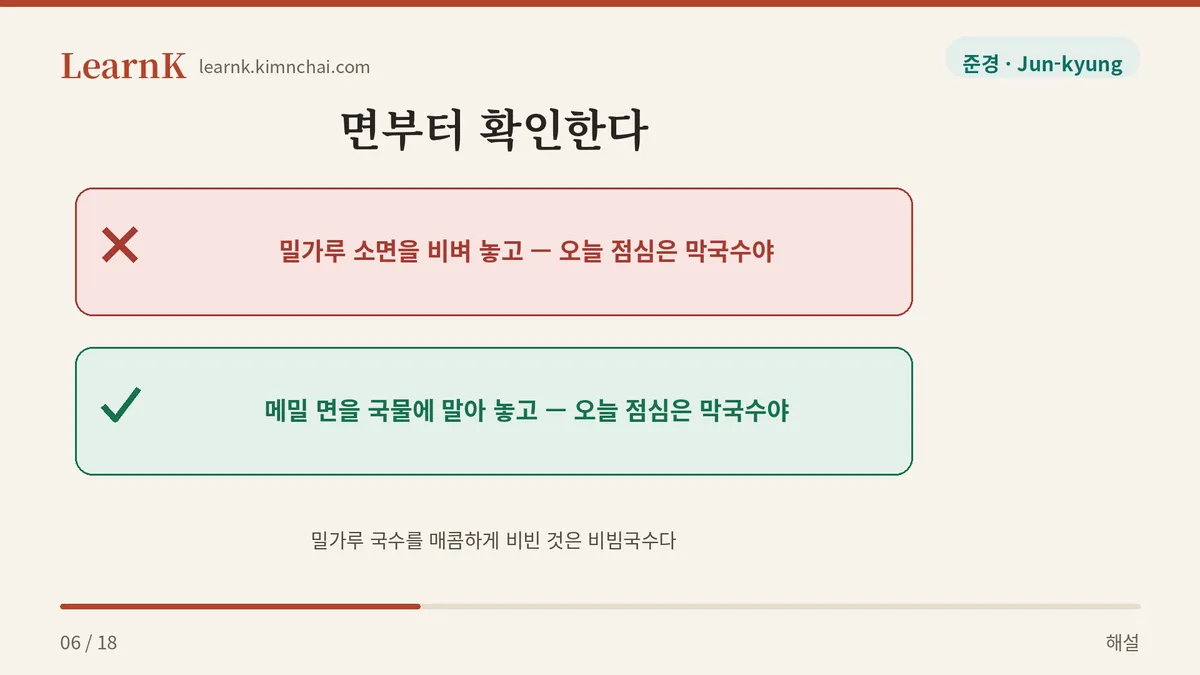
✗ (over a bowl of thin wheat noodles tossed with gochujang) 오늘 점심은 막국수야. (oneul jeomsimeun makguksuya.) — “Lunch today is makguksu.” ✓ (over buckwheat noodles in broth, or tossed with sauce) 오늘 점심은 막국수야. (oneul jeomsimeun makguksuya.) — “Lunch today is makguksu.” → If the noodles aren’t buckwheat, you don’t call it makguksu. Wheat noodles tossed with something spicy are 비빔국수 (bibimguksu). Even the dictionary definition opens with the words “buckwheat flour.”
✗ (to the owner of a makguksu restaurant) 사장님, 이거 막국수니까 대충 말아 주세요. (sajangnim, igeo makguksunikka daechung mara juseyo.) — “Since it’s just makguksu, sir, throw it together however.” ✓ (to the owner of a makguksu restaurant) 사장님, 막국수 하나 주세요. 면은 좀 넉넉히 부탁드려요. (sajangnim, makguksu hana juseyo. myeoneun jom neokneokhi butakdeuryeoyo.) — “One makguksu, please. And a generous portion of noodles, if you don’t mind.” → Because of the 막- (mak-) at the front of the name, some learners assume it means “noodles thrown together any old way” and toss it out as a joke. But buckwheat dough doesn’t hold together easily, and pulling those noodles takes real work. It’s not the thing to say in front of an owner who has been making them their whole life.
Example sentences by situation
1. Suggesting lunch to a coworker on a hot day
오늘 너무 더운데 막국수 어때요? 뜨거운 건 도저히 못 먹겠어요. oneul neomu deounde makguksu eottaeyo? tteugeoun geon dojeohi mot meokgesseoyo. (It’s so hot today — how about makguksu? I really can’t handle anything hot.)
This is polite speech, but not stiff — a lunch suggestion between coworkers. ”~ 어때요?” (~ eottaeyo?) is the safest, most neutral pattern there is for proposing a menu.
2. Ordering at a restaurant
여기 물막국수 둘이랑 수육 소자 하나 주세요. yeogi mul-makguksu dulirang suyuk soja hana juseyo. (Two makguksu in broth and a small plate of boiled pork, please.)
At a makguksu place it’s normal to state up front whether you want 물 (mul, in broth**)** or 비빔 (bibim, tossed in sauce**). Ordering 수육 (suyuk, boiled pork)** alongside is a common pairing too, so this one sentence gets your whole order in.
3. Asking a Korean friend for a good restaurant
이번 주말에 춘천 가는데, 막국수 잘하는 집 좀 추천해 줘. ibeon jumare Chuncheon ganeunde, makguksu jalhaneun jip jom chucheonhae jwo. (I’m going to Chuncheon this weekend — recommend me a good makguksu place.)
”~ 잘하는 집” (~ jalhaneun jip) means “a restaurant that makes that dish especially well,” and it’s the expression Koreans reach for most often when asking after a good spot.
Polite vs. casual speech, and similar expressions
The noun itself has nothing to do with honorifics; the register comes from the verb you pair it with. To a friend it’s 막국수 먹으러 가자 (makguksu meogeureo gaja); to someone older it becomes 막국수 드시러 가실래요? (makguksu deusireo gasillaeyo?). When you’re ordering at a restaurant, the default is 막국수 하나 주세요 (makguksu hana juseyo), no matter who you’re speaking to.
Set it beside the noodle dishes it resembles and its place comes into focus.
| Expression | Feel & register | Where it belongs |
|---|---|---|
| 막국수 (makguksu) | Plain, strongly regional | Trips to Gangwon Province and Chuncheon, summer lunches. Buckwheat noodles are a given |
| 냉면 (naengmyeon) | Fits formal occasions too | Dessert course at a barbecue place, Pyongyang-style specialty shops. Noodles blend buckwheat and starch |
| 비빔국수 (bibimguksu) | Light, everyday | Home cooking, snack shops. Usually thin wheat noodles |
| 메밀국수 (memilguksu) | Clean-tasting, quiet | Also used for Japanese soba. The dipping-sauce side of the family |
Makguksu and naengmyeon are both cold buckwheat-family noodles, but where naengmyeon calls up formality and cities (Pyongyang, Hamhung), makguksu sits closer to country markets and the foot of the mountains. Makguksu is generally the cheaper of the two, as well.
Cultural background — Chuncheon and buckwheat fields
Buckwheat grows even in poor, cool soil. That’s why it has long been cultivated in the mountainous parts of Gangwon Province, where rice paddies are difficult — and why the region’s noodles are buckwheat noodles. So makguksu carries the label “Gangwon Province food” wherever it goes, and even the dictionary example summons Chuncheon.
As for the 막- (mak-) at the front of the name, plenty of explanations circulate, but none has been settled as the accepted account. Rather than pass along a plausible-sounding story, it’s better to state only what’s certain — what the dictionary vouches for is buckwheat noodles, kimchi broth or meat stock, and the fact that you serve the noodles in that liquid.
The scene at a makguksu restaurant has a grammar of its own. You sit down and hot buckwheat tea or noodle water comes out first; on the table sit pots of mustard and vinegar. Taking a sip of the broth and adding a few drops to taste is the customer’s part of the job. 수육 (suyuk, boiled pork**)** and 감자전 (gamja-jeon, potato pancake**)** are common on the side, and in Chuncheon the sequence of ordering makguksu as a palate-cleanser after 닭갈비 (dakgalbi) has hardened into something like official procedure.
In Korean dramas and travel variety shows, when a line like “주말에 춘천이나 다녀올까” (jumare Chuncheonina danye200lkka) — “Should we take a trip out to Chuncheon this weekend?” — comes up, the next shot is, with high probability, a plate of dakgalbi or a bowl of makguksu. An hour by train from Seoul, no great resolve required: it’s practically the emblem of the Korean day trip. That’s also why this word is such a welcome one for Korean learners. You don’t have to stop at knowing the meaning — actually get on the train, empty a bowl, and come home, and the word is written into your body that same day.
Today’s quiz
A Korean friend asks:
“이번 주 토요일에 춘천 가려는데, 뭐 먹지?” (ibeon ju toyoire Chuncheon garyeoneunde, mwo meokji?) — “I’m heading to Chuncheon this Saturday. What should I eat?”
Which of the following is the most natural reply here?
- 춘천 가면 막국수지. 메밀 면에 동치미 국물 말아 주는 집으로 가자. (Chuncheon gamyeon makguksuji. memil myeone dongchimi gungmul mara juneun jibeuro gaja.) — “Chuncheon means makguksu. Let’s go to a place that serves buckwheat noodles in cold kimchi broth.”
- 춘천은 겨울에만 막국수를 파니까 다음에 가자. (Chuncheoneun gyeoureman makguksureul panikka daeume gaja.) — “Chuncheon only sells makguksu in winter, so let’s go another time.”
- 막국수는 밀가루 국수라서 소화가 잘될 거야. (makguksuneun milgaru guksuraseo sohwaga jaldoel geoya.) — “Makguksu is wheat noodles, so it’ll be easy to digest.”
The answer is number 1. Number 2 is a seasonal misconception that comes from the dish’s summer-treat image (nothing in the dictionary definition limits it to a season), and number 3 gets the ingredient wrong. Makguksu noodles are made from buckwheat — the very first words of the definition are “buckwheat flour.”
Definitions and example sentences are from the National Institute of Korean Language’s Basic Korean Dictionary (krdict.korean.go.kr); that portion of this post, including our translations, is licensed under CC BY-SA 2.0 KR.