마성의 매력 (maseong-ui maeryeok) — The Phrase for When Even You Can't Explain the Attraction
마성의 매력
마성의 매력 (maseong-ui maeryeok) describes a bewitching, spellbound kind of appeal — the pull you feel toward someone even though, when you check off the reasons one by one, nothing really explains it. Compliments like 잘생겼다 (jalsaenggyeotda, “he’s handsome”), 예쁘다 (yeppeuda, “she’s pretty”), or 목소리가 좋다 (moksoriga jota, “he has a great voice”) all come with a reason attached: big eyes, tall, a lovely smile. 마성의 매력 (maseong-ui maeryeok) sits at the exact opposite end. It’s the name Koreans have given to the state of “I don’t even know why I like them, but they keep coming to mind.”
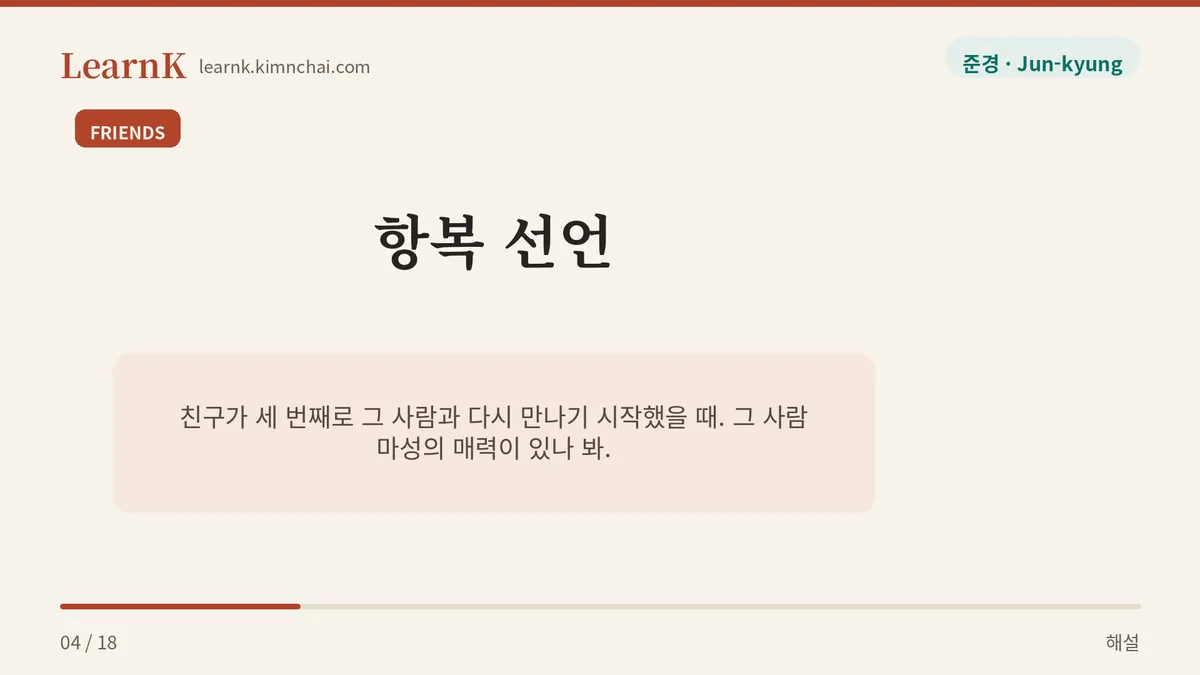
The moments that call for this phrase tend to look alike. A friend shows you a photo of the person they’ve been seeing, and honestly, they’re not your type at all. And yet your friend is now on round three of breaking up and getting back together. That’s when you say “그 사람 마성의 매력이 있나 봐 (geu saram maseong-ui maeryeok-i inna bwa)” — “I guess that person has some bewitching charm.” It comes out when a drama villain does nothing but terrible things and the viewer message board still fills up with posts about that actor, or when the member of an idol group who is best at neither singing nor dancing somehow collects the most fans.
What matters is that this expression carries a touch of grievance. It isn’t pure praise — it’s closer to a declaration of surrender: “I held out, I tried not to fall for it, and I fell for it anyway.” That’s why the face of the person saying it is usually half laugh, half sigh. The intensity is high but the temperature is light. This is not a phrase for a serious confession of love; it’s the exaggeration friends use while cackling and admitting defeat.
And it doesn’t attach only to people. You’ll often hear it applied to food, as in 마성의 떡볶이 (maseong-ui tteokbokki) or 마성의 곱창 (maseong-ui gopchang) — the things you know can’t possibly be good for you, that you already ate yesterday, and that you order again today anyway. People or food, the common thread is the same: you know better, and you lose anyway.
Seeing It in Real Conversation
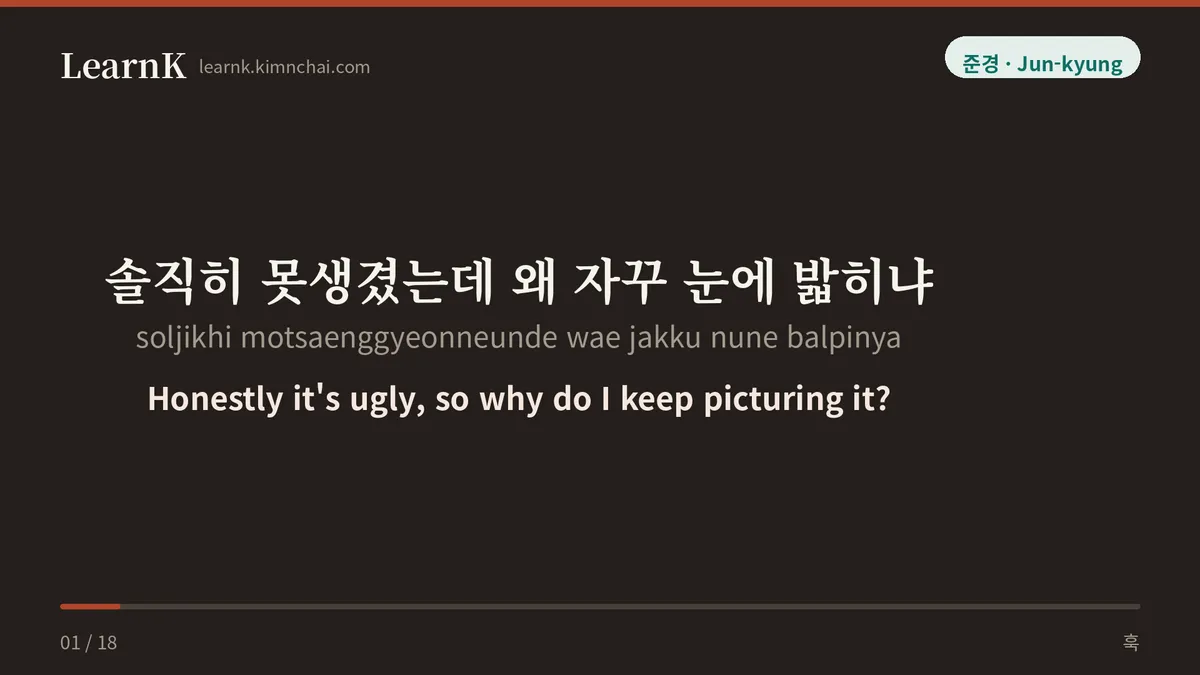
Setting: Saturday afternoon, on the way out after volunteering at a stray dog shelter. Jun-kyung keeps glancing back over his shoulder.
Jun-kyung: 아, 큰일 났다. 나 아까 그 똥개 자꾸 생각나. Oh no, I’m in trouble. I keep thinking about that mutt from earlier.
Emily: 귀 한쪽 접힌 애? 야, 걔 진짜 마성의 매력 있어. The one with the one floppy ear? Dude, that dog has seriously bewitching charm.
Jun-kyung: 그치? 솔직히 못생겼는데 왜 자꾸 눈에 밟히냐. Right? Honestly it’s ugly, so why do I keep picturing it?
Emily: 그게 마성의 매력이라는 거야. 예쁜 애들은 그냥 예쁘고 끝인데, 걔는 사람을 홀려. That’s exactly what bewitching charm is. Cute ones are just cute and that’s it, but that one casts a spell on you.
Jun-kyung: 나 오늘 진짜 구경만 하러 온 거였는데… I honestly just came to look around today…
Emily: 홀렸네, 홀렸어. 내일 또 올 거지? You’re under its spell, totally. You’re coming back tomorrow, aren’t you?
When It Sounds Awkward
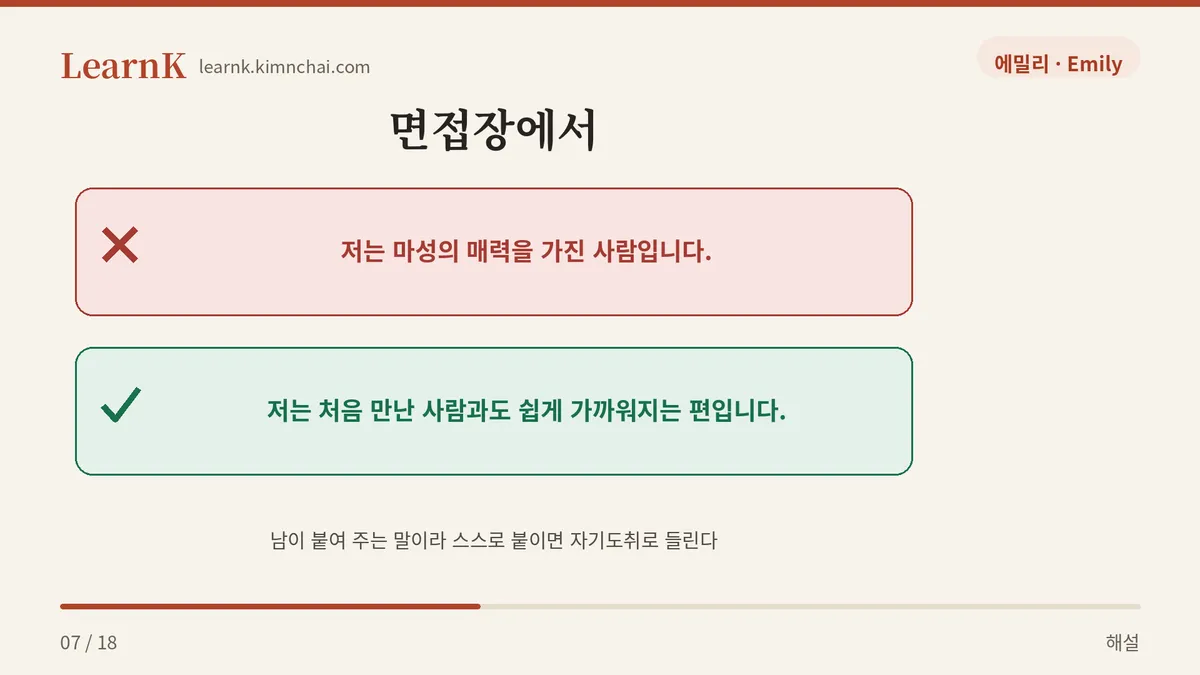
✗ (in a job interview) 저는 마성의 매력을 가진 사람입니다. (jeoneun maseong-ui maeryeok-eul gajin saram-imnida.) — “I am a person with bewitching charm.” ✓ (in a job interview) 저는 처음 만난 사람과도 쉽게 가까워지는 편입니다. (jeoneun cheoeum mannan saramgwado swipge gakkawojineun pyeon-imnida.) — “I tend to get close to people easily, even on a first meeting.” → This is a phrase other people pin on you, not one you pin on yourself. Self-applied, it sounds like self-infatuation, and your listener will just laugh.
✗ (to your manager) 부장님은 정말 마성의 매력이 있으세요. (bujangnim-eun jeongmal maseong-ui maeryeok-i isseuseyo.) — “Sir, you really do have bewitching charm.” ✓ (to your manager) 부장님은 사람을 편하게 해 주시는 힘이 있으세요. (bujangnim-eun sarameul pyeonhage hae jusineun him-i isseuseyo.) — “Sir, you have a real gift for putting people at ease.” → On the surface it looks like a compliment, but the undertone of “you cast a spell on people” is baked in, so aimed at a senior — or at someone of the opposite sex — it can cross from joke into flirtation. This is a phrase for teasing among peers.
Example Sentences by Situation
1. Talking about a club senior’s artwork
An art club exhibition. The painting people linger in front of longest is, technically speaking, the clumsy one.
선배 그림 잘 그린 건 아닌데 자꾸 보게 돼. 그게 마성의 매력이지. (seonbae geurim jal geurin geon aninde jakku boge dwae. geuge maseong-ui maeryeok-iji.) — “선배 그림, 잘 그린 건 아닌데 자꾸 보게 돼요. 그게 마성의 매력이죠.” (“Your painting isn’t technically great, but I keep coming back to look at it. That’s bewitching charm.”)
2. Your regular snack shop
Calling it a great restaurant would be a stretch, and yet you find yourself there twice a month.
여기 떡볶이 엄청 맛있진 않아. 근데 왜 자꾸 오지? 마성의 매력이야. (yeogi tteokbokki eomcheong masitjin ana. geunde wae jakku oji? maseong-ui maeryeok-iya.) — “여기 떡볶이가 엄청 맛있진 않아. 그런데 왜 자꾸 오게 되지? 마성의 매력이야.” (“The tteokbokki here isn’t amazing. So why do I keep ending up here? It’s bewitching charm.”)
3. The new hire at the office
There’s always someone who makes the most mistakes and yet, somehow, nobody can get angry at them.
걔 실수 진짜 많이 하잖아. 근데 아무도 못 혼내. 마성의 매력 있어. (gyae silsu jinjja mani hajanha. geunde amudo mot honnae. maseong-ui maeryeok isseo.) — “그 친구 실수 진짜 많이 하잖아. 그런데 아무도 못 혼내. 마성의 매력이 있어.” (“That guy makes so many mistakes, right? And nobody can scold him. He’s got bewitching charm.”)
Polite vs. Casual Speech, and Similar Expressions
In casual speech (반말, banmal) you’d say 마성의 매력 있어 (maseong-ui maeryeok isseo), and when you want to dress it up a little, 마성의 매력이 있네요 (maseong-ui maeryeok-i inneyo) is about as far as it naturally goes. But in genuinely formal settings — especially in front of someone older or senior — switching to polite speech does not make the awkwardness go away. It isn’t the form of the words that’s light; it’s the phrase itself.
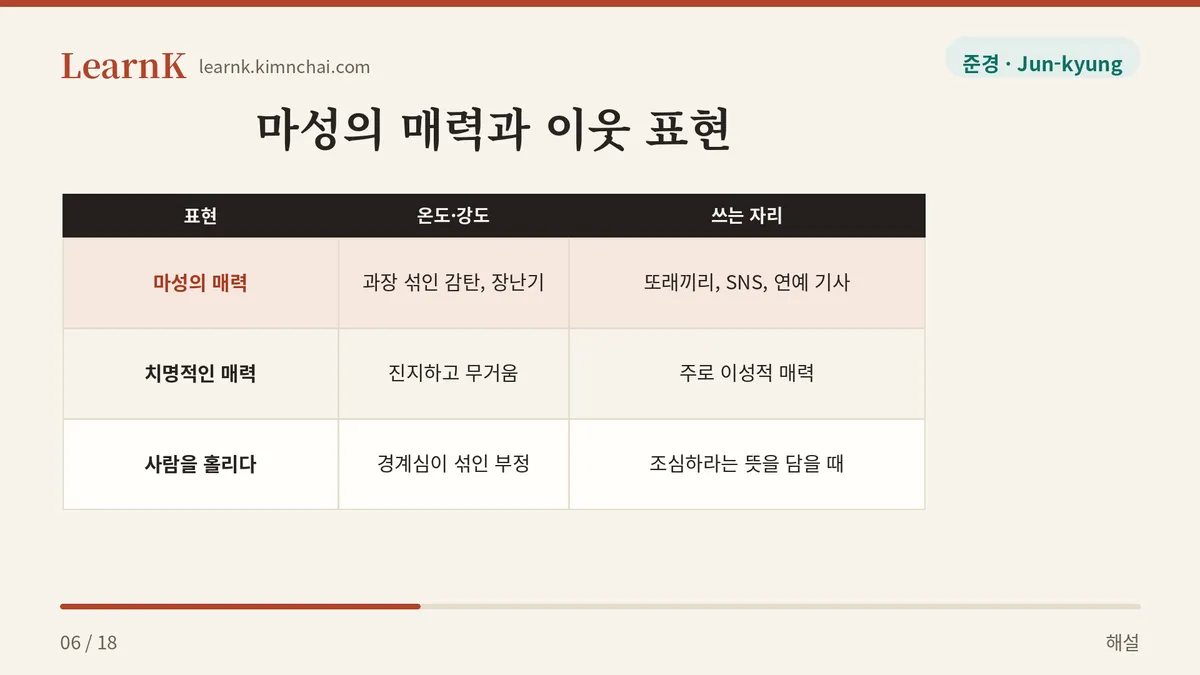
| Expression | Temperature / Intensity | Where It’s Used |
|---|---|---|
| 마성의 매력 (maseong-ui maeryeok) | Exaggerated admiration, playful | Among peers, on social media, in entertainment news. Not used toward seniors |
| 치명적인 매력 (chimyeongjeogin maeryeok) | Serious and weighty | Mostly limited to romantic attraction |
| 매력 있다 (maeryeok itda) | Neutral | Anywhere, formal settings included |
| 사람을 홀리다 (sarameul hollida) | Negative undertone, tinged with wariness | When you mean “watch out for that one” |
They may look interchangeable, but they belong to different rooms. 치명적인 매력 (chimyeongjeogin maeryeok) leans toward a serious romantic context, and 사람을 홀리다 (sarameul hollida) can amount to a warning: “be careful around that person.” Only 마성의 매력 (maseong-ui maeryeok) carries the laugh of “okay, I lose.”
Cultural Background — A Word Descended from 魔, the Character for “Demon”
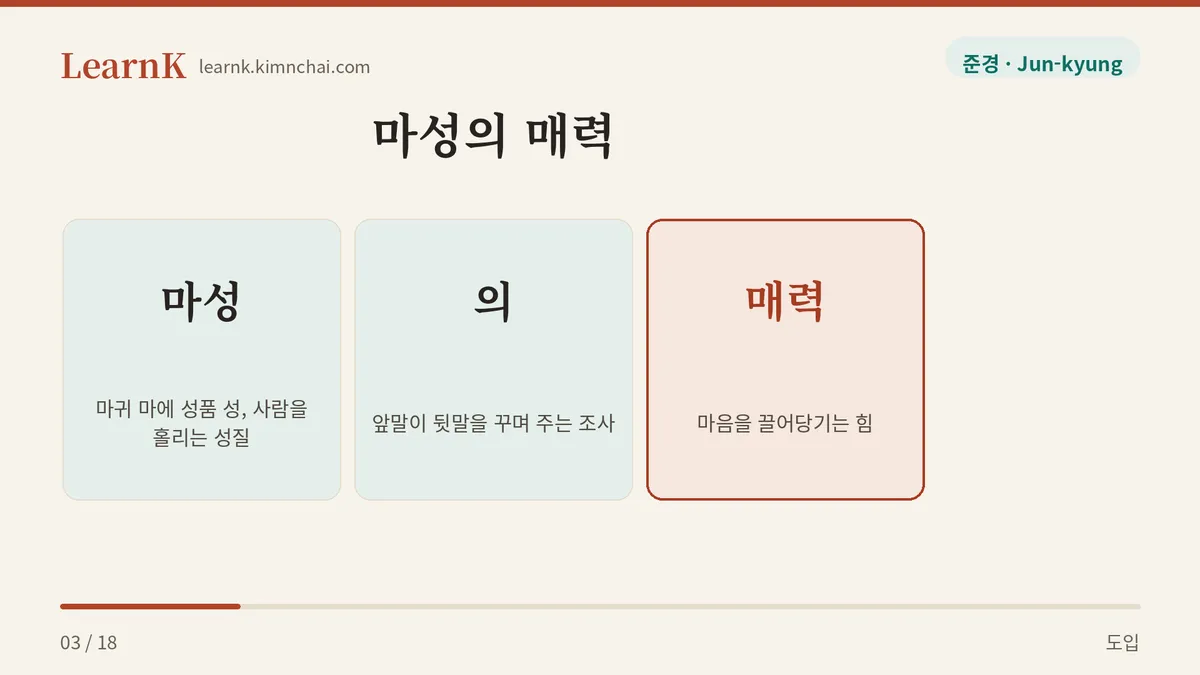
마성 (maseong, 魔性) is a Sino-Korean word. It joins 마 (魔), the character for “demon,” to 성 (性), the character for “nature” or “disposition” — literally, “demonic nature.” Originally it was a heavy word for the quality of bewitching people until they lose their senses. The fun of this expression lies in taking that heavy Sino-Korean word and slapping it onto everyday praise. You’re essentially complimenting someone while half-treating them as a supernatural creature — so it’s no wonder learners can’t quite gauge its temperature the first time they hear it.
The places this phrase spread from are dramas and fandom culture. Korean dramas are full of villains you can’t bring yourself to hate. What they do is clearly bad, but once you learn their backstory the hatred won’t hold, and eventually the moment arrives when viewers are rooting for them. Headlines dub characters like this 마성의 악역 (maseong-ui angyeok), “the bewitching villain.” The same goes for variety show subtitles: a cast member busts out a bizarre dance, and the editor slaps 마성의 몸짓 (maseong-ui momjit), “bewitching moves,” across the screen. Here the phrase isn’t heartfelt praise — it’s exaggeration engineered for laughs.
So if a Korean friend tells you “너 마성의 매력 있어 (neo maseong-ui maeryeok isseo),” rather than taking it as a compliment on your looks, this is the more accurate translation: “You’re really weird, and I like that.” In Korean, the most affectionate compliments often arrive wearing exactly this face.
Today’s Quiz
Which of the following uses 마성의 매력 (maseong-ui maeryeok) most naturally?
- 안녕하세요, 마성의 매력을 가진 신입사원 김준경입니다. Hello, I’m Kim Jun-kyung, your new hire with bewitching charm.
- 부장님, 오늘 넥타이에 마성의 매력이 있으십니다. Sir, there’s a bewitching charm to your tie today.
- 저 배우 딱히 내 취향 아닌데 왜 자꾸 그 드라마를 보게 되지? 마성의 매력인가 봐. That actor isn’t really my type, so why do I keep watching that drama? Must be bewitching charm.
- 이 서류는 마성의 매력이 있어서 결재가 빨리 났습니다. This document has bewitching charm, so it got approved quickly.
Show the answer
Answer: 3
It contains the surrender structure — “not my type, and yet I keep getting pulled in” — exactly as it should be, which makes it the most natural. Number 1 applies the phrase to oneself and comes off as self-infatuated. Number 2 aims it at a senior, so the joke goes too far. Number 4 attaches it to an object, a document — and when you use it for objects, it only works for things you keep reaching for, like 떡볶이 (tteokbokki) or 곱창 (gopchang). There’s nothing bewitching about a document that got signed off.
The definitions, example sentences, and dialogue in this post are all our own original writing. 마성의 매력 (maseong-ui maeryeok) is not listed as a headword in the National Institute of Korean Language’s Basic Korean Dictionary (krdict.korean.go.kr), so this post contains no dictionary quotations.