남친/여친 (namchin/yeochin) — The Two-Syllable Word Koreans Use for the Person They're Dating
남친/여친
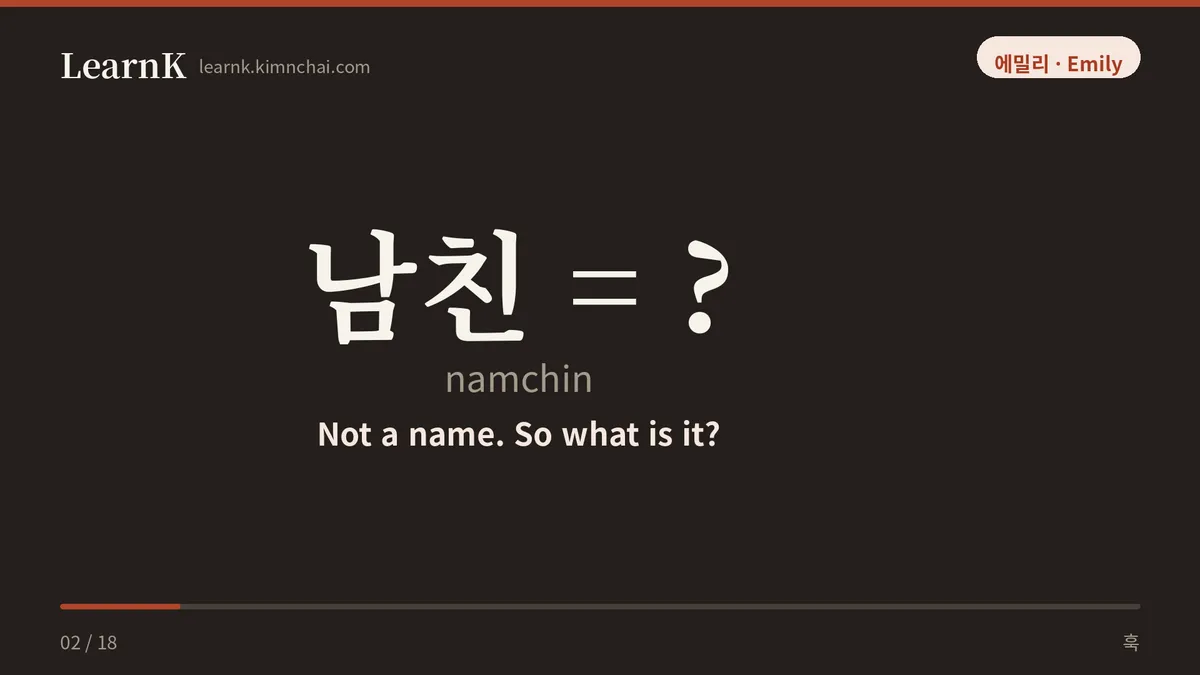
남친/여친 (namchin/yeochin) are two-syllable contractions of 남자친구 (namja chingu) “boyfriend” and 여자친구 (yeoja chingu) “girlfriend,” and they refer to the person you’re dating right now. Once you start watching Korean dramas, these words jump out at you constantly. At a cafe, a friend turns her phone screen toward you and says, “이 사람이 내 **남친 (namchin)**이야” (“this is my boyfriend”). At lunch, a coworker asks, “너 여친 (yeochin) 있어?” (“do you have a girlfriend?”). They rarely make it into Korean textbooks, but spend just one month around people your own age in Korea and you’ll hear them several times a day.
The fact that they’re contractions explains almost everything about them. 남친/여친 aren’t special in meaning — they’re special in temperature. Saying 남자친구 or 여자친구 in full is neutral and works anywhere, but the moment you shorten it, the register slides one notch toward casual. This is the word for friends, for KakaoTalk, for something you half-mutter to yourself. So even though both forms point at the same person, which one you pick carries an extra message: “right now I’m treating you as someone I’m relaxed with.”
The boundaries are clear, too. First, you don’t use it for someone you’re married to. Once you marry, they become 남편 (nampyeon, husband) or 아내 (anae, wife); 남친/여친 is a label that only sticks during the dating years before marriage. Second, it isn’t just a close friend of the opposite sex, either. Korean has a separate word reserved for that role (we’ll get to it below). The moment you say 남친/여친, you’re also declaring “we’re a couple.” That’s why, if you reach for this word first while things are still undefined, Koreans will read the word itself as a signal.
Seeing it in a real conversation
Scene: the last evening of the Chuseok holiday. The two of them are sitting under a parasol in front of the neighborhood convenience store, drinking canned coffee.
Jun-kyung: 아, 나 이번 명절도 큰집에서 시달렸어. 앉자마자 “여친은 언제 데려오냐”래. Ugh, I got grilled at my uncle’s place again this Chuseok. The second I sat down: “When are you bringing your girlfriend over?”
Emily: 크크, 나도 옆집 아주머니가 물어보시더라. “에밀리는 남친 없어?” Haha, my next-door neighbor asked me too. “Emily, don’t you have a boyfriend?”
Jun-kyung: 그래서 뭐랬어? So what did you say?
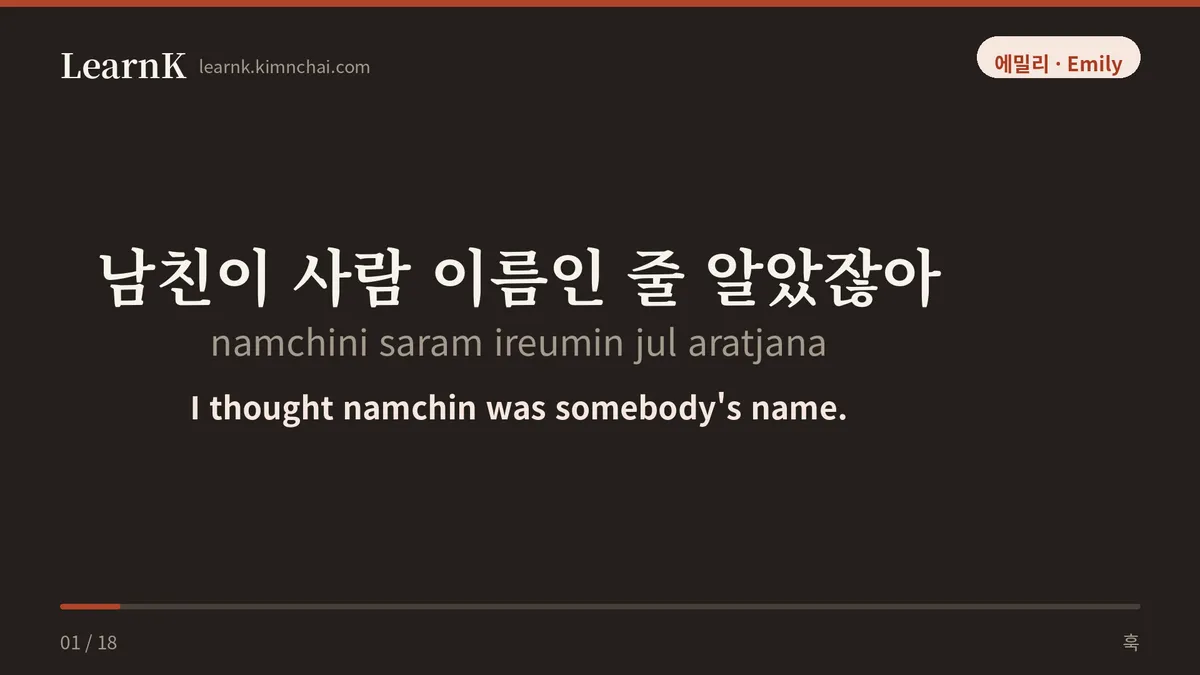
Emily: 그냥 웃었지 뭐. 근데 나 한국 처음 왔을 때는 남친이 사람 이름인 줄 알았잖아. I just smiled. You know, when I first came to Korea I thought “namchin” was somebody’s name.
Jun-kyung: 야, 진짜? 그냥 남자친구 줄인 말인데. (웃음) Seriously? It’s just short for “namja chingu.”
Emily: 이제 알지. 근데 아직도 “내 여친” 이런 말은 입에 잘 안 붙어. 왠지 좀 간지러워. I know that now. But saying “my yeochin” still doesn’t roll off my tongue. Feels a little cringey.
Used this way, it sounds off
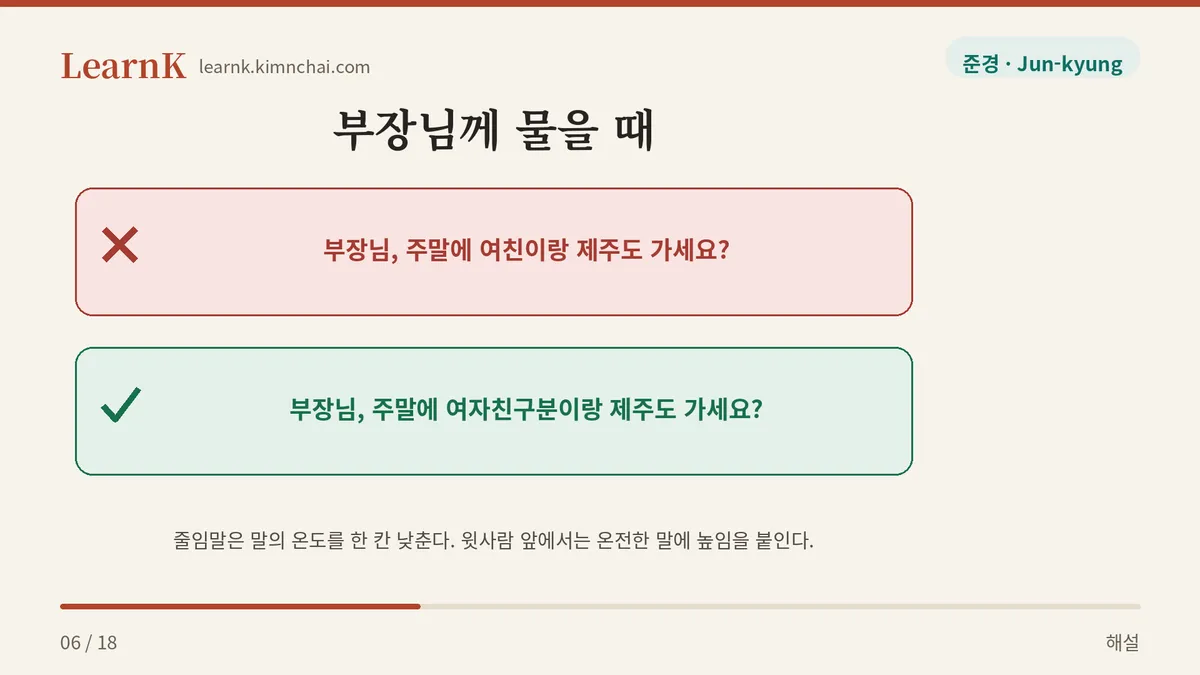
✗ (to your department head) 부장님, 주말에 여친이랑 제주도 가세요? Sir, are you going to Jeju with your girlfriend this weekend? ✓ (to a coworker) 야, 너 주말에 여친이랑 제주도 간다며? Hey, I hear you’re going to Jeju with your girlfriend this weekend? → A contraction lowers the temperature of your speech by one notch. Using a casual short form to talk about a senior’s love life makes it sound like you’re treating their private life lightly. With someone above you, it’s safer to use the full word plus an honorific ending, as in “여자친구분 (yeojachingu-bun).”
✗ (to a senior colleague who’s been married ten years) 선배, 여친분은 잘 지내세요? Is your girlfriend doing well? ✓ (to a senior colleague who’s been married ten years) 선배, 사모님은 잘 지내세요? Is your wife doing well? → The grammar is fine here; the relationship is what’s been misnamed. 남친/여친 attaches only to someone you’re dating, so using it for a spouse sounds like you’re asking, “You’re not actually married yet, right?”
Example sentences by situation
1. When a university classmate you haven’t seen in ages asks what you’ve been up to
나 요즘 남친 생겼어. (na yojeum namchin saenggyeosseo.) 나 요즘 남자친구 생겼어. I’ve got a boyfriend now.
In Korean, a romantic partner more often enters the conversation through “생기다 (saenggida)” — to come into being — than through “있다 (itda)” — to have. The nuance is that something that wasn’t there has now appeared, which suits the moment when you’re breaking news. If you’ve been together a long time already, you’d say “남친 있어 (namchin isseo)” instead.
2. When a friend invites you hiking for the weekend but you already have plans
미안, 주말엔 여친이랑 약속 있어. (mian, jumareneun yeochin-irang yaksok isseo.) 미안, 주말에는 여자친구랑 약속이 있어. Sorry, I’ve got plans with my girlfriend this weekend.
Giving your 남친/여친 as the reason for turning something down is extremely common. In Korea this excuse is close to universal, so most of the time nobody digs any further — you just get an “아, 그래 (a, geurae)” and that’s the end of it.
3. When your boss asks about your private life at a company dinner and you answer politely
아, 여자친구는 아직 없습니다. (a, yeojachinguneun ajik eopseumnida.) Ah, I don’t have a girlfriend yet.
Here the key is not shortening it. Drop “여친 없습니다” into a polite sentence and the front and back halves of the sentence sit at different temperatures, which makes the listener snag on it slightly. Once you’ve committed to polite speech, it’s more natural to keep your vocabulary in its full form to match.
Politeness levels and similar expressions
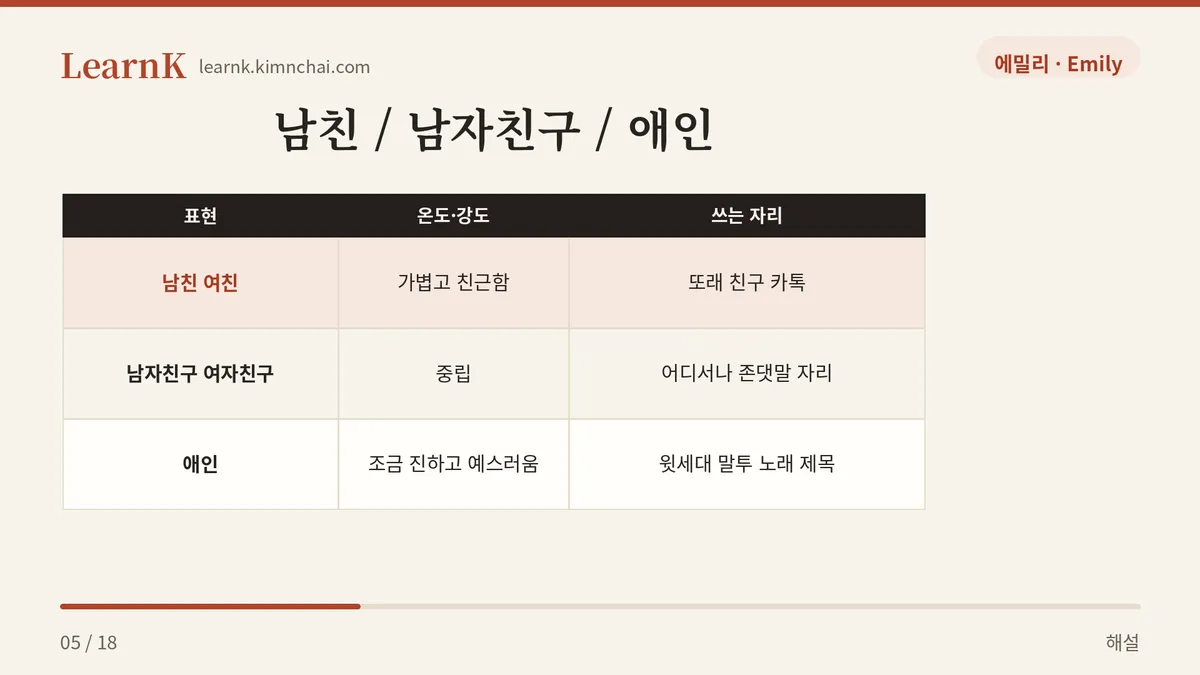
| Expression | Temperature & intensity | Where it’s used |
|---|---|---|
| 남친/여친 (namchin/yeochin) | Light and friendly | Peers, friends, KakaoTalk, social media. Avoided in front of seniors |
| 남자친구/여자친구 (namja chingu/yeoja chingu) | Neutral | Anywhere. The default form for polite speech |
| 애인 (aein) | A little heavier, slightly old-fashioned | The older generation’s register; song and drama titles. Koreans in their 20s rarely use it now |
| 사귀는 사람 (sagwineun saram) | Understated and careful | When it’s still too early to introduce them, or when you’re mentioning them formally |
| 남사친/여사친 (namsachin/yeosachin) | Light and playful | When you want to make it clear “this is not a romantic partner” |
That last row matters most. 남사친 (namsachin) is short for 남자 사람 친구 (namja saram chingu, “a male-person friend”), and 여사친 (yeosachin) for 여자 사람 친구 (yeoja saram chingu, “a female-person friend”). 남친 and 남사친 differ by a single syllable, but the relationships are completely different. Learners really do introduce someone with “내 남친이야 (nae namchin-iya)” and watch the other person’s eyes go wide.
Cultural background — the habit of shortening things to two syllables
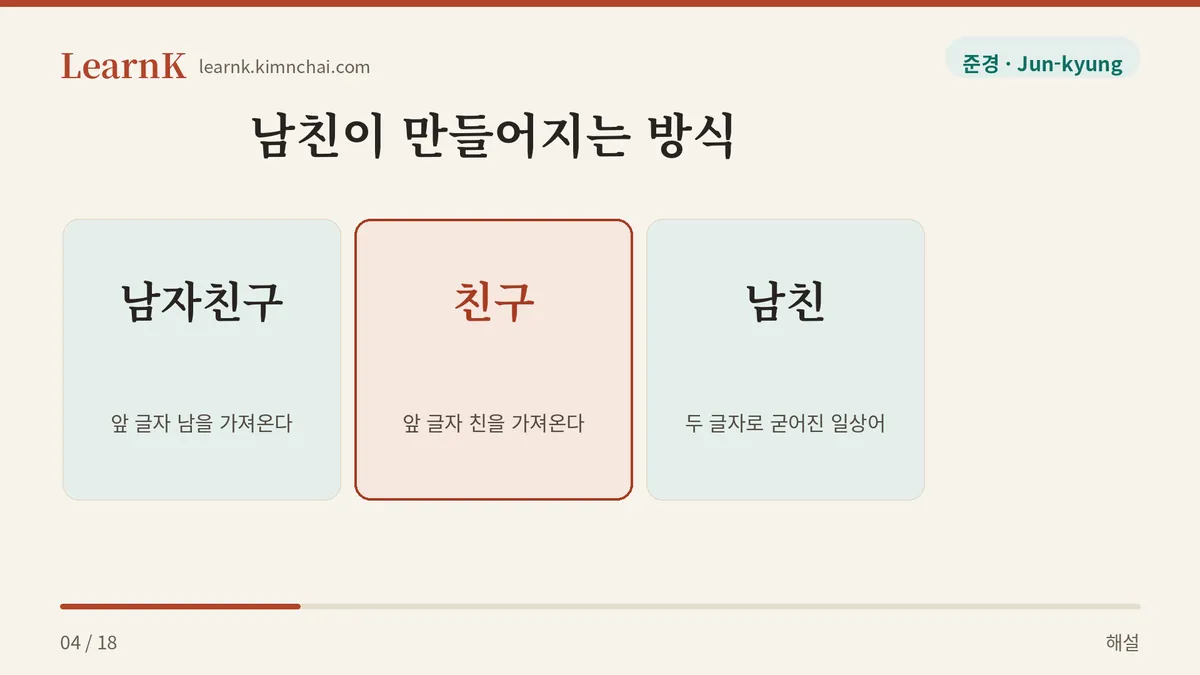
남친 is built from the 남 of 남자친구 and the 친 of 친구. Korean is unusually fond of this move: take the front syllables of a word and crunch it down to two. It’s the same principle that turns 셀프 카메라 (selpeu kamera, “self camera”) into 셀카 (selka) and 아르바이트 (areubaiteu, “part-time job”) into 알바 (alba). And once a pattern like this takes hold, it reproduces on its own. After 남친 settled in, 남사친 and 여사친 were coined by borrowing the same frame — and today those words are firmly established in daily life well ahead of any dictionary.
There’s a reason the words got short. 남친/여친 mostly travel not through the mouth but through the fingers. When a word gets sent back and forth dozens of times a day over messenger, the short version is the one that survives. That’s why you see it constantly in texts, comments, and subtitles — and almost never from a news anchor or in an official notice.
Korea’s dating culture is bound up with the word, too. Rather than letting a relationship drift along undefined, Koreans commonly put it into words at some point: “우리 사귀는 거 맞지? (uri sagwineun geo matji?)” — “we’re dating, right?” Dramas treat this confirmation scene as practically mandatory. Only after that confirmation do you earn the right to call the other person your 남친/여친, and from that moment the anniversary culture kicks in — counting 100 days, 200 days together. In other words, these two syllables aren’t just a label; they’re more like a stamp certifying that the relationship has crossed into a new stage.
And finally, the place this word comes up most often isn’t actually between couples — it’s at the holiday dinner table. On the list of questions that relatives you haven’t seen in a year fire off instead of small talk, 남친/여친 is always there. Foreigners living in Korea aren’t exempt either, so once the holiday passes you hear the same story all over: “got that question again this year.” Learning this expression really means learning the atmosphere at that table along with it.
Today’s quiz
Your department head asks, “주말에 뭐 했어요? (jumare mwo haesseoyo?)” — “What did you do over the weekend?” You saw a movie with your girlfriend. Which one sounds more natural?
- 여친이랑 영화 봤어요.
- 여자친구랑 영화 봤습니다.
See the answer
Answer: 2
When you’re answering someone above you, it’s more natural to unfold the contraction. Option 1 isn’t grammatically wrong, but mixing a polite ending with a casual short form leaves the temperature of the sentence out of joint. If a friend had asked the same question, “어제 여친이랑 영화 봤어 (eoje yeochin-irang yeonghwa bwasseo)” would actually be the natural choice. Using 남친/여친 well isn’t about knowing what it means — it’s about knowing when to shorten it and when to spell it out.