남산타워 (Namsan Tawo) — If You Could Only Visit One Place in Seoul: Why Koreans Shorten This Name

남산타워
남산타워 (Namsan Tawo) means “the observation tower standing on top of Namsan, the mountain right in the middle of Seoul.” When a friend visiting Seoul for the first time asks, “If I could only go to one place, where should it be?”, nine times out of ten this is the name that comes out first. Map apps list it under a different name, and the signs say something different too — but what actually comes out of Korean people’s mouths is always 남산타워 (Namsan Tawo).
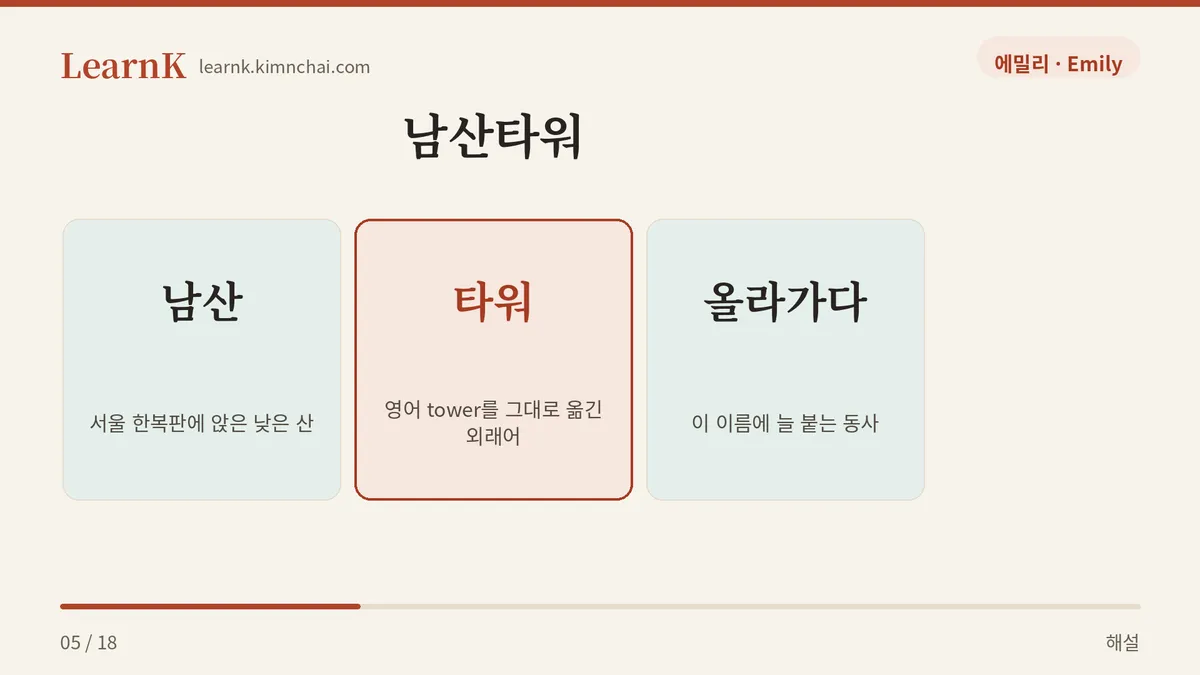
Take the word apart and it’s simple. 남산 (Namsan) is the name of a low mountain sitting between Seoul’s Jung-gu and Yongsan-gu districts, and 타워 (tawo) is just the English word “tower” borrowed straight into Korean. So: “the tower on Namsan.” What matters is that an entire mountain is baked into the name. To a Korean, 남산타워 isn’t a tall building downtown — it’s 올라가는 곳 (ollaganeun got), a place you go up to. That’s why in real conversation, 남산타워에 올라갔어 (Namsan Tawo-e ollagasseo) “I went up to Namsan Tower” and 남산타워 올라가자 (Namsan Tawo ollagaja) “let’s go up to Namsan Tower” are used far more often than 남산타워에 있어 (Namsan Tawo-e isseo) “I’m at Namsan Tower.” Once you know which verb belongs there, your sentences sound natural right away.
There’s a nuance to it as well. The word carries a little flutter of excitement. It isn’t pronounced flatly, the way you’d say a company name or a subway stop — it travels with scenes like dates, day trips, and long-awaited guests. 남산타워 갈래? (Namsan Tawo gallae?) “Want to go to Namsan Tower?” is closer to “let’s spend some time together,” and 남산타워에서 야경 봤어 (Namsan Tawo-eseo yagyeong bwasseo) “I saw the night view from Namsan Tower” is a signal that the day was something special.
Seeing It in Real Conversation

Setting: Saturday afternoon, at the foot of the road up Namsan. Jun-kyung won’t budge from the bus stop.
준경: 야, 그냥 버스 타자. 여기서 남산타워까지 걸어가면 진짜 한 시간이야. Hey, let’s just take the bus. It’s a solid hour to walk to Namsan Tower from here.
에밀리: 한 시간은 무슨. 나 저번에 사십 분 만에 올라갔거든? An hour, my foot. I made it up in forty minutes last time.
준경: …진짜? 나 서울에서 삼십몇 년 살면서 남산타워 걸어서 올라간 적 한 번도 없는데. …Seriously? I’ve lived in Seoul for over thirty years and never once walked up to Namsan Tower.
에밀리: 그러니까 서울 사람들이 더 몰라. 계단 길로 가면 중간에 성곽 나와, 완전 예뻐. That’s exactly why Seoulites don’t know it. Take the stairs and you hit the old fortress wall — it’s gorgeous.
준경: 알았어, 대신 내려올 땐 케이블카다. 콜? Fine, but we’re taking the cable car down. Deal?
에밀리: 콜. 대신 야경까지 보고 내려오는 거야. Deal. But we’re staying for the night view.
Saying It This Way Sounds Off

남산타워 is a place name, so it isn’t picky about who you use it with. But there are two spots where learners commonly trip.
✗ (to a friend who lives in Seoul) 우리 이번 주말에 남산타워 관광 갈까? Shall we go sightseeing at Namsan Tower this weekend?
✓ (to a friend who lives in Seoul) 우리 이번 주말에 남산 갈까? Want to go to Namsan this weekend?
→ The grammar is perfectly fine, but the tone is pure tourist. Attaching 관광 (gwan-gwang) “sightseeing” to your own city makes it sound like someone else’s neighborhood. On top of that, when Seoulites name this destination to each other, they usually skip the tower part and just toss out the mountain’s name.
✗ 남산타워가 서울에서 제일 높은 건물이죠? Namsan Tower is the tallest building in Seoul, right?
✓ 남산타워가 서울에서 제일 높은 데 있는 전망대죠? Namsan Tower is the observatory in the highest spot in Seoul, right?
→ A common misconception. Measured purely by building height, Lotte World Tower in Jamsil is far taller than Namsan Tower. The reason Namsan Tower is visible from all over Seoul isn’t that the tower is huge — it’s that it stands on a mountain. Say it with that distinction in mind and you’ll get an impressed “oh, you actually know your stuff.”
Example Sentences by Situation
1. Planning a route for a foreign friend you haven’t seen in ages
첫날은 시차도 있으니까 남산타워 (Namsan Tawo) 만 올라갔다 오자. 해 지기 한 시간 전에 올라가면 낮 풍경이랑 야경을 한 번에 볼 수 있어.
You’ll be jet-lagged the first day, so let’s just do a quick trip up to Namsan Tower. If you go up an hour before sunset, you get the daytime view and the night view in one go.
This is the sentence that comes up most often when you’re mapping out someone’s Seoul itinerary. Going up before sunset and sticking around until it gets dark is a trick every local knows. Memorize the round-trip expression 올라갔다 오다 (ollagatda oda) “to go up and come back” as a single chunk and you can use it for mountains, observatories, rooftops — anywhere.
2. Light small talk about weekend plans
A: 주말에 뭐 했어? B: 별거 안 했어. 그냥 남산 (Namsan) 좀 걷다 왔어.
A: What did you do over the weekend? B: Nothing much. Just went and walked around Namsan a bit.
B might have gone all the way up the tower, or might have only strolled the trail around the mountain. In Korean it’s more natural to leave it lumped together like this rather than spelling out which. Get too detailed and you start to sound like you’re giving a report.
3. Showing someone a photo
이거 작년 겨울에 남산타워 (Namsan Tawo) 에서 찍은 건데, 그날 미세먼지가 없어서 인천까지 보였어.
I took this at Namsan Tower last winter — there was no fine dust that day, so you could see all the way to Incheon.
~에서 찍다 (~eseo jjikda) “to take (a photo) at ~” is the basic skeleton of any photo story. Add a line about the weather or the visibility and the sentence really comes alive. In fact, when Seoulites talk about a view, they mention visibility before weather — and fine dust before anything else.
Polite vs. Casual, and Related Expressions

There’s more than one way to refer to this tower. Which one you pick reveals where the speaker stands.
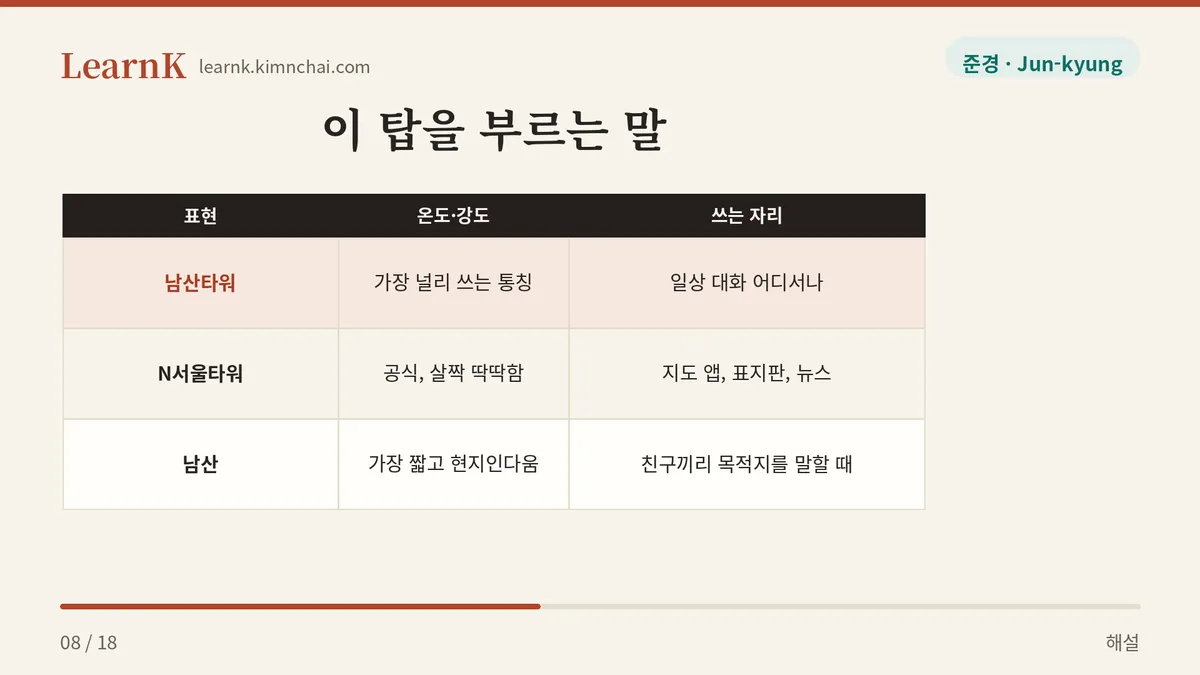
| Expression | Tone / intensity | Where it’s used |
|---|---|---|
| 남산타워 (Namsan Tawo) | The most widely used common name; comfortable | Anywhere in everyday conversation. There’s nowhere it doesn’t work |
| N서울타워 (N Seoul Tawo) | Official and neutral, slightly stiff | Map apps, signs, admission tickets, news articles |
| 남산 (Namsan) | The shortest, most local-sounding | Between friends, when naming the destination |
| 서울타워 (Seoul Tawo) | The old name, a touch dated | Older generations, or older articles |
The sentence ending shifts depending on who you’re talking to. With a friend, 남산타워 갈래? (Namsan Tawo gallae?); with someone older or someone you’ve just met, 남산타워 한번 가 보시겠어요? (Namsan Tawo hanbeon ga bosigesseoyo?) or 남산타워 가 보셨어요? (Namsan Tawo ga bosyeosseoyo?) are safe. The place name itself has nothing to do with honorifics — what you change isn’t the name, only the ending on the verb that follows it.
Cultural Background — A Transmission Tower on the Southern Mountain
남산 (Namsan) literally means “south mountain.” When the Joseon dynasty established its capital at Hanyang, this mountain sat to the south of the city walls, so that’s what it was called; before that it was more often known as Mongmyeoksan. So the name 남산타워 is a very plain bit of word-building: “the tower on the southern mountain.” And since it just means “south mountain,” there are Namsans all over the country. Gyeongju has one, and it’s common for small regional cities to have a Namsan of their own. Still, if you say “남산” with nothing else attached, Seoulites will take you to mean this one.
The tower wasn’t originally built as a tourist attraction — it was a transmission tower for broadcast signals. Construction began in the late 1960s and finished in the mid-1970s, and it opened to the public in 1980. It was extensively renovated in the mid-2000s and picked up its current official name then, but the old common name stuck to people’s tongues and was never pushed out. Change the sign and people still call it what they always called it — a prime example of just how stubborn common names are in Korean.
There are three main ways up: the cable car, the shuttle bus, and the stairs. The cable car is an old line laid in the early 1960s, so it’s a sight in itself, and the stair route climbs alongside the old Hanyang city wall, which gives the walk a completely different flavor. The railings below the observatory are packed solid with padlocks — famously, couples write their names on one, lock it, and throw away the key. These days you don’t have to be a couple; friends and families hang them too.
It has deep ties to K-dramas, too. After a scene in a hit mid-2000s romantic comedy where the two leads climb the Namsan stairs together became a talking point, those stairs were known for a while as “the stairs from that drama.” Since then, they’ve shown up again and again in Seoul-set productions as the place where a character sorts out their feelings or makes a confession. If you’re watching a Korean drama and a tower glowing red at night catches the corner of the frame, you can be almost certain it’s a visual cue saying, “this is Seoul, and it’s nighttime.”
Today’s Quiz
A friend who lives in Seoul asks you this:
“주말에 남산 갈래?” “Want to go to Namsan this weekend?”
Where is this friend suggesting you go?
① 남산이라는 이름의 카페 — a café named Namsan ② 남산타워가 있는 바로 그 산 — the very mountain that Namsan Tower stands on ③ 남산이라는 동네의 재래시장 — a traditional market in a neighborhood called Namsan
Answer: ②
In Seoul, saying just “남산” with no explanation means the mountain that Namsan Tower stands on. And usually 올라가자 (ollagaja) “let’s go up” is silently left off the end. Even if you never actually enter the tower, strolling around, taking in the night view, and heading back down all fall under “남산 간다” (going to Namsan). Next time a Korean friend asks you this, try answering with 좋아, 케이블카 타고 갈까 걸어서 갈까? (Joa, keibeulka tago galkka georeoseo galkka?) — “Sure, should we take the cable car or walk?” In that moment, you’re not speaking like a tourist. You’re speaking like a Seoulite.
Definitions and example sentences are from the National Institute of Korean Language’s Basic Korean Dictionary (krdict.korean.go.kr); that portion of this post, including our translations, is licensed under CC BY-SA 2.0 KR.