온천 (oncheon) — Time to Soak in Water the Earth Warmed for You
온천
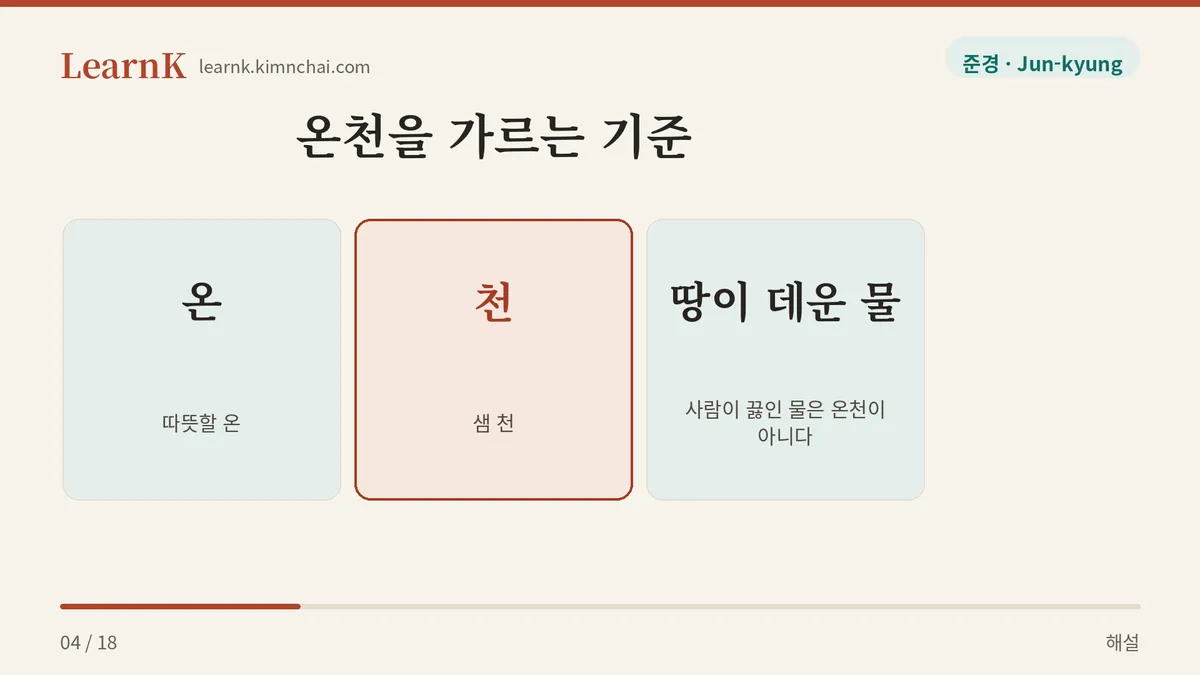
온천 (oncheon) means a facility built so you can bathe in water that was heated naturally underground — or the spring from which that water rises. The important part here isn’t “hot,” it’s “the earth heated it.” A neighborhood bathhouse that fills its tubs with boiler-heated water is never called 온천, no matter how scalding the water is; and water that comes up only a little lukewarm still counts as 온천 as long as it warmed up on its own down below.
So the situations where this word shows up are more or less fixed. In November, when the cold wind starts, someone floats the idea: 올겨울엔 온천이나 한번 가자 (Olgyeouren oncheonina hanbeon gaja) — “Let’s go to a hot spring this winter.” When you’ve come down off a mountain and your knees are wobbling, when your shoulders have been stone-hard for days, when you’re trying to figure out where to take your parents — Koreans think of 온천. It’s the name of a destination and, at the same time, a word with a purpose baked into it: you go there to loosen your body.
The dictionary splits the word two ways. One is the facility built for bathing; the other is the spring itself, where the water comes out. In everyday life the first meaning wins by a landslide. If someone says 온천 갔다 왔어 (oncheon gatda wasseo), they don’t mean they went sightseeing at a spring — they mean they got in the water.
The words that travel with it are nearly locked in place. With 온천, the verb isn’t so much 들어가다 (deureogada, “go in”) as 몸을 담그다 (momeul damgeuda), “to submerge your body,” and when you describe the result, out come 개운하다 (gaeunhada), 거뜬하다 (geotteunhada), and 긴장이 풀리다 (ginjangi pullida). Memorize those three as a set with 온천 and your sentences will come out sounding Korean. One more: the 노천 in 노천 온천 (nocheon oncheon) means “open-air, no roof,” so it refers to an outdoor bath.
Checking It in the National Institute of Korean Language Dictionary
온천 (oncheon) 「noun」
- 땅속에서 자연적으로 데워진 물로 목욕할 수 있게 만든 시설. 또는 그런 물이 나오는 장소. A facility made for bathing in water naturally heated underground; or a place where such water comes out.
- 땅속에서 자연적으로 데워진 물이 솟아나오는 샘. A spring from which water naturally heated underground rises up. — National Institute of Korean Language, Basic Korean Dictionary (krdict.korean.go.kr)
[en] hot spring — A facility for bathing in water naturally heated from the ground, or a place where such water comes out. [ja] おんせん【温泉】 — 地中で自然に熱せられた水で入浴できるようにした施設。また、そういう水が出て来る場所。 [es] termas — Instalación para bañarse con agua calentada de manera natural bajo tierra. O lugar del que emerge dicha agua. [zh] 温泉 — 由地下自然加热的水供人洗浴的设施;或指涌出这种热水的地方。 — National Institute of Korean Language, Basic Korean Dictionary (krdict.korean.go.kr)
※ The Portuguese entry isn’t in the dictionary, so we translated it ourselves (our own translation): fonte termal / termas — instalação para banhos com água aquecida naturalmente no subsolo, ou o local de onde essa água brota.
Below are the actual example sentences printed in the dictionary. For each one, I’ll point out the kind of situation the word turns up in.
온천에서 열 찜질을 했더니 팔다리가 거뜬한 느낌이다. (Oncheoneseo yeol jjimjireul haetdeoni paldariga geotteunhan neukkimida.) I had a heat soak at the hot spring, and now my arms and legs feel light. — National Institute of Korean Language, Basic Korean Dictionary (krdict.korean.go.kr)
거뜬하다 (geotteunhada) means something heavy has become light. This sentence paints the state you’re in after steaming yourself in the hot vapor and coming out with your arms and legs noticeably lighter. When you want to say the fatigue is gone, no partner word fits better.
등산 후 온천의 뜨거운 물에 몸을 담그니 몸이 곤해져 움직일 수가 없었다. (Deungsan hu oncheone tteugeoun mure momeul damgeuni momi gonhaejyeo umjigil suga eopseotda.) After the hike I sank into the hot spring water, and my body went so heavy I couldn’t move. — National Institute of Korean Language, Basic Korean Dictionary (krdict.korean.go.kr)
곤하다 (gonhada) means “worn out,” but this isn’t bad tiredness. It’s the pleasant drowsiness of muscles that were taut from climbing finally letting go in hot water, until you don’t want to lift a finger. It’s also worth noticing that hiking and hot springs land in the same sentence — that really is how a Korean weekend is routed.
어쩐지 온천에 몸을 담그니 개운한 느낌이 드네요. (Eojjeonji oncheone momeul damgeuni gaeunhan neukkimi deuneyo.) Somehow, soaking in the hot spring, I feel refreshed. — National Institute of Korean Language, Basic Korean Dictionary (krdict.korean.go.kr)
This is polite speech that’s close to talking to yourself. The ending -네요 (-neyo) attaches when you notice something on the spot, as you’re experiencing it, so it comes out half-directed at whoever is next to you. If you catch a stranger’s eye in the tub, saying about this much wouldn’t be awkward at all.
이곳의 온천에는 몸에 좋은 광물성 성분이 녹아 있대요. (Igose oncheoneneun mome joeun gwangmulseong seongbuni noga itdaeyo.) They say the hot spring here has healthy mineral content dissolved in it. — National Institute of Korean Language, Basic Korean Dictionary (krdict.korean.go.kr)
The ending -대요 (-daeyo) passes along something you heard from someone else. Koreans talk a lot about water quality when the subject is hot springs — alkaline this, sulfur that — and this sentence is the textbook version of that conversation.
뜨거운 온천에 몸을 담그니 모든 긴장이 다 풀리는 것 같다. (Tteugeoun oncheone momeul damgeuni modeun ginjangi da pullineun geot gatda.) Sinking into the hot spring, it feels like all my tension is melting away. — National Institute of Korean Language, Basic Korean Dictionary (krdict.korean.go.kr)
긴장이 풀리다 (ginjangi pullida) works for both body and mind. It can mean muscles relaxing, and it can mean being released from something that’s been on your nerves for days. The reason 온천 is treated not as plain bathing but as “a place you go to rest” is right there in this one sentence.
Seeing It in a Real Conversation
Situation: They’ve just come down the mountain after a late-autumn hike. Both of them have wobbly knees.
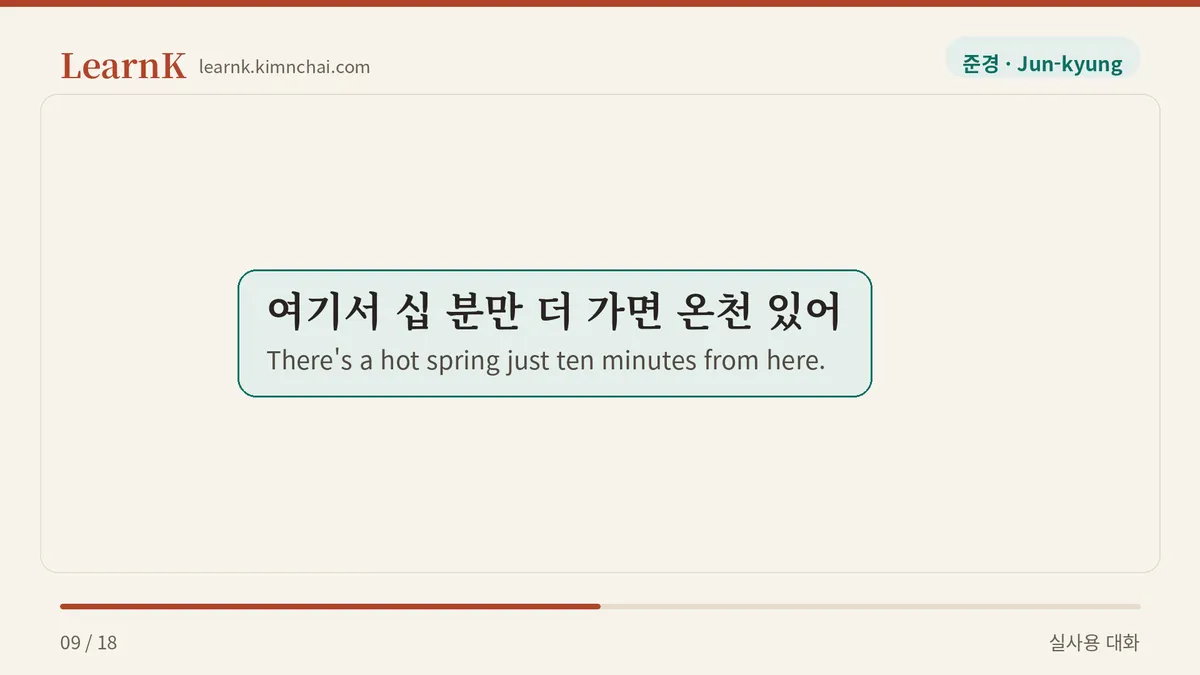
Jun-kyung: 아, 다리 풀렸다. 여기서 십 분만 더 가면 온천 있는 거 알지? Ah, my legs are done. You know there’s a hot spring just ten minutes from here, right?
Emily: 알지. 근데 나 수건도 없는데? I know. But I don’t have a towel.
Jun-kyung: 거기 다 팔아. 등산하고 나서 온천에 몸 담그는 게 진짜야. They sell everything there. Soaking in a hot spring after a hike — that’s the real deal.
Emily: 아 좋다. 그 온천 노천탕도 있어? Oh nice. Does that hot spring have an outdoor bath too?
Jun-kyung: 있지. 밖에 앉아 있으면 김 올라오는 게 보여. 단풍이랑 같이. Yeah. If you sit outside you can see the steam rising. Along with the autumn leaves.
Emily: 야, 그럼 진작 말했어야지. 빨리 가자, 빨리. Hey, you should’ve said that earlier. Let’s go, hurry.
These Uses Sound Off
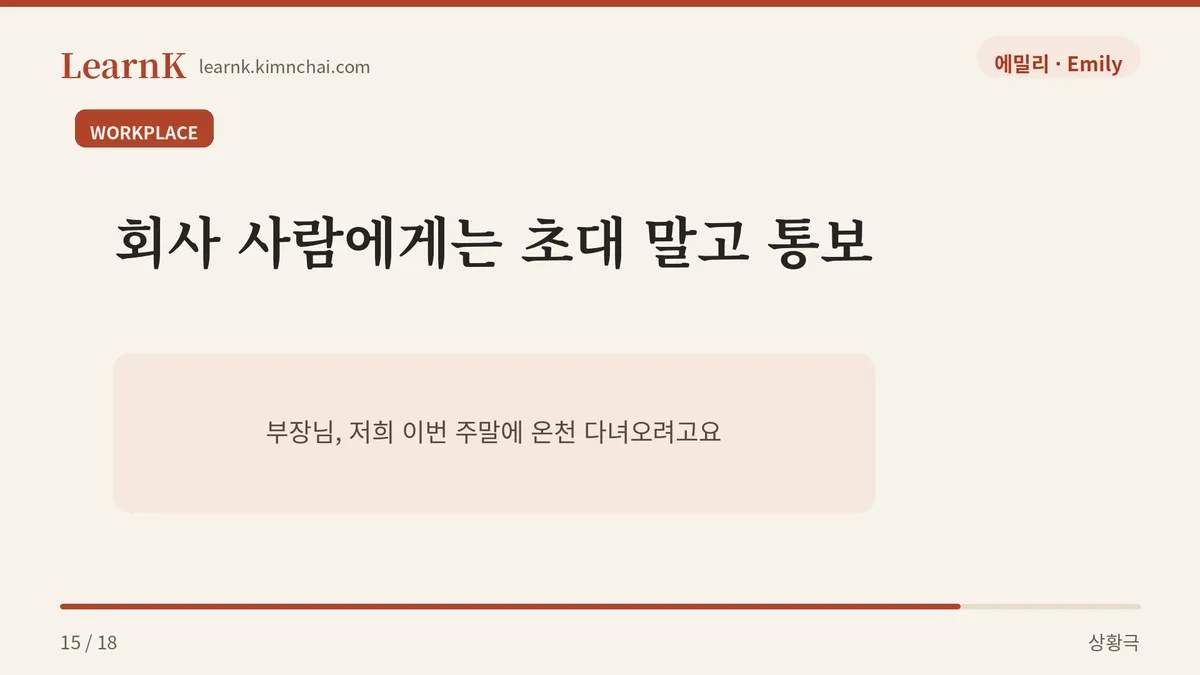
✗ (To your department head) 부장님, 이번 주말에 저희랑 온천 가실래요? (Sir, would you like to go to a hot spring with us this weekend?) ✓ (To your department head) 부장님, 저희 이번 주말에 온천 다녀오려고요. (Sir, we’re planning to go to a hot spring this weekend.) → In Korea, a hot spring means taking off all your clothes and bathing together. “Let’s go to a hot spring,” said to a coworker — especially to someone of the opposite sex — reads easily as an invitation that includes staying overnight. Unless you’re very close, it’s safer to stop at simply telling them your plans.
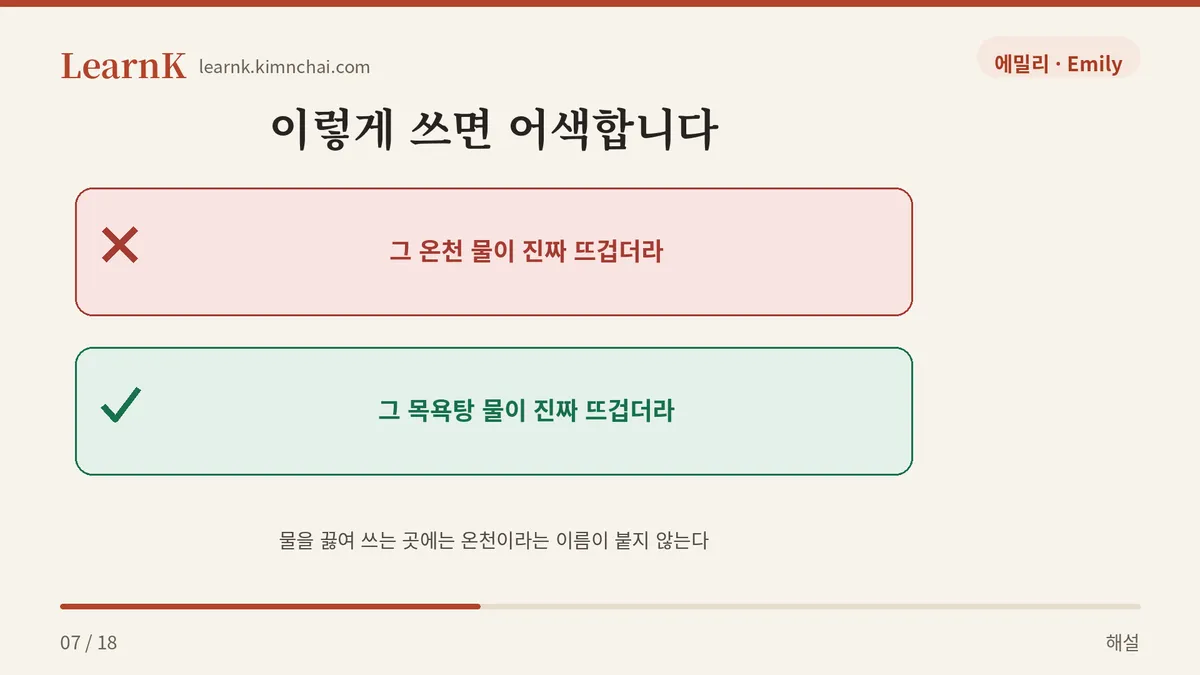
✗ 어제 동네 사우나 갔다 왔는데, 그 온천 물이 진짜 뜨겁더라. (I went to the neighborhood sauna yesterday, and that hot spring water was seriously hot.) ✓ 어제 동네 사우나 갔다 왔는데, 그 목욕탕 물이 진짜 뜨겁더라. (I went to the neighborhood sauna yesterday, and that bathhouse water was seriously hot.) → A local bathhouse or sauna that heats its own water is not a 온천. The name only attaches to places where water rises already warmed by the earth, so slapping it on any old tub sounds like an exaggeration.
Example Sentences by Situation
1. Making end-of-year plans in the family group chat 이번 겨울엔 눈 오는 날 노천 온천 있는 데로 가자. (Ibeon gyeoure nun oneun nal nocheon oncheon inneun de-ro gaja.) “This winter, let’s go somewhere with an open-air hot spring on a snowy day.” → “An open-air hot spring on a snowy day” is the exact picture Koreans hang their winter-trip hopes on: below freezing outside, the water hot, snow coming down on your head. One sentence like this and the family group chat will not stay quiet.
2. When your body is stiff, said politely to a coworker 어깨가 하도 뭉쳐서 주말에 온천이라도 다녀올까 봐요. (Eokkaega hado mungchyeoseo jumare oncheonirado danyeoolkka bwayo.) “My shoulders are so knotted up, I’m thinking of at least going to a hot spring this weekend.” → The particle -이라도 (-irado) carries the nuance of “nothing better comes to mind, so I’ll try this at least.” And -ㄹ까 봐요 (-lkka bwayo) is the tone for floating a plan you haven’t committed to yet, which makes it easy for the other person to pick up with “Sounds good — where are you going?”
3. Introducing your own neighborhood
이 동네는 예전부터 온천으로 유명해서 역 이름에도 온천이 들어가요.
(I dongneneun yejeonbuteo oncheoneuro yumyeonghaeseo yeok ireumedo oncheoni deureogayo.)
“This area has been famous for its hot springs for a long time, so even the station name has 온천 in it.”
→ (으)로 유명하다 ((eu)ro yumyeonghada, “famous for ~”) is the standard frame for introducing a place. Since hot springs are both tourist attractions and parts of place names, the word shows up often in exactly this kind of neighborhood description.
Polite and Casual Forms, and Similar Words
온천 is a noun, so there’s no honorific level in the word itself. The verb that follows decides the politeness.
- Casual: 우리 온천 갔다 왔어. (Uri oncheon gatda wasseo.) — “We went to a hot spring.”
- Polite: 저희 온천 다녀왔어요. (Jeohui oncheon danyeowasseoyo.) — “We went to a hot spring.”
- Formal: 지난 주말에 온천에 다녀왔습니다. (Jinan jumare oncheone danyeowatseumnida.) — “I went to a hot spring last weekend.”
Worth remembering: simply swapping 갔다 오다 (gatda oda) for 다녀오다 (danyeooda) lifts the sentence one notch in politeness.
Here are the words that look similar but need to be kept apart.
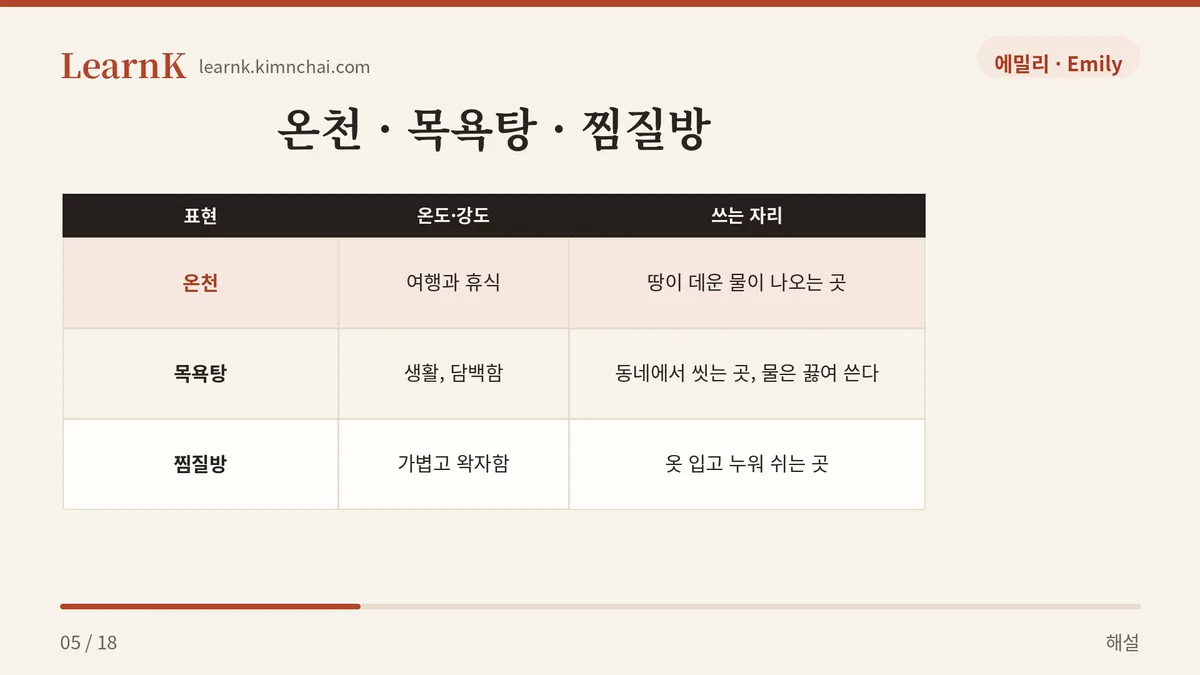
| Expression | Weight / intensity | Where it’s used |
|---|---|---|
| 온천 (oncheon) | Carries the weight of a trip and a rest | A place where water naturally heated underground comes out. Anything from a day outing to an overnight trip |
| 목욕탕 (mogyoktang) | Everyday, plain, close to home | The neighborhood spot for washing up and loosening your body. The water is boiled |
| 찜질방 (jjimjilbang) | Light and lively | You keep your clothes on and lie around. Friends and families sometimes stay all night |
| 사우나 (sauna) | Short and strong | Mostly dry heat. A facility attached to a bathhouse or gym |
| 노천탕 (nocheontang) | Tilts toward the romantic | An outdoor bath with no roof. Used for one part inside a hot spring facility |
Cultural Background — Water Even Kings Came For
In hanja it’s 溫 (warm) + 泉 (spring): literally “warm spring.” The meaning sits right there in the two characters, which puts it among the easier words to memorize if you already know Chinese characters.
온천 is an old word in Korea. Records from the Joseon dynasty tell of kings staying at the hot springs of Onyang (today’s Asan, South Chungcheong Province) to treat their illnesses. Those traces are still embedded in place names and station names, so you’ll run into the two syllables 온천 fairly often on a transit map: Onyang Oncheon Station on the Janghang Line, Yuseong Oncheon Station on the Daejeon Metro, Oncheonjang Station on the Busan Metro. When you hear one of these names in a subway announcement, read it as a sign that the neighborhood made its name on water a long time ago. Suanbo in Chungju, Baegam and Deokgu in Uljin, and Bugok in Changnyeong are hot spring towns too — say the name and people know it.
Go to one and you’ll find that Korean hot springs are mostly built like public bathhouses. The men’s and women’s sides are separate, and inside you take everything off. The order is to wash yourself before getting into the tub, and it’s good manners to keep your small towel out of the water. Once you’re done and dressed, buying a banana milk or a 식혜 (sikhye, sweet rice punch) at the snack counter has hardened into something like a ritual. Plenty of people feel the sentence “온천 갔다 왔다” isn’t complete until you’ve done that last part.
The way hot spring scenes get used in dramas follows the same logic. Without quoting any lines, just looking at the grammar of the scene: a hot spring isn’t where events happen, it’s where hearts loosen. Sit two characters side by side in steaming water and formality drains out of the frame, and the things they’d been putting off saying finally come out. The place that loosens tension in the body doubles, inside the story, as the place that loosens tension in the mind.
Today’s Quiz
Which of the following is the most appropriate situation for using the word 온천?
- You filled the bathtub at home with hot water and took a half-body bath.
- You got into a tub of boiled water at the neighborhood bathhouse.
- At the foot of a mountain in Gangwon Province, you soaked in an outdoor tub filled with water that had warmed up on its own underground and risen to the surface.
- You sweated for ten minutes in the sauna at your gym.
The answer is 3. What decides whether something is a 온천 isn’t the temperature of the water but its origin. Numbers 1, 2, and 4 involve water people heated, or heat with no water at all, so none of them get the name. Put situation 3 into a sentence with today’s vocabulary and you get: 산에서 내려와 노천 온천에 몸을 담그니 긴장이 다 풀렸다. (Saneseo naeryeowa nocheon oncheone momeul damgeuni ginjangi da pullyeotda.) — “I came down from the mountain and sank into an open-air hot spring, and all my tension melted away.” Both of today’s collocations, 몸을 담그다 (momeul damgeuda) and 긴장이 풀리다 (ginjangi pullida), are right there in it.
Definitions and example sentences are from the National Institute of Korean Language’s Basic Korean Dictionary (krdict.korean.go.kr); that portion of this post, including our translations, is licensed under CC BY-SA 2.0 KR.