뻘짓 (ppeoljit) — The Word That Comes Out When Two Hours of Work Means Starting Over

뻘짓
뻘짓 (ppeoljit) means a useless act — something you put time and energy into that ended up amounting to absolutely nothing. Riding the subway for a full thirty minutes before realizing you’re headed the wrong way. Closing the window on a document you’d been wrestling with for three hours without saving it. Buying an umbrella at the convenience store and stepping outside just as the rain stops. This is the short word a Korean person mutters with a hand pressed to their forehead.
At the center of this word, then, is “waste” rather than “failure.” More than the sense that something went wrong, what comes first is the indignation that an entire block of time just evaporated. It isn’t the lack of a result so much as the feeling of “I’m never getting those two hours back” that calls this word out. Which is why it doesn’t really get used for a pointless task that took five minutes. The longer the time you invested, the stronger this word gets.
The pronunciation is close to [뻘찓]. It’s a noun, and it’s most commonly used with -하다 attached: 뻘짓하다 (ppeoljit-hada). At the end of a sentence, it shows up in past-tense forms like 뻘짓이었다 (ppeoljit-ieotda) or 뻘짓했네 (ppeoljit-haenne) in most cases — because it’s a word for looking back on something already finished and passing a verdict on it. There’s a coarser version, 뻘짓거리 (ppeoljitgeori), but we don’t recommend it for learners.
There are three things you absolutely have to remember about the nuance. First, it isn’t a swear word, but it isn’t a genteel one either — it’s colloquial speech with one foot in the vulgar. Second, it’s overwhelmingly used on yourself. Attach it to someone else’s effort and it turns into mockery. Third, it’s angry and somehow funny at the same time. Its temperature is half indignation, half self-deprecation, so it actually doesn’t come out much in situations where someone is truly, seriously angry.
See It in a Real Conversation
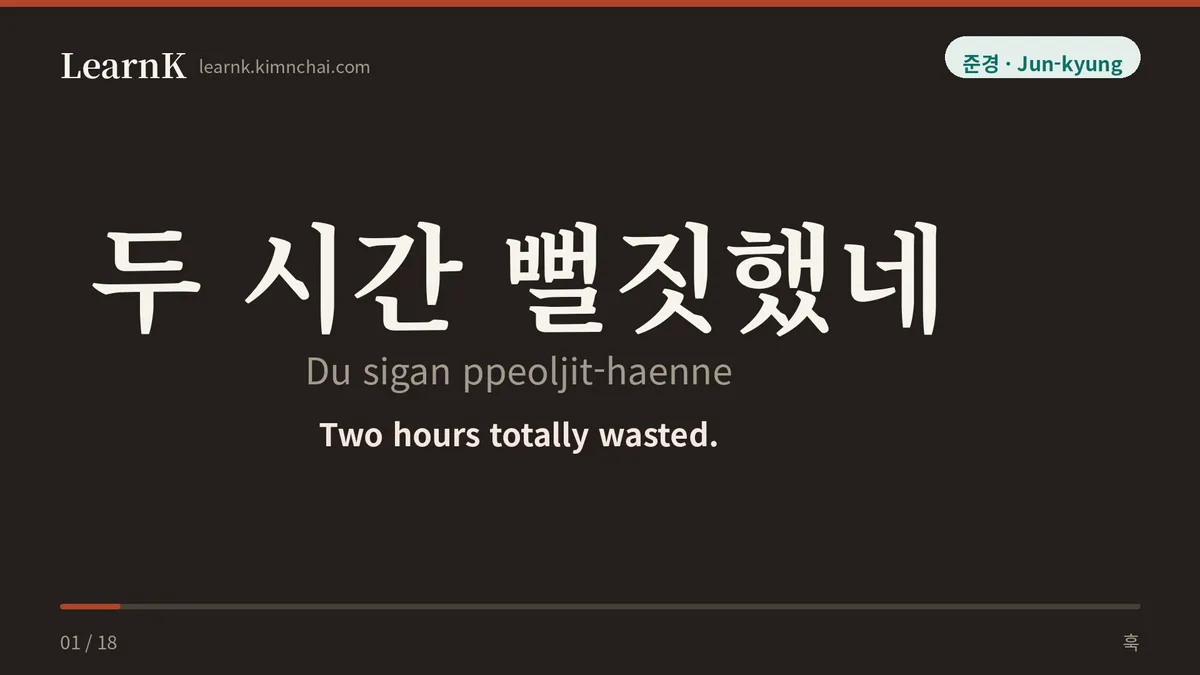
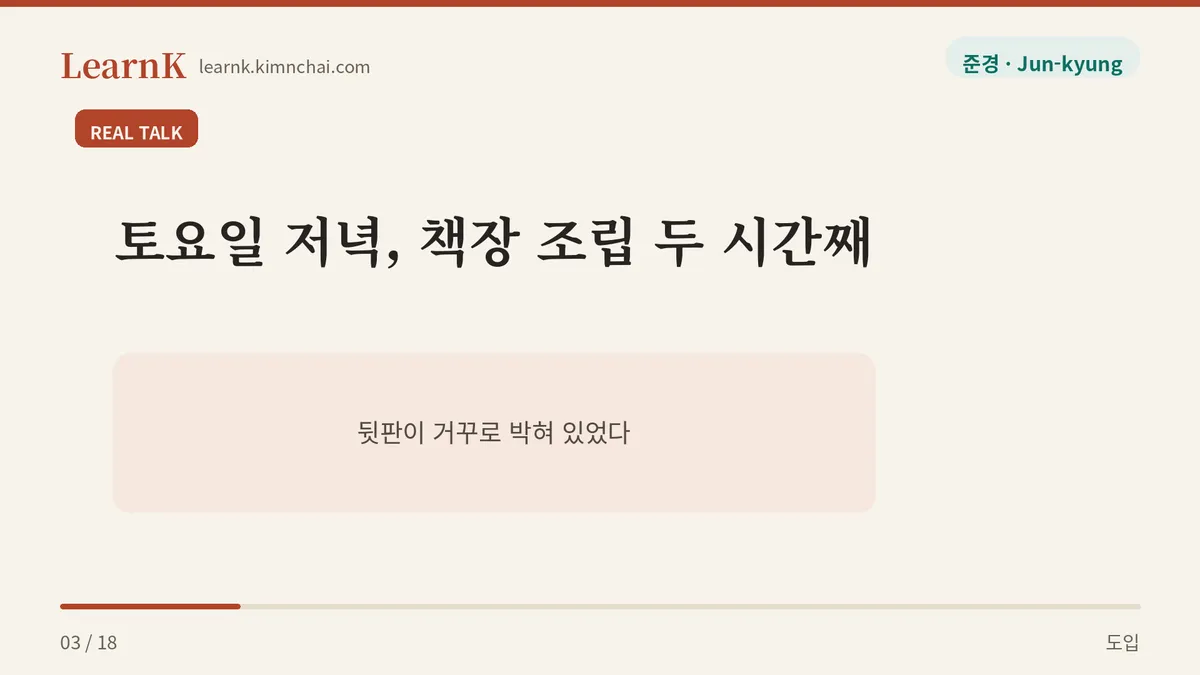
Scene: Saturday evening, the living room floor. They’ve been assembling a bookshelf for two hours, and they’ve just discovered the back panel is on the wrong way around.
Jun-kyung: 어… 잠깐만. 뒷판 무늬가 왜 안쪽을 보고 있지? Uh… hold on. Why is the pattern on the back panel facing inward?
Emily: 뭐? 나 나사 스무 개 다 박았는데. What? I already screwed in all twenty of them.
Jun-kyung: 다 뜯어야 돼. 두 시간 뻘짓했네. We have to take the whole thing apart. Two hours totally wasted.
Emily: 뻘짓은 아니지. 덕분에 조립 순서는 외웠잖아. It wasn’t a total waste. At least now we’ve got the assembly order memorized.
Jun-kyung: 그게 위로가 되냐. Is that supposed to make me feel better?
Emily: 그럼 설명서 안 펴고 시작한 게 진짜 뻘짓이었고. Fine — the real waste of time was starting without opening the manual.
This Sounds Off
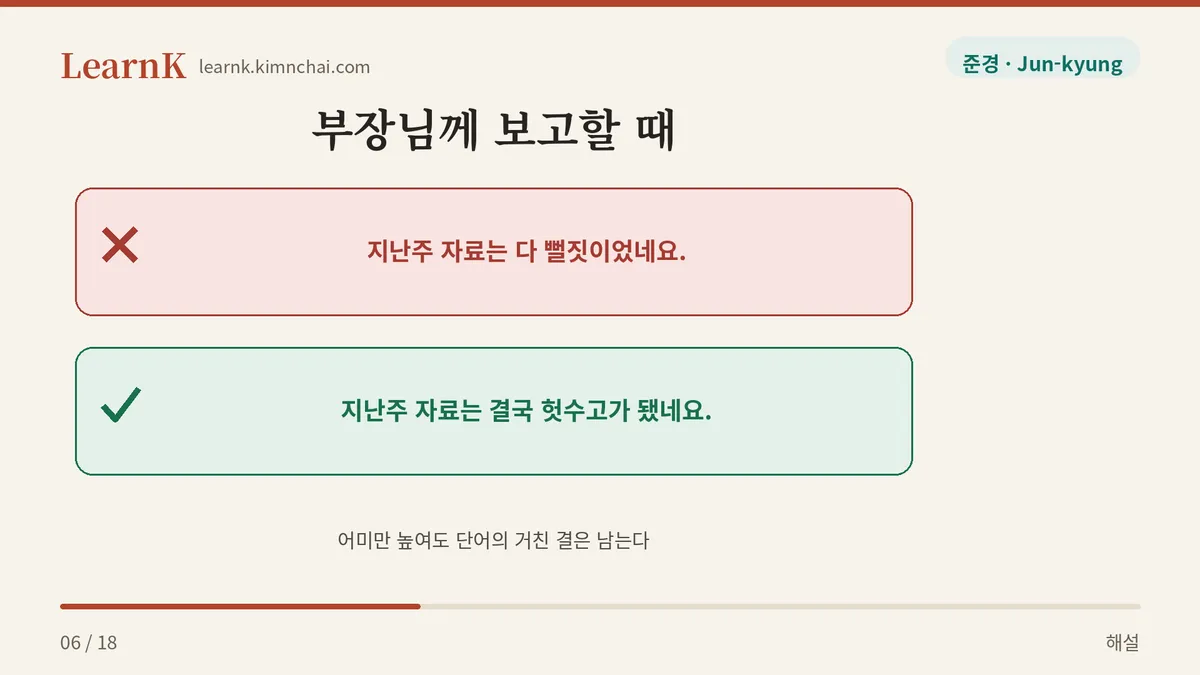
✗ (To your manager) 부장님, 지난주에 제가 만든 자료는 다 뻘짓이었네요. (Bujangnim, jinan-jue jega mandeun jaryoneun da ppeoljit-ieotneyo.) — “Sir, everything I put together last week was a total waste.” ✓ (To your manager) 부장님, 지난주 자료는 결국 헛수고가 됐네요. (Bujangnim, jinan-ju jaryoneun gyeolguk heotsugoga dwaenneyo.) — “Sir, last week’s materials ended up being wasted effort.” → The grammar is perfectly fine, but the grain of the word is rough. Even if you add -요 and drop it into a polite sentence, the slangy feel stays right where it was, and in front of someone senior to you it makes you look like a person with a coarse mouth. With a superior, 헛수고 (heotsugo) is the safe choice.
✗ (To a colleague whose project, worked on for days, just got scrapped) 야, 너 그거 완전 뻘짓했네. (Ya, neo geugeo wanjeon ppeoljit-haenne.) — “Hey, that was a complete waste of your time.” ✓ (Same situation) 아이고, 고생만 했네. 진짜 헛고생이다. (Aigo, gosaeng-man haenne. Jinjja heotgosaeng-ida.) — “Oh no, all that trouble for nothing. What a waste of your hard work.” → 뻘짓 is fundamentally a word for putting yourself down. Slap it onto someone else’s effort as-is and it stops being comfort and becomes a verdict: “what you did was pointless.” What sounds natural is waiting until the other person says “아 완전 뻘짓했어” first, and then just going along with a “그러게.”
Example Sentences by Situation
① After riding the subway thirty minutes in the wrong direction, catching the station name out the window
아, 반대 방향 탔어. 30분 뻘짓했다. (A, bandae banghyang tasseo. Samsip-bun ppeoljit-haetda.) — Ugh, I got on the train going the wrong way. Thirty minutes down the drain.
This is either muttered to yourself or said to the person next to you. Putting a length of time in front of it (‘30분’, ‘두 시간’) lays out exactly how big the indignation is.
② Realizing in the morning that the report you wrote all night never got saved — texting a friend
세 시간 쓴 거 저장을 안 했어. 완전 뻘짓이었네. (Se sigan sseun geo jeojang-eul an haesseo. Wanjeon ppeoljit-ieotne.) — I didn’t save three hours of work. Completely wasted effort.
Putting 완전 (wanjeon, from 완전히) in front adds emphasis. The -네 at the end of the sentence gives the feeling that you’ve only just realized it.
③ After standing in line for two hours, hearing the announcement that they’ve run out of ingredients
두 시간 줄 섰는데 재료 소진이래. 오늘 뻘짓 제대로 했다. (Du sigan jul seonneunde jaeryo sojin-irae. Oneul ppeoljit jedaero haetda.) — I stood in line for two hours and they say they’re out of ingredients. I really wasted my day today.
제대로 (jedaero) originally means “properly,” but when it comes in front of a negative word like this, it flips into irony and means “in a really big way.”
Polite Form, Casual Form, and Similar Expressions
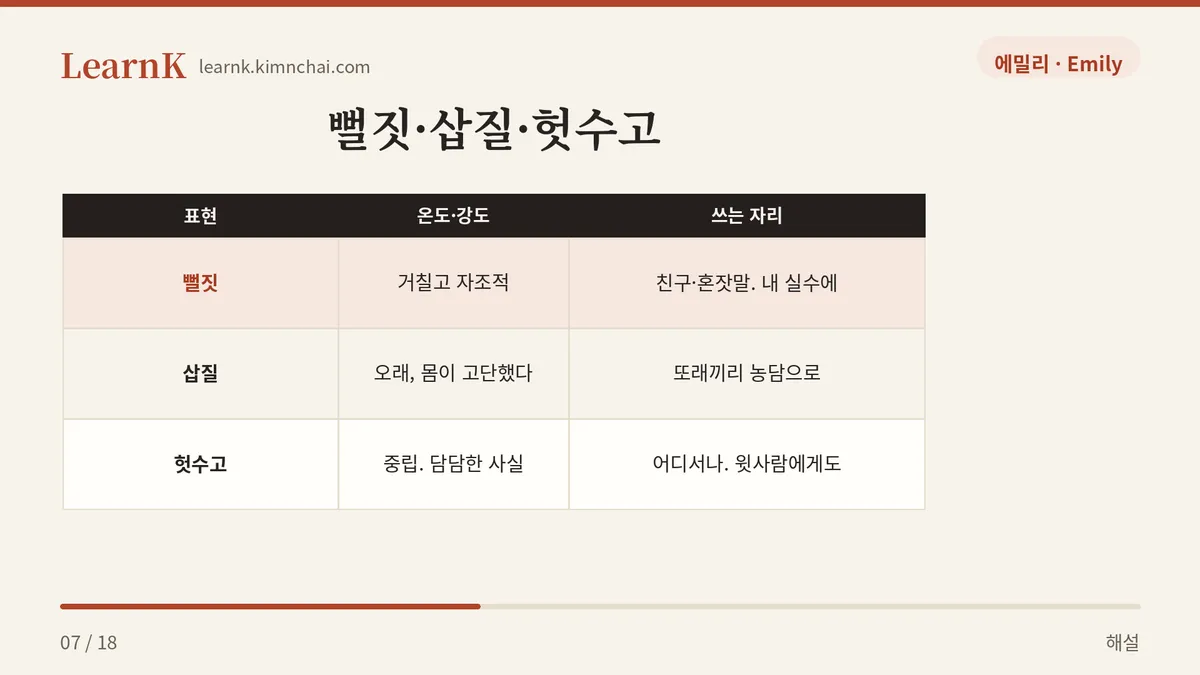
뻘짓 has no separate polite form. Even if you raise only the ending, as in 뻘짓했습니다 (ppeoljit-haetseumnida), the coarse grain of the word itself remains — so in front of a superior or in a formal setting, you’re better off switching to an entirely different word. Just pick the one that fits the room from the table below.
| Expression | Tone & Intensity | Where to Use It |
|---|---|---|
| 뻘짓 (ppeoljit) | Rough and self-deprecating, mixed with indignation | Friends, peers, talking to yourself. Not in front of someone senior |
| 삽질 (sapjil) | Similar to 뻘짓, but emphasizes “for a long time, the hard way” | Joking around with peers or close coworkers |
| 헛수고 (heotsugo) | Neutral. A calm statement of fact | Anywhere. Fine with superiors too |
| 헛고생 (heotgosaeng) | Mixed with sympathy. Leans toward comforting | Good for laying on someone else’s situation |
The difference between the four becomes clearest around the question of who you’re using it on. 뻘짓 for your own mistakes, 헛고생 for someone else’s suffering, 헛수고 for reports and meeting rooms. 삽질 (sapjil) overlaps with 뻘짓 almost entirely, but since it comes from the image of digging in the ground with a shovel, it carries a stronger feeling of “my body is worn out.” For something that went wrong with a single misclick, 뻘짓 fits better than 삽질.
Cultural Background — The Temperature Carried by the Word 짓 (jit)
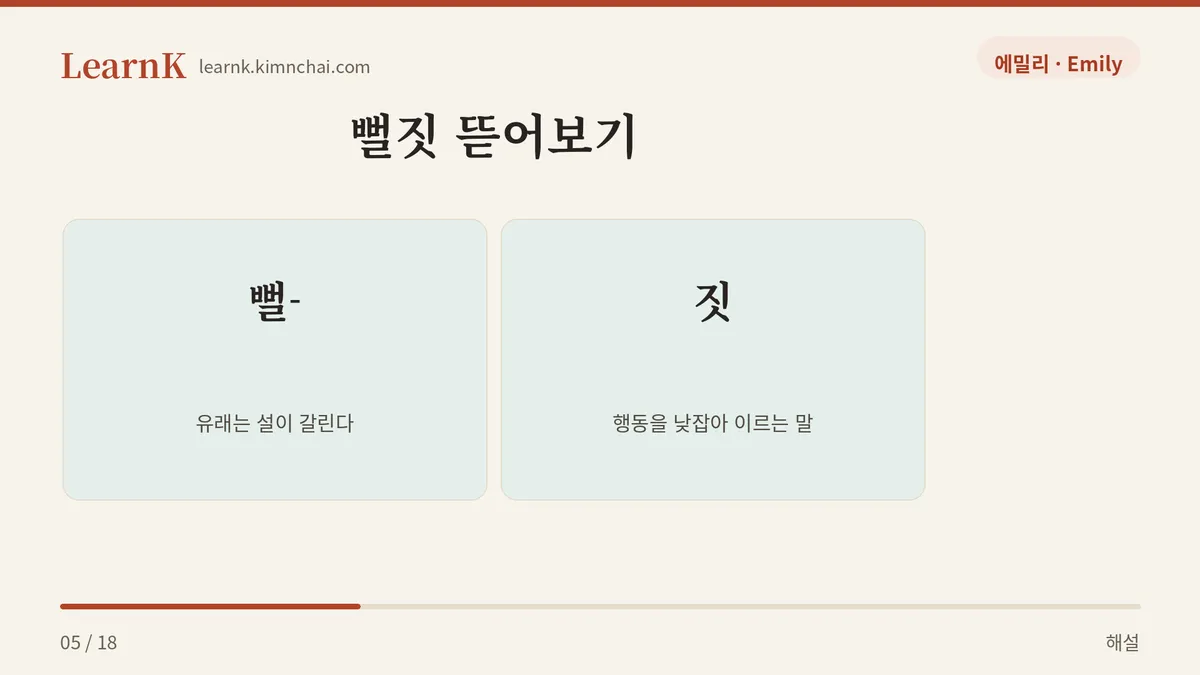
The second syllable of this word, 짓 (jit), is a term that refers to human behavior in a belittling way. There are compounds where it’s hardened into something neutral, like 손짓 (hand gestures) and 발짓 (foot gestures), but when ‘짓’ stands on its own it’s almost always negative. 못된 짓 (a wicked act), 나쁜 짓 (a bad act), 헛된 짓 (a futile act) — so the moment ‘짓’ attaches to an action, that action has already been judged once. A good portion of 뻘짓’s harsh feel comes from right here. As for the origin of the first syllable ‘뻘-’, the theories are split, so we won’t make any pronouncements here. Etymology is the easiest place in the world to invent something plausible.
What’s more interesting is that Korean has an unusual abundance of these self-deprecating words. 뻘짓, 삽질, 개고생, 헛물켜다 — words that put a name on effort spilled for nothing. These get used far more often to turn your own day into a joke than to attack anyone else. When someone who’s lost two hours laughs it off once with “아 뻘짓했네,” those two hours change character: from an unjust loss into tonight’s drinking story. It’s a way of enduring a loss by converting it into a joke.
Korean workplace dramas include a scene for this exact emotion almost as a matter of convention. The materials someone stayed up all night preparing get scrapped three minutes into the meeting, and the protagonist stays behind in the empty conference room, tidying up the printouts. Misaeng (미생, tvN, 2014), widely known for its finely detailed portrait of an office worker’s day, is the classic example. Watching a scene like that, the same two syllables surface in the viewer’s head even with no line of dialogue. If a learner gets this word down, they’ll read one extra layer of feeling that isn’t in the subtitles.
But check one more time before you use it. Is there anyone senior to me in this room right now — and is the time I’m about to dismiss my own time, or someone else’s? Keep just those two straight, and 뻘짓 is an extremely useful word.
Today’s Quiz
Emily stood in line for two hours and finally got into the store, only to be told that the bread she wanted just sold out. What’s the natural way to say this to the friend standing next to her?
- 오늘 정말 뻘짓했네.
- 친구야, 너 정말 뻘짓했구나.
- 사장님, 저 오늘 뻘짓했습니다.
Answer: 1. 뻘짓 is a word you use on yourself when your own time has gone up in smoke. Number 2 doesn’t fit the situation, since the person whose effort was wasted is Emily herself and not her friend — and even if it were the friend’s ordeal, saying it this way would come out as a sneer. Number 3 puts the word in front of a superior, where its rough grain is fully exposed. In that setting, something like “헛걸음했습니다” would be the right call.
Definitions and example sentences are from the National Institute of Korean Language’s Basic Korean Dictionary (krdict.korean.go.kr); that portion of this post, including our translations, is licensed under CC BY-SA 2.0 KR.