삐지다 (ppijida): When Someone Won't Say They're Upset — But Their Whole Body Says It
If you watch enough Korean dramas, this scene is bound to show up. Someone who was laughing happily just a moment ago suddenly clamps their mouth shut over one small remark, gives short answers, and turns their body sharply away. Nobody’s yelling, but the air goes cold. Ask “화났어? (hwanasseo?, Are you mad?)” and they’ll answer “아니거든 (anigeodeun, No, I’m not),” yet their face and voice are already saying they’re upset. There’s one perfect Korean word for exactly this subtle state. Today’s expression: 삐지다 (ppijida).
삐지다
삐지다 (ppijida) means to get sulky and turn away because you feel angry or hurt. There’s an important nuance here. 삐지다 isn’t a big, explosive rage — it’s the sulky feeling that comes from disappointment building up inside and leaking out on the surface. Instead of openly shouting “I’m mad!”, you talk less, avoid eye contact, and get gloomy. That’s why 삐지다 is mostly used between close, affectionate people. You don’t get 삐진 at someone who means nothing to you. In fact, it’s proof that the other person cares about you and is close enough to feel let down.
Checking the National Institute of Korean Language dictionary
The National Institute of Korean Language’s Basic Korean Dictionary (한국어기초사전) defines 삐지다 like this:
삐지다 (verb): 화가 나거나 서운해서 마음이 뒤틀리다 (for one’s mind to twist because one feels angry or hurt). [English] become sullen; sulk — For one’s mind to be twisted because one feels angry or hurt. [Spanish] ponerse malhumorado [Chinese] 发火,发脾气 — 生气或遗憾而心里别扭。 — National Institute of Korean Language, Basic Korean Dictionary (krdict.korean.go.kr)
Shall we also look at the real usage examples the dictionary provides?
- 친구가 삐지다. (chinguga ppijida) — A friend gets sulky.
- 여자 친구가 삐지다. (yeoja chinguga ppijida) — A girlfriend gets sulky.
- 아이가 삐지다. (aiga ppijida) — A child gets sulky.
- 아내가 삐지다. (anaega ppijida) — A wife gets sulky. — National Institute of Korean Language, Basic Korean Dictionary (krdict.korean.go.kr)
Look at the subjects of these examples. 친구 (chingu, friend), 여자 친구 (yeoja chingu, girlfriend), 아이 (ai, child), 아내 (anae, wife) — every one of them is someone close to you. The nuance we mentioned earlier, that it’s “used between people who share affection,” shows up right there in the dictionary examples. Picture “친구가 삐지다 (chinguga ppijida)” as a friend getting gloomy after you forgot a plan, and “아이가 삐지다 (aiga ppijida)” as a child sticking out their lower lip when they don’t get the toy you promised.
By the way, the dictionary doesn’t have a Portuguese translation for this word, so if we render it to keep the meaning, something like ficar de mal (삐져서 토라진 상태, being sulky and turned away) works. (This is our own translation, not provided by the dictionary.)
Example sentences for real situations
Let’s get a feel for real conversation with three examples we made ourselves.
Situation 1 — To a friend who forgot your birthday
너 혹시 삐졌어? (neo hoksi ppijyeosseo?) — Are you maybe upset with me?
This is what you carefully say to check when a friend’s expression seems off.
Situation 2 — Me, insisting I’m not, but already sulking
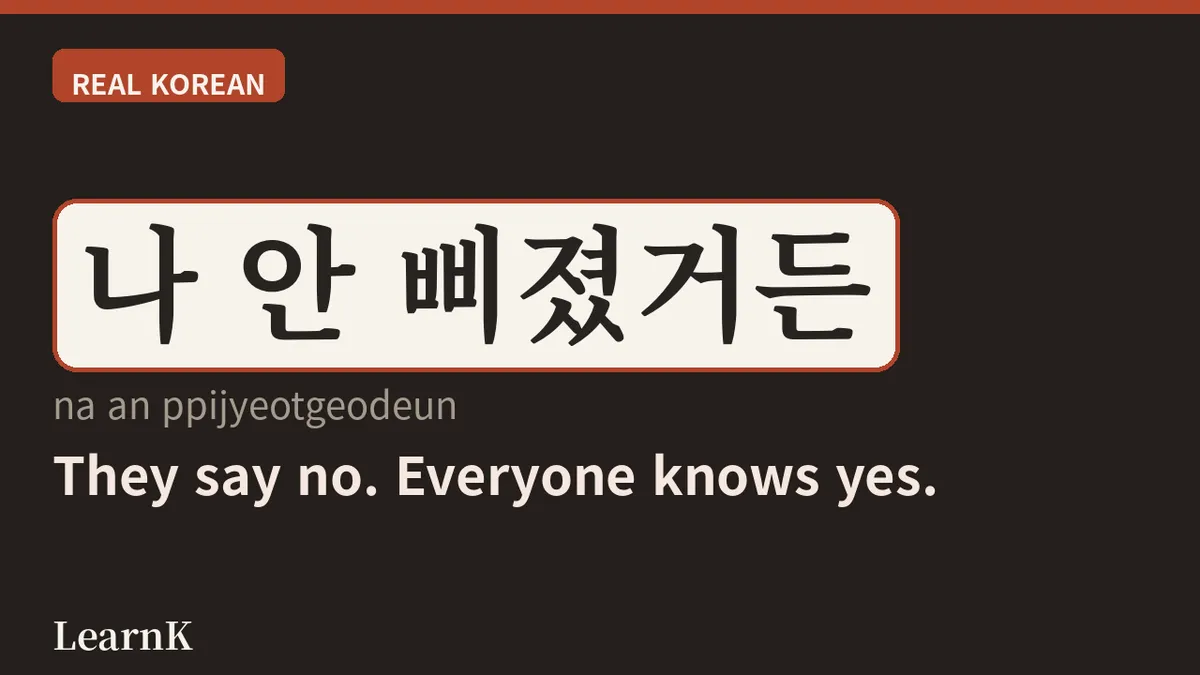
나 안 삐졌거든. (na an ppijyeotgeodeun.) — I’m not upset, really.
Your mouth says no, but you actually are — the most quintessentially Korean scene there is.
Situation 3 — Soothing someone who’s sulking
삐지지 마, 내가 잘못했어. (ppijiji ma, naega jalmothaesseo.) — Don’t be upset, it was my fault.
Comparing polite/casual speech and similar expressions
삐지다 feels most natural in casual-speech situations between close, comfortable people. In casual speech you’d say “삐졌어? (ppijyeosseo?)”, and to be a bit more polite you could say “삐지셨어요? (ppijisyeosseoyo?)” — but you wouldn’t really use it with someone who requires formality, like a boss at work.
Let’s also learn some similar expressions. 토라지다 (torajida) has almost the same meaning as 삐지다 and can be swapped in for it. 서운하다 (seounhada) is the feeling right before you get sulky — closer to “섭섭하다 (seopseophada, to feel let down)” — and 화나다 (hwanada) is a much bigger, more direct anger than 삐지다. And here’s a note on standard Korean: the original standard word was 삐치다 (ppichida), but in 2014 삐지다 was also accepted as standard, so now both are correct.
Cultural background
Korean emotional expression carries an underlying sentiment of “wanting to be understood even without spelling it out.” 삐지다 is the star player of that. Rather than confronting someone directly about hurt feelings, you send signals through silence and facial expression, waiting for the other person to notice and come soothe you first. That’s why drama couples keep getting sulky over trivial things, and the other person keeps making up with snacks or aegyo (playful charm). So once you understand 삐지다, the way Korean people express affection becomes a whole lot clearer.
Today’s quiz
A friend doesn’t answer your texts, and even when you meet up, they act cold and indifferent. It’s not that their anger exploded — they just feel hurt and have turned sulky. What’s the perfect thing to say here?
① 너 화났어? (neo hwanasseo?, Are you mad?) ② 너 삐졌어? (neo ppijyeosseo?, Are you upset with me?) ③ 너 슬퍼? (neo seulpeo?, Are you sad?)
(Answer: ②. For that “hurt and turned sulky” state — not big anger, not sadness — 삐졌어? (ppijyeosseo?) is the most natural.)
Definitions and example sentences are from the National Institute of Korean Language’s Basic Korean Dictionary (krdict.korean.go.kr); that portion of this post, including our translations, is licensed under CC BY-SA 2.0 KR.