삽질하다 (sapjilhada) — When You've Used Up All Your Energy and Have Nothing Left in Your Hands
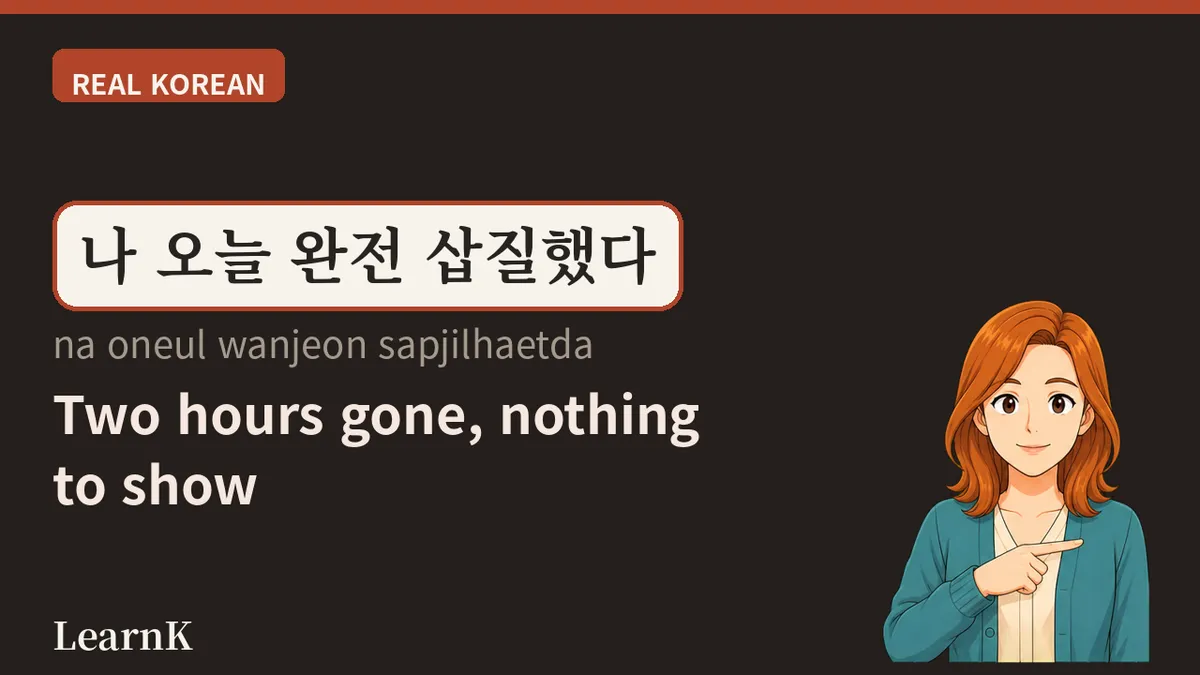
삽질하다
삽질하다 (sapjilhada) literally refers to digging in the ground with a shovel, but in everyday conversation it means to do something futile and pointless. When you’ve used up all your energy and have nothing left in your hands, this is the first thing a Korean person reaches for. When you waited two hours and the appointment simply evaporated, when the material you stayed up all night making became completely unnecessary because the meeting was canceled, when you read the map upside down and walked thirty minutes in the wrong direction — a Korean will let their shoulders droop and say: 아, 오늘 완전 삽질했네 (a, oneul wanjeon sapjilhanne). Ugh, today was a total waste.
The important thing here is that 삽질하다 (sapjilhada) is different from simple “failure.” Failure says the result was bad, but 삽질 (sapjil) also says something about how much effort you put in. A person who sat still doesn’t 삽질하다. Only when you sweated, spent your time, and wore out your feet — and then nothing came out of the hole you dug — does it become 삽질 (sapjil). That’s why this word is mixed half and half with frustration and laughter.
The second thing to know is that this is slang. The dictionary clearly attaches “(속된 말로)” — “(as slang)” — in front of the definition. Between friends, between colleagues, or about yourself, it becomes humor; but choose the wrong setting and it turns extremely rude. We’ll cover that in detail later on.
Checking It in the National Institute of Korean Language Dictionary
삽질하다 (sapjilhada) (verb)
1. 삽으로 땅을 파거나 흙, 눈 등을 퍼내다. [en] shovel — To dig or scoop soil, snow, etc., with a shovel. [ja] シャベルですくう — シャベルで土地を掘ったり土、雪などをすくう。 [es] cavar — Cavar la tierra con pala o remover barro, nieve, etc. [zh] 挖,铲 — 用铲子掘地或把泥土、积雪等舀出来。
2. (속된 말로) 헛되고 쓸데없는 일을 하다. [en] do useless work — (slang) To do a vain, useless job. [ja] 無駄で甲斐の無いことをするのを俗にいう語。 [es] cavar — (VULGAR) Pérdida de tiempo, hacer algo vano e inútil. [zh] 做无用功,白费力气 — (粗俗)做没有意义用途的事。
— National Institute of Korean Language, Basic Korean Dictionary (krdict.korean.go.kr)
A Portuguese definition is not included in the dictionary above. So the line below is not a dictionary quotation but our own translation, and we note that clearly. → 1. cavar com a pá / 2. (gíria) fazer um trabalho inútil, perder tempo à toa.
Notice that the dictionary lists two meanings side by side. Number 1 is real labor with a real shovel in hand, and number 2 is a metaphor that borrows only the picture from that labor. Almost everything a learner will actually hear is number 2, but because number 1 is still there, this word carries the “sweating” image around with it.
Here are the actual usage examples the same dictionary provides.
열심히 삽질하다. (yeolsimhi sapjilhada.) — to shovel hard / to work hard at something pointless 힘들게 삽질하다. (himdeulge sapjilhada.) — to shovel with great effort / to labor hard for nothing 혼자 삽질하다. (honja sapjilhada.) — to shovel alone / to waste effort all by oneself 괜히 삽질하다. (gwaenhi sapjilhada.) — to shovel for no reason / to bother doing something pointless 눈을 삽질하다. (nuneul sapjilhada.) — to shovel snow
— National Institute of Korean Language, Basic Korean Dictionary (krdict.korean.go.kr)
Each example shows the character of this word well.
- 열심히 삽질하다 (yeolsimhi sapjilhada) — the key is that it pairs with 열심히 (yeolsimhi), “diligently.” A lazy person can’t 삽질하다. The harder you work, the bigger the 삽질 (sapjil) gets — the very backbone of this word is right here on display.
- 힘들게 삽질하다 (himdeulge sapjilhada) — the fact that your body was worn out comes first. This is a spot that talks about the weight of the process, not the result.
- 혼자 삽질하다 (honja sapjilhada) — the form you’ll hear most often. It’s used to mean everyone else already knew the answer and only you kept digging without knowing. Perfect for that hollow feeling when you find out the truth too late.
- 괜히 삽질하다 (gwaenhi sapjilhada) — add 괜히 (gwaenhi), “needlessly,” and the regret of “I didn’t have to do this at all” is layered on top. It’s something you wouldn’t have done if you had asked first.
- 눈을 삽질하다 (nuneul sapjilhada) — this one is meaning number 1, an actual shovel story. That motion of scooping out snow on a winter morning. If you only know the metaphorical side, this sentence can feel strange, so remember it along with the rest.
Seeing It in a Real Conversation
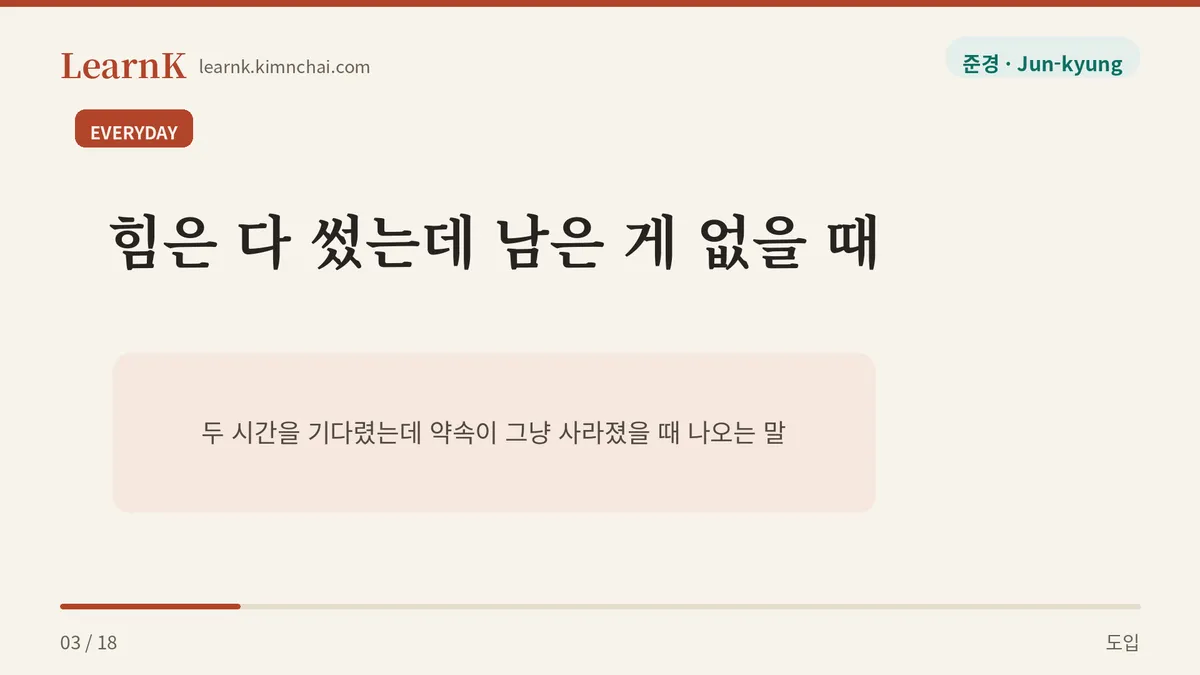
Situation: Saturday afternoon, in front of Exit 3 of a subway station. Emily is supposed to pick up a desk she bought secondhand, but the seller hasn’t shown up for two hours now. Jun-kyung has driven over in a truck and is waiting with her.
에밀리: 아 진짜… 두 시간을 여기 서 있었어. Seriously… I’ve been standing here for two hours.
준경: 아직도 연락 없어? 전화는 해 봤고? Still no word? Did you try calling?
에밀리: 열 번은 했지. 나 오늘 완전 삽질했다. Like ten times. I totally wasted my day today.
준경: 야, 그건 네가 삽질한 게 아니라 저 사람이 잠수 탄 거지. Hey, you didn’t waste anything — that guy just ghosted you.
에밀리: 그래도 트럭까지 빌렸잖아. 기름값은 기름값대로 나갔고. Still, I even rented a truck. And the gas money’s gone anyway.
준경: 됐어, 저기 국밥집 가자. 그냥 가면 진짜 삽질로 끝나잖아. Forget it, let’s hit that gukbap place. If we just leave, then it really was for nothing.
Pay attention to that last line. Jun-kyung is saying, “If we at least eat some gukbap, today won’t have been 삽질 (sapjil).” That sense that something has to be left over for a day not to be wasted is the exact opposite pole of the word 삽질 (sapjil).
These Uses Sound Off
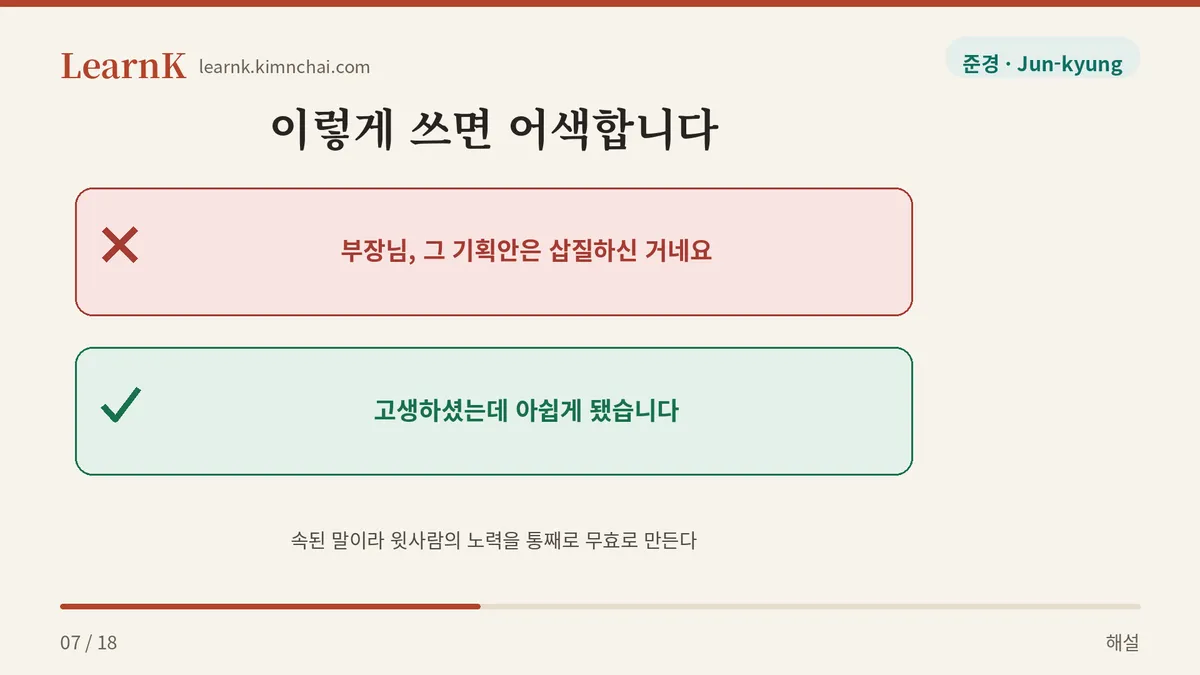
✗ (To your department head) 부장님, 지난주 그 기획안은 삽질하신 거네요. (bujangnim, jinanju geu gihoegan-eun sapjilhasin geoneyo.) — “Sir, that proposal last week was you wasting your effort, then.” ✓ (To a colleague) 야, 우리 지난주에 완전 삽질했다. (ya, uri jinanju-e wanjeon sapjilhaetda.) — “Man, we totally wasted our time last week.” → Even the dictionary marks this expression “(as slang).” Using it about a superior’s work isn’t just coarse language — it becomes a verdict that voids their entire effort. In front of someone above you, 고생하셨는데 아쉽게 됐습니다 (gosaenghasyeotneunde aswipge dwaetseumnida), “You worked hard on it; it’s a shame how it turned out,” is the safer route.
✗ (To a friend who failed an exam they prepared three years for) 그럼 삼 년 동안 삽질한 거네. (geureom sam nyeon dongan sapjilhan geone.) — “So you wasted three years, then.” ✓ (To the same friend) 고생 많았어. 그 시간이 아깝진 않을 거야. (gosaeng manasseo. geu sigani akkapjin aneul geoya.) — “You went through a lot. That time won’t have been wasted.” → 삽질 (sapjil) is fundamentally self-deprecation you use on yourself. When I say it about my own day it’s humor, but when you lay it on someone else’s failure it’s not comfort — it’s a sentencing. When the other person says 나 삽질했어 (na sapjilhaesseo), “I wasted my effort,” first, then receiving it with something like 그러게, 고생했다 (geureoge, gosaenghaetda), “Yeah, that’s rough — you worked hard,” is about the right level.
Example Sentences by Situation
1. When an all-nighter’s work goes down the drain
You made materials for a meeting all night, and in the morning the meeting itself was canceled. To a colleague, with a sigh.
밤새 자료 만들었는데 회의가 취소됐어. 완전 삽질했네. (bamsae jaryo mandeureotneunde hoeuiga chwisodwaesseo. wanjeon sapjilhanne.) I worked on the deck all night and the meeting got canceled. Total waste.
2. When you take the wrong road
You read the map upside down and walked thirty minutes in the opposite direction. Nobody made you suffer, which makes it feel even emptier.
지도를 거꾸로 봐서 삼십 분을 반대로 걸었어. 혼자 삽질한 거지. (jidoreul geokkuro bwaseo samsipbuneul bandaero georeosseo. honja sapjilhan geoji.) I read the map backwards and walked thirty minutes the wrong way. Nobody’s fault but mine.
3. When you assemble furniture without reading the manual
You finished assembling it and found the shelf was upside down, so you started over from the beginning. This is a spot where you can use polite speech (with a close senior, or an acquaintance around your own age or older).
설명서를 안 읽고 조립해서 두 번 삽질했어요. (seolmyeongseoreul an ilkgo joriphaeseo du beon sapjilhaesseoyo.) I didn’t read the manual, so I had to do the whole thing twice for nothing.
Polite and Casual Forms, and Similar Expressions
The casual form is 삽질했어 (sapjilhaesseo), and a little rougher, 삽질했네 (sapjilhanne). For polite speech, 삽질했어요 (sapjilhaesseoyo) is about as far as it naturally goes. There’s a point here where learners often get confused. Raising the ending to -습니다 and saying 삽질했습니다 (sapjilhaetseumnida) does not make the speech polite. Because the word itself is slang, attaching a formal ending actually sounds like an outfit that doesn’t match. In reports, presentations, and interviews, it’s better to simply not use it.
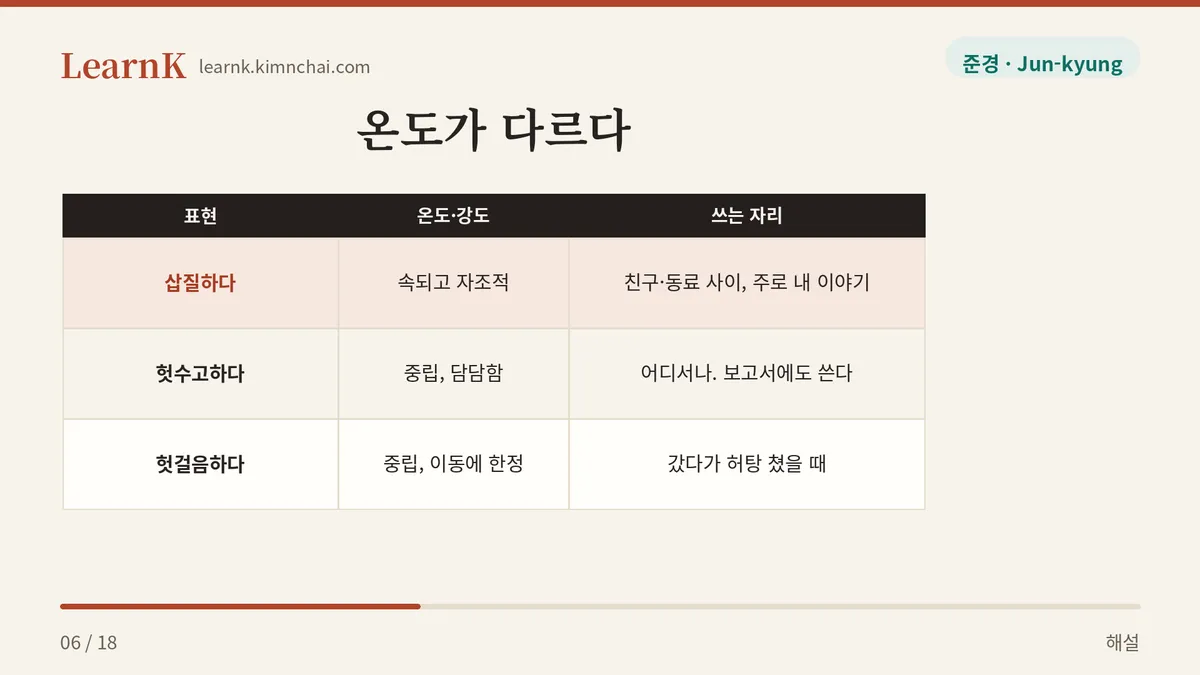
| Expression | Temperature / Intensity | Where to use it |
|---|---|---|
| 삽질하다 (sapjilhada) | Slangy and self-deprecating, strong | Between friends and colleagues, mostly about yourself. Not used with superiors or in formal settings |
| 헛수고하다 (heotsugohada) | Neutral, matter-of-fact | Anywhere. Can be used in reports and news |
| 헛걸음하다 (heotgeoreumhada) | Neutral, limited to going somewhere | When you went and came up empty. Fine with superiors too |
| 뻘짓하다 (ppeoljithada) | Rougher than 삽질하다 | Very close relationships, and the internet. Never with someone you’ve just met |
Line all four up against the secondhand-deal story and the differences become clear. If the seller didn’t show and you just came back, you 헛걸음했다 (heotgeoreumhaetda) — made a wasted trip. If you even rented a truck and got nothing out of it, you 헛수고했다 (heotsugohaetda) — made a wasted effort. If you’re venting to a friend with a laugh, you 삽질했다 (sapjilhaetda). And if you’re angrier than that and the other person is a very close friend, you might go as far as 뻘짓했다 (ppeoljithaetda). The safest and most versatile one for learners is 헛수고하다 (heotsugohada); the one that sounds the most like a native speaker is 삽질하다 (sapjilhada).
Cultural Background — The Picture a Single Shovel Paints
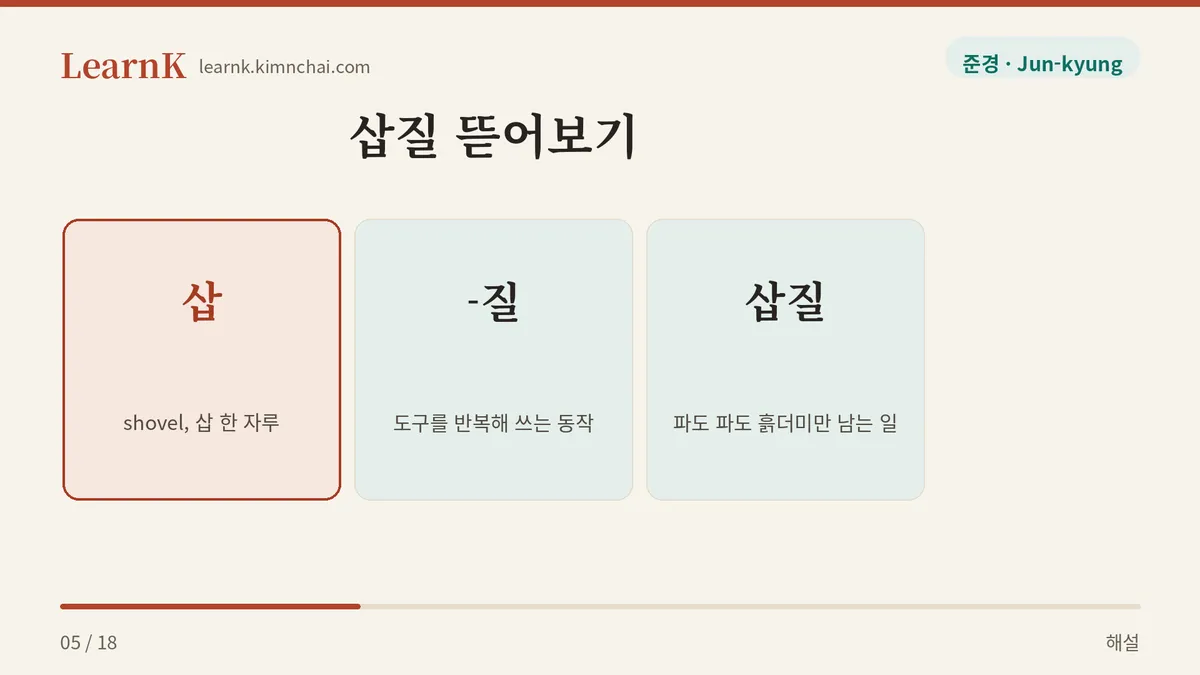
The word formation is remarkably transparent. The suffix -질 (-jil) is attached to 삽 (sap), “shovel.” This -질 (-jil) creates words for the repeated use of a tool, as in 가위질 (gawijil, using scissors), 부채질 (buchaejil, fanning), 걸레질 (geollejil, mopping with a rag), and 망치질 (mangchijil, hammering). And this suffix often carries along a grain of looking down on the action a little. So 삽질 (sapjil) came to mean both “the motion of holding a shovel and scooping away” and a slightly dismissive gaze at that motion.
Picture it and the meaning unravels on its own. Shoveling is among the most primitive kinds of labor. With no machine and no technique, you scoop out dirt with nothing but arm strength. Dig for ages and all that’s left in front of you is the pile of dirt beside you. Maximum effort, and the result is a dirt pile — that single scene became the metaphor itself. Korean has many words like this that borrow a movement of the body to draw a state of mind. Expressions like 애가 타다 (aega tada, to be anxious — literally “one’s insides burn”), 발이 넓다 (bari neolda, to know a lot of people — literally “wide feet”), and 손이 크다 (soni keuda, to be generous — literally “big hands”) belong to the same family.
There are two places where this word gets tossed around especially often. One is the workplace. Korean dramas about company life, like Misaeng (미생, tvN, 2014), repeatedly show scenes where material made all night goes in the wrong direction and has to be started over from scratch — and if you name that moment in one word, it’s 삽질 (sapjil). The other is internet message boards and gaming communities. Someone who spent hours trying the wrong method will title their own post 삽질기 (sapjilgi), “a chronicle of wasted effort,” turning their own failure story into a laugh.
So using this word properly is less about knowing one vocabulary item and more about knowing its temperature. Said about your own day, it’s humor; said about someone else’s day, it’s rude. When a Korean friend says 나 오늘 삽질했어 (na oneul sapjilhaesseo), “I wasted my whole day today,” that’s both a signal asking for comfort and a signal that they’ve already half laughed it off. In that moment, something like 고생했다, 밥이나 먹자 (gosaenghaetda, babina meokja), “You’ve been through it — let’s just go eat,” is the most Korean reply there is.
Today’s Quiz
Which of the following is the most inappropriate place to use 삽질하다 (sapjilhada)?
- To a friend: 지도 잘못 봐서 삼십 분 헤맸어. 완전 삽질했네. (jido jalmot bwaseo samsip bun hemaesseo. wanjeon sapjilhanne.) — “I misread the map and wandered around for thirty minutes. What a total waste.”
- To a coworker who joined the same year: 우리 어제 그거 다 다시 해야 한대. 하루 종일 삽질한 거지. (uri eoje geugeo da dasi haeya handae. haru jongil sapjilhan geoji.) — “They say we have to redo all of that from yesterday. So we wasted the whole day.”
- To your department head during a presentation: 부장님께서 지난 분기에 삽질하셨습니다. (bujangnimkkeseo jinan bungie sapjilhasyeotseumnida.) — “Sir, you wasted your effort last quarter.”
See the answer
The answer is number 3. Since the dictionary explicitly marks this expression “(as slang),” attaching a polite ending still doesn’t make it fit a formal setting. On top of that, calling a superior’s work 삽질 (sapjil) turns into a statement that voids their whole effort. In a setting like this you’d have to change it to something like 지난 분기에는 성과가 아쉬웠습니다 (jinan bungieneun seonggwaga aswiwotseumnida), “Last quarter’s results were disappointing.” Numbers 1 and 2 are self-deprecation with “I” or “we” as the subject, so they sound perfectly natural.
Definitions and example sentences are from the National Institute of Korean Language’s Basic Korean Dictionary (krdict.korean.go.kr); that portion of this post, including our translations, is licensed under CC BY-SA 2.0 KR.