서사 (seosa) — Why Fandom Borrowed a Word from Korean Class
서사
서사 (seosa) means writing down the facts as they are — that is, a story that lays out what happened in the order it happened. Going by the dictionary alone, it’s a stiff Sino-Korean word that smells of a school literature textbook. Yet in Korea today, the place this word flies around most fiercely isn’t the classroom — it’s fandom. In community posts at 3 a.m. after a concert, on a timeline the moment a comeback teaser drops, Korean fans write things like this: “이 팀은 서사가 미쳤다 (i timeun seosaga michyeotda)” — this group’s 서사 is insane. “여긴 서사 맛집이야 (yeogin seosa matjibiya)” — this group is a five-star spot for 서사. Neither one is saying the songs are good, or that the members are good-looking. It means the path these people have walked from debut until now connects into a single line, and that line moves you.
Even learners with solid Korean trip over this word once. Machine translation gives you narrative, but the words that actually overlap in English-speaking fandom are closer to story arc, lore, and backstory. So rather than memorizing the definition, it’s much faster to learn when this word comes out of people’s mouths.
The heart of 서사 is time. A single event doesn’t make a 서사. There were the unknown years, then this happened, and now they’ve arrived here — only when it runs from A to B and B to C, with change in between, do Koreans call it a 서사. That’s exactly why Korean uses the phrase 서사를 쌓다 (seosareul ssatta), literally to stack up a 서사. Like bricks, you have to lay them one at a time before you get any height. Which is why nobody says a group six months past debut has a 서사, no matter how good they are. There hasn’t been time to stack anything yet.
The temperature of the word is fairly heavy. Because it comes from literary terminology, even when it’s used in admiration, something serious lingers in it. 서사가 좋다 (seosaga jota) is not the same as “that was fun.” Fun is a reaction to this moment; 서사가 좋다 is a verdict on the entire stretch of time someone has come through.
Checking the National Institute of Korean Language dictionary
First, let’s look at exactly how the national institution’s dictionary defines the word.
서사 「명사」 사실을 있는 그대로 적음. [en] narrative — Writing down the facts as they are. [ja] じょじ【叙事】 — 事実をありのままに述べ記すこと。 [es] cuento, historia, narración — Escribir los hechos tal como son. [zh] 叙事, 纪实 — 如实写出事实。 — National Institute of Korean Language, Basic Korean Dictionary (krdict.korean.go.kr)
A Portuguese gloss isn’t included in this dictionary. For reference, it would come out to something like narrativa, relato — “Escrever os fatos tal como são.” — but we should note that this one line is our own translation, not the dictionary’s original text.
The part of the definition worth noticing is “있는 그대로 (inneun geudaero)” — as they are. Writing down what actually happened, not something made up: that’s this word’s original home. And the fandom sense of 서사 isn’t far from it. What moves fans isn’t a well-constructed premise; it’s the time that group actually lived through.
Next, let’s look at the real usage examples the dictionary carries.
서사를 전개하는 방식이 참신하기 때문입니다. — National Institute of Korean Language, Basic Korean Dictionary (krdict.korean.go.kr)
Because the way it unfolds its narrative is fresh. This is a sentence that turns up constantly in reviews of creative work. Seeing it paired with 전개하다 (jeongaehada), to unfold, to develop, shows that a 서사 isn’t an object sitting in one place — it’s something that spreads out along time. It’s also striking that it appears with the ending “~기 때문입니다 (-gi ttaemunimnida),” the formal way of giving a reason in a presentation or review. This word was born in exactly those formal settings.
이 영화는 실화를 재구성하여 사건의 서사를 드러냈다. — National Institute of Korean Language, Basic Korean Dictionary (krdict.korean.go.kr)
This film reconstructed a true story to reveal the narrative of the incident. 실화 (silhwa, a true story), 재구성 (jaeguseong, reconstruction), and 사건 (sageon, an incident) all sit in one sentence. It means taking something that really happened and weaving it back together in order to show it — so this example demonstrates the dictionary definition at work inside a sentence. It’s also the house style of film write-ups in the press.
민준이는 그 드라마의 서사에 감동을 받았다. — National Institute of Korean Language, Basic Korean Dictionary (krdict.korean.go.kr)
Min-jun was moved by that drama’s narrative. Here the 서사 is the thing doing the moving. Not the actors, not the music — the flow of the story itself is what stirred him. That points to exactly the same spot as the fandom’s “서사가 미쳤다.” Only the temperature is different.
서사를 쌓다. / 서사를 만들다. / 서사를 표현하다. — National Institute of Korean Language, Basic Korean Dictionary (krdict.korean.go.kr)
These are the collocations the dictionary lists alongside the entry — the partners this word habitually travels with: to stack a 서사 / to make a 서사 / to express a 서사. It’s interesting that 쌓다 (ssatta), 만들다 (mandeulda), and 표현하다 (pyohyeonhada) are all verbs about getting something done with your hands. Korean treats a 서사 not as a finished state but as a process you build.
A real conversation
Setting: the night a concert has just ended. They’re being carried along by a crowd of people holding merch bags, walking toward the subway station. Jun-kyung was dragged along by Emily and is here for the first time today.
준경: 야, 아까 마지막 곡에서 사람들 왜 우는 거야? 노래는 신나던데. Hey, why was everyone crying during the last song? The song was upbeat.
에밀리: 무대 세트가 데뷔 무대랑 똑같았어. 8년 만에 같은 자리로 돌아온 거야. The stage set was identical to their debut stage. They came back to that same spot after eight years.
준경: 아… 그래서 옆에 아저씨까지 울었구나. Ah… so that’s why even the guy next to me was crying.
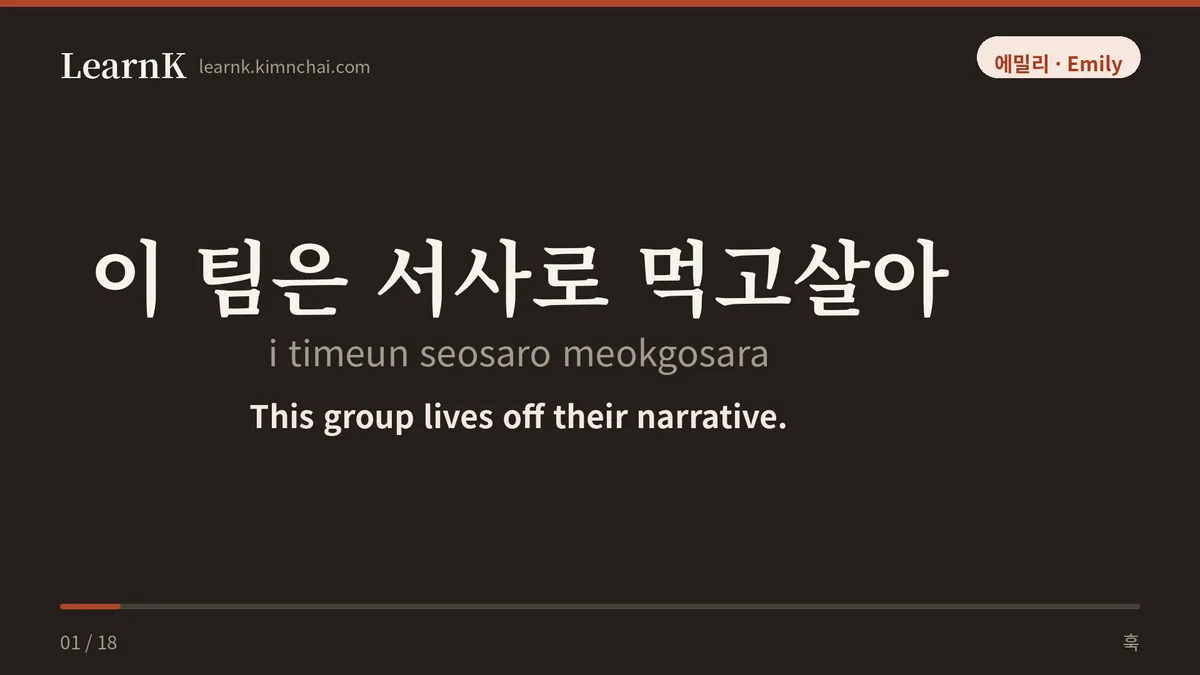
에밀리: 그러니까. 이 팀은 서사로 먹고살아. 노래만 들으면 절대 몰라. Right? This group lives off their narrative. You’d never get it just from the songs.
준경: 근데 나 오늘 처음 왔는데도 좀 뭉클하더라. But even though it was my first time here, I still got a little choked up.
에밀리: 다음엔 내가 서사 정리해서 보내 줄게. 그거 읽고 오면 너도 운다. Next time I’ll put together their story arc and send it to you. Read it before you come and you’ll cry too.
This is where it sounds wrong
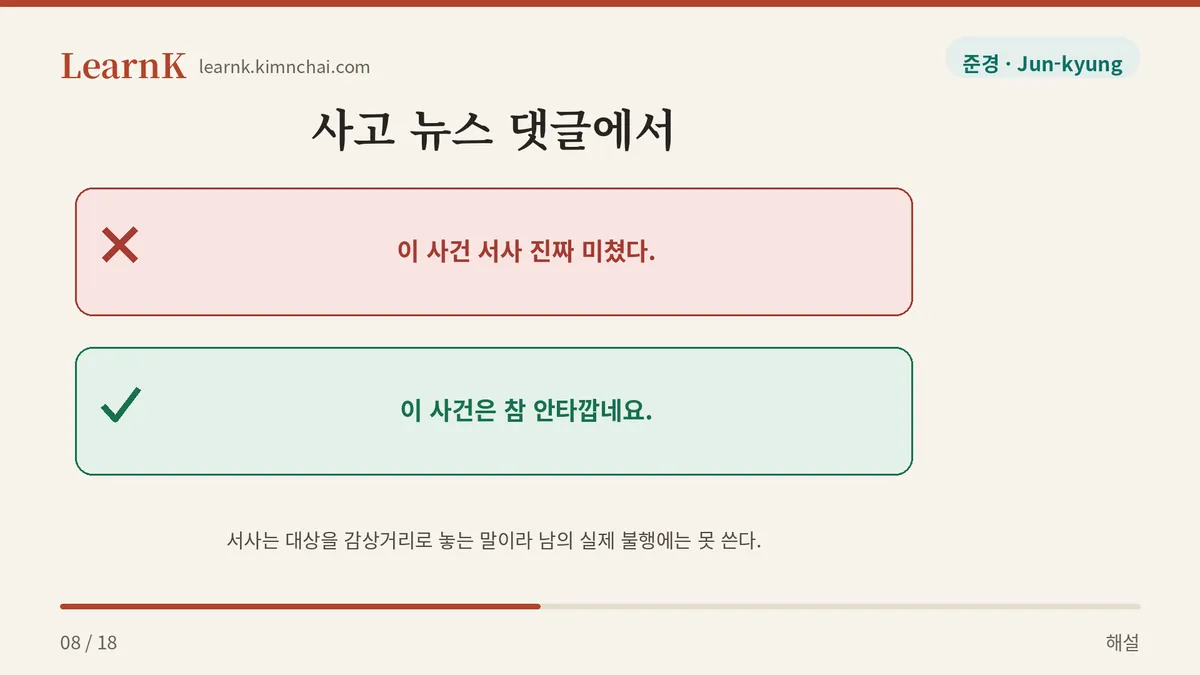
✗ (as a comment on news about a real accident) 이 사건 서사 진짜 미쳤다. This incident’s narrative is absolutely insane. ✓ (watching the news) 이 사건은 참… 안타깝네요. This incident is just… so heartbreaking. → 서사 is a word that places its subject in front of you as something to appreciate. Used on someone’s real misfortune, it reads as consuming another person’s life as a spectacle. Even inside fandom, this usage gets called out as crossing a line.
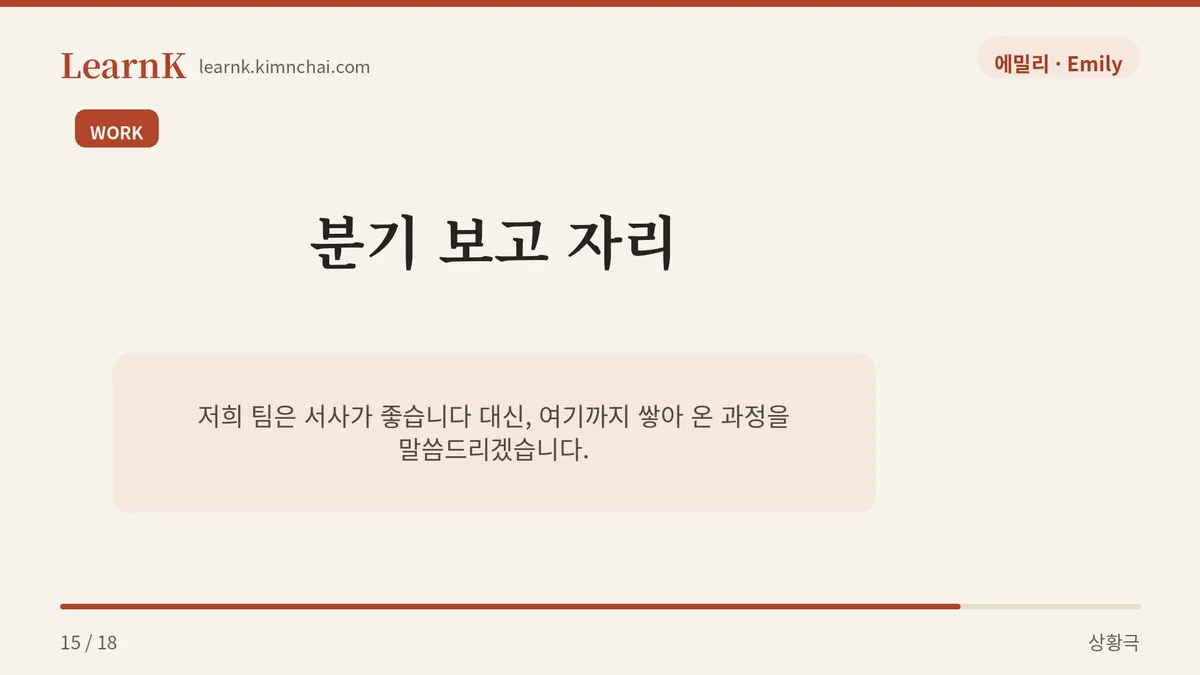
✗ (presenting to executives) 저희 팀은 서사가 좋습니다. Our team has a great narrative. ✓ (presenting to executives) 저희 팀이 여기까지 쌓아 온 과정을 말씀드리겠습니다. Let me walk you through the process our team has built up to get here. → The grammar is perfectly fine, but the temperature of fandom slang comes through with it. In an official setting it sounds either flippant or like you’re chasing a buzzword.
Example sentences by situation
1) Telling someone to listen to an album in order
이번 앨범은 서사가 다 이어져 있어서 순서대로 들어야 돼. (ibeon aelbeomeun seosaga da ieojyeo isseoseo sunseodaero deureoya dwae) This album’s story is all connected, so you have to listen to it in order.
→ It means that if you pull out just one track, the flow breaks. It’s also the single most common piece of advice Korean fandoms give newcomers. Here 서사 refers to the track order and the arc of the lyrics as a whole.
2) When a long-unknown group suddenly makes it
무명 7년이면 서사 하나는 확실하게 쌓았네. (mumyeong chil nyeonimyeon seosa hananeun hwaksilhage ssatanne) Seven years of obscurity — that’s one solid backstory right there.
→ This is the kind of sentence you’d see in an article about a song charting years later, or in variety-show subtitles. The dictionary’s collocation 쌓다 (ssatta) is used exactly as listed, with a span of seven years placed in front of it. It shows clearly that 서사 is a word for measuring the thickness of time.
3) Saying a film or drama fell short (polite speech)
연출은 화려한데 서사가 약해서 후반부가 지루했어요. (yeonchureun hwaryeohande seosaga yakaeseo hubanbuga jiruhaesseoyo) The directing was flashy, but the story was weak, so the second half dragged.
→ 서사 isn’t used only for praise. 서사가 약하다 (seosaga yakada, the narrative is weak) and 서사가 무너졌다 (seosaga muneojyeotda, the narrative collapsed) are staples of Korean reviews. They compress into one word the complaint that the visuals are fine but the story doesn’t hold together.
Polite vs. casual speech, and similar expressions
서사 is a noun, so there’s no honorific level built into the word itself. The register is decided by the predicate that follows. Casual: 서사 좋다 (seosa jota) / 서사 진짜 탄탄해 (seosa jinjja tantanhae). Polite: 서사가 좋습니다 (seosaga jossumnida) / 서사가 탄탄하네요 (seosaga tantanhaneyo). That said, forms that have hardened into pure slang, like 서사 미쳤다 (seosa michyeotda), sound off even if you swap only the ending into polite speech. In those cases you have to replace the whole expression.
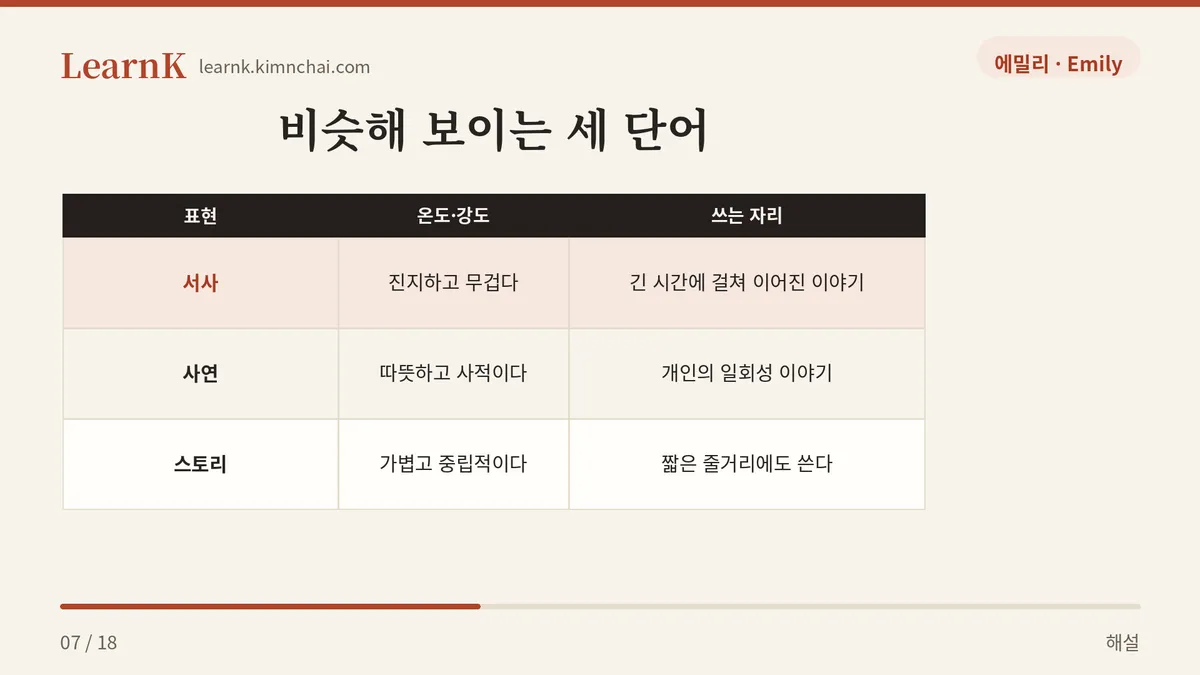
| Expression | Temperature / intensity | Where it’s used |
|---|---|---|
| 서사 (seosa) | Serious and heavy; close to admiration | Fandom, reviews, criticism. Only for a story that runs over a long stretch of time |
| 사연 (sayeon) | Warm and personal | An individual’s one-off story. Radio listener stories, haggling on a secondhand app |
| 스토리 (seutori) | Light and neutral | Anywhere. Used even for a short plot summary |
| 세계관 (segyegwan) | Explanatory; refers to structure | The setting and rules a story unfolds within. Used as a pair with 서사 |
The pair learners mix up most is 서사 and 세계관. 세계관 is the stage and its rules; 서사 is the time that actually passes on that stage. No matter how elaborate the concept, if nothing happens inside it, fans will say “세계관은 있는데 서사가 없다 (segyegwaneun inneunde seosaga eopda)” — they have a world, but no narrative.
Cultural background — how a word from Korean class walked into fandom
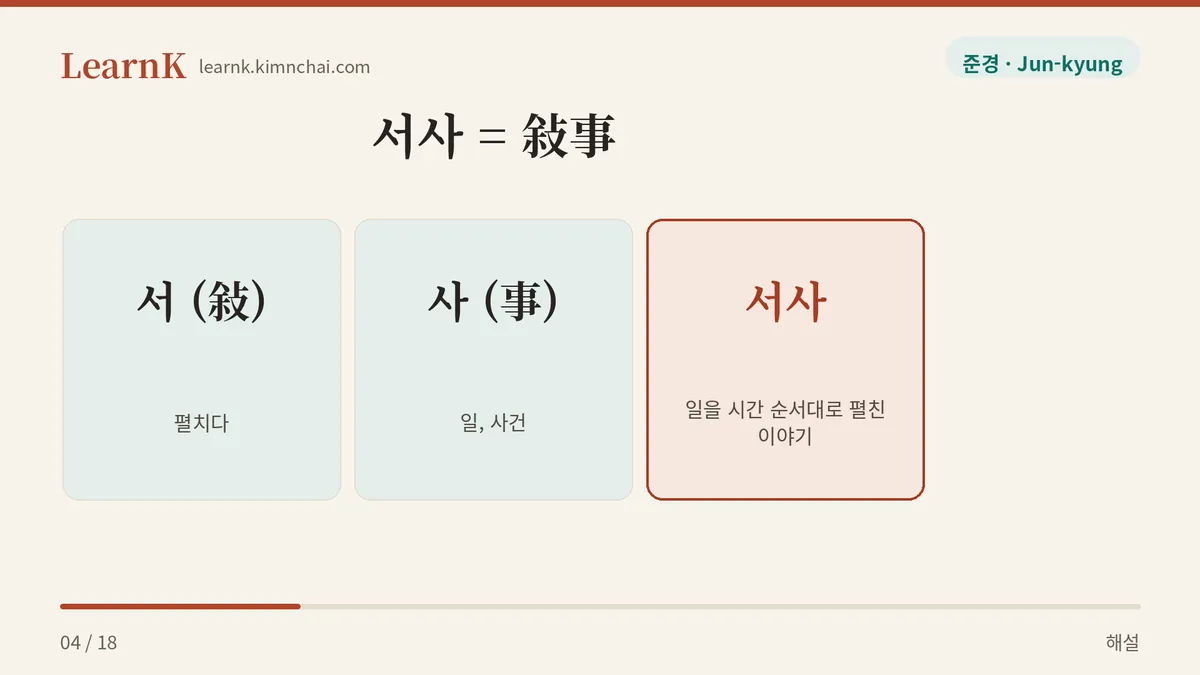
서사 is the Sino-Korean word 敍事. 敍 means to spread out, 事 means matter, event. Literally, spreading out events. Korean students learn in middle and high school literature classes that literature divides into 서정 (seojeong), 서사 (seosa), and 극 (geuk). 서정 (抒情) is poetry that pours out emotion; 서사 is a story that unspools events in chronological order; 극 is dialogue on a stage. The word 서사시 (敍事詩, seosasi), epic poetry, comes from here too. In other words, 서사 was originally a word that showed up on exams.
There’s a reason it crossed over into fandom. As Korean idol planning shifted from releasing albums one at a time to releasing series in which several albums link into one whole, fans needed a name for that entire flow. BTS’s 화양연화 (Hwayangyeonhwa) series is the classic example. And the 서사 they’d learned in Korean class fit that slot perfectly.
One more distinctly Korean circumstance layers on top: the trainee system. The years before debut, the scenes of getting eliminated on a survival show, the footage from the unknown days left in a group’s own content — fans already know everything about the time before debut. So one stage doesn’t end at being one stage. Spinoffs like 서사 맛집 (seosa matjip) and 서사 부여 (seosa buyeo) grew out of this soil too. The first is praise for a group whose story has piled up layer by layer; the second is a criticism, meaning a story that isn’t there is being forcibly attached. One word doing both the applauding and the jeering.
It’s the same with dramas. When viewers say a show’s 서사가 무너졌다 in the back half, they aren’t talking about acting or cinematography. They mean the path a character has walked so far and what that character is doing now no longer line up. That consistency is the most common yardstick for judging a story in Korea, and 서사 is the name of that yardstick.
Today’s quiz
Which of the following uses 서사 (seosa) most naturally?
- 오늘 점심 뭐 먹었는지 서사 좀 말해 줘. Tell me the 서사 of what you had for lunch today.
- 이 그룹은 데뷔 때부터 지금까지 서사가 이어져서 볼 때마다 뭉클해. This group’s 서사 has run unbroken from debut until now, so I get choked up every time I watch them.
- 어제 지하철에서 지갑 잃어버린 서사가 있어요. I have a 서사 about losing my wallet on the subway yesterday.
Answer: number 2.
Number 1 is a single simple fact, so no 서사 is formed. Just ask “뭐 먹었어? (mwo meogeosseo?)” Number 3 is a one-off event from a single day yesterday, which is 사연 (sayeon) territory. Only number 2 points to a flow that has continued over several years, and it even comes with a reaction — being moved by it — which makes 서사 the best fit.
Definitions and example sentences are from the National Institute of Korean Language’s Basic Korean Dictionary (krdict.korean.go.kr); that portion of this post, including our translations, is licensed under CC BY-SA 2.0 KR.